Thursday, January 05, 2006

NME: Alien Visions


First published in the NME on May 20th 1978.

Pictures by Pennie Smith

Is It true that Columbia Pictures have bought you a ticket on the space shuttle?
"No, I bought it myself."
For £7,000, is that right? That was the figure I was quoted.
"For £7,000! Oh my God, no. I wouldn't pay £7,000 for a ticket on the space shuttle. I paid $750. I bought two tickets as a matter of fact. The first ticket is for my luggage to be sent ahead of me."
Do you plan to take a camera with you?
"Oh my God, a battery — good heavens, yeah."


STEVEN SPIELBERG is fond of pointing out that he was born in 1947, the year that Jack Arnold coined the term "flying saucer" after noticing a group of strange objects in the sky while piloting his plane over Washington State.

Sixteen years later, Spielberg borrowed $5000 from his father to make a two-and-a-half hour movie called Firelight which he tells me: "Was a UFO contact story about an invasion with the worst of intentions. People being melted, blood, the army mobilised. It was my version of War of The Worlds".
Now, in 1978 Steven Spielberg has created one of the most expensive motion pictures ever made in Hollywood — Close Encounters of the Third Kind. And the aliens are friendly.

SPIELBERG IS NOT the charismatic "boy wonder" figure you might expect to meet; more Clark Kent than Superman. Closeted with him in the palatial Edwardian atmosphere of London's Connaught Hotel it is easy to forget that sitting opposite you is the most successful young director in New Hollywood who has already produced the biggest-grossing movie of all time in Jaws and could be set to beat that with his new colossal celluloid confection.

His films reflect his middle American roots. His parents — father an electrical engineer, mother a concert pianist — kept a blanket over the TV and wouldn't let young Steven see a movie until he was 14. Because of — or in spite of — this, Spielberg developed into a true film freak, making a number of home movies before breaking into American TV and signing a seven year contract with Universal at the tender age of 21.

Knocking out episodes of Columbo and Marcus Welby in just ten days provided him with a valuable education which paid off when Duel — a television movie featuring Dennis Weaver being menaced by a psychotic truck — proved to be his launching pad from the small screen to the wideworld of theatrical features. His first attempt, Sugarland Express picked up good reviews but bad box office. The came Jaws and suddenly the young director who "couldn't command ten cents" was the hottest man in town.

Faced with the seamless spectacle of Close Encounters it is difficult to conceive how such a project was pieced together. Producers Julia and Michael Phillips claim that around the time of Sugarland Express (when they were working on The Sting in the next lot), Spielberg talked to them about a movie mixing UFOs and Watergate.

Spielberg pinpoints his inspiration for the film somewhat differently: "When I heard the song 'When You Wish Upon A Star' from Walt Disney's Pinnocchio, sung by Cliff Edwards, everything kind of fell into place. That song combined with my seduction by the universe from years before. I was a kind of amateur astronomer and a real fanatic of the sky at night. The two went together very well."
(The song was originally featured at the end of the film but was cut after a negative audience reaction during the test screening in Dallas).

"The first step then was writing a series of encounter sequences. I just sat behind the typewriter and wrote seven or eight scenes that never got into the movie, but it put a fire under me. Then I sat and wrote the story -the structure, the idea, the plot points, the characters and, in parting, the final encounter. In fact, I began with the final encounter and worked backwards, telling the story that led up to it."

George Lucas had been laughed out of several boardrooms before he managed to sell Star Wars. Had Spielberg had the same problem with his cosmic baby?

"As a matter of fact David Begelman, who was then head of Columbia Pictures, approached me and said I've heard you are writing a novel about UFOs and I have a strong interest in them. Before you take it to any particular studio I would like to have an opportunity to bid for it."

Not for the last time in our conversation, Hollywood politics raised its head. Begelmman is currently facing four charges of grand theft and forgery involving alleged misappropriation of $40,000 in funds and phoney checks while he was Columbia's big cheese. Inside rumours in the American press claimed that one reason Close Encounters was passed over for a best-film Oscar nomination was Hollywood's reaction to the scandal.
Another was the trend now growing against big budget productions. From conception to shooting Close Encounters grew into a very expensive proposition. There were several factors at work here. Spielberg and the Phillips had both had huge hits in the meantime with Jaws and The Sting and were thus bankable; during the same period the definition of what was an expensive movie was going through the ceiling.

Besides, as Michael Phillips put it: "I think Columbia always believed that this could be their biggest film of all time. It could solve their financial problems in one fell swoop." As it turned out, the future of the whole studio came to rest on Spielberg's shoulders. When did he realise that that was the case?

"When I saw their product for next year. When I realised they had nothing coming out with a cosmic topside potential except Close Encounters, which was potentially a hundred million dollar movie and only I could ruin that... I could very easily make a movie that nobody would go and see. But the success of Jaws gave me a great deal of insulation from any would-be detractors at Columbia Pictures and there weren't very many, just a couple of assholes ..."

Meantime, three years after the initial conception, Doug Trumbull (of 2001 and Silent Running fame) was brought in to do the special effects.

"Doug was probably much less creative on Close Encounters than he was on 2001. He was my engineer. He took my vision, my concepts . . .and it was his job to hire the best special effects experts in town. He built a lab just for the film, surrounded himself with about 45 technicians . . . and supervised the workload. He was much more a nuts and bolts collaborator."

Maybe so, but Trumbull still managed to update the whole state of the art in the process. If you consider that the giant Mother Ship was, in reality, a model barely a yard wide, drilled with tens of thousands of tiny holes, 10-25 thousandths of an inch wide, which were then capped with plastic bubbles and illuminated from inside by 1,000 neon tubes, you get some idea of what this cinematic magician can achieve.

Later in the conversation, Spielberg seems to contradict himself by claiming: "Close Encounters is not a special effects movie at all. It is a humanist movie about people caught up in extraordinary circumstances." How many punters queueing to gawk at the saucers would agree, I wonder?
Special effects aside, Spielberg faced innumerable problems filming the final sequence of the movie inside a vast dirigible hangar in Mobile, Alabama, which was so huge that rainclouds formed inside it.

"Nothing was petty, everything was a crisis. We were giving them numbers on the scale of 1 to 10. One would be a crisis but 10 would be a crisis to the tenth degree. The kind of crisis when an electrician faints in the 150 degrees temperature, 95 feet in the air, and he falls in a dead faint on a small catwalk three feet wide and just misses falling to his death. Things like that happened every day. It was a physically debilitating experience."

In his giant encounter arena, psychological pressures were equally intense: "I had by this time surrounded myself with the most neurotic people in the industry who, I also believed, were the best at their jobs. The art director Joe Alves is a neurotic genius. In his own very quiet and almost monkish way Doug Trumbull is a neurotic genius. I'm a neurotic pragmatist.

"The more disharmony occurring aboard my ship, the more benevolent the space visitors became in my overall concept. I needed a friend."

WHICH BRINGS US right down to the root of the matter. There is no denying that Spielberg is a very accomplished and professional filmmaker, possessing the rare combination of technical, artistic and organisational skills necessary to put together a movie of the size and complexity of Close Encounters but many of the film's basic concepts worried me. How did Spielberg himself view UFOs?

"The UFO phenomena is not a mystical phenomena, it's a nuts and bolts phenomena. It's about craft of a highly advanced variety visiting us from God knows how many light years distance and obviously being
operated by flesh and blood, depending on what kind of flesh and what kind of blood."

For me, the aliens were the biggest disappointment of all, particularly when one winked. Why did he choose to show them with a vaguely humanoid form? After all, it is conceivable that alien life could be microscopic.

"It's conceivable that alien life could resemble anything your imagination permits. It's just that reports from around the world conform to the extra-terrestrial portrait in Close Encounters. I would have loved to exercise my imagination at that crucial point in the movie and put on aliens that much more conform with my thinking, with everything as spectacular as the Mother Ship but ... I felt that too many people know what extra-terrestrials look like and I didn't want to put a pin into the balloon."

Naturally, Spielberg had spoken to many people who claimed to have actual contact with aliens. "The story that interested me the most was told me by Dr. J. Allen Hynek (American UFO expert who advised on the film), and this happened to a friend of his who was also a scientist. I found it fascinating because it pretty much sums up what is happening in America, with the government involved in a cosmic cover-up.

"There was a ballistics expert, working in the Space programme, who was very good at measuring the impact of meteors against the Earth. He was contacted by the Air Force, sworn to secrecy and then told to meet at a certain time at an airforce base. A bus picked him up — there were 20-25 people in the bus already, some of whom this gentleman knew — and he was given instruction not to speak to anyone on board. The bus had black windows so you couldn't see out and there was a curtain separating your view and the driver's view of the road.

"They drove for hours and eventually began to bump down some sort of dirt road before the bus finally came to a stop. When the door opened it was night and there, in a field under the stars, were three huge tents set up with big stadium lights surrounding them.

"He walked round the corner and saw a cylindrically shaped vehicle with no seams, no apparent rivets, smashed into the field, buried seven or eight feet with another 20-25 feet visible. It was being worked on by dozens of people, soldiers and civilians, and he was given his instructions to measure the velocity of impact.

"He finished his work in about an hour-and-a-half and walked away from the vehicle. And on his way back to the holding area he passed by a tent and looked inside. And just for a few seconds he observed four occupants, very short humanoid creatures, obviously dead, inert on a makeshift operating table being worked on by seven doctors in green gowns with surgical masks. It was obviously an autopsy because they were talking into microphones and tape recorders.

"But before he could really get the gist of what was happening inside the tent, the flap was pulled down and he was physically taken back to the holding area, put back on the bus and driven back to his point of origin.

"Dr. Hynek chose not to tell me this man's name or why this man decided to talk about the incident which, by the way, happened 15 to 20 years ago."

Spielberg has already described the now-fashionable conspiracy theory about UFOs as a "cosmic Watergate". Did he really believe in the cover-up?

"Yea, but I don't think the cover-up has malignant roots. I feel it's less than a cover-up and more of a bungled job, poorly done. I think that the scientists and the Air Force and the Federal Government know as much about UFOs as the public — nothing. They have no idea what it is, where it comes from, whether it's extra-terrestrial or meteorological, or something that ten years from now we'll have an answer for."

Still, I had nagging doubts. Surely if aliens did land they would be greeted by a more military-dominated reception committee?

"Well, I would have felt that the military had its place in my movie on the south side of Devil's Tower. I felt that was very, very important but I don't know if in real life that would be the case. I would think that for our own protection and for our own gesture of welcome if we were to have military advisers at the base of operations during a close encounter, they would dress as civilians."

Incidentally, why did he choose to make Lacombe a Frenchman?
"Well, he could have been a German or Spanish. I was determined to make the team leader of the corporate project a European. I've always felt that UFOs are of global interest and I didn't want this to be a product of American conceit."

On the face of it, Spielberg's grasp of the deeper implications underlying his film seems a trifle weak. But he should worry. He is, after all, a mass entertainer to whom sharks, trucks and UFOs are all grist to the mill. The film will make him very rich, as will the novel from the film — of which, by the way, he only wrote four chapters.

And yes, there is a sequel on the way, which Spielberg hopes to have finished scripting by the summer, as well as a joint project with Lucas.

SINCE THE FILM opened. Dr. Hynek has been receiving 7,000 letters a week at his UFO centre. According to Spielberg "The letters were from people who now fell it safe to talk about their encounters and that's what I felt was very positive and healthy.

"It's been a cultist closet phenomena and it's suddenly going public. Everything's going public these days anyway. The closet queens are coming out and marching down the streets with placards. Presidents are admitting lust for other women during a marriage, so there's nothing unusual in the case of people saying: 'UFOs have been on my mind for 20 years but I was afraid you'd put me in a loony bin, so I kept my mouth shut'."
Footnotes:
1. Was Dr Hynek a super-secret mole for the CIA. Read the arguments for and against.

Tuesday, January 03, 2006

NME: The Hills Are Alive With The Sound of Chaos


This exclusive interview with Julien Temple, on The Sex Pistols film The Great Rock 'n'Roll Swindle, was the first major piece to appear on the subject. (The DVD version of the film has only recently been released). It ran over three pages - including the centre spread, in the NME on 27th October 1979. Itwas one of the few pieces I wrote for the paper that appeared under my own name. It makes interesting reading in the light of what we now know, particularly as Temple has subsequently remade the story in a different form in The Filth and The Fury - one of the greatest music documentaries ever made.

Remember those fabulous '70s? Once upon a time, before Mod, before Sham 69, even before The Boomtown Rats... there were The Sex Pistols. You remember them, don't you? There was Sid, of course, and there was Ronnie Biggs and Steve Jones and Paul Cook and even, somewhere in there, the spindly looming presence of Johnny Rotten.

And who could forget their manager, sneaky snappy sleazy Malcolm McLaren and his enigmatic teammate Vivien Westwood? All those great names from the hallowed past... brings a tear to even the most hardened of noses. This is Our Heritage!

And now? Sid Vicious and Nancy Spungen are underground, roasted in the most spectacular flame-out in the history of the rock and roll banner headline: murder/heroin/punk rock'n'roll suicide.

Steve Jones and Paul Cook are on the ligging circuit, arousing themselves from the torpor for occasional bouts of running around in circles or —just for variation — barking up blind alleys. John Lydon has PiL and — in a manner unique to the survivors of the Pistols saga — his own career. Malcolm McLaren is in Paris, minding his own business and plotting yet another cataclysmic assault on the values and vaults of Western consumer capitalism.

Throughout the entire saga, vast amounts of McLaren's cash, creativity, concern and attention was lavished on the production of a Sex Pistols movie. The flick in question went through bewildering changes of title, format, subject matter, style, Inner Meaning and basic concept, passing through the hands of a weird assortment of writers, directors, backers and minders before emerging as The Great Rock ‘n’ Roll Swindle, McLaren's metaphor for the Pistols' career and rock and roll itself.

But is the movie simply the story of the swindle or is it (gulp) the crowning glory and final masterstroke of the swindle itself? The only person who really knows is Julien Temple, the man who wound up holding McLaren's baby.

Now 25 years old. Temple went straight from the National Film School to working with Malcolm McLaren at Glitterbest and ended up directing The Great Rock 'n 'Roll Swindle.

The movie, due for release before Christmas by GTO Films, takes the form of a fast and furious lesson in how to swindle money from the music business, delivered by Malcolm the Master and his petite sidekick Helen Wellington-Lloyd. Like The Sex Pistols themselves, the film has no taste and rockets along at the speed of sound, at any moment threatening to dissolve into pure anarchy. It combines concert footage with animation, newsreel with real life, and is guaranteed to raise a laugh and offend.

Julien Temple recently completed work on another film, a short feature entitled Punk Can Take It featuring The UK Subs. It's constructed like a wartime documentary, and was to have gone out as a short feature with Scum but was considered "too strong".

Temple is one of a number of young people currently working in film who are going to shove a stick of dynamite under the traditional cosy assumptions of the British film business. Anarchy is about to hit the one-and-ninepennys. You have been warned.

When we met. Temple was wearing a very red baggy suit and brothel creepers. We recorded the interview on the top floor of an editing studio in Covent Garden, squatting on cardboard boxes. Through the open window wafted the aroma of the drains below, tempered only by the large pair of white boxer shorts hanging on the sill.

JM: When was the film first proposed?

JT: Malcolm first thought about the film when the group were banned The idea was if they couldn't be seen playing, that they could be seen in a film That was probably just after they got thrown off A&M in spring '77. Obviously with 'God Save The Queen' and that kind of global attraction that that whole episode had, he began to think more seriously about it and he approached Russ Meyer in early summer '77 and he went out to Hollywood and talked to him

JM Why Russ Meyer?

JT: Well it was just thought that it would be a great idea to have that polar clash between American fascism, or whatever Meyer represents, and The Sex Pistols Big tits meets Johnny Rotten. Previous to that though, we had been filming the group. We'd done a little film called Sex Pstols Number 1 (sic) which was basically the group's appearances on TV including the Grundy show and so on, edited in a certain way, which was shown a couple of times at gigs. So we had a backlog of documentary material on the group that was separate, at that stage, from the idea of doing a featurefilm.

So Malcolm went out to Hollywood with Meyer and kind of dictated his ideas to a funny guy called Roger Ebert He wrote Beyond The Valley Of The Dolls. He was an extraordinary guy who iust slaves over a typewriter until a thing is done and stays up all night. Meyer actually pays him with the women that he has. He doesn't pay him money, he offers him Mary Ann and Cherie for the night.

They did the Who Killed Bambi script which Malcolm came back to England with and a deal was set up from there. It started off as a low budget thing but — I think it's quite a common thing with Malcolm — he gets very grandiose ideas. Things that start very small escalate into very important things, big crowd scenes constantly being written in The whole thing went through about seven drafts. It became bigger and bigger and by the time that shooting was about to start, it was in the region of £800,000. It was getting bigger every day and Malcolm was changing the script very frequently, trying to get new ideas that he had in.

Meyer was increasingly freaked out by the virtual constant changes of a script that he'd basically written with this guy Ebert in Hollywood. There was also a lot of worry about whether the film would ever be completed because of the nature of the band and so investors kept pulling out and others had to be arranged. The whole finance was very precarious.

JM: What was the original concept for Bambi that Meyer had?

JT: I think he intended it to be a Russ Meyer film using the Sex Pistols, whereas Malcolm obviously intended it to be a Sex Pistols film using Russ Meyer. So there was a basic conflict from the start. Meyer was very excited by it. He thought it would be the film that would crown his career.

JM: What sort of guy is he?

JT: He's a most extraordinary character. He was a news cameraman in Korea. Really heavily into the whole US Army mythology. Spare weekends when he was in London, he used to fly to the continent to visit US war graves and things like this, and he was always accompanied by his sound man, who was an old Korean War buddy.

He's very Californian as well, a mixture of complete sentiment as well as bizarrely bad taste. His mother is a cripple and every Sunday he wheels her across the road into this topless restaurant to have brunch.
His other big thing is that he was a very famous pin-up photographer and he's always been into that kind of sexploitation number. He calls himself the King of the Nudies and he takes it very seriously that he's actually a pioneer of that whole thing.

He's extraordinary. In London he had his girlfriend Kitten with him. These huge tits. Whenever you saw them together she was just climbing all over him, kissing him all over the place as you were talking to him — and he is about 65, he's very old.

He violently dislikes Rotten because Rotten insulted him all the time. Rotten used to talk to him in words that he didn't understand, like English swear words. It was quite amusing to see Mever trying to make sense of it
Meyer took Rotten out to dinner and Rotten was incredibly rude and disgusting over his food. He was trying to alienate him because it was Malcolm's project. By that stage Rotten ready didn't get on with Malcolm, so the film was one of the major causes of a rift in the group that led to the break-up

Rotten felt very, very strongly that the group should play. Initially the group were heavily banned but Malcolm obviously used that as a publicity thing and as a mechanism to make a lot of statements about the group. Rotten as well as Vicious got increasingly frustrated, and they saw this film thing as Malcolm's number that they weren't into at all. As it became clear that they probably could play, it also became clear that Malcolm was spending 90 per cent of his time on the film and about 10 per cent on managing the group. That was the cause of the initial rift.

Rotten was just such a liability — and Meyer got very nervous about working with him because of the total gap of understanding between them. I mean Rotten was planning things like the clothes he'd wear. He wanted to be a hippie. He was buying these big old platform shoes and getting big, flared, flowery bell-bottoms to totally fuck you up because he was supposed to be there as the punk incarnate. So the task of actually making the film would have been very, very difficult.

JM: Where did the Bambi idea come from?

JT: It was from Ebert actually. It was going to be called, at various times, Anarchy In The UK or God Save The Oueen but they had this crazy little plot about a pop star killing a deer in a forest, a kind of hunting estate, and it was the craziest kind of Disney thing. He doesn't really want it so he drives off with it and dumps it on a cottage doorstep. A little Hansel and Gretel girl finds it and it's her favourite pet or friend in the forest. At the end of the film this guy, who's a kind of cypher for Mick Jagger or Rod Stewart, is shot, and it turns out that it was the girl who shot him. Everyone thinks it's Johnny Rotten but it turns out that it was her. You see her with a smoking pistol and she goes "That's for Bambi" - which is very obscure.

After that it was kind of developed because it had a lot of notoriety as a name, and a song was written to try and make it into a thing about who was responsible for destroying punk. With Bambi there is a certain kind of innocence and that was used as a metaphor. Bambi being the anarchy of punk kids who are still in touch with being kids before they lose it and before the whole thing got commercialised and ruined. So it took on more than it had initially.

In Rock 'n' Roll Swindle we were hoping to use Meyer's footage as a kind of Rosebud-like cypher throughout the whole thing, but we can't use that footage so it's even more enigmatic. Aflter this huge build-up and a lot of money being spent on sets being built and props being made and units being got together and Meyer being paid, they shot for three days and the thing caved in, with a lot of acrimony between Malcolm and Meyer. By that stage Meyer thought Malcolm was a mad Communist anti-American lunatic and he was demanding more money because the thing looked risky. Meyer was very, very angry when it fell through. Kept referring to Malcolm as Hitler. "Sue Hitler's ass" and all this stuff.

JM: What did the footage he shot consist of ?

JT: Funnily enough, out of all that, it was just the killing of the deer, which Meyer shot himself with a pistol.
They did a lot of tricking them into pretending that it was some animal preservation film, I think. This was in Wales. Meyer was amazing directing this — I wasn't there but I've seen the rushes — and it's like a real military operation. He says, "ACTION! ACTION! RUN LIKE HELL!", really screaming it like they're going over the top in the trenches. Apparently they spent three days tracking down this deer until they found the right one, and Meyer shot it himself. The focus puller was thrown off for being squeamish about the thing. Meyer wouldn't have anyone anti-American on his set.

JM: So Meyer went back to the States and got a legal case together about being paid. What happened next?

JT: There were attempts to get in a replacement director, a guy called Jonathan Kaplan, who's done a couple of Corman pictures, and he came over with a scriptwriter called Danny O' Patashu and they did what was basically a kind of social-realist type script about punk — which was completely different from the ideas in the Bambi thing, which was a sort of mad fantasy, much more like a kind of perverted Disney thing and set in a very unreal Dickensian-type London. Much more exciting really than this thing that was more in tune with the Clash mentality — high rise blocks and poor kids on the dole and stuff. Johnny Rotten really liked it, so they stood no chance with Malcolm.

They were pretty bizarre. I remember going round and seeing them where they were staying in this flat off Baker Street and the writer guy was incensed. He was going roundthe flat saying “Look at this! Look at this!There are flies in the bath" And he opened the fridge and said, "Look at this dust, look at this dust" and it was just things that weren't there, complete hallucinations He kept wanting Sid Vicious' phone number, we couldn't workout why.

What had happened was that he was a junkie this guy, really strange junkie, and Sid had been taking his money and not delivering and the writer couldn't tell anyone because he’d get fired immediately. So they got the boot in the end, although they tried to come up with other mad ideas to kind of stay in the thing.

We developed one of them, the idea of a town taken over by punks. We were going to do it in Wales on Christmas Day and have The Sex Pistols, who were still supposedly banned, play and invite all these kids from all over the country to turn up and take over, and have lots of crews going around filming the occupation of this town. Anyway, that wasn't viable.

By this stage, the group were getting really near the end of the line This was just before Christmas, before they went to America. The last attempt to do something was with a guy called Pete Walker, who is an English exploitation film-maker. He was like a poor man’s Russ Meyer, English style, who has hundreds of films, made a lot of money from them as well, really straight from the barrel as a director.

They wrote a script that was a diluted version of Who Killed Bambi, only it didn't have any of the guts, called The Star Is Dead. It had some interesting little ideas in it but it really was not that strong. But by that stage, the band was in America and the problems in the group had come to a head and they broke up. Malcolm had really wanted them to break up. So we were left with nothing really at that stage other than this backlog of documentary footage we'd been gathering together.

JM: AT what stage had you become involved and on what basis ?

JT: I'd become involved a long time before that on the level of just kind of recording the group. I think that's why Malcolm wanted me around really. I was involved a bit on some of the rewrites on Bambi as well. But the thing about that whole company (Glitterbest) was that we were all working very much together, people had ideas collectively. It was obviously Malcolm's project but everyone there contributed a lot to what was going on in terms of promotional ideas and general theory about what the group should be doing.

JM: How had you linked up with Malcolm in the first place?

JT: I was trying to do a film on Mods in '76 when I was at the National Film School and I just heard about this band who did a couple of crazy versions of Small Faces songs, and I went to see if they would be any good for this film. That was The Sex Pistols. There was no need to make a film about Mods anymore. I was really fascinated by it and I just started to make a documentary about the punk thing.

At that stage, in '76, I'd worked more with the Clash than the Pistols, but then I went filming on the Anarchy tour and it became very clear that The Sex Pistols were a lot more original and a lot more threatening and interesting than The Clash could ever be. So I spent some time talking to Malcolm and just started working.

I think everybody in that organisation just kind of drifted into it. One week you found that you were doing something and got paid and the next week you got paid again. It was totally chaotic, but everyone there was committed to the politics of the thing because it just did seem a very powerful weapon at the time, the access to the media.

I think Malcolm's greatest achievement really is the manipulation of the media. I don't think he manipulated The Sex Pistols at all, those guys are just themselves. What he did do was manipulate their image and manipulate the way the press received their image. He understood how gullible the press can be and how you can play the press off against each other in a fantastic way. I think that's a very interesting thing he's opened up. It was shock tactics. It was trying to get as much mileage out of shocking people into thinking about certain things; not actually saying what they should think but making them think.

When all these other films fell through I was pushing that we should use the stuff that we had, to continue and make the film regardless, do it ourselves.

Then we went to Brazil, because that was obviously a major event in The Sex Pistol’s history. The filming was finished within about ten days but I was actually stuck there – not against my will – but stuck there because there was a scene where they throw the gear in the sea and we’d rented all that equipment. So I had to wait for money to come out to pay for it.

The idea of Brazil, the idea of Biggs, was that he was another media headline. Of course it was a publicity stunt but the whole thing had been a series of publicity stunts or had been presented as such. It was totally in line with a great part of the group’s story, using that link-up with Biggs, because it put in perspective what they’d actually been doing – ripping all that money off record companies, exposing the workings of record companies. It was just fantastic to have a train robber in the Top Ten alongside all these other jerks like Rod Stewart, It was just wonderful each week reading Ronnie Biggs, John Travolta and stuff — purely people who've inhabited the headlines.

Biggs is actually less impressive than he should be. You go out there expecting to find some big bandit character hanging out, bandana and hairy chest and stuff, but he's actually quite a normal South London guy. He.'s regressed a bit being out there. It was very strange how well he got on with Steve Jones and Paul. They had exactly the same kind of background, the same kind of humour.

His main purpose in terms of the Sex Pistols story was his role as a media figure. The legend of Ronnie Biggs was all that really mattered. You don't really want to know how he feels in Brazil, that wasn't important to us. What was important was the image of the Great Train Robber and prison escapee singing with the band who'd swindled their way to the top.

By this stage, after the whole American thing, Sid was in a badway and he was going to Paris and we thought we'd film him. Sidwasvery difficult there because hewas very ill and he had Nancy with him who was very, very difficult to have around. I mean if we went out for a day filming with him, he'd come back in the evening and she'd be lying on the bed with a pool of blood next to her where she'd cut her wrists with a glass. She was in that kind of state. They were fighting all the time and it was very difficult.

One of the main problems was we'd happened to choose as a location for most of the stuff the old Jewish ghetto of Paris. Sid was wearing his swastika T-shirt and it did provoke really violent reactions from the local inhabitants there. Old women would come up to the cameraman in tears saying "What are you working with this thing for ?". As a result, the camera crews were very strained by this.

Sid was very ill and we had to stash him in a hotel, set up the shot outside the door, drag him out, do the shot, pull him back in, do another set, drag him out - which is a very difficult way of filming.

The cameramen were very unhappy about doing the whole thing, especially with knives and things like this on the street. One cameraman said: "I've been in the Congo, I've been in Vietnam, I've been everywhere but I've never had such a problem as Sid Vicious. The Vietnam War was nothing.'

After Paris we had the single ('My Way') and we really started to sit down and try and work out the ideas for the film. Malcolm and I spent a long time locked away, coming out with various different ideas; we had one complete script that got thrown out. We spent the first part of the summer doing that and by August we were ready to film. Well, we weren't really ready but we thought we'd better film or we'd never get it done.

We didn't really have the experience of making a large-scale film and there wasn't much money. Part of the deal with Warners when they signed the band as a recording act was to put up money for the making of a feature film. That money was an interest-free loan. It was a large amount of money, but it was mainly eaten up by the pre-production costs of the Meyer film and paying Meyer and paying off the crew who had been hired. It's a bit murky, the money side of it, because that's what Johnny Rotten's case was about.

The money kept kind of drying up and Malcolm would go out and score more money and we could film a bit more. He certainly raised money from Virgin and from Don Boyd as a finishing cost but mainly the thing was subsidised by Malcolm's money and the group's money. I'm not really clear. I'm not the person to talk about that really, how the finance was done. It was totally chaotic whatever the situation was.

We did a solid block of filming in August/September but then Sid went to America and things were dictated very much by events. By this stage the pressures were really building up on Malcolm with Sid's murder thing, and the ideas kept changing.

Malcolm wanted to change everything. Things that had already been shot, he wanted to try and edit them into something else, and film new stuff based on that premise. He kept ringing up from America with more editing plans. We did a final bit of shooting in January based on the series of changes that had gone on through the autumn. Then the Receivers were called in when Rotten sued Malcolm, the process came to an end and we just edited it — though Malcolm wasn't involved anymore.

One of the things that I thought — because we had so many different types of film like Super-8, video — that it would be nice to be as anarchic as possible in the type of film medium that we used.

The thing that sparked off the animation, although it was partly the idea of diversifying the look of the film as much as possible, was we wanted to get something in about Meyer and the famous incest scene that was one of the big problems on the Meyer film. The obvious way to do that was with a cartoon, to set up a Disney-type situation but with characters like Sid Vicious instead of Snow White. We did do this cartoon which, again, we were not able to use, of Meyer directing Sid and his mother in this incest scene. But from then on we decided to use cartoon to show some of the incidents that the group had been through.

JM: You must at some stage-have asserted yourself as director and developed the shape of the film.

JT: Yeah, I did that during the shooting in the summer. Initially Malcolm and myself were working very closely and were very sympathetic in terms of what we were doing but it was a really strange film because it was determined so much by events.

If every film was like that I wouldn't bother doing a film because what you really need is a script that you start off with. It's an anchor and if you want to change it you change it, but you know where the hell you are. We were going through so many fluctuations in what we were doing and what we could do, that it was very difficult to impose a structure on it — other than the idea we had of presenting the thing as a swindle manipulated by a mad mastermind manager. We did settle on that at a certain point and stick with that.

Really I would say I could only assert what I wanted to do with what I had when Malcolm had stopped saying, "Let's do this this week". I mean it was his money, it was his project and, although we had worked very closely together, ultimately his were the decisions.

I think, in a funny way, it does reflect the pace of the history of the group and the anarchic nature of the group in a surprisingly accurate way. I do think it's very much a film about the Sex Pistols attitude — which is a very unique attitude, and one I don't think people have really understood.

I think that it was about a form of cultural terrorism It was a total attack on show business and the way in which show business and people's leisure time conditions what they think How people enjoy themselves seems to be more and more important in a political sense.

The Sex Pistols were a definite intervention in that scheme of things. The enemy that it was directed against was initially the record business, but it had to keep changing, once there was a danger of The Sex Pistols being a kind of celebrated cause for Time Out liberals. It was important to attack them as well because what the Sex Pistols were about was never being predictable, never being smug.

Other mainstream political acts like Tom Robinson or The Clash have this terrible smugness about their position, that this is black and white and we're on the right side and you're on the wrong side.

I don't think punk rock, in the real meaning of the thing, was anything to do with that. It was being nihilistic in a way, but it was there to shock people into realising certain things about what kids feel and what life is about. I think England is obscene in its stagnant kind of culture; the whole cultural feeling is morbid and incestuous. Punk rock was a great electric shock in the middle of that.

There's been a lot of real criticism from people saying it was just Malcolm selling out and making money and all this kind of thing. But what it was, really, was a move to cut the ground away from the people who were trying to build up The Sex Pistols into some kind of perfect, naive, innocent expression of punk rock. There was a definite change in the liberal media representation of punk from total abhorrence at the beginning, saying. "Oh God, they can't play" until it became very acceptable to like The Sex Pistols and to think Johnny Rotten was a saint amongst men.

The Rock 'n' Roll Swindle idea was to say that the whole thing was just a swindle and that we conned everybody in the way that any other -recording star conned, people into buying their records. The Sex Pistols used that mechanism but want to point out that that's what it was —which is like exposing the seams of the thing and not worrying whether they're ugly or nasty, 'cause they are, they always are.

JM: So you think that McLaren's real achievement was in manipulating the media?

JT: Well, I think that shows the way ahead really. A sit-in at a college, a demonstration doesn’t do that much. A folk singer in a club or The Clash singing about the White Riot only really gets through to a few hundred people in a hall or a few thousand people who read NME. If you can get through using the mass media that exists, your message doesn't have to be that explicit. If you can intervene and shock people and make that number of brains think about a certain thing, you're going to get a lot more interesting results than standing up and preaching to a few virtually converted people.

The whole history of the Left since the War has been very much one of telling people that this is right and this is wrong; it hasn't been 'actually throwing the initiative onto people themselves.

The mass media, which is obviously very carefully controlled, can be infiltrated in the way The Sex Pistols did, in order to make people think.

I think kids, because of The Sex Pistols, know a lot more about the structure of the record business than they ever knew before. They know the deals that have been done, the money that's been made, and the power that people have behind that bit of plastic that they're buying, in a way that they never knew before. That has been not by The Sex Pistols preaching. It's been by making kids interested and thinking for themselves. What excited the kids really, more than anything else I think, was the headlines. Each front-page headline was as good as a Number One record, and that's a fact.

Malcolm didn't originally want to be the rock and roll manager acting the ten lessons, but he certainly did get into it and developed it a lot. The idea was to blow out of all proportion the myth of him that had been around in the music press as some kind of manipulator and try and make him boastful and arrogant, claiming that he'd planned it for ages. And that the whole thing was just a con trick on everybody in order for people to try and put The Sex Pistols swindle up against their knowledge of the music business.

The rock and roll business is swindlingpeople every day. Every time someone goes into Virgin Records they're being swindled, as far as I'm concerned.

JM: With this film it seems that the battle The Sex Pistols fought with the recording industry isnow just moving to another quarter — to the film industry.

JT: Well, it is part of the same thing, isn't it? They're both spectacles that are used to entrance people usually.

JM: It seems now that the film business is beginning to come under attack in the same way that the record companies were in the '50s. The film business in this country is run by old men with cigars but there's a lot of young directors, actors and so on who want to break through that system, and a lot of new wave bands getting into making films. Do you see any kind of parallel between the two situations?

JT: I think there is a parallel. I don't think it's too watertight though because the main thing in the film business is that the villains of the piece are the distributors and exhibitors and the people who have made vast amounts of money out of the film business, the people who've sold out to America.

The young/old thing I'm not sure about because a lot of these supposedly young people are from the '60s. I certainly couldn't back them against the guys who've been working at Ealing and who've really done some good stuff. It's not quite as simple as Old Wave versus New Wave. There's been a criminal neglect of very able and interesting people who have been unable to work. I think that older way of making films is probably superior to that of the '60s people.

I don't know about new wave bands. I hate films about bands. The reason that I wanted to make a film about The Sex Pistols was that, for me, they weren't just a rock, and roll band, they were far more interesting than that. I think music in films is great, but without a really good context for it I don't like it because I think music itself is better than the film version of the music.

JM: Finally, what part of the film do you like most or comes closest to what you were trying to achieve?

JT: I really like the bit where Sid shoots the audience, especially singing 'My Way'. It’s a very good example of The Sex Pistols' attitude. Especially given Sid's character as a kind of social actor, or whatever he was., with the annihilation of that song. To me it is tremendous. All the egotism and the individualism and the hypocrisy involved in that song and the audience lapping it up and getting shot to pieces is just wonderful to me.

Thursday, December 01, 2005

NME: The Stone With The Golden Arm


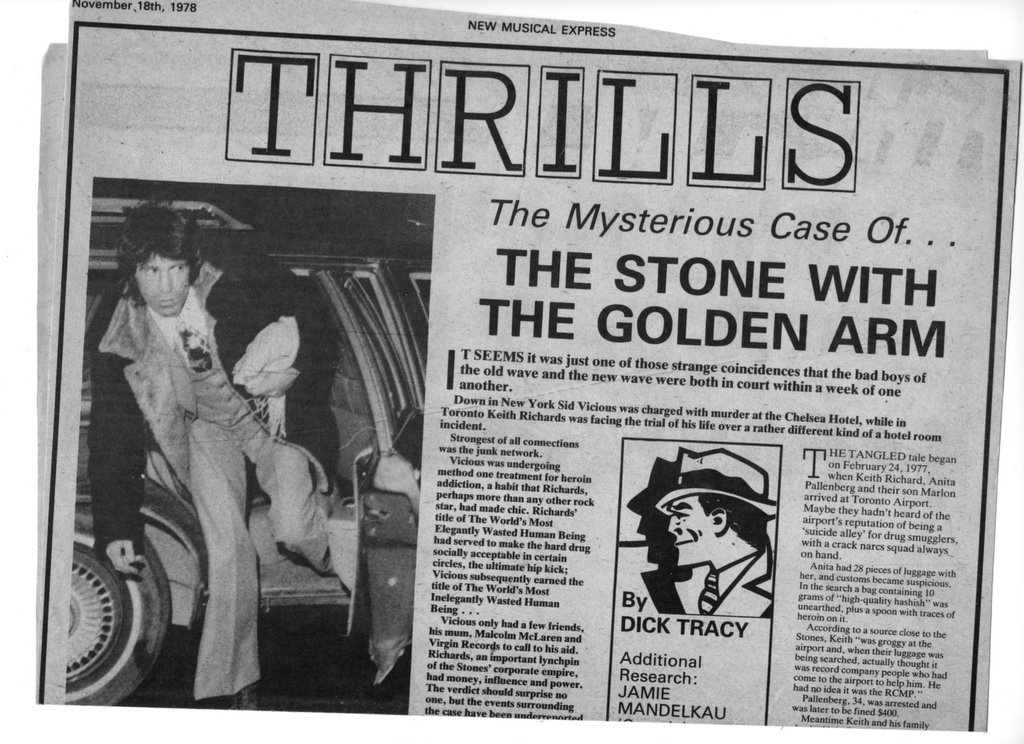
This the original text of the Dick Tracy story that appeared in the NME on Noveember 18th, 1978.
Valuable additional research for the story was done by Jamie Mandelkau in Canada plus help from Kathy Kelly in London.


It seems it was just one of those strange coincidences that the bad boys of the old wave and the new wave were both in court within a week of one another. Down in New York, Sid Vicious was charged with murder at the Chelsea Hotel, while in Toronto Keith Richards was facing the trial of his life over a rather different kind of a hotel room incident.

Strongest of all connections was the junk network.


Vicious was undergoing methadone treatment for heroin addiction, a habit that Richards, perhaps more than any other rock star, had made chic. Richards' title of The World's Most Elegantly Wasted Human Being had served to make the hard drug socially acceptable in certain circles, the ultimate hip kick; Vicious subsequently earned the title of The World's Most Inelegantly Wasted Human Being . . .

Vicious only had a few friends, his mum, Malcolm McLaren and Virgin Records to call to his aid. Richards, an important lynch pin of the Stones corporate empire, had money, influence and power. The verdict should surprise no one, but the events surrounding the case have been undereported over here.

What follows is the fullest account to date in the British press of the case of the Stone with the golden arm.

The tangled tale began on February 24,1977, when Keith Richard, Anita Pallenberg and their son Marion arrived at Toronto Airport. Maybe they hadn't heard of the airport's reputation of being a 'suicide alley' for drug smugglers, with a crack narcs squad always on hand.

Anita had 28 pieces of luggage with her, and customs became suspicious. In the search a bag containing 10 grams of "high-quality hashish" was unearthed, plus a spoon with traces of heroin on it.

According to a source close to the Stones, Keith "was groggy at the airport and, when their luggage was being searched, actually thought it was record company people who had come to the airport to help him. He had no idea it was the RCMP."

Pallenberg, 34, was arrested and was later to be fined $400.

Meantime Keith and his family checked into Rooms 3223-24-25 at the Harbour Castle Hotel under the name of K. Redland. Another Stones employee reported that their suite was "almost a fortress, with security guards imported from Buffalo to keep watch." Inside, he said, "their room looked terrible, because they didn't want maids snooping around. Both Keith and Anita looked awful."

It was just three days after the airport incident, at 4.30 am on the Sunday morning, that the big bust came down.

Rumour has it there was a tip-off from another guest in the hotel. An unspecified number of Mounties and Ontario provincial police arrived at the hotel with a warrant in Pallenberg's name, spent 45 minutes locating Richards, burst in and searched the suite. In the bathroom they found a leather pouch containing heroin, a hypodermic needle and a teaspoon with traces of what later turned out to be cocaine. Richards and Pallenberg were arrested, their passports confiscated, and all hell broke loose.

MICK JAGGER arrived in town on March 3 and, by all accounts, took control of the situation.

The Stones were in town to complete their live American tour album and start work on a new LP. Out on bail, Richards attended the rehearsals held every night at Cinevision, a film studio in the suburb of Lakeshore.

A Stones employee later told reporters: "I was amazed Keith made it to rehearsal every night because his situation with the arrests had almost ostracised him from the band. They were supportive, but they felt uneasy about the pressure."

Worse was to come when the Stones appeared at the El Mocambo Club and in the audience was Canada's First Lady, Margaret Trudeau. She followed the band to New York, bringing scandal and sensationalist publicity in her wake.

Canada had been a bad place for the Stones — and the future of the band looked bleak indeed.

THE WHEELS of justice everywhere in the world grind slow, and it was almost 18 months before Richards
was to return to Toronto for his court appearance.

One can only speculate on the deals that went down over that period. Richards' only public interviews concentrated strongly on what was to be the main plank of his defence — his cure at a clinic in New York. The man in the dock was obviously to be presented as a reformed character.

With the huge financial investments at stake in the Stones' future, nothing was to be left to chance. Obviously, the Stones' power as a live and recording act wou'd be severely muted if Richards spent time inside.


Court Drawing: Laurie McGaw/Toronto Star

CUT TO Toronto a week before the trial is to begin. Down at the courthouse on University Avenue, special security precautions are being arranged. Rumours are circulating the city that Richards will not show, a story quickly squashed by Stones publicist Paul Wasserman, whose other clients include Neil Diamond and Bob Dylan.

"That's silly," he pointed out. "After all, if he didn't turn up for the trial, he could be extradited from almost anywhere, with the exception of somewhere like the Yemen. And they don't have 24-track recording studios, so he couldn't go there."

Sure enough Richards arrived, very much the family man, with his mother and two kids, Marion and Dandelion, in tow. There was no trace of the man who had a string of drug and other convictions stretching back ten years, the hedonist who had once owned a yacht called Mandrax. Richard was under heavy manners and facing the heaviest bust so far.

With money no object, the Stones had hired the best Canadian lawyer they could find: Austin Cooper, a 49-year-old criminal lawyer with 25 years experience, a man well respected in legal circles for being the prime mover behind introducing the legal aid system in Ontario. He was to tell reporters: "I'm just a lawyer and I'm really awfully dull. I don't even play the guitar."

The case was to be heard by Judge Lloyd Graburn, a 52-year-old with a college haircut and two sons. Unaware of who exactly Richards was, he had to ask around before realising the true celebrity credentials of the defendant.

As is common in most legal cases, plea bargaining was the order of the day.

With the judge's approval, the more serious charge of trafficking heroin was dropped, as was the cocaine possession charge, leaving Richards to face a simple heroin possession rap. This still meant, though, that he was looking at the chance of going down.

The defence tactics soon became clear. Cooper explained to the court that Richards had bought the heroin in bulk to reduce the chances of detection. His New York score amounted to 22 grams of 34% pure smack which, when diluted, was enough for 440 injections with Richards shooting them up at the rate of 10 a day.

Cooper's oratory was overwhelming. Richards was described to the court as a man with "a poor self-image .... a tragic person who became addicted to heroin to prop up his sad personal life." His name was ranked alongside such other tormented artists as Van Gogh, Judy Garland, F. Scott Fitzgerald and Billie Holiday.

The Cooper version of Richards' habit began in 1967. "H was after a very gruelling schedule with the group, and he was exhausted after all the playing and touring. He experimented with drugs.

"In 1969 he started with heroin, and it got to the state where he was taking such quantities of the drug and getting no euphoria from it. He was taking such powerful amounts — as much as 2 1/2 grams a day — just to feel normal."

The first cure came in 1972, "but he fell back into the cauldron." Another cure attempt at a Swiss clinic the following year worked for a while. Cooper claimed, "but again he fell off the wagon, so to speak."

In 1974 he failed again, but since May 1977 Richards had been undergoing treatment at the Stevens Psychiatric Centre in New York, and this time he was winning the struggle.

Health factors aside, Richards' habit took a heavy financial toll. In just two years, the court was told, Richards spent $650,000 on heroin.

Cooper pleaded eloquently: "He should not be dealt with as a special person, but I ask your honour to understand him as a tortured creative person — as a major contributor to an art form. I ask you to understand the whole man."

Perhaps the strangest note of Cooper's defence came when he claimed that Richards was in the process of setting up an international addiction centre at an undisclosed location. Richards later told a press conference that he did not instruct Cooper to say that, and claimed: "It may be true and it may not. I'll let you know when I've paid the lawyers."

The defence rested, and the prosecutor asked the judge for a jail sentence on the grounds of the amount of heroin snatched, Richards' previous record and his age. The judge decided to retire and deliver sentence the following day.

THE VERDICT was a shock to nearly everyone. The judge said jail was out because Richards was taking the cure. "His efforts to remove himself from the drug subculture can only have a salutary effect on those who admire him." Secondly, because Richards had money — it has been revealed that in 1977 Richards earned some $300,000 — he was unlikely to resort to crime to support his habit.

So Richards was put on a year's probation, ordered to continue his cure and to play a concert for the blind. Richards gave a clenched fist salute to the packed courtroom before leaving with his bodyguard. Another trial, another day.

Reactions to the verdict in Canada were mixed. Former Prime Minister John Diefenbaker was outraged and urged an appeal, but the largest paper in Canada, The Toronto Globe, described the verdict in its editorial as "a model of enlightened sentencing, one which should pave the way for a more equitable and civilised treatment of convicted drug addicts in Canadian courts."

It should be made clear that less than half the people convicted in Canada of simple possession of heroin go to jail.

But it was the concert for the blind that raised most eyebrows. How had the judge reached that idea? Onestrong rumour was that Cooper had suggested it, but this was tracked down to blind superfan Rita Bedard,who attended the trial every day and was invited in by Cooper to meet Richards and get his autograph. It turned out that she was responsible for the story; Cooper dismissed it.

In fact the judge had called John Simmons of the Canadian National Institute for the Blind (CNIB) just 30minutes before going into court onthat final day. Simmons claims: "He asked me if I would object if he sentenced a young musician to play music at the Institute. We only foundout later it was Richards. We were *shocked and pleased."

But not everyone was that euphoric. CNIB's John Rae said it could negatively affect public attitudes towards blind people, and called the verdict "outrageous, bizarre and patronising".

"We're seeking equal rights, not a handout," he said. "If the judge intended to help blind people, there are a number of organisations besides the CNIB that should have the opportunity to benefit as well."

The big problem for the CNIB now is that their auditorium on Bayview Avenue only holds 200, and their switchboard has been jammed with people hustling for tickets. The owner of the 16,000 seatcr Maple Leaf , Gardens has offered his venue for the event, but no final decision has been reached.

THE COURT scene over, Richards arrived an hour late for a press conference, his last public appearance before waving Canada goodbye. Wearing jeans, a scratched leather jacket and a T-shirt with the legend 'Robbie Rocker' on it, he fielded a barrage of press enquiries.

How had the whole incident affected him?

"Oh it's all show business. Every day of my life is show business. I didn't give it much thought until the last few days. I mean, it wasn't as if I was waking up each day thinking the trial is coming."

Had he made any jail contingency plans?

"I just wondered if the uniform was with stripes or arrows?" He described his probation officer as "sweet".

On the subject of heroin, he said he gave up his addiction because it was boring and commented: "You lose your respect and confidence. Once you get to the stage of addiction it is just where you get to ask, 'Where is the dope?' You wonder what you're doing sitting in an apartment with four men who are dribbling . . .

"I'm happy to be off it ... I have become a lush."

When asked about the Stones' reaction to the verdict, he said: "They were very ticked off I didn't get put away for 30 years. I'm going to use the bail money to bribe the rest of the band to do the benefit."

Of the judge's comment that some Stones' songs glorified drug use, he said: "I think that is a misconception. There are drug overtones in about one per cent of the band's material and Mick wrote them, not me."

So Richards is out once more. Meanwhile Vicious spends time in Bellevue psychiatric hospital after a suicide attempt. Another week in the history of rock and roll.

NME: Adventures in the Music Press

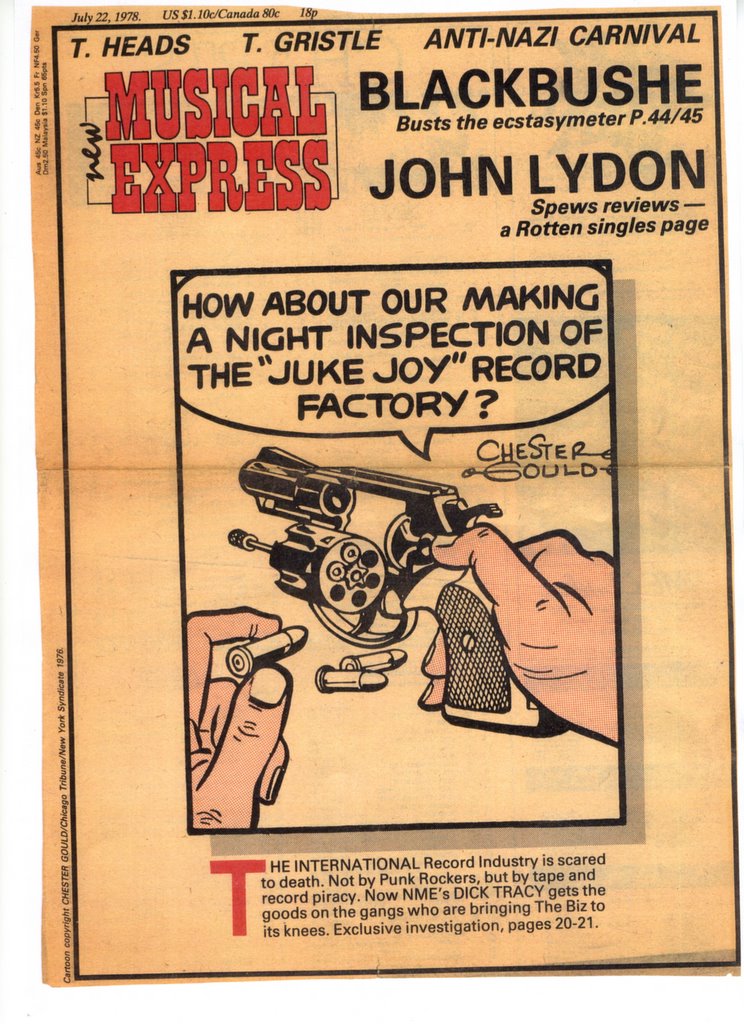
Dick Tracy's first and only cover story, investigating record
and tape piracy. July 22nd, 1978.


It was a recent weekend Guardian magazine profile of Tony Parsons that initially triggered all this off – a flood of memories. Tony, now a best-selling novelist and a regular columnist for The Mirror, was interviewed in connection with his just-published novel ‘Stories We Could Tell’ based on his time at the New Musical Express (NME). The least said about that the better. Paul Morley's review 'Those Weren't The Days' is right on the button I think.

My story begins back in the days of what was then called the ‘underground press’. I was part of Frendz magazine, one of a number of nationally-distributed haphazardly-produced mags and papers that documented the counter-culture of the period. It was here that I met Nick Kent who turned up and asked me if he could write some rock reviews for the papers. Good writers of any kind were hard to come by, particularly ones that didn’t want paying, and within a few weeks Nick was pumping out live and record reviews that immediately convinced that here was man with real talent. We became best mates

Within a few weeks it seemed, Nick was suddenly everywhere, hanging out with the Grateful Dead and Keith Richards. (He took me once to Richards house in Chelsea but he wasn’t in). I remember travelling down to Brighton with him on a coach with Captain Beefheart and the Magic Band, hanging out in Wembley with the legendary San Fran rock band The Flaming Groovies (later seeing them live with Nick at their appearance at the legendary Iggy Pop gig at the Kings Cross cinema)

Frendz, in its last incarnation, was being designed in Osterley by Pennie Smith (later to acquire legendary status as a rock photographer par excellence for the NME) in her funky converted railway station pad, helped by our dear departed friend Kevin Sparrow. I remember Roxy Music being the big thing at the time.

Inevitably Frendz came to a close – there was no money left and only a few survivors on the staff – and our last issue, designed by George Snow, featured news of an exclusive Lou Reed piece by Nick Kent which never materialised, we had to print a big apology in the paper. By now Nick and Pennie had migrated to the NME.

The New Musical Express (NME), founded in 1962, had begun recruiting from the underground press and Nick and Charles Shaar Murray, one of the schoolkids featured in the infamous OZ issue that became the subject of the longest obscenity case in British legal history, between them ushered in a whole new era of rock writing – inspired by Lester Bangs and Creem magazine – that made the paper a must-read for so many at that time. This was New Journalism of an irreverent drug-fuelled kind that captured the spirit of the times.

It must be remembered that, at that time, there was no coverage of music in the national press at all – except for headlines when one of the Beatles got married or such like. Hence the strength of the music press and feelings that attached to them. This was vital reading for music fans and the NME along with its rivals Melody Maker and Sounds saw their circulations rise rapidly during the 1970s with the NME way out on top in a dominant position before the decade was out.

Clustered here were the some of the best writers and editors around – the late great Ian McDonald, Tony Tyler and the editor Nick Logan, who would go on to found Smash Hits and subsequently his own magazine The Face, the style bible for the decade to come.

I was determined to get into the paper if I could and it was thanks to Mick Farren, former editor of International Times, who had also joined up, that I managed to get a gig around 1976. I believe my first piece was a three-line story about a guitar-plucking contest which carried my by-line. I remember leaping up-and-down with excitement. I had made it into the NME – the nearest thing we’ve ever had in this country to a national youth newspaper.

Amongst the great writers on NME were Tony Parsons and Julie Burchill, perhaps the best known now to a mass audience, but music journalist afficianados will recognise not only Kent, Murray and Farren but also the truly excellent Chris Salewicz, Vivien Goldman, Brian Case, Danny Baker, Paul Morley et al

The best source of information to date on NME and the other papers of the period is ‘In Their Own Write: Adventures in the Music Press’ by Paul Gorman [Sanctuary Publishing 2001], consisting entirely of interleaved interviews with the above mentioned and others.

What is missing from this account, and from other assessments I have read about the NME is the fact that although the paper carried principally music journalism, there was also a great deal of material on books, films and the general youth culture.

From my earliest days at the NME it was clear to me that I wasn’t going to be able to compete with the music writers but I found my niche as the person who wrote everything that wasn’t music. In the process, I became Dick Tracy, investigative journalist and, under that nom de plume, wrote a considerable amount of stories between 1976-82. A few pieces appeared under my own name but Dick Tracy acquired a bigger profile and cachet than my real identity.

So much so that the following small notice was run in the paper on May 20th 1978 in connection with a piece I wrote called ‘Cloning Papers’:

‘Contrary to popular belief, Dick Tracy is not the pseudonym used for NME team efforts. Tracy is one man who works alone, albeit with occasional help from both inside and outside NME central. The only journalist to unearth the covert activities of the Animal Liberation Front, the only journalist to present an alternative view of Operation Julie acid purge, Dick Tracy now offers the most convincing theory to date about The Man Who Was Cloned.’ [An interview with David Rorvik, author of ‘In His Image’ which claimed to be the true story of the first human cloning]

I don’t have a complete record of everything I wrote during this period so what follows is a fraction of the total but includes some of the most important stuff:

FILMS: During the mid-1970s cinema attendances had collapsed, to be subsequently revived by the new generation of sfx films led by Star Wars. The film industry was desperate to get coverage in the NME and I was, in the beginning, one of the paper’s principal film writers, with access to major film studios, artists and writers.

- Exclusive first- run interview with Julian Temple about the first Sex Pistols film
- The first piece, some six months before the film was released, on ‘Quadrophenia’ followed by interviews with Franc Roddam and Phil Daniels.
- Interview with Milos Forman about ‘Hair’.
- Interview with Steven Spielberg about ‘Close Encounters’
- Interview with Billie Hayes and Brad Davis, the actor who played him in ‘Midnight Express’
- Feature on the films of Clint Eastwood.
- UNPUBLISHED: Interview with David Mingay on the Clash film ‘Rude Boy.’

PLUS: Numerous reviews of movies beginning with ‘The Missouri Breaks’ (Jack Nicholson/Marlon Brando)

DRUGS: Wrote a regular drug column called Inside Dope. Major pieces on Keith Richard’s heroin trial, on British drug prisoners on foreign jails, on Operation Julie.

POLITICS:
- Worked as part of a team, with Angus Mckinnon, Ian McDonald and others, to produce the four-page NME Guide to the Nuclear Age. There was a nuclear explosion on the cover of that week’s issue. (June 11th 1977)
- Numerous pieces on the Animal Liberation Front and the birth of what has become a worldwide radical movement.
- Number of pieces on the Save The Whale movement and campaigns – the biggest environmental issue of that time. Also the seal culls in Newfoundland

Much of this sort of coverage was taken up in a more expansive form by Andrew Tyler, who now runs the excellent Animal Aid. Hats off to a great writer. See details of his latest campaign here.

MUSIC BUSINESS: I was one of the first journalists to write investigative pieces about the music industry itself, profiling major corporations and pillaging the trade papers of the times for juicy leads. This led to MY ONLY COVER STORY, on Record Piracy. Also did major piece on The Elvis Industry following the death of the King plus similar piece on the mass cross-marketing of Saturday Night Fever.

The NME years were genuinely exciting. The power and reputation of the paper was such that doors opened wherever you went. Johnny Rotten, Paula Yates, The Stranglers and the like would drop round the office, always full of the pressure cooker atmosphere of a weekly paper.

Yes, I spent a lot of time in the legendary ‘kinderbunker’ with Tony and Julie, who liked what I was doing and were real mates to me, inviting me to a number of punk events – like the memorable Johnny Thunders deportation party – encouraging me to go and interview Blondie but also supporting the animal liberation coverage I was writing for the paper.

I was not a major figure on the paper but I made a contribution. Thanks to Chris Salewicz for saying in ‘In Their Own Write’: ‘John May was very good as Dick Tracy. He started the film coverage with what was called Silver Screen and he was quite instrumental in changing the paper.’

Thanks also to Phil McNeill, who took a real interest in the investigative journalism I was writing and supported some very ambitious and difficult stories.

So much more to be said. Consider this a 1st Draft memory exercise.


Footnote:

1. Mick Farren’s account of those times can be found in his biography ‘Give The Anarchist A Cigarette’. I am covered by a sentence that reads: ‘Old underground press contacts came up with stories on bizarre media events, weird performance art, animal rights, the environment, recreational drugs and drug enforcement.’

2. For Neil Spencer’s recent account as his period as editor (1978-85), see here.

3 Am currently chasing up the ‘Inky Fingers’ documentary on the NME, shown on July 4th, 2005, on BBC4. Some of you lucky people who can get digital tv will have seen it already. Further comments to come.

4. A huge amount of journalism from the NME and other music papers can be found at
www.rocksbackpages.com. Highly recommended.

Thursday, November 24, 2005

The Archaeology of New Journalism

Who’s Afraid of Tom Wolfe: How New Journalism Rewrote the World by Marc Weingarten [Aurum Press 2005]

The New Journalism
– Tom Wolfe and E.W. Johnson
[Picador 1975]

The New New Journalism: Conversations with America’s Best Nonfiction Writers on Their Craft – Robert S. Boynton [Vintage Books. 2005]

Jack London: A Life – Alex Kershaw [Flamingo. 1988]

Can anything be 'new' I guess is the first question. When Tom Wolfe ‘invented’ New Journalism and launched it on the world in the early 1970s, his aim was to supplant the novelists and literature practitioners in the Cultural hierarchy with journalists producing what he considered ‘the most important literature being written in America today.’

New Journalism, writes Boynton – ‘uses complete dialogue, rather than the snippets quoted in daily journalism, proceeds scene by scene, much as in a movie, incorporates varying points of view…’

‘The New Journalism,' he writes, ' was a truly avant-garde movement that expanded journalism’s rhetorical and literary scope by placing the author at the centre of the story, channelling a character’s thoughts, using non-standard punctuation, and exploding traditional narrative forms.’

Wolfe claimed that the true progenitors of New Journalism were the ‘literary realists’ of the 19th century – Fielding, Sterne, Dickens, Zola. Boyd and Weingarten both hold the view that, in a sense, ‘new journalism’ was always there in the ‘old journalism’. Campaigning journalism by Stephen Crane and Jack London, Lincoln Steffens and Jacob Riis represents its first 19th century flowering, says Boyle.

Its second came with a generation of writers centred around The New Yorker in the 50s and 60s – John Hershey, Lillian Roth and others – who Wolfe writes off as ‘Not Half-Bad Candidates’. He was also to memorably dismissed the magazine itself, in a stunning NJ performance for Esquire entitled ‘Tiny Mummies.’

Wolfe’s New Journalists included Hunter S. Thompson, Michael Herr, Norman Mailer, Truman Capote, Joan Didion, Gay Talese, Terry Southern. The famous anthology also contains material from Garry Willis, Robert Christgau, ‘Adam Smith’, John Gregory Dunne, James Mills, George Plimpton, Barbara L. Goldsmith, Nicholas Tomalin, Joe Eszterhaus, rex Reed and Richard Goldstein. Interestingly there is no Jimmy Breslin, who Wolfe admired enormously.

Weingarten probes the mags, editors and antics behind classic works like ‘The Electric Kool-Aid Acid Test, Hell’s Angels, Dispatches. Boynton’s book profiles the ‘New New Journalists’, through brief summaries of their careers and extended interviews about their craft and technique.

‘Contrary to the New Journalists’ this new generation experiments more with the way one gets the story,' he writes. 'To that end they’ve developed innovative immersion strategies ' typified by Ted Conover, who lived as a hobo to write his book Rolling Nowhere and worked as a prison guard for Newjack.

He calls it ‘the literature of the everyday’ and says it is often focused on impoverished subcultures, ‘drilling down into the bedrock of ordinary experience, exploring what Gay Talese calls ‘the fictional current that flows beneath the streams of reality.’

Other writers featured in the book are: Richard Ben Cramer, Leon Dash, William Finnegan, Jonathan Harr, Alex Kotlowitz, Jon Krakauer, Jane Kramer, William Langewiesche, Adrian Nicole LeBlanc, Michael Lewis, Susan Orlean, Richard Preston, Ron Rosenbaum, Eric Schlosser, Gay Talese, Calvin Trillin, Lawrence Weschler, Lawrence Wright.

Both Tom Wolfe and Hunter S. both read Jack London when they were kids. London himself read Kipling and Stevenson.

Jack became the most successful writer in America in 1903 with The Call of the Wild, based on his own extraordinary real-life adventures. Less well-known is the fact that he wrote two non-fiction prototype new journalism books: one of the first books about drifting across America called simply The Road, and his impassioned study of poverty in London’s East End – The People of the Abyss – which deeply influenced George Orwell in his writing of Down and Out in Paris and London.’

He was possibly the first journalist to write about surfing and, says Kershaw, 'to turn the natural drama of sport into stirring fiction.’ He was also a passionate pioneer organic farmer.

Kershaw’s masterful biography of Jack London (1826-1924), is approachable and sweeps you along expertly, revealing an extraordinary man who, for once, fits that old overworn phrase ‘larger than life.’

Jack came from the streets, ran away from home, became an oyster pirate, shipped out on a sealer with a vicious captain and lots of blood on deck, travelled to the Yukon, on a memorable, miserable, extreme journey that would have killed a lesser man and almost did for Jack.

Resolving to write stories and get them published if it killed him, Jack did almost expire once more before luck and fortune smiled and he rapidly became the biggest writer in America through his adventure stories such as the memorable ‘White Fang’ and ‘The Sea Wolf.’ From poverty he found riches, living in a huge house on the hills above San Francisco, from where he was to witness the destructive earthquake and fire that razed his birthplace to the ground.

In other mad adventures, he became a war correspondent in the Russian/Japanese war and sailed across and around the Pacific with an untrained crew.

London was, of course, a troubled man of gargantuan appetites, a huge physical presence, out of whom poured stories that still resonate, a man of enormous industry who suffered genuine tragedies and weathered personal loss and great pain and suffering. He was a socialist who genuinely believed that Anglo Saxon races were superior to other men. Yet he knew what it was like to be poor.

There are many interesting parallels and connection between London and Guthrie, whose autobiography ‘Bound for Glory’ contains, in Chapter One, a powerful ‘new journalistic’ account of a long and frightening ride inside a boxcar full of cement dust with a lot of desperate men with no heating and little water. Both had a driven ability to write copiously, both escaped from grinding poverty that left its scars.

New journalism or old, these books make you want to rush out to write right now, to see the world with new eyes, to ravish it, consume it and regurgitate every single last detail in torrents of vivid prose that inspire and entertain the reader. Why else would we all do it? As for what’s new. We’ll let the historians argue over that one.

Wednesday, November 23, 2005

CLIPS '92

Just discovered a bunch of material that I was assembling back in 1992, aimed at creating a kind of DIGEST OF NEW KNOWLEDGE AND THINKING. Thought this might be of interest. Click on the document to bring up full screen version.

Remembering Hunter S. Thompson

More than a little delighted that my old buddy Lee Torrey, who I hadn't spoken to for at least a decade, found me through this little blog. Needless to say he's had his adventures in the meantime. Torrey was, of course, for those in the know, the legendary creator of the library classification system based on Roget's Thesaurus, which he invented and pioneered whilst working on the now equally legendary book 'An Index of Possibilities'. More of that anon. Turns out he has his own blog here but he was kind enough to allow me to repro on this site his excellent memories of the late, great Hunter S., who we all miss greatly in these benighted times. Lee writes like a dream, methinks, when he puts his mind to it. This piece reads fresh and original

When people ask me what Hunter Thompson was like I tell them he was just like the character in his books, and they smile and nod and leave me alone. I’m allergic to small talk, and despite my years at the National Enquirer, I really hate sharing gossip about celebrities. Besides, they say it’s not right to speak ill of the dead.

But that bastard Thompson nearly got me fired because he couldn’t keep his mouth shut about our nocturnal activities. And he broke his solemn promise not to drag my good name into any of his wretched works of fiction. That’s right, fiction that he sold as journalism. So, yeah, let’s kick some dirt at the maniac’s ghost.


Thompson in Aspen in 1981

Let’s start in Palm Beach in 1983. Peter and Roxanne Pulitzer were having a messy public divorce and the national press corps was having fun in Florida covering the trial. Thompson was reporting the event for Rolling Stone, Reggie Potterton for Playboy, and I was covering it for the Enquirer. We didn’t mix well with the straight press, and so it was natural for the three of us to pool our resources.

A few weeks into this circus, in the middle of one night, Thompson calls me up and says he has an emergency. He’s always having emergencies and I told him to call 911. But he’s says he’s having a problem with the Pulitzer story and needs my help.

That woke me up. The secretive, reclusive, sociopathic egomaniac wants my help? This was totally uncharacteristic. Hunter was a solo operator. He was a lone wolf. He would never ask for help.


Thompson loved playing with fire.

So I go over to his low rent bungalow in West Palm, and find both the front and back doors are wide open, and the lights are off. So I turn on the lights and no one is home. The living room was littered with bottles and overloaded ashtrays and dead junk food. Remember the cheap hotel rooms where Nicholas Cage drank himself to death in Leaving Las Vegas? Just like that.

Eventually, Hunter ambles inside wearing only a bathrobe and dark aviator glasses, and of course his cigarette holder is clutched between his teeth. He was gripping a long black flashlight in one hand and a Colt 45 Combat Commander in the other. And there was a cut on his balding head that was leaking a little blood. He was mumbling more loudly than usual, and there was a hillbilly lope to his gait which gets really pronounced when he’s drunk.

This is all completely normal behavior for Thompson, and I did’t see any emergency that justifies getting me out of bed.

Certainly, there was no sense asking him why he was running around in the dark with a flashlight and handgun. I would never get a straight answer. He often reminded me of an autistic child who was off in his own world. A world, I suspect, that was populated by some pretty fearsome demons. Not that Hunter would ever show fear or turmoil or doubt, but he had a head full of trouble.


One nice thing about Hunter is that he could pull the big master switch in his brain and turn off the psychopath and turn on a personality that could communicate with the real world. His uncanny ability to shape shift his personality was a talent that let him make a living. And it kept him out of the slammer on many occasions. In fact, on rare days, he could be actually charming.

So he switches on an agreeable personality and pours us drinks and stuffs some typewritten sheets of paper in my hands. He asks me to read his first draft of the Pulitzer story.

And it’s garbage. Pulitzer is hardly mentioned. It is the unprintable ramblings of an intoxicated lunatic.

I didn’t know what to say or do because Thompson still had the gun in his hand. And he was waving it around and making incoherent noises.

It is fitting that Thompson died from a gun shot wound to the head. He was a gun nut. The most fun he had in Florida was going to the Everglades on the weekends and shooting up the tropical flora and fauna with exotic automatic weapons. Guns were exciting and wonderful toys to Hunter and he seemed oblivious to the danger they posed to himself and others, which is probably why he shot so many people. Yeah, accidentally.

So, while I sat on his bed, waiting to be shot, I re-read the Pulitzer piece, and it seemed better after I reordered some of the pages. And after a third reading, key lines were jumping out at me and I suddenly got it. The master craftsman had shifted the focus of the story away from the Pulitzer divorce trial and he had launched a howling indictment of Palm Beach society.

Brilliant. The Pulitzer story was small potatoes. Who cared that Roxanne Pulitzer had sex with a trumpet and drank too many daiquiris. Certainly not the readers of Rolling Stone. But the Palm Beach society angle was good. F. Scott Fitzgerald good. He had stumbled upon a diamond as big as the Ritz. This was class warfare. He had discovered why they called the denizens of Palm Beach filthy rich.

And we started talking about this angle and he got excited and he put down the gun.

Soon it was sunrise. Hunter was not fond of early morning light and I managed to escape, exhausted and drunk, but not shot.

And so it went when Thompson got into your life. It was an unending series of close scrapes with disaster, but it was also like hanging out with an alien life form that did not understand, or care about, the customs and laws of pathetic Earthlings. While Hunter could mix with bikers, madmen and drunks, he also had a subtle aloofness. He enjoyed being different. He enjoyed being smarter than the rest of us.

He also liked being unpredictably aggressive. When David Letterman made the mistake of inviting Thompson on Late Night to promote the film Where the Buffalo Roam with Bill Murray, Thompson attempted to take over the show. I mean he physically tried to get Letterman out of his desk and take over the show. And there was a nasty rumor that he had brought an explosive device on the set. The good doctor of gonzo journalism was escorted off the set and his antics were edited from the segment.

After the broadcast I asked him what had happened and he denied bringing a bomb to the show, and he said he was just trying to give Letterman the same rough treatment that the TV comedian gave all his guests. Or whatever.

In a picture I have, at the film premier of Fear & Loathing, you can see Thompson holding a ripped bag of popcorn which he had been throwing at Johnny Depp. Yeah, Hunter could act like a two year old.

He had to be the center of attention. If there was another celebrity in the room on whom all the cameras were focused, he would do something like set the room on fire. Unless, of course, he wanted to be left alone. He’d rip your head off if you stumbled uninvited into his space. And forget about waking him up if he was late for an appointment.

Despite his violent mood swings and prickly personality, people everywhere adored him. On countless occasions on the street I saw all kinds of people approach him and ask for autographs. I was always amazed at the warmth the public had for a man with such an unwelcome reputation.

In fact, Thompson had groupies who would follow him from story to story. This puzzled him. He never could figure out how they knew what he was working on because not only was he obsessively secretive, but because he seldom knew himself what he was working on or where he might be tomorrow. Most of these groupies were young women who would do anything for some face time with the doctor.

Of course these deluded hormone-soaked creatures got the shock of their lives when they got up close and personal with Hunter, who was as liable to lash out and humiliate them as he was to bend them over. Which is not to say that he was a misogynist; he was more of a misanthrope. He really didn’t care for anyone getting too close or too personal.

I was happy to learn that he got married a few years ago, hoping that he had mellowed, and praying that Anita would live through the experience with her sanity intact. And I was not shocked to learn that he blew his brains out last week and left instructions to have his cremated remains shot out of the end of a canon. A perfect ending to a crazy life.

News reports say Anita was talking to him on the phone when he pulled the trigger. She later told reporters that he wanted to get out “while he was still on top of his game.”

He was pushing seventy and you can say he got out before his brains turned to mush. You can argue that the whole fear and loathing thing was getting old in the 21st Century, but in some ways, here in the brave new era of political correctness, we probably need Hunter Thompson more now than we did in the counterculture years.

We will always need blasphemous iconoclasts who are willing to tell anyone who’ll listen that your President is a liar and the government is not working in your best interest. The legend of Hunter Thompson is so shrouded in the trappings of his eccentric lifestyle that we tend to overlook his contributions. And there were many.

"America is just a nation of two hundred million used car salesmen with all the money we need to buy guns and no qualms about killing anybody else in the world who tries to make us uncomfortable."
- Hunter S. Thompson

Long before anyone had heard of Woodward and Bernstein, Thompson was telling us that Nixon was a crook. Long before most Americans knew where Iran was on the map, Thompson was warning us that Jimmy Carter was weak. He told us Reagan was senile before Alzheimer’s was a household word. And he’d been telling us Bush was not an honest man long before we invaded Iraq.

But Thompson was more than a political prophet. He tore down the façade of objective journalism by showing that a reporter is always part of the story, and that an observer always disturbs what he is observing. Thompson was always telling us that there is no such thing as “fair and balanced.” He knew that his drug-addled perspective on our society was just as skewed as – and just as valid as – the family value howlings of Bill O’Reilly.

Even loaded to the gills with alcohol, it takes actual courage to put your name on a story in a national publication and call the President of the United States a liar. Years before anyone else had a clue.

So an era has passed. A great American is gone. A warrior has fallen.

Which one of you will pick up his sword?

Howl For Now


Illustration: Michael Anderson

Some of the best things you ever come across, someone tips you off over. Yeah, the internet, blah blah, digital stuff. So’s anyway, it was Flo that tipped me the wink and Route books up north who came through with a review copy of this here compact green-covered volume that I, in turn, am about to hip you to. Thus passing on the favour, if you follow my drift or, at least, my general direction.

HOWL FOR NOW is the book of the event staged in Leeds to celebrate recently the 50th anniversary of the first reading of Howl by Allen Ginsberg on oct 7th 1955 at the Six Gallery in downtown San Francisco in front of an audience of poets, hipsters and other such, including Jack the Kerouac and others. The audience was transformed.

We have seen the best minds of our and subsequent generations being destroyed by various means since that time and the Poem and the Poet have since been righteously, realistically recognised by all and sundry and judged to be one of The Biggest of Big Deals as in 20th century masterpiece kind of stakes.

Howl is read a lot still by young people all over the world and that seems to be the most important thing, it being a great shout of exuberance, insanity and protest against the VERY BIG THINGS that are fucking up our world, So that’s why Howl will always be a contemporary book in the way those old ancient Greeks are and why it was a good idea to celebrate this recent anniversaire with some kind of Beat Bonanza.

I wasn’t there but I’m pleased to learn that the film maker who made the multi-media-movie of Andy Warhol’s 1966 ‘Exploding Plastic Inevitable’ event is currently editing footage of the Howl for Now performance, held at the School of Music at the University of Leeds, for release next year so that we can all see what went on.

In the meantime it is my pleasure to heartily recommend this Route book which contains essays by some of the key players, organisers and hipcat heads involved. I more or less read the whole thing in one big gulp (accompanied by three pints of the new Irish Guinness that is in town, and listening also through both ears to the conversation of the Czech barmaid and the jukebox which was on random shuffle.

Let’s be straight about this, as in I found this a crackerjack book in the sense that each essay gave me something, triggered a thought-stream, made me sit and ponder, intrigued me in some way or other.

So without further ado, here is the line-up: begins with old-time beat David Meltzer, still operating in the Bay area, who sets the vibe in two pages in a jazz riff called Howling Wolves.

Next up Steven Taylor’s ‘the poem and I are fifty’ which recounts the times when he played guitar with Ginsberg and, more importantly, gives us real sense of the real stuff that made up Allen Ginsberg, brings him to life for the reader in a cool and touching manner.

Simon Warner, editor of the book as a whole and a kinda mastermind-type character in the whole howl-for-now scenario, broadens out the focus in ‘Sifting the shifting sands: Howl and the American landscape in the 1950.’ This is totally fascinating wake-up, showing how the Beats and Be-bop intertwined, how Howl and Rock around the Clock coincided, pulls it all together.

You’ve just recovered from that, had a pause, a half-pint, a bit of a think when George Rodesthenos bats you right on the button with a powerful piece on Rimbaud and Ginsberg, about bodies and nakedness and much else. Through this, discover new poet Constantine Cavafy (1863-1933) who I already love and am no longer immune to.

Then come the interviews – with Ronald Nameth, formerly mentioned filmmaker, godfather of modern multimedia, about the Howl for Now event and film and then also Bill Nelson talking about the soundtrack front.

Sandwiched between (appropriately), another cross-dressing cultural exercise by Michael Anderson – ‘The visual arts and Howl: painters and poets in the American 1950s.’

Get the general drift – I loved it all. The publishers Route are based in Pontefract and seem to be up to lots of other good things also. Check them out on http://www.route-online.com/ and buy this book. And have a howl for now, for God’s sake or anybody else’s.

Howl for Now, Edited by Simon Warner [Route. 2005. £9.99]


PS: For those who find the style of this review irritating, you haven’t met my barroom buddy Hip Flipster, Beat Poet.