Sunday, August 29, 2010

SCIENCE NEWS: METEOR IMPACT CRATERS

ries-100

ries-102

[Above & Left]: Aerial picture and geological map of the meteoric impact crater at Ries in Germany. [Below]: Landsat image of crater at Talemzane in Algeria and 3-D modelling of same  by Dr. Carlos Roberto de Souza Filho

tlz-3

TALEMZANE_EXAG7_64_3D

These images come from the Earth Impact Database, which is currently managed by John Spray (Director, Planetary and Space Science Centre, University of New Brunswick, Canada..

The Earth Impact Database is maintained as a not-for-profit source of information to assist the scientific, industrial, government and public communities around the world in furthering our collective knowledge of impact structures on Earth. It is regularly updated with new discoveries.

The database is regularly updated with new discoveries but, to be included in the listings, the proposer must provide convincing evidence of shock features or impact formations, preferably in a published form. These rigid criteria help maintain the integrity of the data. [They have a long list of currently unproven impact structures, which they are planning to publish]

The FAQ shows two structures that look like meteor impact craters but are not – in Hudson Bay and Mauritania. Crater Lake, Oregon – often mistaken for an impact crater -  is a caldera lake, the product of a St Helen’s style volcanic explosion.

There is a very interesting essay on impact craters on their site, based on a 1990 Scientific American piece by Grieves.

Our view of the importance of meteoric impacts has been radically changed in recent years by the findings from planetary exploration missions. This clearly shows that virtually all planetary surfaces are cratered from the impact of planetary bodies. It is now accepted that they have played a major role in reshaping the surface of Earth.

‘Most of the terrestrial impact craters that ever formed, however, have been obliterated by other terrestrial geological processes. Some examples however remain. To date, over 160 impact craters have been identified on Earth. Almost all known craters have been recognized since 1950 and several new structures are found each year.’

Saturday, August 21, 2010

GEOENGINEERING: PAST & PRESENT

12-header_HOME_hand_smaller The big theme of this blog is connectivity between people, places, things and ideas, and its content is often driven by chance and coincidence – as in this post.

A few days back I imagediscovered Hands off Mother Earth (HOME) -  a Stop Geoengineering protest site. You can add your photo protest pic. They are against geogineering in general and target four such projects in particular: biochar, ocean fertilisation,cloud whitening and artificial volcanoes

REVIOUS POSTS:

PLANET NEWS (Sept 2007) we noted  The Climate Engineers, an excellent and detailed essay by James R. Fleming [The Wilson Quarterly.Spring 2007]  A full pdf of the piece can be found on the writer’s website: Selected Works of James R Fleming. Fleming is Prof of Science, Technology and Society at Colby College in Maine.

‘As alarm over global warming spreads, a radical idea is gaining momentum. Forget cuts in greenhouse-gas emissions, some scientists argue. Find a technological fix. Bounce sunlight
back into space by pumping reflective nanoparticles into the atmosphere. Launch mirrors into orbit around the earth. Create a planetary thermostat. But what sounds like science fiction is actually an old story. For more than a century, scientists, soldiers, and charlatans have hatched schemes to manipulate the
weather and climate. Like them, today’s aspiring climate engineers wildly exaggerate what is possible, and they scarcely consider political, military, and ethical implications of attempting to manage the worlds climate with potential consequences far greater than any their predecessors were ever likely to face.’

In STEWART BRAND: REINVENTING ENVIRONMENTAL THINKING [October 2009] we discover that Brand is in favour of geoengineering.

CHARIOT693

The coincidence part of our story stems from the fact that, later the same day I discovered HOME, I found this book in a cardboard box outside my favourite discount book store in Brighton. It was £2.  It knocked me sideways. It is about geoengineering using nuclear bombs and one particular project which I was criminally unaware of: Project Chariot. Here is the skinny:

‘If your mountain is not in the right place, drop us a card.’                                                                                                                  – Edward Teller.

Following the development and deployment of atomic bombs in the 1940s, both the US and Russia conducted numerous atmospheric nuclear tests during the 1950s. Concern about the negative image of nuclear weapons, a concept of Atoms for Peace was developed and championed, principally by physicist Edward Teller who successfully established his own lab – Lawrence Livermore – to further these notions.

‘At its height Plowshare employed 290 people and spent $18 million annually to recast the bomb as a peacetime tool. Physicists became public works engineers and set about to correct “a slightly flawed planet.”

“To remedy nature’s oversights,” detonations would gouge out canals and “instant harbours".” They would slice through mountain ranges. Edward Teller spoke of “a new and important discipline,. Geographical engineering. We will change the earth’s surface to suit us.”

Project Plowshare’s principal aim was  to create a new sea-level Panama Canal. In order to fulfil such a project, they needed a test site to try out the techniques of atomic earth-moving. The point they chose was Cape Thompson in northern Alaska, where they planned to create a new  harbour.

CHARIOT2694 Project Chariot, as it was named, was spiked by the activities of a few key scientists, conservationists and organisations and the steadfast opposition of the Inuit people of Port Hope.

Dan O’Neill has done an exemplary job in presenting the story in vivid detail. In the course of his research he managed to get a huge amount of secret material declassified.

It was his research that in 1992 uncovered the fact that nuclear waste in the form of radioactive dirt had been buried at Cape Hope during Project Chariot without the knowledge of the local Inuit. This developed into a major issue and a costly clean-up.

US Biologist/activist Barry Commoner, who has been variously described as ‘the dean of the environmental movement’ and ‘the father of grass-roots environmentalism’ had this to say in 1988:

‘I think, in so far as I had an effect on the development of the whole movement….Project Chariot can be regarded as the ancestral birthplace of at least a large segment of the environmental movement.’

The environmental study carried about by Alaskan biologists to try and determine what effect the atomic bombs would have on the local ecosystem, was the most comprehensive environmental program ever done at that time; it can be considered the first environmental impact statement (EIS).

The Inuit of Port Hope, the population who were closest to the Chariot test site, founded Tundra Times to promote their opposition to the project. The issue of Native land claims formed a core part of their arguments and their campaign can rightly be seen as the start of a process that led to the passage of the Alaska Native Claims Settlement Act of 1971, which conveyed 40 million acres to the Inuit people and awarded them $1 billion compensation for lands already lost.

This remarkable and important book should be more widely known.

‘The Firecracker Boys’ by Dan O’Neill [Basic Books/St Martin’s Press. 1994]


Sunday, August 15, 2010

INSIDE DOPE: SPEED GOES GLOBAL

image

(Top): Notable locations of manufacture and main trafficking routes of amphetamine group substances 2008-2009. (Below): Notable locations of manufacture and main trafficking routes of ecstasy-group substances 2008.

image

Source: World Drug Report 2010 [UN Office on Drugs and Crime (UNODC)]. Section 1.4 The global amphetamine-type stimulants market

The report estimates that an estimated 161-588mt of amphetamine-type stimulants (ATS) and 55-133mt of ecstasy were manufactured in 2008. During 2008-2009, the number of amphetamine users worldwide ranged from 14-53 million; number of ecstasy users from 10-26 million.

Globally, cannabis users comprise the largest number of illicit drug users (129-190 million people). Amphetamine-group substances rank as the second most commonly used drug, exceeding the number of opiate and cocaine users combined.


SPEED2684

Hot off the press from Los Angeles comes this capsule-shaped book – a publishing first (?) – in which Mick Farren takes the reader through a ‘fast history’ of amphetamine, first synthesised by Romanian chemist Lazar Edeleanu at the University of Berlin in 1887.

In the almost 125 years since then, its various forms and derivatives have permeated global society and culture, fuelling factory workers and truck drivers, criminals and soldiers,musicians and writers, mods and gays who desired the benefit of its side effects – alertness, euphoria, heightened physical energy, prolonged stamina, rapid verbalisation, enhanced concentration, boosted confidence and intensified sex drive.

Amongst famous users were Hitler, Jack Kennedy and Anthony Eden, Jack Kerouac, and a whole raft of singers and entertainers including Elvis, Johnny Cash, Hank Williams, the Beatles and the cast of Andy Warhol’s Factory.

Mod and punk were two musical/style movements in which amphetamines played a major part. XTC or psychedelic speed fuelled club and rave culture

Amphetamines were extensively used on all sides during the second World War, were ubiquitous in Vietnam and remain in widespread use in current conflicts.

Farren tracks the development of ‘ice’ or ‘crystal meth’ and documents the involvement of the Hell’s Angels in the amphetamine trade and how this is now largely dominated by various Mexican gangs.

Also touched on is the use of Ritalin and Adderall by US schoolchildren, a supposed cure for ADD and ADHD.

Farren, lead singer of the freak 1960s/70s band the Deviants is no stranger to amphetamines and he paints vivid pictures of the scene in the back of their van when the band were coming down whilst driving back from the gig. Also of stumbling across Ladbroke Grove with Lemmy of Motorhead, a band named after a street term for speedfreak.

The book carries no health warnings but its numerous dark stories of come-downs, paranoia and violent incidents will make it clear to any reader that sustained amphetamine use comes with a hefty downside.

[‘Speed-Speed-Speedfreak: A Fast History of Amphetamine ‘ by Mick Farren is published by Feral House.]

See Previous Post:THE UNDERGROUND PRESS GAZETTE

Mick Farren/Wikipedia

AMPHETAMINE NEWS

image On the 4th August 2010, baseball player Alex Rodriguez became only the seventh member of the Major League Baseball’s 600 home-run club which currently stands as follows:

1) Barry Bonds – 762; 2) Hank Aaron – 755; 3) Babe Ruth – 714;  4) Willie Mays – 660;   5) Ken Griffey Jr. - 630
6) Sammy Sosa – 609; 7) Alex Rodriguez - 604*. Japanese star Sadaharu Oh holds the world major league record for career home runs with 868.

Acording to PopFi.com: Bonds, Sosa and Rodriguez are all rumoured to have used or admitted to using steroids and ‘baseball’s ban on performance enhancing drugs and amphetamines has declined hitting numbers all across the board, which explains the massive explosion of no-hitters throughout baseball this season.’

Tuesday, August 10, 2010

NUCLEAR FIRES: RUSSIA & USA

The Russian Fires are causing threats to nuclear facilities and the area around Chernobyl. The story is being reported around the world. Here is the story from Wired: Russia Fires Approach Nuclear Plants:

image

‘There are much bigger problems looming. The fires have approached the Red Forest, an area that suffered the worst of Chernobyl’s fallout in 1986, with the soil still heavily contaminated by cesium-137 and strontium-90.

Similarly, the Mayak nuclear fuel reprocessing facility in Chelyabinsk Oblast is also threatened by the flames, as is a nuclear research center in Sarov, which was formerly known as the secret town Arzamas-16. If any of the structures succumb, then radionuclides could be spread widely afield, generating new zones of radioactive pollution and displacing the population of those areas.

By chance discovered this story about the threat of fire to US nuclear plants from earlier this year.

Fires break out at three U.S. nuclear plants over the weekend, FACING SOUTH,  By Sue Sturgis , March 29, 2010

Emergencies were declared at two Progress Energy nuclear power plants in the Carolinas over the weekend due to fires. There was also a fire at a nuclear power plant in Ohio on Sunday that sent two firefighters to the hospital. The blazes were put out and disaster averted, but the incidents underscore concerns about U.S. nuclear plants’ failure to comply with fire safety regulations……

The emergencies “are a reminder that virtually all U.S. nuclear power plants remain in noncompliance with fire protection regulations,” says Jim Warren, executive director of the N.C. Waste Awareness and Reduction Network, an energy watchdog group.

Fire represents the leading risk factor for a US nuclear plant meltdown.

In 1975, a fire broke out at the Tennessee Valley Authority’s Browns Ferry nuclear plant in Alabama in an area that housed electrical cables used to power critical safety equipment.


In response to the near-disaster at Browns Ferry, the NRC adopted fire-safety regulations designed to prevent similar incidents. However, most of the nation’s commercial nuclear power plants still not have come into compliance with those regulations, according to reports by the NRC Inspector General and the U.S. Government Accountability Office.

Source: Nuclear-News


ARCHIVE: THE POISONING OF MOTHER RUSSIA

This major news feature was published in the Sunday Times on 9th November 1980. It was an exclusive story that I sold to the paper, having been given advance access to the manuscript of Boris Komarov’s book ‘The Destruction of Nature in the Soviet Union’, which was published five days after this article’s appearance by Pluto Press in London.

It was an important story and very shocking at the time. Pollution was considered a very western phenomenon and this was the first indication that were serious similar problems in the Soviet bloc. It was my first major feature for the paper, at the age of 30 – a kind of coming of age. The Sunday Times was under the editorship of Harold Evans at that point, with offices in Gray’s Inn Road. It was a great paper at that time.

RUSSIA POLUTION681

Illustration: Peter Brookes

The Poisoning of Mother Russia

The Destruction of Nature in the Soviet Union is a passionate indictment of the Soviet authorities for allowing the country's air, land, water and wildlife t be despoiled, while claiming that serious environmental damage is a capitalist phenomenon. JOHN MAY reports.

‘A FEW YEARS ago an English film was shown on our screens in which a lunatic general hunted deer with ground - to - ground missiles •quipped with heat-seeking warheads. Soviet zoologists and ornithologists commented ironically after seeing it that the English director and script-writer must have really enjoyed making their little fantasy, which ridicules the manic militarist.

"Among the divisions quartered in the Baikal area, however, hunting for deer in this manner has heen a long and serious practice (in contrast to the pure fantasy of our Englishmen). Our rocket officers reasoned quite soberly that they could find no better targets for training troops to shoot ground-to-ground heat-seeking missiles at than wild boar and deer on the run. Startled by the sound of a shot, the animals dash across the wooded hills, and the accurate rockets overtake them wherever they go. Everything is quite logical, everyone sane. . . ."

This is one of the more vivid examples of the environ­mental vandalism, which, according to Boris Komarov, is rife in the Soviet Union. Constitutionally, the state guarantees environmental protection—as well as human rights. In reality, says Komarov, the leading Soviet planning agencies connive at the widespread destruction of nature, and at covering up the disastrous effects of their policies. His assertions in­clude :

* Mining, logging, dumping and erosion have laid waste about 10 per cent of the habit­able land—an area the size of Western Europe.

*Largely because of air pollu­tion, the incidence of lung cancer doubled between the late Sixties and the late Seventies. Each year, 5 to 6 per cent more children are born with genetic defects. One city in the Urals set up a special workers' brigade to clear dirt and soot from the rooftops every three months— otherwise, the roofs would collapse.

*Newspapers and television stress how Western capitalists are polluting the world, butsay nothing about pollution in Russia. " Showcase examples " of good ecological management are used to deceive both Soviet citizens and foreign visitors.

image

Satellite picture of the Cheliabinsk plant. In the intervening years, the full story of the accident have come to light. Source: Global Security

*Soviet authorities covered up an explosion of nuclear wastes in 1958—a claim made four years ago by Dr Zhores Medvedev, a Russian biologist now living in London. Komarov says the explosion happened near the city of Cheliabinsk, in the industrial Urals, and that all crops, animals and homes in the area were destroyed; the popu­lation was evacuated for a radius of at least 200 kilometers. "It was only chance that the radioactive cloud did not reach Sverdlovsk a city north of
Cheliabinsk but passed over a comparatively sparsely populated region. The number of victims remains a secret to this day."

* The small Sea of Azov, ad­joining the Black Sea, has be­come " a latrine." with levels of oil pollution reaching 100 times the officially permitted maximum concentrations. It was once the most productive body of water in the world, yielding three times as much fish as the Black Sea, the Caspian, and the Baltic put together. The current yearly catch of about 3,000 tons is one ninetieth of what was taken in the postwar period.

*The poaching of wild ani­mals and birds—encouraged by the scarcity of fresh meat in the shops—is virtually uncontrolled. Wildlife reserves are routinely plundered, especially by top-ranking officials and the mili­tary. " Eagles, hobbies, kites and
other birds of prey are wiped out from military helicopters just for practice." In 1976, a commander of the Strategic Missile Forces was prosecuted for shooting I5 polar bears from a helicopter, using an automatic rifle in a special turret.

*Chemical effluents are des­troying the unique eco-system of Lake Baikal in central Sibe­ria—the deepest lake in the world, and the largest volume of freshwater. The damage will be increased by the construction of a secret industrial complex— including lead and zinc mines— on the Kholodnaia River, to the north of the lake.
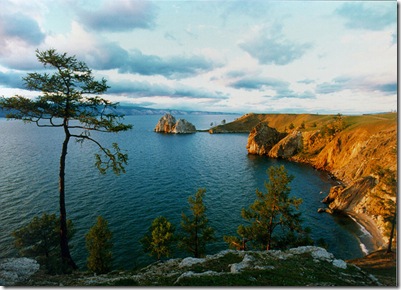
 

baikal2 Source: Pacific Environment

“LAKE BAIKAL has inspired both poets and chroniclers of amazing phenomena. “Baikal," wrote the Soviet historian Leonid Leonov, is not only a priceless basin of living water but also a part our souls." And the Guinncss Book of Records gives it a double entry—for depth (6,365 feet) and capacity (5,520 cubic miles). The story of its pollution shows in detail how Soviet agencies collude in the destruction of natural resources, while pay­ing lip-service to environmental principles. Baikal is 25 mil­lion years old, but Komarov claims that chemical wastes have brought it to “the brink of irreversible change " in a single decade.

The public first learned of the plan to build two paper and pulp combines on the lake shores through a disquieting essay in the maga­zine October in 1963. The writer said that the plant— construction of which had already begun – was threatening to poison the lake and ruin the surrounding forests. In fact, says Komarov, scientific experts had been opposing the Baikal scheme since its proposal in the late Fifties, but the State Planning Committee had pressed on regardless. Neither Siberian nor Moscow scien­tists — let alone ordinary citizens — had been allowed up see details of the project. The real pressure to build the plant had come from the Ministry of Defence, which cited the  “strategic interests d the country.” The Ministry wanted a domestic supply of durable cord for bomber tyres, then being imported from Canada and Sweden. Only two sites could provide the huge quantities of clean water needed for the manu­facturing process: Baikal and Lake Ladoga. But Ladoga, near Leningrad, was already surrounded by industry and the chief source of drinking water for the city.

To  allay the widespread concern that followed the October article, it was announced that the most sophisticated and costly treat­ment facilities in the world would be built at the Baikal combines. A special commis­sion, set up by the Presidium of the Academy of Sciences in Moscow, confirmed in 1966 that the measures to protect the lake were effective, and, on the whole, adequate.

Komarov reveals, however, that the published report was a whitewash. In fact it was the fourth report produced by the commission; the three previous versions had been rejected because they failed to approve of the combine. He quotes a first-hand account from a member of the com­mission:

‘We submitted our report to the vice-president of the Academy of Sciences, A. P. Vinogradov. He took a look at our conclusions and immediately sent the report back to us. "You maintain that the Baikal com­bines will prove fatal to the lake. Rut how can this be ? The government decides to build, and you say “impossible…” Take your report and do some work on it.” That is hen the real arm-twisting began. Elementary arithmetic showed that, even after treatment, effluents con­taining dissolved matter each year would clump more than 30,000 tons of sodium sulfides and chlorides, toxic lignin, foul-smelling mercaptan com­pounds, and the like into Baikal. The concentration of mineral compounds in the waste waters after purification would be 30 to 40 times higher than the normal Baikal levels. . . . There was, it seemed, no way out. Neither the Presidium of the Academy of Sciences nor Vinogradov could object to our work. But no means were spared. To oppose our com­mission the Presidium created its own commission, consisting of chemists. At its head put Zhavoronkov, an academic­ian, secretary of the chemistry department, a government man who knew what the Presidium needed. “

At one subsequent meeting, says the commission member, " one old academician began to scream at us: ' But why are we going on so about this Baikal? Pollute it if we have to. Now we have nuclear energy, and if later we have to, we cam easily make a big pit and fill it with water, and that's it. We'll make Baikal again '."

Two more versions of the commission's report were re­jected. In a fourth report, the authors dropped their categorical conclusion that " construction would be ruin­ous for the lake." There were conditions, however: a pipe­line should be built to dis­pose of waste waters over a ridge into the Irkut river; a national park should be created; and there should be extensive restricted zones around the lake where no wood pulp would be pro­cessed. Komarov claims that at his time of writing, in 1977, almost all of these conditions were still in "the discussion and design stage."

Meanwhile  Lake Baikal had suffered a decade of defilement. A second report of the Academy of Sciences re­ported in 1975-6 that the com­bine should be shut down and re-equipped for environment­ally safe production.

The report pointed out that a tiny crustacean—epishura —formed the first link in a food chain that supported all the fauna of the lake, including whitefish, cod, grayling and seals. The ephishura lived only in Lake Baikal, dying even if kept in pure Baikal water in a laboratory test tube.

Ephisura are not only an ir­replaceable food. They also act as a potent biological filter, helping to extract about 250,000 tons of calcium a year from the waters of the rivers flowing into the lake. They are responsible for the unique purity of the Baikal water, and for its satura­tion with oxygen even in winter.

Epishura die in the (sup­posedly purified) effluents from the paper and pulp combine, even when these effluents are diluted 20, 60 and 100 times. The crustacean is becoming extinct for several square kilo­meters around the plant.

Algae are flourishing in the southern part of the lake—some­thing previously thought im­possible—and fish are becoming infested with worms. There are constant breakdowns in the combine's purification equip­ment, and at these times the sewage entering the lake is hundreds of times more toxic than usual.

" Pollution has even begun to interfere with the operations of the combine itself," writes Komarov. " It now extracts water that it has polluted itself and is unable to do the job it was built for—produce a specially durable cord for tyres. However, this no longer bothers anyone—since 1964, before the BPPC had been completed, such cord has been made from petroleum."

So, asks Komarov: " Why are we slowly but surely destroying the most precious body of water on the planet? " His answer: to produce about 160,000 tons of ordinary cord—a small propor­tion of the nation's needs; 3,000 tons of coarse packaging paper —the kind used to wrap nails; 100,000 tons of nutrient yeast for feeding pigs; and a little turpentine and oil, used in paints

The great mass of Soviet citizens remain ignorant of the pollution of Lake Baikal, thanks to three government resolutions restricting information about it since the alarm of 1963. The latest of these, in 1975, covered not only information about Baikal but any ecological infor­mation in the mass press throughout the country.

" Major ecological problems began with Baikal, but unfortu­nately they will not end with the lake," writes Komarov. " During these years ' the blue orb of Siberia' has become a symbol of hundreds of Russian lakes and rivers being ruined by pollution, a symbol of the smoke-filled sky suffocating forests and people, a symbol of perishing nature."

WHO IS BORIS KOMAROV?

Boris Komarov, whoever he is, dearly has had access to much restricted information, and understands thee political factors behind environmental decisions. His British publishers, Pluto Press, believe he is " a high official in close touch with the scientific and political establishment," and that he is still living in the Soviet Union.

Harry Rothman, a senior lec­turer at the technology policy unit of the University of Aston, who wrote the foreword to the British edition of Komarov's book, describes him as " an 'insider' who believes that the causes of the Soviet ecological crisis are due to fundamental weaknesses in the socio-economic structures o£ the Soviet Union."

Zhores Medvedcv, the dissi­dent biologist whose claim of a covered-up nuclear disaster is confirmed in the book, says Komarnv is " very well-informed," particularly about chemical contamination. He believes that Komarov probably worked in the chemical indus­try, and " writes from personal experience." He thinks it unlikely that Komarov is a high-ranking official, hecause he does not quote from official documents.

Komarov's book was first pub­lished, in Russian, by Possev-Verlag, an emigre firm based in Frankfurt.

UPDATES:

BORIS KOMAROV

KOMAROV

Photo of Ze’ev Wolfson on Jan 26th 2007 by David Rabkin.

All these years later, thanks to the wonders of the Internet, have today discovered who Boris Komarov is: Ze’ev Wolfson

Ze'ev Wolfson was born in 1944 in the USSR. He received a Ph.D degree in Enviromental Policy from Moscow State University in 1978. The work The Destruction of Nature in the Soviet Union (under pseudonym Boris Komarov) was published in 1979 in the West in eight editions in seven languages. The book was awarded the Gambrinus European Award (Italy) for best book on ecology in 1983. After the Chernobyl disaster he focused his interests on the consequences of developing of nuclear technology, and chemical and biological weapons in the former Soviet Union and in Russia. The author has published numerous articles on these subjects. In September 2000 his work “Syrian-FSU Military Cooperation” was published in NATIV. From 1987 he was affiliated with the Mayrock Center for Russian, Eurasian and Eastern European Research of the Hebrew University as a researcher and editor of the Environmental Policy Review and from 1998 as editor of CIS Environmental and Disarmament Yearbook.

Source: Ariel Center for Policy Research

Read the Foreword  by Yurii Shcherbak (Ukraine’s Former Minister of the Environment, leader of Ukraine’s “Green Movementg” and currently Ukraine’s Ambassador to Israel) to Boris Komarov’s  ‘The Geography of Survival Ecology in the Post-Soviet Era’ [Published by M.E. Sharpe Inc in 1994]. Available on Google Books.

LAKE BAIKAL:

images

Wednesday, June 30, 2010

Greenpeace and WWF present 125,000 signatures to UNESCO to save world’s oldest, deepest and largest lake

UNESCO today received a petition of signed by 125,000 people around the world protesting against the re-opening of a paper and pulp mill on the shores of Lake Baikal, a World Heritage site in the Russian Federation.

The petition was presented to UNESCO Assistant Director-General for Culture, Francesco Bandarin, by Greenpeace and the World Wide Fund for Nature (WWF), who agreed to bring it to the attention of the World Heritage Committee, when it meets in Brasilia from 25 July to 3 August.

"The World Heritage Committee will discuss the Baikal issue at its meeting in Brasilia, and will offer recommendations and support to Russia to define the most appropriate solutions," Mr Bandarin said.

"We have had, in the past, proof of the Russian Government's commitment to the conservation of World Heritage sites," he added. "We are confident that the authorities will understand that Lake Baikal requires decisions that will effectively protect its conservation."

Greenpeace Russia campaign director Ivan Blokov urged UNESCO "to do everything within it's power to protect Lake Baikal from the catastrophic consequences that would inevitably result from the re-opening of the Baikalsk Paper and Pulp Mill (BPPM) on its shores". "The 125,000 signatures on the petition we have presented to UNESCO today provide ample testimony to the concern of people the world over about this unique site," he said.

Lake Baikal is the deepest, oldest and largest lake in the world, containing 20% of the planet's unfrozen fresh water. Over 25 million years it has developed an extraordinarily rich biodioversity, including a freshwater seal, and is often referred to as the 'Galapagos of Russia'.  It was inscribed on UNESCO's World heritage List in 1996.

Source: UNESCO News

ARCHIVE: RUSSIAN CONSERVATIONIST ALGIRDAS KNYSTAUTUS

RUSSIA KNYSTAUTUS682

This article was published in The Guardian on March 31st 1987.

AFTER Chernobyl and the period of guilty secrecy immediately following the accident, doubts were raised in Western minds about Soviet awareness of and seriousness about ecology and conservation. Perhaps, muttered the pessimistic, it would all end not in the bang of a nuclear war, but in the whimper of radioactive poison spread by Soviet sloppiness.

Evidence that the people of the Soviet Union do care — and that it is, as ever, bureaucracies which fail to take all factors into account — comes this week with the publication of the first modern English language book on Soviet wildlife and the almost Western-style PR hype of the visit of its author to this country.

image Conservation is given great prominence in the ‘Natural History of the USSR’ and Algirdas Knystautas, the stylish, blond-haired 30-year-old ornithologist who wrote it, paints an optimistic portrait of the state of the Russian environment. The Soviets' love for the earth, as expressed so often in their literature and music, has, he says, for many years found a practical form in conservation.

"If you look at the roots of conservation," he says, "it's not a recent thing at all. The Astrakhan nature reserve,which is very important in the Volga delta, was created in 1919 by Lenin. More nature reserves are being created and recently huge territories have been withdrawn from any kind of industrial or agri­cultural activities.

"Taimyr nature reserve is about 1,500,000 hectares, an enormous territory of virgin tundra with about 3,000 red-breasted geese breeding there. They are a symbol of the USSR Ornithological Society. It is definitely improving in all ways. Aware­ness among the people, especially the people who deal with agriculture and just common people, is very important."

Dr Knystautas was born in Lithuania, in Vilnius, a town of 40,000 inhabitants, and spent his first six years in his grandparents' house "which had a big garden, old trees, many birds nesting and, of course, it was a place to explore." His love of nature is, he says, "just genetics, just inborn. I really do not think that environment had so significant an effect on me.' Birds were always my sub­ject. I've always felt like that and I'm very confident that things happen to me that way, so let them be that way."

His seriousness and his confidence are intimidating. So is his refusal to conform to cultural stereotypes. He is neither tweedy ornithologist nor baggy-suited Soviet scien­tist. Midway through his lec­ture and publicity tour of the UK and already a veteran of similar trips to Canada and the USA, he does not res­emble his unbecoming book-jacket photo. He is wearing a sharp suit and a fashionably voluminous belted overcoat. And he is talking with a pas­sion and intensity which leaves no room for small talk. And he is not smiling.

image

Source: www.ibisbilltours.com

His traveller's tales are full of dangers and diffi­culties, beauties and tri­umphs. There was his hunt for the Ibisbill, a rare and mysterious wading bird of the Central Asian mountains, pic­tures of which are seen in this book for the first time in the West. There was the golden eagle he watched hatch on the Aksu-Dzhabagly nature reserve in the West­ern Tien Shan mountains of Central Asia.

Blue Whistling Thrush -Wat Tham Suea

Source: Birding2Asia.com

And he almost smiles when he says: "One of the most exciting birds is the Blue-Whistling Thrush which lives on mountain waterfalls and builds the nest just near. You can imagine what sound the waterfall produces, the bird has to sing in those condi­tions so that the song is heard clearly by other birds. That is really exciting."

Photography is also a passion and one he is extremely serious about — an attitude justified by results. "My love of nature is so strong," he says, "I cannot keep it to myself. What I see I must show people. It is always with me. If I have had a joyous experience or found something very funny in a book, I must share it with someone else. The same is with nature."

There are many willing to be shared with. As in the West, nature programmes are big on Soviet television. There is The Life of Plants, Ecological Diary and, most popular, The World of Animals. There are many magazines, some national, some local. Gerald Durrell was mobbed by readers of his books when he visited the USSR and Sir Peter Scott and other Western naturalists are increasingly turning their attention eastward's for fresh material.

Knystautas stresses that the fight to save the rarer species of fauna and flora is engaged on a mass level. He says: "I think a great deal was done by establishing the Red Data Book. Every republic has its own and ordinary people can go to the authorities and say: 'Look, this bird is breeding just near and what have you done to conserve it?' This is very important."

He adds: "The main differ­ence between problems of natural conservation in the USSR and the West is the fact that in the Soviet Union there is state ownership of the land and it makes it much easier to look after the natural re­sources because we don't need to make an endless effort, as the World Wildlife Fund or the RSPB do, to buy land from private individuals for enormous, enormous prices."

But don't the layers of bu­reaucracies make it difficult to pilot ideas and proposals through the system? "You know, nothing ever goes very smoothly at all points. But in my experience a positive response is more usual than a negative one."

The Natural History of the USSR by Algirdas Knystautas is published by Century Hutchinson

Sunday, August 08, 2010

PLANET NEWS: FORESTS ON FIRE

image

Dense, billowing white and gray smoke pours from wildfires and shrouds the ground near Nizhny Novgorod, western Russia, as the Moderate Resolution Imaging Spectroradiometer (MODIS) aboard the Aqua satellite passed overhead on July 27, 2010. The city lies at the confluence of the Oka and the Volga Rivers, just southeast of center in this image. It is the fourth largest city in Russia, the administrative center of Nizhny Novgorod Oblast and the Volga Federal District, and home to more than 1.3 million people. Although it lies in a relatively clear section of the image, the city is almost entirely obscured by haze, smoke and cloud cover.

Major fires can be seen as large red hotspots in the forests east of Nizhny Novgorod and north of the meandering Volga River, and also as a bright band of large hotspots in the western mountains. The extremely dense, billowing white smoke and large red squares in the southwest of this image marks intense infernos, where both forest and peat blaze out of control.

The fires ignited in late July, after weeks of extreme heat joined a long-standing drought to turn vegetation tinder-dry. Reported as the hottest summer since record keeping began in Russia 130 years ago, highs of 40°C (104°F) have been reported, with many days exceeding 35°C (95°F). In the region, the average high in July is only 19°C (66°F).

Although many of the fires captured in this image have come under control, weather forecasts call for continuing hot, dry conditions and “extreme” fire danger in many regions. So far this year, fires have burned over 729,761 hectares and killed at least 52 people in Russia. At least 540 homes were destroyed in the area covered by this image.

image

Smoke and fires across western Russia. Latest currently available image: 5th August, taken at 08 :20 UTC

Source: MODIS WEB

Russians seek shelter as fires rage out of control‘Russian firefighters appeared to losing their battle against the wildfires even as firefighters from Italy, Germany and Bulgaria flew in to help. More fires broke out overnight with the number increasing to 853 across Russia from 831, blazing across a territory of 193,516 hectares. ‘

By Catherine Belton in Moscow and Isabel Gorst in Nizhny Novgorod [Financial Times published: August 7 2010 15:34 ]

image

Global distribution of fire occurrences. Latest fire map: 10 July 2010 - 19 July 2010. Source: MODIS Rapid Response System

This extraordinary image shows forest fires burning across the globe during a ten-day period last month.

The MODIS Rapid Response System was developed to provide daily satellite images of the Earth's landmasses in near real time. True-color, photo-like imagery and false-color imagery are available within a few hours of being collected, making the system a valuable resource for organizations like the U.S. Forest Service and the international fire monitoring community, who use the images to track fires.

Saturday, July 31, 2010

WIKILEAKS 2: NEW DEVELOPMENTS

image


Illustration: Stuart Bradford. Source: ‘Click and Dagger Factory’ in MotherJones

Since our last post on the subject back in April (see WIKILEAKS) this groundbreaking network and their frontman Julian Assange continue to cause controversy and grab the headlines – most spectacularly with the recent release of thousands of US secret files on the war in Afghanistan.  This is being called the biggest leak in intelligence history.

The Guardian’s Afghanistan: The War Logs is the place to read it all.

How the paper came to run the story and interact with Wikileaks is documented in ‘A Tranformative Moment’ by David Leigh, which ran yesterday in the Media Guardian. It explains in detail how The Guardian, Der Spiegel and the New York Times collaborated in an unprecedented journalistic effort to analyse the raw intelligence and prepare some of it for publication, from a secret ‘bunker’ in The Guardian’s London office. A key figure in the operation was journalist Nick Davies whose book ‘Flat Earth News’ is now a standard text on the decline of journalistic standards. This new experience in computer-assisted reporting may have changed his perspective.

Running alongside Wikileaks (and in consultation with it) are the plans  to create the world’s first ‘information haven’ in Iceland, a place that will protect investigative journalism against litigation. The Icelandic Modern Media Initiative has already been unanimously passed by the country’s Parliament.

‘Shall We All Go To  Iceland’ by Afua Hirsch (Media Guardian 12th July 2010)  is an informative overview of the situation as of this month.

Rumours have been going round the net that Assange is planning to abandon Wikileaks. This report summarises the rumours and publishes a robust and sensible Wikileak response. Read it for yourself. Make up your own mind.

‘Is Wikileaks Really Being Abandoned’ by Martin Bryant [11th July 2010) 

Have just discovered

No Secrets: Julian Assange’s mission for total transparency. by Raffi Khatchadourian (New Yorker . 7th June 2010)


MUSIC: BONNIE ‘PRINCE’ BILLY

 BPBILLY1654 I’m a late-comer to the music of this man but I’m entranced. Like all the best things, I came upon it by chance – or not. I had just read a profile of him in The New Yorker (of which more later), whilst on the train going to London, thinking I must check this guy out. Two days later, I’m rehearsing with new BOHO guitarist Nick Benjamin, esteemed luthier, in  his small workshop (there’s wood shavings on the floor, exotic smells  of tropical tone woods). We’d  been playing through our set  - on acoustic guitars rather than using the electrics. It sounded great. The workshop is about one minute from the Lewes Arms, to which we repaired. I was buzzing with the music, enthusiastically drinking Guinness and jabbering with Leon (who also has a band and loves his music) when I brought up the name Bonnie ‘Prince’ Billy and this article I’d just read. Turns out Leon is a long-term afficianado of his work and fan. He goes upstairs (Leon’s partner Abbie is the licensee) and returns clutching a stack of CDs – official releases, live recordings -  of the man in his various musical incarnations. I go home and stick on this record. Its a very beautiful thing with exceptionally evocative lyrics and spare arrangements. It is steeped in the world of what Greil Marcus calls ‘old, weird, American music’ but it also has touches and flavours of The Incredible String Band and many other influences. Find a quiet space and just down with this this and be amazed and inspired. I started writing poetry while first listening to it – discontinuous verses

‘The mad and the delirious/The strange and the mysterious/Mixed together in a potent brew’

‘Real life i more extraordinary/Than you can imagine/more imaginative/Than you can conceive.’

The songs have unconventional structures and are constructed out of what appears to be very little, yet there is a full sound, illuminated by his affecting voice and lyrical notions.  A great album. Also check out ‘The Letting Go’.

See:

‘The Pretender’ by Kelefa Sanneh. [The New Yorker. 5th Jan, 2009]

Wikipedia

Saturday, July 24, 2010

CULT BOOKS: DEREK RAYMOND, AMIN MAALOUF, JOSÉ SARAMAGO

CULT BOOKS1651 CULT BOOKS2652

Following my usual random practice of buying novels from second-hand bookshops for my morning novel-and-coffee sessions, these three come highly recommended.

Derek Raymond, widely credited as the father of British noir for his series of ‘Factory’ novels (you need a strong stomach), wrote this dystopian novel in 1970. The main character is journalist Richard Watt, who is living a quiet life of exile in the Italian countryside. Britain has become a dictatorship, run by the ruthless politician named Jobling, who Watt wrote an expose on before he came to power. Forced to return to the New Britain that Jobling has created, Watt comes face to face with its frightening reality. In a tradition that includes Orwell’s 1984, Ken Brownlow’s ‘It Happened Here’ and Constantine Fitzgibbon’s ‘When The Kissing Had To Stop’, ‘A State of Denmark’ is a haunting what-if read.

By contrast Lebanese journalist and writer Amin Maalouf’s ‘Samarkand’ is a magical exploration of the life of Omar Khayaam and the fabled city of the title. The  book  begins tantalisingly with the information that the only original copy of the Rubaiyaat went down with the Titanic.  We are then plunged into the world of 11th-century Persia, brilliantly realised, following the adventures of Khayaam (his love affairs, his narrow escapes from death) and the magic book he has created, in a skilful blend of fact and fiction. One of the book’s other major characters is Hassan Sabbah – a latterday Osmama bin Laden - whose disciples were contemptuously described by his enemies as hashishiyun (‘hashish smokers’), which has widely been considered the origin of the word ‘assassin’. Maalouf corrects this, writing that ‘Hassan liked to call his disciples Assassiyun,  meaning people who were faithful to the Assass, the ‘foundation’ of the faith. Beuatifully written, this entrancing saga has important contemporary relevance,giving readers in the West a deeper understanding of the roots of Iran and Khayaam’s towering importance.

Nobel prize winner José Saramago, one of the greatest of Portugese novelists alongside Pessoa, recently died. His legacy is a series of deep novels which I am continuing to gradually explore. Some years back I read ‘The Cave’, a wonderful book about an old potter and his dog (a wonderful characterin his own right) which was unlike anything else I had ever read. ‘All the Names’ is equally unusual and centres round the life of Senhor José, a humble clerk in the city’s Central Registry, a vast Gothic archive where the basic details of all citizens, alive and dead, are carefully documented in mass banks of card files by a cadre of bureaucrats, rigorously organised, whose lives are dominated by this suffocating and cloistered world. Jose’s life is upturned by chance when he accidentally finds a record of an unknown woman and sets out (illegally and clandestinely) to find out who she was. Saramago is the polar opposite of  Cormac McCarthy, who’s recent books ‘No Country for Old Men’ and ‘The Road’ are  virtually entirely composed of short sentences. Saramago, by contrast, writes in huge compound sentences that often fill an entire page. The book is chapterised but the chapters have no paragraphs, thus the text looks quite daunting. Once ensnared in his tale, which becomes curiouser and darker as it progresses, one realises that one is in the hands of a master storyteller who seems able to reach into other dimensions of time and space and describe and inhabit states of mind beyond our ken. His characters have many dimensions and  subtleties and the worlds he creates have an intensity that haunts the mind.

In his 1998 Nobel Prize lecture, entitled ‘How  Characters became the Masters and the Author Their Apprentice’ :

‘Saramago outlined the progression of his novels, explaining how each protagonist's journey paralleled his own life, and that each of his creations was also partially responsible for creating him. "Letter-by-letter, word-by-word, page-by-page, book after book," he said, "I have been successively implanting in the man I was the characters I created.’ [Source: L.J. Lindhurst at The Modern Word]

Saramago’s obituary in The Guardian

BI-WEEKLY.PL


I stumbled into this great Polish website while looking for information on the banquet that Picasso staged in 1908 at the Le Bateau-Lavoir in Paris in honour of Douanier Rousseau. I then spent the next hour or so sampling its delights.

Bi-Weekly.pl is just one of the outputs from Poland’s National Audiovisual Institute, established on April 1, 2009. This on-line journal – a beautifully designed, multi-level experience – was originally just published in Polish at  Dwutygodnik.com The new English-language version started in May this year and is currently on its 6th issue. A treasure trove of interesting stuff, with fresh perspectives and thought-provoking ideas.

The single most exciting piece I’ve so far discovered is ‘You Have To Be Ruthless’ an interview by MICHAŁ CHACIŃSKI with WERNER HERZOG – one of the most important and vital filmmakers in the world today – currently experiencing yet another renaissance with a clutch of new movies due for release. Anyone interested in making movies should read this extraordinary account of Herzog’s working methods. They don’t teach this at film school.

‘Culture in Times of the Cornucopia': A New Agenda for the Cultural Institutions’ by ALEX TARKOWSKI

‘Less than twenty years ago, with democracy and the free market, the Web came to Poland. Twenty years from now, a generation will become fully mature that has never lived in analog times. Thus, we’re halfway from the analog world to a truly digital one. We’re living in interesting times, facing the task of creating foundations for a culture that for many of us will no longer be comprehensible. ‘

‘Photography, Stills and Gnash: Which Way Photojournalism’ by CHRIS NEIDENTHAL

‘The ABC of New Culture': B as in Blog’ by Mirek Filiciak / Alek Tarkowski

‘A good blogger writes primarily for himself, while internet users read over his shoulder’

NOT IN ENGLISH YET is a fantastic and tantalising glimpse into the ocean of material not yet available in translation.

TOP SECRET AMERICA

There’s a lot of loose talk around about the ‘death of journalism’ and the decline of journalistic standards. so it was heartening and impressive          (and frightening) to discover the results of a two-year Washington Post investigation into Top Secret America. What a brilliant piece of work.

A hidden world, growing beyond control

The top-secret world the government created in response to the terrorist attacks of Sept. 11, 2001, has become so large, so unwieldy and so secretive that no one knows how much money it costs, how many people it employs, how many programs exist within it or exactly how many agencies do the same work.

These are some of the findings of a two-year investigation by The Washington Post that discovered what amounts to an alternative geography of the United States, a Top Secret America hidden from public view and lacking in thorough oversight. After nine years of unprecedented spending and growth, the result is that the system put in place to keep the United States safe is so massive that its effectiveness is impossible to determine.

The investigation's other findings include:

* Some 1,271 government organizations and 1,931 private companies work on programs related to counterterrorism, homeland security and intelligence in about 10,000 locations across the United States.

* An estimated 854,000 people, nearly 1.5 times as many people as live in Washington, D.C., hold top-secret security clearances.

* In Washington and the surrounding area, 33 building complexes for top-secret intelligence work are under construction or have been built since September 2001. Together they occupy the equivalent of almost three Pentagons or 22 U.S. Capitol buildings - about 17 million square feet of space.

* Many security and intelligence agencies do the same work, creating redundancy and waste. For example, 51 federal organizations and military commands, operating in 15 U.S. cities, track the flow of money to and from terrorist networks.

* Analysts who make sense of documents and conversations obtained by foreign and domestic spying share their judgment by publishing 50,000 intelligence reports each year - a volume so large that many are routinely ignored.

Read full story here

image

The National Counterterrorism Center's operations floor. (Photo by Alex Wong and Melina Mara / The Washington Post)

An extensive, searchable database built by The Post about Top Secret America is available at washingtonpost.com/topsecretamerica.

See also:

Top 10 blockbuster revelations from the Washington Post’s intelligence complex exposé

Why has the Post series created so little reaction?

Sunday, July 18, 2010

BP: A DEEPER HOLE

image

Source: Map of the northern Gulf of Mexico showing the nearly 4,000 active oil and gas platforms. NOAA

One of the world’s biggest natural disasters continues to dominate the headlines, as BP struggles to control the ‘Deep Horizon’ spill. This multi-headed hydra of a story continues to expand and deepen.

Two  major stories are now coming to the fore

– BP’s appalling safety record in the US prior to this latest disaster

See: The Project on Government Oversight story

‘According to our Federal Contractor Misconduct Database, BP has 52 instances of misconduct since 1995 (the most of any contractor in our database) for which it has paid $1.6 billion in fines, penalties, settlements and judgments.

Before the Gulf tragedy, BP’s most notorious misconduct incident in recent years was the 2005 explosion and fire at its Texas City refinery which killed 15 and injured hundreds. That refinery alone accounts for nine separate instances in our database and over $477 million in penalties, including civil and criminal damages and fines for workplace safety and environmental violations.

There was also “Black Thursday,” when BP racked up over $380 million in penalties in five separate instances on one day in October 2007

See also: ‘The well is capped. But what else lurks below the surface for BP?’ by Tim Webb [The Observer July 18, 2010]

image

- BP’s ongoing contracts with the US military. The key story was ‘BP has steady sales at Defense Department despite U.S. scrutiny’ by Washington Post Staff Writer R. Jeffrey Smith [July 5, 2010].

He reports US Defense Logistics Agency (DLA) figures which show that, in the fiscal year 2009, BP was the Pentagon's largest single supplier of fuel, providing 11.7 percent of the total purchased. BP has contracts worth $980 million in the current fiscal year

‘BP spokesman Robert Wine said he was aware of at least one "big contract" signed by the U.S. military after the oil rig explosion on April 20, involving the supply of multiple fuels for its operations in Europe’

In the US there is a process called ‘debarment’ which is used to shut off companies from receiving federal contracts.

‘Jeanne Pascal, a former EPA [Environmental Protection Agency)  lawyer who until recently oversaw the review of BP's possible debarment, has said she initially supported taking such action but held off after an official at the Defense Department warned her that the Pentagon depended heavily on BP fuel for its operations in the Middle East.

"My contact at DESC, another attorney, told me that BP was supplying approximately 80 percent of the fuel being used to move U.S. forces" in the region, Pascal said.

She added that "BP was very fortunate in that there is an exception when the U.S. is involved in a military action or a war."

A DLA spokeswoman told the Washington Post that "none of BP's current energy contracts are in direct support of operations in Iraq and Afghanistan" and that the department could meet its requirements without BP fuel.

Further details emerged on CNNMoney.com in a story ‘BP is still a top supplier to US military’ (July 15th)

‘BP is still among the biggest suppliers of fuel to the U.S. military, and the Defense Department has no plans to stop awarding the company lucrative contracts.

‘As of last week, BP has been awarded 17 contracts valued at just under $1 billion, the Defense Logistics Agency (DLA) said. That makes BP the third-largest supplier of fuel to the armed services so far this fiscal year.

‘In fiscal 2009, the DLA granted BP a total of 26 contracts valued at $2.2 billion, or nearly 12% of overall fuel purchases, making it the military's largest fuel supplier that year.

’In fact, BP has already received one small contract since the April 20 explosion on the Deepwater Horizon killed 11 workers and led to a catastrophic oil spill in the Gulf of Mexico. On May 17, the DLA awarded BP a contract worth $342,854 over four years to supply jet fuel to a regional airport in Oregon.

See Also:

Pascal Spills It on BP, Sporkin, and the Disaster in the Gulf on ‘Corporate Crime Reporter’

EPA Officials Weigh Sanctions Against BP’s U.S. Operations by Abrahm Lustgarten [Badlands Journal. June 21, 2010]

BP May Lose U.S. Oil Leases, Contracts as Gulf Spill Punishment by Jim Efstthiou and Jeff Plungis [Bloomberg. June 14, 2010]

BREAKING NEWS:

BP buys up Gulf scientists for legal defense, roiling academic community