Thursday, April 07, 2011

CHERNOBYL 5: THE LEGACY

Chernobyl_burning-aerial_view_of_core.jpg - 56335 Bytes
Chernobyl aerial view into the core, smoke from the graphite fire and core melt down. The photo was taken from a helicopter on May 3, 1986, of the destroyed Unit 4. File:Chernobyl burning-aerial view of core. [Source: Wikipedia]


This well-informed report by Mark Peplow in Nature gives a fascinating insight into the current situation at Chernobyl. Two extracts as a taster. Read the full article here (also available as pdf download): Chernobyl’s Legacy

Valeriy Seyda, a deputy director of the Chernobyl Nuclear Power Plant, explains that the plant’s top priority now is to construct a new confinement shelter for reactor 4 before the sarcophagus becomes too unstable. If it collapses before the new shell is in place, it could throw up a cloud of radioactive particles and expose the deadly remnants of the reactor.


REPLACING THE RUSTING TOMB
The plan is to build an enormous steel arch adjacent to the reactor and slide it along a runway to cover the building. The arch will reach 105 metres high, with a span of 257 metres — the world’s largest mobile structure, according to its designers. It is expected to be in place by 2015 and should last for 100 years. It will enable robotic cranes inside to dismantle the sarcophagus and parts of the reactor.

Long-term plans call for finishing the clean-up work at Chernobyl by 2065.

Some of the concrete trenches for the project are in place. But the international Chernobyl Shelter Fund that supports the US$1.4-billion effort still lacks about half of
that cash, and the completion date has slipped by almost ten years since the shelter plan was agreed in principle in 2001. One of the key goals of a forthcoming conference — Chernobyl, 25 Years On: Safety for the Future — to be held in Kiev on 20–22 April is to secure more cash commitments from international donors.

{SEE PREVIOUS POST: CHERNOBYL 1: 25TH ANNIVERSARY for visualisation of the shelter)

*

In Ukraine and Belarus, hit hard by the break-up of the Soviet Union in 1991, lingering fears about radiation are thought to have contributed to a sense of hopelessness that is linked to high rates of alcoholism and smoking — factors that have a much bigger health impact.
“There’s tremendous uncertainty for these people,” says Elisabeth Cardis, a radiation epidemiologist at the Centre for Research in Environmental Epidemiology in Barcelona, Spain. “Some think they are doomed because of their radiation exposure.”

NUCLEAR NEWS: LOW LEVEL RADIATION

image

Light projection onto the cooling tower of the nuclear power plant at Leibstadt. Photo: David Adair

‘We are clearly at a fork in the road regarding nuclear power, where we will either have to replace our ageing fleet of reactors or move away from nuclear power entirely.

To make rational decisions about these momentous questions, we need to understand the risks of low doses of radiation with a great deal more certainty. Otherwise the debate will be framed around the extreme positions of 'radiation is universally dangerous' and 'low doses of radiation pose no risk'.

- David J. Brenner

As part of its ongoing coverage of the unfolding nuclear crisis, THE GENERALIST is now turning its attention to Nature, one of the most respected and long-lasting scientific magazines. Its doing a great job.

We don’t know enough about low-does radiation risk

This is probably the single most important article I have read on low-level radiation. It is succinctly written by David J. Brenner who works at the Center for Radiological Research, Columbia University, New York, New York  and focuses on radiation-risk estimation at both high and low doses.


Wednesday, April 06, 2011

BROKEN ARROW: PALOMARES CLEAN -UP


Eighty days after if fell into the ocean following the January 1966 midair collision between a nuclear-armed B-52G bomber and a KC-135 refueling tanker over Palomares, Spain, this B28RI nuclear bomb was recovered from 2,850 feet (869 meters) of water and lifted aboard the USS Petrel (note the missing tail fins and badly dented "false nose").

This photograph was among the first ever published of a U.S. hydrogen bomb. Left to right are Sr. Don Antonio Velilla Manteca, chief of the Spanish Nuclear Energy Board in Palomares; Brigadier General Arturo Montel Touzet, Spanish coordinator for the search and recovery operation; Rear Admiral William S. Guest, commander of U.S. Navy Task Force 65; and Major General Delmar E. Wilson, commander of the Sixteenth Air Force. The B28 had a maximum yield of 1.45 megatons.

Source: Brookings

Last month I was interviewed by a Japanese tv crew for a primetime documentary on Broken Arrows (serious military accidents involving nuclear weapons) – on the day before the earthquake [See: Japanese Earthquake: Nuclear Accidents 1]

[GPNUCLEARAGE3534.jpg]

I was the main author and producer of this book (published in 1986), at that time the most comprehensive list of civil and military nuclear accidents available. What follows is a short version of one of the lengthier accounts in the book concerning  Broken Arrow 5: Palomares.

A B-52 bomber, carrying four H-bombs collided with a flying tanker during refuelling, 30,000ft above  Palomares,  a small fishing village of some 3,000 people,  on the Spanish coast. Both planes broke up spreading debris over 100 sqmls.

Bomb 1 was recovered relatively intact from a dry river bed. The high explosive in Bombs 2 and 3 exploded, scattering plutonium over the village and its surroundings. Bomb 4 fell into the sea.

This triggered off not only a massive decontamination on land but also what has been described as ‘the most expensive, intensive, harrowing and feverish underwater search for a man-made object in world history.’ It took them two weeks to find it [The proud moment is pictured above]

Ever since the accident, there have been concerns over health problems and contaminated water in the area and a long-running compensation battles.

Thanks to John (like the suntan !) for tipping THE GENERALIST off to the coverage in The Olive Press ( billed as ‘Spain’s No 1 English News website’) of the latest developments in the story.

 Operation Nuclear Clean-Up

‘THE US has finally agreed to help clean up land it contaminated with nuclear bombs in Almeria.

It will ‘co-operate’ with Spain to remove toxic plutonium near Palomares. A total of 60 hectares of land were contaminated after a B-52 bomber and tanker collided in 1966 detonating two explosives. After the accident, America removed 1,300 cubic metres of soil, but Spain is demanding the remaining 6,000 cubic metres are taken away. A US spokesman confirmed both countries would now split the cost of the clean-up, estimated at 31 million euros.’

The Olive Press reported as recently as July 30th, 2010, in a story entitled Nuclear Water, that radioactive traces had been found in tap water in 19 Almeira villages.

In January 25th, 2007, they published Bob Maddox’s lengthy account of the original incident - ‘The day the H-bombs came to Andalucia – on the fortieth anniversary.

SEE PREVIOUS POSTS:

BBC REVEAL LOST NUKE IN GREENLAND 1968

Tuesday, April 05, 2011

ABNER STEIN RIP

image

Sad to learn only today, via the obituary in The Independent that Abner Stein, the literary agent, died on the 12th January this year.

To myself and my colleagues at the Index of Possibilities, Abner was a very special person at that time in the early 1970s, when we became his clients. He agented our books until at least the mid 1980s. I think we were his second clients after Jamie Mandelkau, who introduced us to him.

We were just a bunch of young freaks with some bright ideas. He was the Man from New York City, with his raincoats and his connections. We got on like a house on fire.

Back in those days publishing was a different world. More drinking and lunching went on. Genuinely creative ideas could be got off the ground if you knew the right people – which Abner did.

We had great fun round his flat in Battersea and at our office in Blenheim  Crescent. Every time he would come to visit he would buy a bottle of retsina from the Greek mom and pop food store over the street. Inevitably and often we would get drunk and laugh the night away.

In those days it was all about the crack. Abner was very businesslike but also was genuinely game for a laugh. What fun we had.

The night I always remember was the end of a day when I had been to a press previews of ‘Rocky’ in the morning and ‘Mean Streets’ in the afternoon. I arrived at his flat pumped up to the max. I was striding round his kitchen bemoaning how difficult it all was. Abner just looked at me and said: “No-one said it would be easy John.”

I really loved Abner and am very sad at news of his passing. He will always be alive in my memory.

THE GENERALIST ARCHIVE: At first glance it seems only a few letters from Abner have survived in the correspondence files of An Index of Possibilities. Here are two of them:

ABNER1892

ABNER2893

SEE PREVIOUS POST: AN INDEX OF POSSIBILITIES

OUT AND ABOUT: MICHAEL CHAPMAN AND WILLIAM TYLER

MICHAEL CHAPMAN 097

Thanks to my friend Nick, took notebook and camera to The Hobgoblin in Brighton for a rare chance to see Michael Chapman, legendary British songwriter and guitarist from the 1970s. He’s not only still on the road but also booked up for three US tours as a result of this successful record on the Tompkins Square label. That’s because he is the real deal.

Michael Chapman began his career on the Cornish folk circuit in 1967. He signed to the Harvest label, home to Pink Floyd, Deep Purple and many others, recording four quasi-legendary albums. The influential ‘Fully Qualified Survivor’ was John Peel’s favorite record of 1970, and featured future Bowie collaborator Mick Ronson. (The album is set for reissue on Light in the Attic in February 2011). ‘Trainsong : Guitar Compositions 1967-2010′  is a 2CD collection of 26 recently-recorded solo guitar versions of tunes spanning his entire career. It is a fascinating look at one of the most prolific and profound guitarists of our time. This release should finally bring proper attention to this inspiring and masterful musician. Tompkins Square is truly honored to be releasing this album by one of our favorite musical heroes ! Song-by-song annotation and tunings by Michael Chapman. Liner notes by Charles Shaar Murray, Unseen photos.’

MICHAEL CHAPMAN 011

The Hobgoblin has had a make-over since my last visit and the walls are now plastered with covers and pages from underground newspaper of the 1960s and 1970s. I felt right at home.

First guy I spoke to was William Tyler, the support act on this tour, whose also has an album out on the Tompkins Square label entitled Behold the Spirit. With one electro-acoustic, two electric guitars + a raft of effects pedals, he conjured up hypnotic riffs and mesmerising soundscapes that earnt him solid and sustained applause from the enthusiastic (mainly young) crowd.

MICHAEL CHAPMAN 018 MICHAEL CHAPMAN 040

MICHAEL CHAPMAN 046 MICHAEL CHAPMAN 048

I pointed out to Will the underground papers and he said “I think I was born in the wrong era”. He says that his dad (a guitarist from Nashville as was  his father before him) always said 1968 was a crazy time, but the only rebellious thing his old man did was sneak a joint into a local screening of 2001. “He now smokes more grass than me,” says Will, now in his early 30s. We talk about John Fahey, that great earlier guitar maestro. On stage he says he is honoured to be touring with Michael and to be in Brighton; looking up at the underground papers, he tells the same story about his dad and says maybe some of the ghosts from that time will be in the room tonight.

MICHAEL CHAPMAN 071MICHAEL CHAPMAN 088

I catch up with Michael Chapman in the corridor just before he goes on stage. A no-nonsense low-key Yorkshireman with a sense of humour honed by almost 40 years of the road. He’s busier than ever and virtually his whole back catalogue is now available. He laments the fact that he still doesn’t get any royalties from his first four albums on Harvest/EMI.

On stage he’s all business. The instrumentals are complex, multi-layered with sprinklings of virtuoso licks and runs. They are no showy flourishes. Like the man himself, the tunes are cut the bone, road tested. When he sings his voice carries eerie echoes of John Martyn, Stealer’s Wheel and J.J. Cale but his style is all his own. Famed for using a wide range of tunings, he deftly alters pitch and tone. I kept thinking about the literally thousands of rooms and bars this man has seen. Dressed down in baseball cap, blue C.F. Martin 175th Anniversary t-shirt, jeans and cowboy boots, tinted aviator glasses, his whole set is measured, tight and flawlessly executed.

In between songs there’s banter. “This is the lo-tech end of the show” he says as he plugs in his one guitar. On audiences: “I hate it when they go quiet. They might be coming forward.” Of one tune he says: “I wrote this song when dinosaurs ruled the earth.”

Introducing his song ‘Memphis in Winter’, he tells the story of the experience behind the song, staying in the Peabody Hotel and witnessing five ducks emerging from a golden lift, the pets of a millionaire, while outside people were freezing to death in the streets. There’s a story about a woman from Louisiana he met in Guildford  and a dunk Brazilian he met in Bradford.

One instrumental, he says, was inspired by three churches – one in Trentino in Italy, one in southern Spain, another in Mexico. “It wasn’t the philosophy; it was just that the sound inside them was wonderful.”

He says: “I have a reputation for deeply miserable songs. Me and laughing Leonard Cohen.” He loves trains and they feature in several of his songs. The one he plays is about the Mallard  one of the most stylish and fastest British steam trains ever built, which he saw on Platform 5 of York station. “Sheer glamour” was the phrase he uses to describe it, wistfully.

SEE: www.michaelchapman.co.uk/

Michael Chapman

POST SCRIPT: TUNINGS AND GUITARS

'Dropped D is my favourite tuning,' Chapman reveals. 'I rediscovered it about five years ago and it's hard to get away from-it's an absolute beauty. My theory is that by just dropping it a tone you gain the use of all the bass string in that octave, which is difficult to do in normal tuning. Then you've got the top strings to play lead on with that rhythn facility on the bass.

‘I use DADGAD for things like Shuffleboat River Farewell; Mallard is dropped D and then on Caddo Lake it's DACCGE, which is a really odd one. When I started using tunings everything came into place. Before then I could hear things but couldn't play them. They make my life easier, there's no philosophy behind it.

'I've been using a Larrivee for four years- it's so young, it still thinks it's a tree! You can just plug it into anything and off it goes. I think it has a Fishman pickup, but if it works that's good enough for me. I've also got a '68 Martin D-18 that I bought in 1968 from Guitar Village when D-18s were £70. 'I've got a couple of Strats,including a '74 with a bullet-head truss rod that I love but no one else will tangle with. The neck's loose because I hit someone with it...it's a disgraceful looking thing.

‘Then there's a Telecaster-no home should be without one. I bought it for £40 in bits. I've got a 1958 Gibson ES-175 with a factory-fitted Bigsby, which spends most of it's time in the studio. Andru (Michael's partner) brought me home one of those map-shaped National Glenwoods from North Carolina...it just looks so cool and plays great. I only take one guitar out with me because i'm too lasy to cart more around.


'I use a '56 Fender Deluxe and a '65 Pro Reverb and a Korg A3 in the studio: all the sounds are on a card and you just dial them up. The Pro Reverb lives in the front room because my back is just not good enough to pick it up. I used to use three Fender Dual Showmans and play in a hotel room.'

Guitar & Bass Magazine/Interview Julian Piper/January 06

Sunday, April 03, 2011

CHERNOBYL 4 : THE STALKERS

tarkovsky_stalker
image image

Poster images from Dinca.org: Journal of Avant-Garde Film & Art

image

A post in two halves. First a welcome chance to celebrate the work of the great Russian film maker Tarkovsky, best known in the West as the maker of the original ‘Solaris’ and the remarkable film ‘Stalker’, which is synopsised below in an interesting post ‘Penetrating the Zone: Andrei Tarkovsky’ by Brecht Anderson in the Open space blog on the SF MOMA site.

Stalker is often considered Tarkovsky’s most profound exploration of the spiritual alienation endemic to modern man.

‘[The] ZONE: a region taken over by a mysterious force which upends the laws of physics, conveying those who dare enter it into a dreamscape of magic and terror. Most who enter are never heard from or seen again. In the center of the ZONE is reputed to be the Room, in which anyone who enters is granted the deepest desire at the core of his or her psyche. Those who have made their way through its doors and returned home have had immediate worldly success, gone insane, or committed suicide.

‘A “Writer” and “Scientist” are guided into the ZONE by the eponymous “Stalker” in an apparent search for much-needed rejuvenation…Having penetrated the ZONE, the trio find themselves in an area that at first seems like the one from which they’ve just travelled, and Writer and Scientist set to bickering, revealing themselves jaded cynics who have come to the ZONE merely to disprove its powers. The Stalker, a figure with analogs to Christ and Dostoyevsky’s Idiot, Prince Myshkin, is brought to the brink of despair by their acrimonious antics, but soldiers on: it is his vocation, his life’s purpose, to bring those who seek his guidance to the portals of the Room. As their trek proves ever more precarious and hallucinatory, Stalker leads Writer and Scientist deep into the labyrinth, to a confrontation with their secret hopes, demons, and the infinite.’

In the Chernobyl Exclusion Zone there are real life Stalkers, a fact that I have discovered from the remarkable site: http://chornobyl.in.ua

According to ‘Routes of penetration of stalkers to the Zone’:

‘Stalkers are reluctant to talk about the ways of penetration into the Zone. It seems that each of the “Game-addicted” believes that his route is somehow unique. “Ideological” stalkers hold a “hole” in secret because of the growing popularity of penetrations in the Chernobyl Zone. They are silent too about the “holes” in the security perimeter of the city of Pripyat. It seems that everyone has his own “secret” route.’

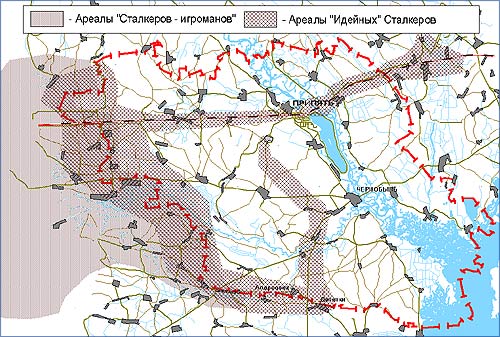
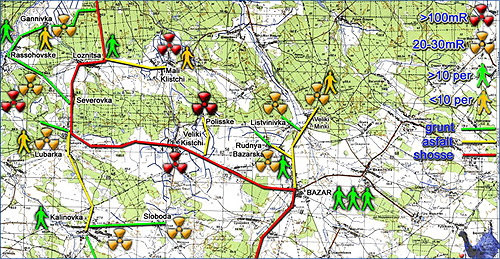
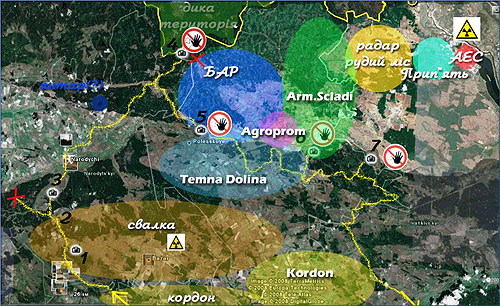
Here are some remarkable schematic maps of penetration Zones based on the analysis of reports and photos by different types of stalkers.

Maps of the stalker routes

Map of the stalker routes

Stalker map of Exclusion Zone

Stalker map of Exclusion Zone

Map by Real Stalker

Map by Real Stalker

On the same site more detailed is added in post Real Chernobyl Stalker reads:

‘.. interest in the Exclusion Zone is increasing for people who are tired of hateful routine and yearning for a temporary retreat….Another reason for the growth of stalkers in the Chernobyl Exclusion Zone is the desire of young people to feel “a real stalker” – to run through the Zone not on the computer screen, but in reality.

stalker

It is worth to note that there are some fundamental differences in people coming to the Exclusion Zone. There is fairly clear distinction of Chernobyl stalkers into two camps – the two categories. Differences between categories are big enough – it shows how the quality of reports prepared, used slang, photos, as well as the appearance of stalkers
First, I would call them – curious gamers. Second – ideological. Regarding these two categories of stalkers it can say the following: The first – young people having the “basic” knowledge of the Exclusion Zone from the computer games, and subsequently from the Internet. Game mania and desire to force sensory understanding of gameplays are the reasons for entry into the Exclusion Zone. Typically, the average age of this category of stalkers is about 20 years, but not older than 22-24 years. Most of these people make just one – two entering into the Zone and by this they calm their ambitions.’

The game referred to is ‘S.T.A.L.K.E.R.: Shadow of Chernobyl’ and its sequels

Image 1

According to a UK Gamespot.com report (August 2010):

‘The computer games company GSC Game World released the original S.T.A.L.K.E.R.: Shadow of Chernobyl in 2007 and has since put out two follow-ups to capitalize on that game's critical success. The first, S.T.A.L.K.E.R.: Clear Sky, arrived in 2008 and operated as a prequel to the events in the original game, while this year's Call of Pripyat served as an extension to the end of Shadow of Chernobyl.

‘Now, GSC Game World is gearing up to deliver a sequel proper to Shadow of Chernobyl, announcing today that S.T.A.L.K.E.R. 2 will arrive in 2012. In announcing the game's development, GSC Game World also noted that the S.T.A.L.K.E.R. franchise has now sold more than 4 million units worldwide.

‘The S.T.A.L.K.E.R. universe takes place in an alternate reality set in the infamous city of Chernobyl, which suffered a nuclear reactor meltdown in 1986. In the game, the town is subjected to a second dose of nuclear fallout, spawning a rash of hideously mutated monsters that now occupy the postapocalyptic town. ‘

CHERNOBYL 3: THE NATURAL HISTORY

CHERNOBYL3891

This book is a seminal work on the natural history of Chernobyl. This review was originally published in an issue of Tree News,  which I was Editor-in-Chief of, in 2006.

Wormwood Forest: A Natural History of Chernobyl by Mary Mycio [Joseph Henry Press h/b £16.99 ISBN 0309094305]

This timely book – we have just passed the twentieth anniversary of the accident at the Chernobyl nuclear plant – is the detailed account of the author’s forays, armed with dosimeters and protective gear, into one of the world’s most radioactive wildernesses.

Here she discovers, to her astonishment, that not only have very few mutated species of animals been found – any that did exist would have been eaten or would have died and decomposed before being able to reproduce – but also that the area has become a burgeoning wildlife sanctuary of radioactive animals.

Plants and trees do mutate, however, and radioactive waste dumps can be identified from the air by the radiomorphism of the trees growing above them. Healthy pines have a single trunk with branches growing from it well above ground level; radiomorphic pines grow a single truck close to the ground but branch into a filigree of multidirectional stems which look like pine bushes and are shorter than the surrounding forests.

The biggest and most dangerous of these radioactive dumps is called the ‘Red Forest’. In 1986, four and a half miles of evergreen woodlands stood directly in the path of the deadliest debris from the explosion and they turned red and died. The trees and one million square metres of topsoil were buried on the spot by the authorities and covered with four feet of sand; years later, young strange-shaped green pines have sprouted but the name has stuck. It is one of the most radioactive outdoor environments on the planet and has become the premier site to study the effect of radioactivity on trees.

According to the author: ‘Radiation resistance among trees varies widely. Evergreens die at lower doses than leafy trees and young trees are more vulnerable than older ones. The growth of spruce and pine, the most sensitive species, gets stunted at absorbed doses of 150 to 250 rads. But it takes 1,000 to 1,500 rads – fatal for most other trees – to slow down an aspen. Birch and alder are somewhere in the middle.’

Incidentally, it is widely believed that Chornobyl (the original Ukrainian word that has been Russianised) means ‘wormwood’, linking the disaster to both the Biblical prophecy of the Wormwood star preceding Armageddon, and to the herb of the same name. Turns out, however, that wormwood is Artemis absinthium whereas chornobyl is Artemissia vulgaris, the common English name for which is ‘mugwort’.

This a genuinely fascinating book which takes you into unreal landscapes and the strange lives of the people who exist there and also seeks to explain, in carefully worded detail, the intricacies of radioactive substances and their effect on human health and the environment. A superb piece of reporting by an American journalist, who still lives in Kiev, that deserves to be widely read.

This review focused on the effect of radiation on trees but there are many other interesting stories to do with the wildlife in the Chernobyl Exclusion Zone.

THE PRZEWALSKI HORSES

image

The Prezwalski’s horse had been native to Asia, primarily China and Mongolia with the last wild horse being spotted in China in 1966.  The horse is named after the Russian geographer and explorer Nikolai Przhevalsky and has never been domesticated, hence it is considered to be the world’s true wild horse. [Text Source: Straight From the Horse’s Heart]

According to a review in Nuclear Engineering International (June 2006)

‘Wormwood Forest describes in detail a highly controversial programme that released an endangered species of horse into the zone. The natural habitat of Przewalski’s horses has been shrinking due to human activity and, by 1960, the species had declined to the point where there were only 59 horses in the world. Successful captive breeding programmes brought the numbers back to over 600 horses by the mid 1980s – enough to consider experimentally releasing some into the wild.

A release programme had been developed by the Askania Nova reserve in south Ukraine, which has the world’s largest collection of Przewalski’s horses, but a suitable place could not be found – until Chernobyl provided the opportunity. Under the Fauna programme, 28 horses from Askania Nova and three from a Kharkiv stud farm were introduced to the zone in 1998 and 1999. Of these, 21 horses survived, and by the end 2003 the population in the zone had grown to 65.

However, it remains to be seen whether this programme has a happy end. Lack of funding for such programmes (one of the common themes in the book) makes it nearly impossible to administer the Fauna programme. By the spring of 2003, there should have been over 90 Przewalski’s horses based on past reproductive rates, but there were only 63. “But the horses aren’t suffering from radiation,” Mycio states on the website that complements Wormwood Forest. “They are being poached – massively, and recently.”

Here is an updated 2008 report on the status of the horses:

Zharkikh T.L., Yasynetska N.I., 2008. Demographic parameters of a Przewalski horse (Equus przewalskii Polj., 1881) population in the exclusive zone of the Chernobyl power plant. Bulletin of Moscow Society of Naturalists. Biological series. Vol. 113, No 5. P. 3–9.

 image

CHERNOBYL 2: THE HUMAN COST

Children of Chernobyl - Oncology department {Source: Belarus Guide)

Really important piece in The Guardian yesterday by their long-term environmental correspondent John Vidal.

Entitled ‘Nuclear’s Green Cheerleaders Forget Chernobyl at our Peril’ it does the valuable service of  trying to pin down the exact human toll of the Chernobyl disaster. The official figures from the UN International Atomic Energy Agency were 50 dead and perhaps 4,000 eventual fatalities.

Vidal begins by recounting his own experiences when, in 2006, he visited the ‘still highly contaminated areas of Ukraine and the Belarus border where much of the radioactive plume from Chernobyl descended.’ Here the picture was grim and the doctors and scientist he spoke to dismissed the UN figures as ‘insulting and grossly simplistic.’

He documents various reports and assessments published since the UN figures; the highest, published in the annals of the New York Academy of Sciences in 2006, puts the death toll at 985,000 people.

He concludes: ‘The fact is we may never know the truth about Chernobyl because the records are lost, thousands of people from 24 countries who cleaned up the site have been dispersed across the vast former Soviet Union, and many people have died. Fukushima is not Chernobyl, but it is potentially worse.’

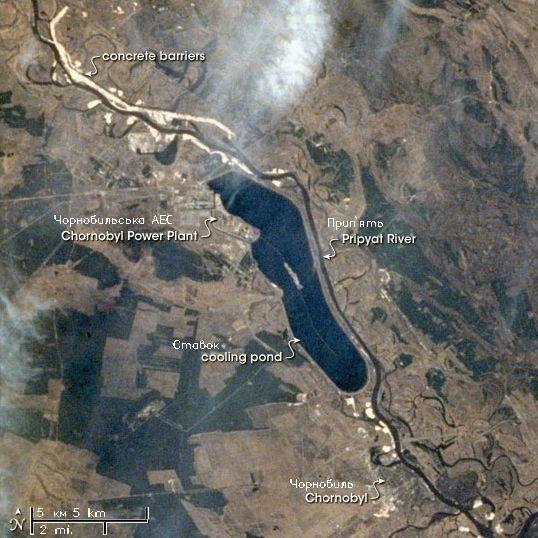
File:ChernobylMIR.jpg
The region around the Chernobyl nuclear power plant, as seen from the Russian space station Mir (27th April 1997)

Another Guardian  writer Craig Bennett tackled the issue from a different perspective with his piece: ‘Fukushima shows us the real cost of nuclear power’ which argues that the economics of nuclear power don’t add up – which is even more reason to invest in renewable energy.'

The tide is turning. It's time to highlight the growing body of evidence showing we can keep the lights on with renewable power if we cut the amount of energy we waste. Experts from the Department of Energy and Climate Change's chief scientific adviser, David MacKay, to the respected European consultancy Ecofys, agree that it is possible to provide the energy we need and reduce carbon emissions without nuclear.

Nuclear power offers no safe solution for waste, economics that don't add up, and dangers of nuclear proliferation. An energy future is possible without these negatives.

Chernobyl safety guardian

Chernobyl tour guide Sergei clutches his faithful Geiger counter... [Source: Virgin Media)

Both Bennett’s and Vidal’s articles followed on from an article in The Guardian on the 21st March by George Monbiot, the veteran green commentator, entitled ‘Why Fukushima made me stop worrying and love nuclear power.’ It begins:

’You will not be surprised to hear that the events in Japan have changed my view of nuclear power. You will be surprised to hear how they have changed it. As a result of the disaster at Fukushima, I am no longer nuclear-neutral. I now support the technology.’

This generated a substantial postbag, leading GM to post an extensive piece on his Guardian blog, entitled ‘The double standards of green anti-nuclear opponents’ which begins:

‘The accusations have been so lurid that I had to read my article again to reassure myself that I hadn't written the things that so many of my correspondents say I wrote. So, before I begin the counter-attack, here's what I didn't say about nuclear power.’

Monbiot, published an earlier piece in The Guardian on 11th July 2006, entitled: ‘Sure, nuclear power is safer than in the past – but we still don’t need it’. It was subtitled: It’s true that another Chernobyl couldn’t happen in a new reactor, but the case against is as strong as ever.’

Monbiot is not the first ‘green’ to argue for nuclear.

SEE PREVIOUS POSTS:

Stewart Brand: Reinventing Environmental Thinking

James Lovelock: Man of the Moment

CHERNOBYL1: 25TH ANNIVERSARY

Saturday, April 02, 2011

ANCIENT ART 4: HERZOG'S CAVE OF FORGOTTEN DREAMS / CAVE ART and PICASSO

image
Back in June 2009, THE GENERALIST published the first of a series of posts on Ancient Art which concluded with the following:

080623_r17477_p465
'A frieze of horses and rhinos near the Chauvet cave’s Megaloceros Gallery, where artists may have gathered to make charcoal for drawing. Chauvet contains the earliest known paintings, from at least thirty-two thousand years ago.'
Read this fantastic New Yorker piece on cave art.
'First Impressions: What does the world’s oldest art say about us?' by Judith Thurman
Turns out that Werner Herzog was equally impressed by the article and this remarkable 3-D movie is the result. Discovered for the first time in 1994, in the cave of Chauvet - Pont D’Arc in southern France, these hundreds of remarkable paintings have been carefully preserved, with access limited to a very small number of scientists. Under strict conditions, Herzog was given permission to film for a limited period, using the minimum of lighting. The special 3D cameras has to be assembled inside the cave itself. Herzog brings his usual high-quality intelligence and film-making acumen to work on these limitations and has created a genuinely profound and moving experience. Truly remarkable.

CAVE PAINTINGS OF THE WORLD


There is a good Wikipedia entry on known cave paintings around the world- in Europe, Africa, Asia, Australia and the Americas.


[Left} Lascaux was discovered on September 12, 1940 by four teenagers, Marcel Ravidat, Jacques Marsal, Georges Agnel, and Simon Coencas, as well as Marcel's dog, Robot.


Altamira was the first cave in which prehistoric cave paintings were discovered. When the discovery was first made public in 1880, it led to a bitter public controversy between experts which continued into the early 20th century, as many of them did not believe prehistoric man had the intellectual capacity to produce any kind of artistic expression. The acknowledgement of the authenticity of the paintings, which finally came in 1902, changed forever the perception of prehistoric human beings.


PICASSO AND CAVE ART


image
This is one  a a series of eleven lithographs entitled Bull, 1945-6 where Picasso deconstructs the academic image of a bull - with its line, shape, shading and form - and with each plate he abstracts it until the final image where it is just line.  Source: The Lighthouse Keeper

According to Paul Bahn in his paper ‘A Lot of Bull? Pablo Picasso and Ice Age Cave Art’:

‘Many claims have been made, and continue to be made, concerning Picasso’s reaction to Ice Age cave art – in particular, it is said that he visited either Altamira or Lascaux and declare that “we have invented nothing” or that “none of us can paint like this”. The paper investigates these claims and finds that they have absolutely no basis in fact. Picasso was minimally influenced by Ice Age art and expressed little interest in it.’

SEE ALSO; ANCIENT ART 2

ANCIENT ART 3: CAVE ART / CHILDHOOD DISCOVERIES

The  cave paintings have fascinated me since I was a kid and that excitement still stays with me. One aspect of the story that I later found particularly intriguing is the fact that three of the earliest and most important discoveries of cave art were made by children.

CAVE PAINTINGS2886
Original copy of the first[and only edition ?]
of ‘Beyond the Bounds of History’
by Henri Brueil [P. R. Gawthorn. London 1949].
 (THE GENERALIST ARCHIVE)
This account comes from the introduction to a book entitled ‘Beyond the Bounds of History’, which contains artist’s impressions of the life of Stone Age man by Henri Brueil, of which more anon


To the children, to the adolescents, I dedicate these. Perhaps, judging by what I have seen, some grown-up people may also take pleasure in them We certainly owe that much to the children.

‘Was it not the little five-year-old girl of Marcelino de Sautuola who, in 1879, whilst her father was digging in the floor of the cave of Altamira (Santander, Spain), was the first to see the great and magnificent frescoes on the roof, greeting them with a cry of  “Bulls! Bulls ! " (Toros ! Toros !) ? Although it is true that she now remembers nothing about it !


‘Was it not the band of lads at Montignac (Dordogne), led by Ravidat and Marsal, who slipped through a narrow shaft into the Hall of the Great Bulls on the 12th September, 1940, and thus were the first to see and understand the incredible frescoes of Lascaux (though their first emotion was fear))?

‘Was it not the three young sons of Count Begouen who, whilst exploring wide dark corridors in 1912-14, had the incomparable luck of finding one after the other the clay bisons of the Tuc d'Audoubert (Ariege) and the neighbouring sanctuary of the Trois Freres, with its horned God looking down on hundred: of admirable engravings ?

‘It is, therefore, to the children and adolescents and those older people who have known how to preserve their freshness of soul and imagination that dedicate these modest efforts. May they inspire some among them to become explorers or prehistorians! ‘

CAVE PAINTINGS3887
So who was Henri Brueil?

Henri Édouard Prosper Breuil (28 February 1877 – 14 August 1961), often referred to as Abbé Breuil, was a French Catholic priest, who spent his life as an archaeologist and paleontologist and was  the great pioneer in the study of cave art. He introduced both Lascaux and Altamira to the general public, travelled widely and made many discoveries. 

His most famous work in ‘Four Hundred Centuries of Cave Art’, published in 1952. He was known as ‘the priest of palaeontology’ and ‘the pope of prehistory’.

SEE ALSO: Interesting essay on Brueil by Graham Johnston on Archaeology Expert
Extensive entry from the International Encyclopaedia of  the Social Sciences (1968)


CAVE PAINTINGS4888
First English Edition published by Hutchinson &
 Co, London. 1955 [THE GENERALIST ARCHIVE]


This is a retelling of the discoveries of Lascaux and Altamira by the children’s historical novelist Hans Baumann. (22nd April 1914 – 7th Nov 1988). 

The author’s profile in the back of the book says:
‘He was struck by the fact that many of the caves had been discovered by youngsters and has the good fortune to have as his guides some of the original discoverers. In Lascaux, Marcel Ravidat and Jacques Marçal told him of the thrill and the dangers of the first discovery. In Trois Frères he was taken to the caves by Count Louis Bégouën, who, as a boy, had been the first to negotiate the difficult entrance. Simon de Altamira, now a man of seventy, was his guide in Altamira.’

SEE ALSO: Hans Baumann Wikipedia entry


CAVE PAINTINGS6890
The story of a young cave boy who dreamed
of becoming a cave painter, written by US
children’s author Justin Denzel
[Lutterworth Press. 1988]
Cover illustration by Mike Wimmer.
[THE GENERALIST ARCHIVE]


Tuesday, March 29, 2011

E. F. SCHUMACHER: SMALL IS BEAUTIFUL

image

image

Source: BetterWorld

"There could be no clearer example of the prevailing dictatorship of economics… That nuclear fission represents an incredible, incomparable, and unique hazard for human life does not enter any calculation and is never mentioned."

To submit to the nuclear lobby, he continues, "is a transgression against life itself, a transgression infinitely more serious than any crime ever perpetrated by man. The idea that a civilisation could sustain itself on the basis of such a transgression is an ethical, spiritual, and metaphysical monstrosity."

- Schumacher on "the so-called peaceful use of atomic energy"

[For an interesting contrary view see: Small is Beautiful, even for Nuclear Fission Reactors By Rod Adams [‘Atomic Insights’ blog]

It was a shock to see the name E.F. Schumacher in The Observer on Sunday. He was the subject of a lengthy profile by Robert McCrum entitled ‘EF Schumacher: Cameron’s choice’

Back in the 1970s Schumacher was one of the thinkers of which we all took note, particularly his classic work ‘Small is Beautiful’

The key hook of McCrum’s piece, which does a good basic job of introducing Schumacher, is to highlight the claimed influence that Schumacher’s ideas have had on David Cameron personally and on the concept of the Big Society. The Generalist remains sceptical on this point. McCrum writes;

‘Long before our current crisis, Schumacher and his ideas were attracting attention here in the UK. Several of the better themes of David Cameron's widely disputed "big society" are indistinguishable in their ambition from parts of Small is Beautiful. The prime minister, indeed, has long been interested in Schumacher's ideas. Almost immediately after becoming leader of the Conservative party, Cameron addressed the Soil Association, engaging with key aspects of the Small Is Beautiful message. Schumacher always said that his arm would wither if he voted Conservative, but he turns out to be a natural godfather for the coalition.’

image

Sources:

Wikipedia resources:

E. F. Schumacher

Small Is Beautiful: Economics as if People Mattered

A Guide for the Perplexed

Small is Beautiful: An Introduction to E.F. Schumacher by Noah Enelow. [Source: Field Guide to the US Economy/5th Feb 2004]

Multiple translations of Schumacher’s essay Buddhist Economics

Organisations with direct links to SchumacherE F Schumacher, copyright Peter Barry Chowka

Practical Action, formerly called the Intermediate Technology Development Group (ITDG), was set up by Schumacher in 1965 to fill what he called the 'technology gap' in the developing world.

Schumacher UK promotes sustainable systems for social, economic and environmental development through the Schumacher Lectures, the Schumacher Briefings, the Schumacher Awards and the Schumacher Institute.

The Schumacher College in the UK provides individuals and groups from across the world with the opportunity to learn on numerous levels about subjects relating to environmental and social sustainability.

The Schumacher Society USA is an educational non-profit organization founded in 1980. The Society has ‘transitioned’ into the New Economics Institute which  works in close partnership with the New Economics Foundation in London

The Soil Association UK exists to research, develop and promote sustainable relationships between the soil, plants, animals, people and the biosphere, in order to produce healthy food and other products while protecting and enhancing the environment. Schumacher became President of the Soil Association in 1970.

Source: EF Schumacher

Monday, March 28, 2011

BEATNIK NEWS: ON THE ROAD MOVIE

image

On The Road is an upcoming adventure drama movie directed by Walter Salles based on a script by Jose Rivera. It's a movie adaptation of Jack Kerouac's novel of the same name. The film is starring Garrett Hedlund, Sam Riley, Kristen Stewart, Kirsten Dunst, Amy Adams, and Viggo Mortensen. There's no official release date yet.

Source: http://on-the-road.film-trailer.com/

SEE ALSO: The 25 Best Road Movies From Around the World by Will Aitken

SEE PREVIOUS POSTS:

‘ON THE ROAD’ IS 50: The Scroll

‘ON THE ROAD’ IS 50: Critics, Movie, Lost Play, Estate

‘ON THE ROAD’ IS 50: A Digital Moment

Sunday, March 27, 2011

GERMANY: NUCLEAR PROTESTS

Headstrong: Protesters want nuclear energy gone

image

image

The signs read “Switch Off”

Around 210,000 demonstrators in Cologne, Berlin, Munich and Hamburg vented their anger at the government's nuclear policy on Saturday, supported by Germany's umbrella union body, the DGB, as well as politicians from the opposition Greens and Social Democrats.

Alarmed by the nuclear crisis in Japan, environmental and religious groups as well as unions organized the demonstrations, which kicked off in Cologne's city center, where nearly 40,000 people turned up to support the cause.

Around 90,000 people took to the streets in Berlin while in Hamburg, organizers counted around 50,000 demonstrators and in Munich the figure was estimated at 30,000.

Organizers said they were the biggest anti-nuclear protests Germany has ever seen.

Source: Deutsche Welle/26th March 2011

German nuclear power plants and their remaining lifespans German nuclear power plants and their remaining lifespans

German Chancellor Angela Merkel said that seven reactors that went into operation before 1980 would be offline for three months while Europe's biggest economy reconsiders its plans to extend the life of its atomic power plants. A previous government decided a decade ago to shut all 17 German nuclear reactors by 2021, but Merkel's administration last year moved to extend their lives by an average 12 years.

Source: Topnews360