Cover Art by Wilson McLean
THE GENERALIST is proud and pleased to reprint, with the permission of the author Mick Brown, a remarkable story published in The Telegraph magazine in 1998. It begins:
'In February of this year, I received a
curious and completely unexpected invitation... Would I like to interview
Carlos Castaneda?
'To the uninitiated, the invitation will mean
nothing.
But those who came of age in the Sixties counter-
culture will
recognise that it was like being invited to
peruse the Cretan Minotaur.'
*
(Left): Cover art/Roger Hane
Carlos Castaneda stands alongside Timothy Leary as one of the great avatars — and one of the great enigmas — of the psychedelic age. In 1968, Castaneda published The Teachings of Don Juan, describing his apprenticeship in the deserts of Mexico to an Indian shaman, and his induction through mind-altering substances into ‘the Yaqui way of knowledge'.
Like Herman Hesse's Steppenwolf and Aldous Huxley's The
Doors of Perception, The Teachings of
Don Juan, and its sequels, became essential reading for a legion of seekers
after truth — guide-books into a
fantastic and exotic world beyond the dull grind of materialism. And long after
the first generation of fans had moved on to more pragmatic concerns —
mortgages, families, tax returns — the books continued to sell.
Since 1968, the
works of Carlos Castaneda have sold more than eight million copies in 17
different languages, totally unhindered by the fierce debate about whether don
Juan really existed or was simply a figure of Castaneda's imagination. No less
a mystery was Castaneda himself. 'The art of the hunter,' don Juan had taught, ‘is
to become inaccessible,’ and it was a maxim which Castaneda had observed with
an almost religious dedication for 30 years, forsaking public appearances,
refusing almost all interviews, leading the life of a recluse.
But now, I was told, there had been a mysterious
and dramatic change of heart. After years of inaccessibility, Castaneda had
emerged into the public eye, bringing with him for the first time what he
claimed was the most important facet of don Juan's teachings — a system of
physical movements known as 'magical passes'. He was prepared to lift the
shroud of secrecy and talk to the world.
A date was provisionally set for me to meet him in
Los Angeles. I was told that he would countenance no photographs, no
tape-recording equipment. I would be allowed only to take notes, as he had
taken notes during his years of tutelage at the feet of don Juan. ‘A recording,’
Castaneda had told the Los Angeles Times
in 1995 in a rare conversation, ‘is a way of fixing you in time. The only thing
a sorcerer will not do is be stagnant. The stagnant world, the stagnant
picture, those are the antitheses of the sorcerer.'
Then the date was changed. And changed again.
Castaneda, I was told, was ‘on retreat’ in the Mexican desert. When — if — he
returned, I would be notified. In late March, I left for California on other
business. But the call never came. There was a simple reason. At the time that
I was in sitting in a hotel room in Los Angeles, Castaneda was not in Mexico at
all. He was three miles away from me in his Westwood home, dying of liver
cancer.
*
Carlos Castaneda died, at the age of 72, on April
27 [1998]. But, peculiarly, it was to be another two months before the news of
his death became public. There was no announcement, no press report, no funeral
or service of any kind. According to the Culver City mortuary that handled his
remains, his body was cremated at once, his ashes spirited away to the Mexican
desert.
In death, as in life, Castaneda remained
inscrutable. When, eventually, the news of his death leaked out to the press,
two British newspapers ran obituaries, alongside photographs of a man who was
not Carlos Castaneda. His friends drew a veil of silence over the death,
refusing to comment. In a statement to the press, his agents, Toltec Artists,
would say only that, ‘In the tradition of the shamans of his lineage, Carlos
Castaneda left this world in full awareness.’
Castaneda, this suggested, was a spiritual teacher
of the highest order, who had left behind a body of work to enrich mankind. In
reality, he left behind a more tangled legacy. Rather than dying ‘the
immaculate death’ of the sorcerer, it is suggested that the sorcerer's
apprentice actually died a frail, paranoid and angry old man, lashing out at
the world with lawsuits — including one against his 73-year-old former wife,
Margaret — and conjuring up the spirit of don Juan in a last, desperate attempt
to exploit it for all it was worth.
*
A key aspect of the teachings of don Juan, as
recounted by Carlos Castaneda, was the necessity of the ‘self to die. It is
imperative to leave aside what [don Juan] called “personal history”,’ Castaneda
told the Chilean magazine Uno Mismo
in 1997. ‘To get away from “me” is something extremely annoying and difficult.
What the shamans like don Juan seek is a state of fluidity where the personal “me”
does not count.’ For Castaneda, ‘the personal me’ was a subject of constant
fluctuation and revision.
By his own account, Castaneda was born on December
25, 1935, in Sao Paolo, Brazil. His mother died when he was seven and he was
raised by his father, a professor of literature whom Castaneda supposedly
regarded with a mixture of fondness and contempt — a shadow of the man he would
subsequently meet in don Juan. ‘I am my father,’ Castaneda told Time magazine in his first — and last
—major interview, in 1973. ‘Before I met don Juan I would spend years
sharpening my pencils and then getting a headache every time I sat down to
write. Don Juan taught me that's stupid. If you want to do something, do it
impeccably, and that's all that matters.’ He claimed to have been educated in
Buenos Aires, and sent to America in 1951.
He travelled to Milan, where he studied sculpture,
before returning to America and enrolling at UCLA to study anthropology.
In fact, American immigration records indicate
that Castaneda was born not in 1935, but in 1925 — not in Brazil, but in
Cajamarca, Peru. His father was not a university professor but a goldsmith. His
mother died when he was 24. And while it was true that he had studied painting
and sculpture, this was not in Milan but at the National Fine Art school of
Peru. Arriving in America in 1951, he studied creative writing at Los Angeles
City College before enrolling on an anthropology course at UCLA in 1959.
The following year, he travelled to the
Mexico-Arizona desert, intending to study the medicinal use of certain plants
among local Indians. At a bus station in the town of Nogales in Arizona, he
would later write, he met the man he called don Juan. For the psychedelic
generation it was the equivalent of Stanley stumbling into a jungle clearing
and discovering Livingstone, the young John Lennon bumping into Paul McCartney
at a church fete in Woolton.
According to Castaneda, don Juan Matus was a Yaqui
Indian nagual, or leader of a party
of sorcerers — the last in a line stretching back to the times of the Toltecs,
the pre-Hispanic Indians who inhabited the central and northern regions of
Mexico a thousand years ago. Under the guidance of the Yaqui sage, Castaneda
was introduced to the psychotropic substances of peyote, jimson weed and 'the
little smoke', a preparation made from Psilocybe mushrooms that had been dried
and aged for a year. Under the influence of these drugs the bemused
anthropologist underwent a series of bizarre encounters, with columns of singing
light, a bilingual coyote and a 100-foot tall gnat — ‘the guardian of the other
world’ — manifestations of the ‘powers’', or impersonal forces, that a man of
knowledge must learn to use.
The Teachings of Don Juan: A Yaqui Way of
Knowledge was first published in 1968 as an anthropological thesis by the
University of California Press. A year later — repackaged in a psychedelic
book-jacket — it was published by a mainstream company. It became an immediate
counter-culture hit, prompting an exodus of would-be apprentice sorcerers to
the deserts of Mexico in search of Don Juan — or at least good drugs.
A
Separate Reality, published in 1971, was more of the
same — giant gnat circles around Castaneda, and he sees don Juan's face
transformed into a ball of glowing light — as the old Indian inducted Castaneda
into the so-called second cycle of apprenticeship. These experiences were not
just psychedelic magical mystery tours. The use of drugs, Castaneda explained,
was don Juan's way of leading his pupil to ‘see’ the world outside the cultural
and linguistic constraints of Western rationalism, unencumbered by conditioned
pre-conceptions or the taint of personal history.
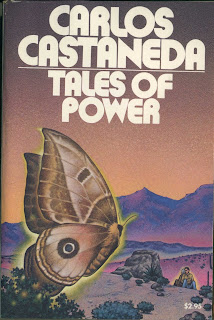
(Left): Covers by Roger Hane
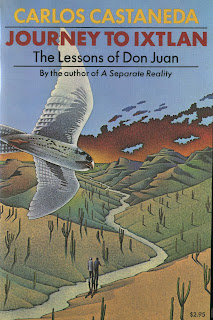 Drugs were not in themselves the destination, he
explained in Journey to Ixtlan, which
was published in 1973; they were merely one route to the destination, to be
discarded once this fundamental shift in perception had been achieved. Journey to Ixtlan won Castaneda his PhD
from UCLA. It also made him a millionaire.
Drugs were not in themselves the destination, he
explained in Journey to Ixtlan, which
was published in 1973; they were merely one route to the destination, to be
discarded once this fundamental shift in perception had been achieved. Journey to Ixtlan won Castaneda his PhD
from UCLA. It also made him a millionaire.
By now, doubts about the authenticity of
Castaneda's accounts had begun to multiply. It was one thing for him to refuse
to divulge the identity and whereabouts of the Yaqui sage (don Juan, he always
made clear, was a pseudonym which he used to protect his teacher's privacy),
but quite another for him to refuse to let his field notes be examined by other
anthropologists. But whatever the doubts about the books' provenance, even the
most sceptical critics agreed that they were powerful parables about the search
for personal enlightenment, ‘remarkable works of art’ as the author Joyce Carol
Oates described them.
 In 1976, a teacher of psychology named Richard de
Mille (the son of Cecil B.) published the first comprehensive critique of the don
Juan books, Castaneda's Journey: The
Power and the Allegory, detailing myriad inconsistencies in the chronology
of Castaneda's accounts and the character of don Juan. Don Juan, de Mille
concluded, was a work of fiction, but Castaneda ‘wasn't a common con-man, he
lied to bring us the truth... This is a sham-man bearing gifts.’ But de Mille's
book vanished without trace while Castaneda's continued to sell.
In 1976, a teacher of psychology named Richard de
Mille (the son of Cecil B.) published the first comprehensive critique of the don
Juan books, Castaneda's Journey: The
Power and the Allegory, detailing myriad inconsistencies in the chronology
of Castaneda's accounts and the character of don Juan. Don Juan, de Mille
concluded, was a work of fiction, but Castaneda ‘wasn't a common con-man, he
lied to bring us the truth... This is a sham-man bearing gifts.’ But de Mille's
book vanished without trace while Castaneda's continued to sell.
(Left): Cover by Peter Schaumann
An anthropologist named Jay Courtney Fikes
provided yet another twist on the don Juan stories in his book, Carlos Castaneda, Academic Opportunism and
the Psychedelic Sixties, published in 1993. In this, Fikes suggested that
rather than being one individual, don Juan was actually an amalgam of two or
possibly three authentic Indian shamans, including a well-respected Mazatec
healer called Maria Sabina, who had also collaborated with the anthropologist
Gordon Wasson on his study of psychedelic mushrooms in the Fifties.
‘I would see Castaneda as an anthropologist-lite,
as it were, or a travel writer,’ Fikes now says. ‘There is a residue of
authenticity there. I think he did make trips to Mexico, and he had some interesting
experiences, and he then fictionalised them and called them non-fiction.
‘I don't think he set out in 1960 to create a
massive hoax. The first book took off, it was bestseller: there were very few
people who publicly expressed scepticism at that point, so he just kept going.’
Castaneda's response to the criticisms was always
the same. He was writing about states of mind and perception outside the normal
conventions of academia, so the normal terms of reference did not apply.
Sorcerers, he said, have only one point of reference: ‘infinity’. He would
continue repeating the same mantra to the very end. ‘I invented nothing.’
*
Castaneda maintained that don Juan ‘left the world’
in 1973, dying ‘the immaculate death’ of the warrior. His departure did nothing
to stem the flow of Castaneda hooks. Throughout the Seventies and Eighties, a
stream of books appeared expounding further on don Juan's teachings. Diligent
readers noted that the anthropological references seemed to grow fewer and that
the books increasingly bore the traces of other influences: the study of
phenomenology; Eastern mysticism; existentialism.
Something weird started happening to don Juan's
voice. One minute he was intoning sonorous desert utterances, the next joshing
in American slang, and the next assuming the stilted, jargon-heavy
circumlocutions of a professor of philosophy. (In Castaneda's last book, The Active Side of Infinity, which is
due to be published next year, don Juan is quoted as saying, ‘The effect of the
force that is descending on you, which is disintegrating the foreign
installation, is that it pulls sorcerers out of their syntax' — a mouthful for
a professor of linguistics, let alone a Yaqui Indian.)
Critics talked of ‘the grim sound of barrels being
scraped’, and noted an increasingly messianic tone in Castaneda's pronouncements.
With don Juan having ‘left the world’, Castaneda himself had become the heir to
the lineage, the nagual. No longer a
mere disciple, he had become the prophet, and as befits a prophet he began to
gather around him a coterie of disciples. Foremost among these were three women
— Carol Tiggs, Florinda Donner-Grau and Taisha Abelar — who, according to
Castaneda, had also been students of don Juan. Abelar and Donner-Grau, like
Castaneda a former UCLA anthropology student, even wrote their own books
recounting their experiences with Don Juan.
‘The four disciples of don Juan’, as Castaneda
styled them, lived in close, but apparently celibate, proximity to each other.
Castaneda once said that he eschewed relationships of ‘a sexual order’, for
shamanic reasons. More prosaically, rumours suggested that Castaneda was
incapacitated by ‘a groin injury’, said to have been sustained when he was
young.
For years, the group remained largely reclusive,
apparently following don Juan's dictum that the sorcerer's way was to ‘touch
the world sparingly’. But in 1993, Castaneda suddenly emerged into the public
eye, propagating what he claimed to be the culmination of the sorcerer's arts —
a system of bodily movements which he called ‘magical passes’. These movements,
Castaneda claimed, had been taught to initiates over 27 generations in
conditions of the utmost secrecy, and passed on by don Juan to Castaneda and
his three other disciples before his death.
Through these ‘magical passes’, Castaneda claimed,
the Toltec sorcerers had attained an increased level of awareness which allowed
them to perform ‘indescribable feats of perception’ and experience ‘unequalled
states of physical prowess and well-being’. The 'magical passes' even had a
brand name — ‘Carlos Castaneda's Tensegrity’ (an architectural term meaning a
combination of tension and integrity) — and an organisation called Cleargreen,
set up by Castaneda to promote seminars and workshops.
Castaneda himself would appear at these seminars,
alongside his three women companions, talking about his experiences with don Juan, before introducing a team of demonstrators, dressed in black work-out
uniforms and known as ‘the chacmools’, to demonstrate the movements.
Even the most credulous students of his writings
were puzzled. In all of the don Juan books there had been no mention of
Tensegrity or ‘magical passes’. If these movements were so important why had
Castaneda never mentioned them before? And why was he breaking the habit of a
lifetime by appearing in public to talk about them?
Castaneda's explanation was typically
mind-boggling. It was true that don Juan had always maintained that the ‘magical
passes’ should be kept secret, but an extraordinary event had dictated they
should now be made public. While following don Juan's techniques in mastering ‘the
art of dreaming’, Carol Tiggs had apparently ‘disappeared into a dream’ in a
hotel room in Mexico City sometime in the Seventies. She had vanished,
Castaneda said, in order to act as a beacon from the other side, guiding
initiates through ‘the dark sea of awareness’. In 1985, however, Tiggs made a
surprising reappearance in a California bookshop where Castaneda was giving a
talk. Her reappearance had convinced Castaneda that the ‘message of freedom’
enshrined in the ‘magical passes’ should now be passed on to the world.
More puzzling still was the fact that there is no
tradition of such bodily movements among pre-Hispanic Indians and that Castaneda's
‘magical passes’ bore a suspiciously close resemblance to such Asiatic
disciplines as kung fu and t'ai chi.
In fact, it seemed that for inspiration Castaneda
had travelled no further than the Los Angeles suburb of Santa Monica, to the
classes of a kung fu teacher and ‘energy master’ named Howard Lee. Lee confirms
that Castaneda studied with him between 1974 and 1989. ‘I didn't even know who
he was for many years,’ Lee says. Castaneda subsequently provided an
endorsement for Lee's brochure, describing him as ‘a most respected and admired
practitioner of the art of dealing with energy’, but he never credited Lee with
being the inspiration behind Tensegrity.
There were allegations that Castaneda paid a
substantial sum of money ‘and the phallus of a puma’ in order to deter Lee from
taking legal action. Lee denies this (‘A what
of a puma?’) and says he has never seen the ‘magical passes’ in action. ‘Some
people have said they're similar to what I teach, but I don't know. I’ve never
seen them and I'm not interested.’
Whatever their origins, the courses in Tensegrity
proved extremely profitable. To a generation who had grown up on the books of Don
Juan, the chance to meet and shake hands with their reclusive author was
irresistible. Workshops and seminars, costing from $200 to $1,000, attracted
hundreds of participants, stimulating a brisk business in Tensegrity T-shirts (‘The
magic is in the movement’) and videos, on sale for $29.95.
In its marketing techniques, its promises of
well-being, its pro-motion of Castaneda as the guru, sceptics could see in
Tensegrity the seeds of a New Age religion. ‘Castaneda had built himself up as
a prophet through the don Juan books,’ says Jay Fikes. ‘The bible, so to speak,
was written; but there was no ritual, so it was necessary to invent one.’
And like every religion, it was suggested, this
one had a bottom line. ‘Another sorcerer once remarked that if don Juan wanted
to demonstrate his power as a sorcerer, he would do some energetic manoeuvre
that might impress you,’ says one insider. ‘But if Carlos Castaneda wanted to
demonstrate his power, he would show you the size of his bank balance.
‘That's using the understanding that money is just
another type of energy. But certainly Castaneda had power; he had the power to
create an enormous amount of energy in the form of money.’
*
Whether Castaneda's books were wholly true, partly
true, or wholly fiction, even his sternest critics acknowledged that their
success opened the door to a tradition of authentic Indian shamanic teachings
which had hitherto been unavailable to the world at large. In the years
following the publication of the don Juan books, a number of teachers emerged
in America, claiming to be in the same Toltec tradition as don Juan, even to
have been taught personally by him or his contemporaries.
The Toltec tradition has even penetrated Britain.
The Sacred Trust, an educational organisation based in Bath and dedicated to ‘the
preservation of indigenous and shamanic traditions’, offers workshops by such
visiting Toltec teachers as Victor Sanchez and Ken Eagle Feather on such themes
as ‘The Double Nature of the Luminous Being’ and ‘The Transformation of the
Other Self’. Among the most prominent of these teachers is an American, Merilyn
Tunneshende — ‘The Nagual Woman'’ — who says that she met the man Castaneda had
called don Juan, on a railway station in Yuma, Arizona, near the border with
Mexico, in 1978, five years after Castaneda claimed he had ‘left the world’.
According to Tunneshende, don Juan was a Yuma, not a Yaqui Indian. She says she
studied with him from 1978 until his death in 1991. At don Juan's instigation,
she met Castaneda in Los Angeles in 1979, remaining in intermittent contact
with him until his death.
Tunneshende became the most vocal critic of Carlos
Castaneda's Tensegrity, writing a series of articles in the American magazine Magical Blend — a forum for such matters
— alleging that Castaneda had actually been expelled from the sorcerer's circle
in 1980. ‘Carlos was a very insecure man in a lot of ways.’ Tunneshende now
says. ‘With Tensegrity, he never felt as though he could reveal at any point
that this was something he'd developed himself. It was as if he needed the name
of don Juan to lend whatever he was doing some authority.’
According to Michael Peter Langevin, the publisher
of Magical Blend, Castaneda's lawyers
attempted to block publication of Tunneshende's criticisms — leading to the
bemusing spectacle of rival sorcerers claiming to be the authentic students of
a man who many people believed had never existed in the first place.
Castaneda, according to one observer, had begun to
behave ‘like the Toltec pope’. In 1995 he filed suit against another Toltec
teacher — and an old friend — Victor Sanchez, claiming that the jacket of
Sanchez's book, The Teachings of Don
Carlos, infringed Castaneda's copyright. And in 1997 he launched a lawsuit
against his ex-wife, Margaret Runyon Castaneda, over the publication of her
book, A Magical Journey with Carlos
Castaneda.
In his determination to obliterate any traces of
personal biography, Castaneda had never made any reference to a wife. According
to Margaret, however, she and Castaneda were married in Tijuana in 1960, and
while they lived together for only six months, their divorce did not become
absolute until 1973. Furthermore, she claims, Castaneda insisted that she sign
documents with the California Department of Public Health making him the legal
father of her son, Carlton Jeremy, or CJ, by another relationship.
The book is a gossipy and affectionate account of
her life with a man she describes as ‘looking like a Cuban bellhop’. (Castaneda
never looked the part of the New Age mystic — 5ft 5in tall, he favoured neat
haircuts and three-button suits.) It casts an interesting light on the possible
origins of the don Juan books. Long before encountering don Juan, she suggests,
Castaneda had read extensively on the use of psychotropic drugs among Indians,
eastern mysticism, and the literature of Aldous Huxley. She recounts a
Thanksgiving dinner with friends in 1959 — a year before Castaneda's supposed
meeting with don Juan — when the conversation turned to how the great religious
scriptures were never written by the teachers themselves but by their
disciples. ‘It seemed to make a big impression on him,’ Margaret Castaneda
writes.
Which is not to say that don Juan did not exist.
Margaret confirms that her husband made frequent field trips to Mexico in the
time he was supposedly apprenticed to the Yaqui sage. But by and large,
Castaneda seems to have been as much a mystery to his wife as he was to
everyone else.
One of his more marked idiosyncracies, she writes,
was to suggest that he had a double. She tells the story of meeting him in New
York, having not seen him for some years, having dinner and passing the night
in a hotel room, conversing about CJ. A few months later, she writes, Castaneda
denied having been with her at all.
Margaret's conviction that her former husband
continued to be ‘part of me. There's no separation. He still feels that’, was
brought up short soon after the book's publication in America when Castaneda
filed the lawsuit against her and her publisher, Millenia Press, claiming
damage to reputation and infringement of privacy, and seeking $100,000 punitive
damages and a ban on the distribution of the book.
‘It was the behaviour of an embittered old man,’
says David Christie, who owns Millenia Press. The lawsuit was subsequently
dropped after Castaneda’s death, but Christie is pressing ahead with the
publication of his 300-page legal defence against the suit under the title David vs New Age Goliath.
*
For Castaneda, there was a tragic irony in his
emergence into the public spotlight. For by 1996, at the time when he was
promoting courses promising ‘unequalled states of physical prowess and
well-being’, his own health was said to be in a state of steady decline.
Castaneda's lawyer, Deborah Drooz, maintains that the author was ill for ‘some
10 to 12 months’ before his death in April 1998. Other sources close to Castaneda,
however, claim that he was aware that he had cancer at least two years before
he died.
In February 1997, Castaneda made his last
appearance at a Tensegrity seminar, in Long Beach, California. A spokesman for
his agents, Toltec Artists, says Castaneda ‘felt that the seminars were taking
their own course and he did not need to be present. It did not mean he couldn't
be present. He was behind each and every seminar.’ But other sources say that
Castaneda had become too ill to attend. ‘He was taking medication, losing
weight,’ said one. ‘People were becoming suspicious. If this stuff is supposed
to lead to health and well-being, why doesn't he look so good?’
Sometimes
Castaneda would be seen at his favourite restaurant near his home. But his
direct communication with anyone outside his immediate circle began to dry up. ‘For
the last 18 months he was all but unavailable to anyone,’ says Michael Peter
Langevin. ‘It was the people around him that seemed to do everything and
control everything.’
Castaneda's condition, however, did nothing to
hamper the work of his organisation, Cleargreen. The seminars continued without
him, and with none of the paying participants any the wiser about his
deteriorating health. And work proceeded on the publication of a new book, Magical Passes, describing the
Tensegrity philosophy and movements. The contract with HarperCollins for the UK
rights was signed by Castaneda himself in July 1997. The publisher was given a
verbal agreement by Castaneda's agents that they would do ‘everything in their
power’ to ensure that, for the first time in years, he would collaborate on
publicity. According to a source at HarperCollins, this assurance was ‘a major
selling factor’ in contractual negotiations. At no time was HarperCollins told
of Castaneda's declining health. By the time I was offered the opportunity to
interview him in February, he was already dying.
*
Shortly before Castaneda's death, his agent
delivered to his publisher the manuscript of his last book, The Active Side of Infinity. Read in the
light of his death, the book has a distinctly valedictory air. Reapprais- ing his
encounters with don Juan, Castaneda reiterates that ‘the total goal’ of
shamanic knowledge is preparation for facing the ‘definitive journey - the
journey that every human being has to take at the end of his life’ to the
region that shamans called ‘the active side of infinity’. "We are beings
on our way to dying,” [don Juan] said. “We are not immortal, but we behave as
if we were. This is the flaw that brings us down as individuals and will bring
us down as a species someday.”
The
Active Side of Infinity carries more than a whiff of
paranoia, not least in its description of a predatory universe populated by
shadowy entities called ‘the flyers’, preying on man's ‘glowing coat of
awareness’. Only by practising ‘magical passes’, Castaneda suggests, could
these dark forces be repelled. Students of the Toltec shamanic tradition have
pointed out this apocalyptic view is somewhat at odds with the customary
teachings about cultivating harmony with the ‘unseen energies’ of the world.
But it is, perhaps, consistent with the state of mind of a man dying of cancer.
It has been alleged that Castaneda was too ill to
write the book alone, and that it must have been largely written by associates.
Toltec Artists say this allegation is ‘absurd’, and that both Magical Passes and The Active Side of Infinity ‘were specifically and only written by
Carlos Castaneda’.
According to Castaneda, the enlightened sorcerer -
the nagual -does not die a normal
death but is consumed by ‘the fire from within’ in a sort of spontaneous
combustion, gathering his mortal energy and carrying the body into the next
realm.
In The
Active Side of Infinity, he describes don Juan's departure from the world
in purple prose: ‘I saw then how don Juan Matus, the nagual, led the 15 other seers who were his companions... one by
one to disappear in the haze of that mesa, towards the north. I saw how every
one of them turned into a blob of luminosity, and together they ascended and
floated above the mesa, like phantom lights in the sky. They circled above the
mountain once, as don Juan had said they would do; their last survey, the one
for their eyes only; their last look at this marvellous earth. And then they
vanished.’ This, says Castaneda, is how don Juan left the world; and - the
implication is clear - as a nagual
himself, this is how Carlos Castaneda would leave the world, too.
Merilyn Tunneshende has another version of the
death of the man she knew as don Juan. She says he died in 1994 at the age of
101, walking from his home to a mesquite tree where he liked to sit. ‘His death
was immaculate. He literally walked out of his body.’
He did not, however, take his body with him, she
says. And nor, for that matter, did Castaneda. ‘Carlos was preaching [to his
followers] that they were going to self-cremate,’ says Tunneshende, ‘that at
the moment of death their energy was going to ignite itself and they were going
to disappear from the world completely, taking their physical bodies with them.
But you cannot defeat death. The body belongs to the earth.’
*
There are any number of theories about exactly why
it took two months to announce Castaneda's death. Cynics point to the
unfortunate coincidence of his death with the publication of Magical Passes: it is hardly an
advertisement for a book promoting a system fostering ‘health, vitality, youth
and a general sense of well-being’ for its author to die of liver cancer.
However, Deborah Drooz says there was never any intention that his death should
be made public at all. ‘Dr Castaneda spent his lifetime avoiding press
attention and keeping the details of his personal life extremely private. He
wanted to be known only through his work.’
Castaneda, she says, was ‘lucid until the very
end. If he had wanted a press release to be issued, he would have directed it,
but he didn't. Those of us who were his friends and his advisers didn't feel it
appropriate to take it upon ourselves.’ Had it not been for the matter of
Castaneda's will, it is possible that his death would have gone unremarked for
years.
The news leaked out when Margaret Runyon
Castaneda's son, CJ, who now goes by the name of Adrian Vashon, received a
court letter indicating he was mentioned in Castaneda's will. According to
Drooz, Castaneda asserted ‘time and time again’ that Vashon was not his son.
Drooz says that Vashon is not named as a beneficiary. He is now contesting the
will, and it is likely to be some months before the matter is resolved.
Castaneda's estate is believed to be worth some $20 million.
Cleargreen would make no comment when I contacted
them to talk about the author's life and death. Florinda Donner-Grau, Carol
Tiggs and Taisha Abelar, I was told, were ‘unavailable’. But the courses in
Tensegrity go on. (This weekend in Ontario, California: ‘The Wheel of Time’.
Cost: $600.) More books are planned, along with an anthology of the aphorisms
of don Juan. The organisation made its first, and to date only, statement about
Castaneda's death on June 22, in a notice posted on their Internet website.
This stated that he had ‘left the world’ in the same way as don Juan, ‘with
full awareness’. ‘The cognition of our everyday life,’ the statement went on, ‘does
not provide for a description of a phenomenon such as this. So in keeping with
the terms of legalities and record keeping that the world of everyday life
requires, Carlos Castaneda was declared to have died’
It is a statement ripe with ambiguity,
acknowledging the legal fact of Castaneda's death, yet leaving open the
tantalising suggestion, for those inclined to believe it (‘a phenomenon such as
this...’) that in his final moments Castaneda had somehow achieved the nagual's ultimate accomplishment of
burning in ‘the fire from within’.
So Carlos Castaneda is dead, but then again
perhaps he's not really dead at all. Already the Internet is buzzing with
accounts from people whom he has supposedly visited in their dreams. It will
not be long before psychics in South Carolina and Virginia begin ‘channelling’
communications with Castaneda from the other side; or, perhaps, before another
young anthropology student walks out of the Mexican desert, bringing with him
the teachings of a sage who looks like a Cuban bellhop: a sham-man's way of knowledge.
*
THE GENERALIST ARCHIVE
Time magazine/5th March 1973
Cover art/Stan Zagorski
The magazine spared no effort in trying to find out the truth of the books and the identity and real life story of Carlos Castaneda himself. The lead investigative journalist Sandra Burton met and interviewed him at UCLA's anthropology department, over dinner at a Japanese restaurant and at a "power spot" in the rugged canyons north of Los Angeles. A team of others in several countries dug into immigration papers and archives and spoke to friends and colleagues. The story itself, compiled from all this evidence was written by Robert Hughes (who I take to be the same RH who became the magazine's art critic and wrote 'The Shock of The New) who had interviewed Castaneda himself two years before. Hughes writes:
'Unhappily for anyone hot for certainties about Carlos Castaneda’s life, Don Juan’s apprentice has taken the lesson very much to heart. After The Teachings became an underground bestseller, it was widely supposed that its author was El Freako the Acid Academic, all buckskin fringe and pinball eye, his brain a charred labyrinth lit by mysterious alkaloids, tripping through the desert with a crow on his hat. But castaneda means chestnut grove, and the man looks a bit like a chestnut: a stocky, affable Latin American, 5 ft. 5 in., 150 Ibs. and apparently bursting with vitamins. The dark curly hair is clipped short, and the eyes glisten with moist alertness. In dress, Castaneda is conservative to the point of anonymity, decking himself either in dark business suits or in Lee Trevino-type sports shirts. His plumage is words, which pour from him in a ceaseless, self-mocking and mesmeric flow. “Oh, I am a bull-shitter!” he cackles, spreading his stubby, calloused hands. “Oh, how I love to throw the bull around!”.
The article then gives almost two columns of text to the biographical account that Castaneda had given to Sandra Burton. Hughes then writes:
'Thus Castaneda’s own biography. It creates an elegant consistency — the spirited young man moving from his academic background in an exhausted, provincial European culture toward revitalization by the shaman; the gesture of abandoning the past to disentangle himself from crippling memories. Unfortunately, it is largely untrue.'
So the first doubts were raised but Time stopped short of full-blown accusations. The piece says: 'Whether Carlos Castaneda is, as some leading scholars think, a major figure in an evolution of anthropology or only a brilliant novelist with unique knowledge of the desert and Indian lore, his work is to be reckoned with. And it goes on.' Following the article's publication, Castaneda sought anonymity and gave very few other interview from then on.
This painting by William Wiley was originally
designed as the Time cover but was never used by them.
However it was used to accompany an extract from
Journey to Ixtlan that was published in the Sunday
Times magazine [13th June 1973]
*
THE SECOND RING OF POWER
Review by John Leonard (International Herald Tribune (13th January 1978)
'When we last heard from Castaneda, he was jumping off the top of a Mexican mountain into the abyss, where he had been reliably informed by his sorcerer-guru Don Juan, he would become "pure perception," bouncing back and forth like a Ping-Pong ball or a luminous egg between the "tonal" and the "nagual" realms of creation. He probably took his writing pad with him. He seems to have started out wanting to be Stanley in Africa and ended up as John Carter on Mars.
I should explain—before sophomores of every age all over America put this book onto the best-seller list, and before this review is accused by Don Juan-istas of "lacking impeccability"— that I choose to read ''The Teachings of Don Juan," "A Separate Reality," "Journey to Ixtlan" and, now, "The Second Ring of Power" as anthropological fiction, or anthropiction. Thus, Castaneda is not quite so funny as L. Ron Hubbard and not nearly so inventive as Frank Herbert.
The only other sensible way to read him is as parody, but Donald Barthelme has already done that.
However: to be sensible, reasonable, rational and wordy is to be everything that Don Juan, or his amanuensis Castaneda, deplores. It is to be trapped in "the domain of the tonal" (the everyday), "the first attention" (the ordinary) and "the first ring of power" (average awareness). The "impeccable warrior," the master sorcerer, wearing two rings and two attentions, sometimes abetted by "allies" in a "perfect gourd" that must be "the size of the thumb of the left hand," goes through the door of the eye into the awesome "nagual."
How does one get to be an impeccable warrior? Castaneda began by munching "psychotropio plants." It helps a lot to listen to Don Juan, a slyboots at paradox and dirty tricks. Don Juan is also very good at patching up the holes in your luminosity, although for true "completeness" you must reaquire the "edge" you gave away to your children, You must accept your fate, even while trying to change it, before losing your "form." You find yourself often taking off your clothes in a hard wind. Your body shivers, your scalp tingles, your windpipe groans. You will
be tested murderously. Jumping into abysses is the least of it.
"The Second Ring of Power" is about the testing of Castaneda, "Wizard of Oz" for freaks. Wherever the zeitgeist went after the 1960s, Castaneda has caught up with it. Liberated women? Fine. He gives us beautiful witches, with built-in menstrual doors of perception. La Gorda even pulls strings of fire from her pubis. Inconvenient children? Right: They steal our edge; we must cease to care about them. The tyranny of genital organization? Too true: His book is full of anatomy and empty of sex; the only consummation is with the nagual. Drugs turned out to be bad for us? All right: We can get to impeccability by gazing and dreaming, too. That is, dreaming. It is italicized to distinguish it from mere dreaming, which is merely tonal.
Castaneda is with it, or behind it, or whatever we're supposed to be. He gains in self-importance and survives his testing. Don Juan has done a vanishing act either to a monstrous dreamy dome or to commune with the red insects the size of ladybugs that he so admires. Carlos—although he has "an attack of profound sadness. . . I felt more acutely than ever the despair of my human frailty and temporariness"—will persist, with La Gorda and Lidia and Rosa and Josefina, down that yellow brick road unto their rendezvous with "vastness." If this book is about dreaming, as opposed to the munching of psychotropic plants as an avenue to vastness, we are promised that the next one will be about "stalking," as opposed to I don't know what and am not sure I care.
I don't like anyone who tells me that my children cause holes In my luminosity.
Really, if Don Juan and Castaneda didn't exist, the counter-culture would have had to invent them, as Pablum for the Dionysiac Pack. No matter that every mystification in the Don Juan series, from the eye to the abyss, has a more interesting referent elsewhere—in Taoism, Platonism, Sufism, alchemy, St. Teresa, Zen, Wagnerian opera, modern physics, Stanley Edgar Hyman and Norman 0. Brown, What a drag to have to read any of that old stuff—the Cabalists or the Koran, or even Sir James Frazer, or even Claude Levi-Strauss. Reading attenuates. Tease the hairy ape!
What a relief, on the other hand, to be promised a vastness, a second ring and realm and attention, in which history and politics and literature and music and children and sex have beer abolished in favor of dreaming and tingles and red bugs and amber impeccability. Look, ma, no guilt! On Mars, maybe.'
*
This article was published in New West magazine (29th January 1979).
Illustrated by Steve Carver
'FEW EVENTS ARE duller to the outsider than the annual meeting of an academic organization, a week-long orgy of stuffy nitpicking, petty politicking and eager job seeking. But sparks flew at the annual American Anthropological Association (AAA) gathering in Los Angeles's Hyatt Regency Hotel a few months ago. A special session entitled "Fraud and Publishing Eth-ics" proved to be an all-out brawl over whether the UCLA anthropology department erred—or intentionally deceived—in awarding Carlos Castaneda a Ph.D. for Journey to Ixtlan, the third book in his don Juan series.
We've all followed Castaneda's fabulous adventures with his Yaqui Indian mentor, from death-defying battles with witches to conversations with coyotes. If truth be known, most of us even believed they happened, at least through the first two books.
The question of Castaneda's credibility is clearly of less importance than the content of his books. But the special session bared some gaping wounds within the field of anthropology. Castaneda received his doctorate without ever showing his professors any of the "field notes" that Carlos the apprentice was forever scribbling through his most harrowing experiences.
Anthropologists like to think their discipline is a science, yet they must work without either the clear-cut laboratory data of the "hard" sciences or the replicable experiments of the social sciences. Thus field notes are as basic to their work as white rats are to psychology: They are the raw data out of which knowledge about cultures is extracted. Some anthropologists feel that no one should get a Ph.D. without showing field notes. Others argue that they shouldn't be required; notes can be fudged any-way. Until the gathering of the special session, the academics had confined the Castaneda Affair to the pages of the American Anthropologist.
The stage was set partly by Castaneda himself, who has weighted his later works with leaps into bottomless abysses, teleportations and the like; and by Richard de Mille, a Santa Barbara psychologist, writer and Cecil B.'s son, who in 1976 published a book called Castaneda's Journey, citing incongruous datings between The Teachings of Don Juan and Journey to Ixtlan, and changes in the sage's diction from book to book.
UCLA faculty members mostly ignored de Mille when in 1975 he sent them a questionnaire while researching Castaneda's Journey. When de Mille's book appeared—suggesting Castaneda was not the only "trickster" involved and all but accusing sociology professor Harold Garfinkel, one of Castaneda's Ph.D. committee members, of being party to the fraud—they didn't appear to take it seriously. "To anyone who was there, de Mille's wild speculations about what happened at UCLA are laughable," says committee member Ted Graves. "We treated Castaneda like any other student. He had to make up his incompletes, pass a written and an oral exam."
As for not responding to de Mille's original questionnaire, Clement Meighan, another anthropologist and committee member, says, "It appeared to me that the conclusions for the book had already been written." Philip Newman, the committee chairman, feels that any comment he makes is just more grist for de Mille.
Admitting that his correspondence was not overly polite, de Mille says he chose a heavy-handed approach because he had concluded that Sandra Burton from Time magazine had gotten nowhere with the faculty by being personable. "I decided to hit them with a hand grenade and see if anything opened up."
Nothing opened up. Enter Joseph K. Long, an anthropologist at Plymouth State College of the University of New Hampshire, who had written a book on parapsychology and anthropology called Extrasensory Ecology. Long began corresponding with de Mille in 1978 when de Mille "tore my book apart in a. re-view, particularly the part on Castaneda." De Mille convinced Long that he and many other anthropologists had been hoodwinked by Castaneda.
To bring the question before his colleagues, Long organized the "Fraud and Publishing Ethics" session. Curiously, neither the session title nor the description mentioned Castaneda. The West Regency Ballroom was less than full, suggesting that many people at the AAA didn't know what it was about.
Long claims the title was necessarily fuzzy because the executive office of the AAA rejected several earlier session proposals. "In my paranoia," he says, "I suspected they had talked to someone like Walter Goldschmidt [UCLA anthropology professor, author of the foreword to The Teachings of Don Juan and AAA president from 1975 to 1976]. I threatened to introduce a motion on the floor of the business meeting censuring the department at UCLA. My next proposal—this one—was accepted."
Long invited the available members of Castaneda's committee; they didn't like his letters any better than de Mille's. "The letters assumed the later books were fraudulent, but did not accuse anyone at UCLA," Long says. He believes that "people are wondering, 'How in the hell could Castaneda get through UCLA, one of the top departments in the country, without showing a single field note?' I organized the session to ask a few questions: How did this happen? What do we do about it? I didn't get any answers."
One person from UCLA did show up: Ralph Beals, anthropology professor emeritus and Yaqui expert. Beals re-called that Castaneda, while still an undergraduate, claimed to have contacted a Yaqui shaman. This surprised Beals, who in all his years with the Yaqui had never met a shaman. Beals thought Castaneda had implied he was making weekend field trips from Los Angeles to the Yaqui River, a 1,000-mile-plus round trip. Beals was suspicious and asked to see his field notes. "I never succeeded in seeing any," he said. "Shortly afterwards he disappeared from my ken. A fellow former faculty member, John Hitchcock, says as far as he knows he was the third professor in succession who tried to deal with Castaneda. I think my colleagues who eventually passed him for a Ph.D. were very naive in failing to insist on seeing some of his missing data."
Beals's comments crystallize the polarity of opinion toward Castaneda within the field, even within UCLA. Ted Graves recalls that "most of the senior faculty members were turned off by him. He was having these drug experiences and says they questioned his sanity." But Clem Meighan was impressed by Castaneda the student. "He's the only undergraduate I've seen who ever laid a finished, book-length manuscript [Teachings] on my desk."
As the session closed, Walter Goldschmidt dramatically appeared with a statement prepared by the professors who were involved with Castaneda. He didn't name them, but they presumably included himself and Ph.D. committee members Newman, Meighan and Robert Edgerton. The statement chronicled Castaneda's rocky odyssey to doctorhood. "He was given a Ph.D. for all his work," read Goldschmidt, "not just the dissertation."
As de Mille sees it, Goldschmidt side-stepped all the issues. He wants to know why Castaneda took the unusual step of making it unavailable to University Microfilms, and why it was accepted under the title of Sorcery: A Description of the World. He claims that when a Los Angeles book reviewer called an excol-league at UCLA to check out a rumor that the dissertation was Journey to Ixtlan, he was told it was not. Says de Mille: "I suspect one or two people there knew what was going on."
But the central dispute seems to be over whether the field notes should have been checked. Castaneda's defenders don't think they're necessary. Faculty can and do get conned, admits Clem Meighan, "but someone's going to have to prove this." Or, as one woman shouted at the meeting, "No one has ever asked for my field notes!"
"Do you need a 'smoking gun' to act?" exploded sociologist Marcello Truzzi, editor of the Zetetic Scholar, a magazine that examines paranormal claims. "In science, normally the burden of proof is on the claimant. What would happen if someone fudged a chemical cancer cure? What kind of science is this? What kind of anthropology? Or don't you know what anthropology is anymore?"
To the pro-Castaneda forces within the field, anthropology is a humanistic study, as well as a science. Ted Graves finds a degree of poetic license tolerable. "Castaneda's purpose was not to write factual ethnography," he notes, "but to convey the subjective experience of confronting a radical challenge to his notions of reality." Graves figures the conversations in the don Juan books are probably paraphrased. "Since Castaneda was reporting on the phenomenology of being an apprentice," he says, "that's perfectly legitimate."
Clem Meighan concurs. "A lot of people get distressed because he reports things like being a frog and jumping across the pond as if it's really going on. It doesn't matter whether his informant is a full-blooded Yaqui who never left Yaqui City. If we'd flunked out Carlos Castaneda, it would have been much more of a discredit to the department than granting him a degree."
De Mille thinks this is nonsense. "Castaneda had been called a fictioneer both popularly and by Edmund Leach, a prominent anthropologist," he says. "Moreover, his work makes extraordinary claims. Extraordinary claims, as Truzzi says, require extraordinary proof. These people had no proof. Once these questions were raised, the committee had a clear responsibility to take a harder look than they would at the ordinary field report."
The question of veracity does affect anthropology undergraduates who read Castaneda's works. Are they presented as subjective experience or objective ethnography? Is the university wasting our tax money or are de Mille, Long, et al. making a mountebank out of a molehill?
If so, they're trifling with reputations. Clem Meighan, for one, wonders at de Mille's suggestion of a "Sonoragate." "There isn't a faculty member alive who's going to enter into a cover-up for some other faculty member's dumb move," he says. Still, they close up like clams when any of their colleagues are challenged.
And through all the brujaha, where is the star of the show? Following don Juan's advice that a warrior is inaccessible, Castaneda has not been seen in public for years. Rumor has it that he rides the Westwood-Ixtlan shuttle bus disguised as a talking coyote.'
*
Carlos Castaneda doesn't live here anymore. After years of rigorous discipline—years of warriorism—he has escaped the ratty theater of everyday life. He is an empty man, a funnel, a teller of tales and stories; not really a man at all, but a being who no longer has attachments to the world as we know it. He is the last nagual, the cork in a centuries-old lineage of sorcerers whose triumph was to break the "agreement" of normal reality. With the release of his ninth book, The Art of Dreaming, he has surfaced—for a moment, and in his way.
COMMON SENSE KILLS
My name is Carlos Castaneda. I would like you to do something today. I would like you to suspend judgment. Please: don't come here armed with "common sense." People find out I'm going to be talking—however they hear—and they come to dis Castaneda. To hurt me. "I have read your books and they are infantile." "All of your later books are boring." Don't come that way. It's useless. Today I want to ask you, just for an hour, to open yourself to the option I'm going to present. Don't listen like honor students. I've spoken to honor students before; they're dead and arrogant. Common sense and idealities are what kill us. We hold onto them with our teeth—that's the "ape."
That's what don Juan Matus called us: insane apes. I have not been available for thirty years. I don't go and talk to people. For a moment, I'm here. A month, maybe two ... then I'll disappear. We're not insular, not just now. We cannot be that way. We have an indebtedness to pay to those who took the trouble to show us certain things. We inherited this knowledge; don Juan told us not to be apologetic. We want you to see there are weird, pragmatic options that are not beyond your reach. I get exotic enjoyment at observing such flight—pure esotericism! It is for my eyes only. I'm not needy; I don't need anything. I need you like I need a hole in the head. But I am a voyager, a traveller. I navigate—out there. I would like others to have the possibility.
THIS WAY OUT
The navigator has spoken before groups in San Francisco and Los Angeles, and his cohorts—Florinda Donner-Grau, Taisha Abelar, and Carol Tiggs—have given lectures ("Toltec Dreaming—The Legacy of Don Juan") in Arizona, Maui, and at Esalen. In the last two years, Donner-Grau's and Abelar's books (in which they discuss Castaneda and their tutelage under don Juan Matus) have entered the marketplace: Being-in-Dreaming and The Sorcerers' Crossing, respectively. The accounts of these two women are a phenomenological mother lode, bona fide chronicle of their initiation and training.'

This is a short extract fr4om an extensive article which appeared in Details magazine in March 1994. The illustration is by Adam Weiss. According to Wikipedia: 'After interviewing Carlos Castaneda for Details magazine in 1994, Wagner became part of Castaneda's inner circle under the assumed name of Lorenzo Drake. He directed the first videos on Tensegrity for Cleargreen and married the mystic Carol Tiggs in 1995. Wagner continues to be close to the group since Castaneda's death in 1998. His first autobiographical piece about his experience with the shaman and author Castaneda appeared in the Fall 2007 issue of Tricycle magazine. After Wagner's novel Memorial was favorably reviewed in that magazine by a Buddhist monk, Wagner wrote its editor, James Shaheen, a letter of thanks, and Shaheen invited him to contribute an essay about Castaneda. Wagner and two partners own the television and film rights to all of Castaneda's books. More recently, Wagner studied with Indian guru Ramesh Balsekar.
*
OBITUARY
*
THURSDAY, APR 12, 2007/salon
The dark legacy of Carlos Castaneda
The godfather of the New Age led a secretive group of devoted followers in the last decade of his life. His closest "witches" remain missing, and former insiders, offering new details, believe the women took their own lives.
ROBERT MARSHALL
 This is the greatest documentary on Marlon Brando to date and it's hard to see how it might be bettered.


 It was 1977 and Brando was in Britain filming Superman. For some weeks or maybe months I was in touch with the press department of the film studio trying to tie something down. My strategy was simple. I said I didn't want to talk about the film, rather the interview would focus on Brando's involvement with the American Indian Movement (AIM). First it was in, then it was off. This happened several times and, during this period, I moved house and was out of touch with the office for some five days (no internet, no fax, no mobiles - how did we manage). When I got back to the office a week later there was a message for me that Marlon Brando was waiting for me at a hotel room in central London. I went into a small room full of grey filing cabinets and kicked the shit out of them.

 My final story connects with Apocalypse Now. I had been documenting the troubled progress of the movie for more than a year I would say and I arrived in Los Angeles in late 1979 the week that the movie was opening on Hollywood Boulevard. I'd just arrived at Barry's flat, fresh from the airport. It was mid-afternoon and I was introduced to Lance (I think it was) who was lead singer of The Motive, a punk band that Barry was managing. Lance was born on Hollywood Boulevard and later took me on a special guided tour. Anyways up, I was just getting a cup of tea down me and trying to acclimatise after the long flight when Lance said did I want to watch Apocalypse Now. I said sure I was thinking of going to the cinema to see it while I was there. He said "no man, I've got it here" and he put on a pirate video of the film that had somehow been sneaked out the studio. When I heard the whirr of those helicopter blades my paranoia levels started to rise ! That night, helicopters with searchlights were patrolling the skies of LA. As someone told me: 'San Francisco is the jungle but LA is the zoo.'


