Thursday, April 14, 2016

SPIRIT & LED ZEPPELIN: LEGAL TUSSLE OVER 'TAURUS' AND 'STAIRWAY TO HEAVEN'

Yesterday The Guardian ran a full page 3 feature on a legal case being brought against Led Zeppelin by Mark Andes of the 60's Californian band Spirit, claiming that the opening riff to 'Stairway to Heaven'  was substantially similar to the opening of a Spirit track 'Taurus' penned by the group's guitarist, the late great Randy California. Behind this story is  a whole shipping container of worms.

Where to start? At the beginning.

I loved this record to bits. LOVED IT. I first heard a track from them on the very first rock sampler album 'The Rock Machine Turns You On' which was also brilliant. I still think its one of the finest records from the period, blending and interweaving rock and jazz vibes in the service of a fine cluster of beautiful songs. As you can see, the cover is also fab.  Ed Cassidy, the bald drummer, significantly older than the other four, was Randy C's stepfather, who played with many jazz greats and later in The Rising Sons with Ry Cooder and Taj Mahal. Randy was in a band with Jimi Hendrix at one point. Mark Andes was a beautiful looking and fine bass player, with John Locke on keyboards and the talented singer Jay Ferguson who wrote most of the songs. The album came out of a period in late 1967 when the entire band, including wives, girlfriends, cats ans dogs, shared one big yellow house in Topanga Canyon.

Image result for spirit band
I was incredibly fortunate to see the band live on their first (and only?) European tour. According to an article in the third issue of the underground paper Friends (dated 25th March 1970) they certainly played at The Lyceum in London (1st Feb), The Speakeasy (2nd Feb), Hornsey [College of Art ?] on the 3rd. I saw them at one of those first two gigs and natch they were tremendous. They'd come from California for crying out loud. They were magic.

Lets get back to 'Taurus' and the Zeps. Taurus was recorded on the 10th November 1967; Stairway to Heaven, one of the most studied tracks in the rock canon,
'originated in 1970 when Jimmy Page and Robert Plant were spending time at Bron-Yr-Aur, a remote cottage in Wales, following Led Zeppelin's fifth American concert tour. According to Page, he wrote the music "over a long period, the first part coming at Bron-Yr-Aur one night.' [Wikipedia]
 Image result for spirit band

The bands knew each other and played on the same bill on several occasions. Using the Zeps own Concert database, those occasions began at the Denver Auditorium Arena (December 26th 1968). This was the most important gig in the sense that it was Led Zepppelin's first ever US gig, supporting Vanilla Fudge and Spirit. Check out the full story + posters and tickets here: http://www.ledzeppelin.com/show/december-26-1968

The other dates were the Atlanta International Pop Festival (July 5th 1969) and the Seattle Pop Festival (25th-27th July 1969). You can check those out on the same site.

Wikipedia says the following:
In December, they appeared at the Denver Auditorium with support band Led Zeppelin,[2] who soon after incorporated parts of Spirit's song "Fresh Garbage" in an extended medley during their early 1969 concerts. Spirit also appeared with Led Zeppelin at two outdoor music festivals in July 1969.
Jimmy Page's use of a theremin has been attributed to his seeing Randy California use one that he had mounted to his amplifier;[3] and Guitar World magazine stated "California's most enduring legacy may well be the fingerpicked acoustic theme of the song 'Taurus', which Jimmy Page lifted virtually note for note for the introduction to 'Stairway to Heaven'."[4]
Page may have reworked a riff from "Taurus" while composing "Stairway to Heaven"; The Independent remarked upon the similarity in 1997.[5]
In 2014, Mark Andes, and a trust acting on behalf of Randy California, filed a copyright infringement suit against Led Zeppelin in an attempt to obtain a writing credit for "Stairway to Heaven".[6][7] Page denies copying "Taurus".[8]
In relation to the 2014 legal suit, the Daily Mail reported that:
'In 2008, Conde Nast's Portfolio magazine estimated that the song had earned at least $525 million dollars in royalties and record sales. It appears on America's third biggest-selling album of all time, Led Zeppelin IV.
'Randy California's family said the reason they waited so long to take legal action was because they could never afford it. They are seeking an injunction to block the re-release of Led Zepellin IV in deluxe, remastered vinyl and CD editions, planned for this June, while they file a copyright infringement lawsuit.
'U.S. lawyer Francis Alexander Molofiy, who is handling the case, said: 'The idea behind this is to make sure that Randy California is given a writing credit on Stairway to Heaven. It's been a long time coming.'
'And, of course, there's the money. California drowned in 1997 while rescuing his son from a rip current while on holiday in Hawaii and the royalties from his music career are now collected by a trust. The beneficiary of that trust is the Randy California Project in Ventura County, California, which teachers youngsters music. Led Zeppelin would not comment on the case.'
SO ARE THE TWO TRACKS SIMILAR? You can check this out by watching two YouTube videos of guys playing the riffs back to back. The first one is a guitar-playing lawyer. There's also a BBC video where Jimmy P puts the vinyl on and talks through the making and composition of 'Stairway to Heaven'. All on the same page here 

PREVIOUS FORM: Led Zeppelin and Plant and Page in particular have also been involved in other legal disputes over credits and copyrights. According to The Guardian piece: 
'Legal challenges have resulted in writing credits being added to 'Whole Lotta Love', 'Babe I'm Gonna Leave You', 'The Lemon Song' and 'Dazed and Confused'.

Turning to another source TURN ME ON DEAD MAN and this interesting and well-written essay: LED ZEPPELIN: PLAGIARISM? which reads in part:
'Allegations of plagiarism against Led Zeppelin have been around since the early days of the band, but the internet has become an echo chamber for misinformation on this issue.
'My main purpose in writing “Led Zeppelin: Plagiarism?” was that I wanted to put any and all claims of plagiarism against Led Zeppelin’s music to the test. I listened to the tracks that Led Zeppelin was accused of stealing from and tried to make an impartial assessment of whether or not Led Zeppelin’s music constituted original work. I tried to identify those instances where they borrowed heavily enough from their influences to warrant crediting the source. My general conclusion was that Led Zeppelin drew on an eclectic array of sources to produce a large body of original and vital music, but that in several instances they were so close to their influence that they should have given them songwriting credit.
'Led Zeppelin did, in fact, give credit where credit was due for some tracks (“You Shook Me”, “I Can’t Quit You Baby”, “When the Levee Breaks”, and a half-hearted attempt with “Boogie with Stu”), but not in all cases. To my ears, 13 of Led Zeppelin’s songs should have some sort of songwriting credit change (that is, eight in addition to the five that have already been changed due to the threat of legal action).
 Image result for Jake Holmes
'Because Led Zeppelin almost always brought a substantial amount of originality to their work, in most cases it would be fair to simply add the influence’s name to Led Zeppelin’s original credits, but “Dazed and Confused” (original by Jake Holmes) and “Boogie with Stu” (“Ooh My Head” by Ritchie Valens) are merely cover versions and the songwriting credits should be changed entirely to reflect that.
 
 'The list below contains the instances where songwriting credits should be changed, and those that have already been changed on recent Led Zeppelin reissues are marked with an asterisk.
Led Zeppelin TitleYearCredit due toTitle

Babe, I’m Gonna Leave You1969Anne BredonBabe, I’m Gonna Leave You (1960) * 


Dazed and Confused1969Jake HolmesDazed and Confused (1967) *


Black Mountain Side1969Bert janschBlackwaterside  (1966)

How Many More Times1969Howlin’ WolfNo Place to Go (1959)

How Many More Times1969The YardbirdsSmokestack Lightnin’ (1965)

Whole Lotta Love1969Willie DixonYou Need Love (1962) *


The Lemon Song1969Howlin’ WolfKilling Floor (1966) *


Bring It On Home1970Sonny Boy WilliamsonBring It On Home (1963) *

Hats Off to (Roy) Harper1970Bukka WhiteShake ‘Em On Down (1937)

Hats Off to (Roy) Harper1970Oscar WoodsThe Lone Wolf Blues (1936)

Since I’ve Been loving You1970Moby GrapeNever (1968)

Stairway to Heaven1971SpiritTaurus (1968)

Custard Pie1975Sleepy John EstesDrop Down Mama (1935)

Custard Pie1975Blind Boy FullerI Want Some of Your Pie (1940)

In My Time of Dying1975Josh WhiteJesus Gonna Make Up My Dying Bed (1933)

Boogie With Stu1975Ritchie ValensOoh My Head (1959)


I have my old school mate Nick Barnett to thank for giving me this album on my 50th birthday. 'Led Astray: The Folk and Blues Roots of Page & Plant' [Connoisseur Collection/1999] is a 16-track of predominantly blues and folk tracks. Only five of these feature on the list above.

The sleeve notes by  Lee Connolly (1999) begin as follows: 

'During the 1960s, blues music gained huge popularity in the UK  due to the 'exposure' given to it by luminaries  such as the Rolling Stones, John Mayall's Bluesbreakers, The Animals, whereby straight-forward covers that had proliferated during the early part of the decade through the likes of Cyril Davies and Alexis Korner were supplanted by 'arrangements' of the music  made by the new young white bands. 

Their rock/pop hybrid version of the blues brought the genre  into the mainstream and for a time this widened interest in the original artists. hence visits to Europe by the likes of Muddy Waters, Sonny Boy Williamson John lee Hooker and many others Led Zeppelin being borne out of the (New) Yardbirds grew out of that situation.  

The Yardbirds themselves having  backed Sonny Boy Williamson on tour and covered his 'Good Morning Little Schoolgirl' for example, and dived  straight into a wealth of old blues songs to provide the backdrop  to their 'heavy' sound.  Nothing new in that but  Zeppelin were infinitely more successful in 'arranging ' those old songs into a form that the then mainstream audience wanted to access, particularly during the early part of their career This album brings you the original versions of some of the songs either covered or arranged, certainly popularised by Led Zeppelin, many of which stemmed from early 20th century blues,'

IN THE CURRENT CASE it seems that wheels grind slowly. The Guardian piece says:

'US judge Gary Klausner ruled that a jury could find "substantial" similarity between the first two minutes of 'Stairway to Heaven' and 'Taurus' which he called "arguably the most recognisable and important segments" of the songs.

'In the suit filed, the surviving members of led Zeppelin deny they shared a stage with or even had discussions with spirit's members when the bands toured the festival circuit in the 60s. However Spirit's surviving members remember things differently, recalling backstage conversations between the bands and performing after each other at festivals.'

Back in 1991, Randy California gave an interview in which he said that 'Led Zeppelin used to come up and sit in the front row of all [Spirit's] shows and became friends."

The beat goes on.

Wednesday, April 13, 2016

WISH YOU WERE THERE: A SOHO MAP 1960-66

This cute little number is a guide map to places that don't exist any more. Entitled 'Wish You Were There', it documents the Soho district of London in the period 1960-66 - the clubs, the boutiques, coffee bars, restaurants, record shops and much more - 130 in all, that made up a dynamic junction box of culture at that time. Meticulously researched with the help of the legendary Jeff Dexter, the map's back contains info on each from The In Place in Allsop Place, which you went to 'after first nights while waiting to read the reviews,' to Sete E Mejo in Whitehorne Street where the'design of the club was Edwardian and the music was way out.' These streets, now clogged with chain stores and modern intrusions, once held the hippest haunts in town. Following their ghostly trail, whilst dropping into surviving pubs and eateries along the  way sounds like a perfect day out, a trip back in time, when sleaze, gangsters,mods, pills, music and fashion made Soho rough and ready but oh so cool.


The map is one of whole stable of similarly intriguing map guides produced by Herb Leslie Associates, a bijou operation run by designer Ben Olins and his partner Jane Smillie. Herb is, incidentally, an imaginary boss, with distinctive tastes. In contrast to yer bog standard guide books and maps, each of these craft-wrought items are the product of shoe leather research by seekers of the unusual, the curious, the old, the entertaining nooks and crannies that gets you under the skin of some of the world's most intriguing cities.

See: www.herblester.com

Herb Lester Maps: Cartographers Talk Maps In A Digital Age And London’s Best Spots 


BEN OLINS - HEY MR DJ !
SEE PREVIOUS POSTS: SOHO: AN INDISCREET GUIDE

Sunday, April 10, 2016

THE GIFT

The first gift came from Clare Whistler who asked me to write an 800 word piece on the 'gift economy' asap for a project that will be launched in July. It was not a term I'd come across before but the very next day, a Saturday, I discovered it was just the right subject that I needed to think about and explore. 

Briefly, before money there was a more ancient economic system driven by gifts and three obligations - giving a gift, receiving a gift and passing that on. A gift ceased to be gift if it was not passed on.

Flash forward through time to this book 'The Gift' - a profound meditation which explores the early gift economies but also focuses on how creative people understand the gifts they have been given and how they can survive in modern societies that commodify everything but also undervalue creative work.

The book has quite a history and comes larded with high-octane recommendations from the likes of Margaret Atwood ('A Masterpiece') , Zadie Smith ('Reminds us of our cultural gifts and our responsibilities to them - a manifesto of sorts.'), David Foster Wallace ('No one who is invested in any kind of art....can read The Gift and remain unchanged.') The quote that did it for me came from a review in the Independent on Sunday by Tim Martin which reads, in part, '....perhaps most importantly, his book offers to the lone-scribbler in his workshop those most valuable of gifts, inspiration, companionship, understanding and justification.' Just what I needed. 

First published in the US in 1983, it amazingly and for some unknown reason, was not published in the UK until Canongate brought it out in 2006 (paperback [above] in 2007). These editions have an additional Afterword by the author.

Below are some of the most useful and insightful reviews and reactions to the book which also explore Lewis Hyde and his other work as poet and translator. This is a book to live with and explore over and again. Much of the first part of the book is anthropological and also examines the role of gifts in folk tales. It roams through history and across disciplines and thought streams. A rich tapestry of information. The second half begins with a great chapter on 'The Commerce of the Creative Spirit' which is followed by two extended examinations of the poetry of Walt Whitman and Ezra Pound examining their 'work and lives in the language of gift exchange'.

He talks of the gift element in a work of art as covering three things - the initial gift acquired by 'perception, experience, intuition, imagination, a dream, a vision or another work of art.' The second part of the gift is the labour to refine the 'materials of perception or intuition....if the artist is gifted, the gift increases in its passage through the self...the finished work is the third gift, the one offered to the world in general.'

The Afterword has much to say about the book's history and intentions, which in 1999 led to Hyde and others founding the Creative Capital Foundation, using a kind of gift economy to help living artists in the US pursue their muses. As they put it on their website: INVESTING IN ARTISTS WHO SHAPE THE FUTURE. They say that 'Creative Capital has awarded $40 million to 642 groundbreaking artists nationwide through funding, counsel and career development services.'

I am taking the liberty of reprinting one extract. Regular readers of this blog may recall a Previous Post about the book 'How To See The World' by Nicholas Mirzoeff and the role of 'visual activism'. Bouncing off that, here's Hyde on Whitman,  art and politics:

'Art is a political force for Whitman, but....we are not speaking of politics in the conventional sense. Art does not organise parties, nor is it the servant or colleague of power. Rather, the work of art becomes a political force simply through the faithful representation of the spirit. It is a political act to create an image of the self or of the collective....
'In an early letter Whitman writes that 'under and behind the bosh of the regular politicians, there burns....the divine fire which...during all ages, has only wanted a chance to leap forth and confound the calculations of tyrants, hunkers, and all their tribe.'
 'The work of the political artist creates a body for this fire. So long as the artists speaks the truth, he will, whenever the government is lying or has betrayed the people, become a political force whether he intends it or not, as witness American artists during the 1930s or during the Vietnam war, Spanish artists during their civil war, South Korean poets in recent years, all Russian artists since the Revolution, Bertolt Brecht as Hitler rose to power, and so forth.
'In times like these the spirit of the polis must be removed from the hands of the politicians and survive in the resistant imagination.  Then the artist finds he is describing  a world that does not appear in the newspapers  and someone has tapped his phone who never thought to call in times of peace.'
This post is my gift to you. Please pass it on. 


By DANIEL B. SMITHNOV. 14, 2008
[New York Times]

THE GIFT BY LEWIS HYDE


Photo by Jessica Scranton

Photo by Jessica Scranton
Radcliffe Magazine
By Lloyd Schwartz

Saturday, April 09, 2016

THE CIRCULAR ECONOMY: THE NEW INDUSTRIAL REVOLUTION


Back in 1997 I was fortunate enough to interview Amory Lovins, an extremely bright man who runs the Rocky Mountain Institute and is one of the world's leading advocates and experts on energy efficiency and much more. You can read my Previous Posts about him here:  AMORY LOVINS 1 and AMORY LOVINS2

He opened my mind to the fact that, following the digital revolution, a new industrial revolution was growing and evolving. The drivers for this are climate change and our need to adapt humankind and its technologies to the carrying capacity of the earth. 

Ever since the 1960s, it was clear to organisations like the Club of Rome that this was the direction we needed to go in. We have ignored the signs and now face another huge boost in population, mass extinctions, water shortages and many other negative effects whilst the evidence for climate change becomes impossible to ignore. We are now in a race against time to make that change.


Nature is one of the world's finest scientific journals and recent issue has a special group of articles on what is being called the Circular Economy. The essence of the idea is summarised brilliantly in the lead piece by Walter R. Stahel:
'Cycles, such as of water and nutrients,abound in nature — discards become resources for others. Yet humans continue to ‘make, use, dispose’. One-third of plastic waste globally is not collected or managed.
'There is an alternative. A ‘circular economy’ would turn goods that are at the end of their service life into resources for others, closing loops in industrial ecosystems and minimizing waste (see ‘Closing loops’).
'It would change economic logic because it replaces production with sufficiency: reuse what you can, recycle what cannot be reused, repair what is broken, re-manufacture what cannot be repaired.
A study of seven European nations found that a shift to a circular economy would reduce each nation’s greenhouse-gas emissions by up to 70% and grow its workforce by about 4% — the ultimate low-carbon economy.'        

One of the passionate advocates for the Circular Economy is  Ellen MacArthur who in 2005 broke the world record for sailing single-handedly around the world and has now established a Foundation to accelerate the transition. This video on YouTube is one of many on this important topic.
                                                   
flow map circular economy
Source: Ellen MacArthur Foundation
Cradle to Cradle.jpgThe circular economy idea builds on thinking and activity that dates back many years. Another key book which influenced my thinking is the excellent Cradle to Cradle by US architect William McDonough & German chemist Michael Braungart. Its about remaking the way we make things. The book's blurb reads as follows:
"Reduce, reuse, recycle" urge environmentalists; in other words, do more with less in order to minimize damage. But...such an approach only perpetuates the one-way "cradle to grave" manufacturing model, dating to the Industrial Revolution, that creates such fantastic amounts of waste and pollution in the first place. Why not challenge the belief that human industry must damage the natural world? In fact, why not take nature itself as our model for making things? A tree produces thousands of blossoms in order to create another tree, yet we consider its abundance not wasteful but safe, beautiful and highly effective.


'Guided by this principle, McDonough and Braungart explain how products can be designed from the outset so that, after their useful lives, they will provide nourishment for something new. They can be conceived as "biological nutrients" that will easily re-enter the water or soil without depositing synthetic materials and toxins. Or they can be "technical nutrients" that will continually circulate as pure and valuable materials within closed-loop industrial cycles, rather than being "recycled" - really downcycled - into low-grade materials and uses.
The book itself, published by North Point Press is an interesting object as its printed using DuraBook technology. The pages are not paper, but rather synthetics created from plastic resins and inorganic fillers. The books are more durable and stronger than traditional paper books, waterproof, and upcyclable.


THUNDERCLAP NEWMAN REDUX


Just a short post to mark the passing of one of the great on-offs of the pop scene Andy Newman. The wondrous single 'Something In The Air', written by the late Speedy Keen, inspired and delighted us so much that in 1969 we produced and enacted a play at the local St John Ambulance HQ for friends and family, about a straight guy with a regular job who suddenly sees the light, throws off conventionality and dances the night away. SITA always sounds special and there's Andy's piano lifting the song up to another dimension.

Back in 2010,my friend from that old time Ian Grant put together a new Thunderclap Newman band  featuring Andy Newman along with Mark Brzezicki (former Big Country), Josh Townsend (Pete's nephew) + Nick Johnson and Tony Stubbings. Their very first appearance was at our local venue The Con Club and my band BOHO had the pleasure of playing the support slot. It was a really memorable evening, packed with happy people, the band sounding great and the show climaxing with the magic song. Truly a special night.  

See also PREVIOUS POST: The Return of Thunderclap Newman

Wednesday, March 23, 2016

POLLINATORS VITAL TO OUR WORLD FOOD SUPPLY UNDER THREAT

This important scientific report deserves a wider audience

Image result for bees and other pollinators

"The growing threat to pollinators, which play an important role in food security, provides another compelling example of how connected people are to our environment, and how deeply entwined our fate is with that of the natural world. As we work towards food security, it is important to approach the challenge with a consideration of the environmental impacts that drive the issue. Sustainable development, including improving food security for the world's population, necessitates an approach that embraces the environment."
Achim Steiner, Executive Director,
United Nations Environment Programme (UNEP)

BY THE NUMBERS

20,000 – Number of species of wild bees. There are also some species of butterflies, moths, wasps, beetles, birds, bats and other vertebrates that contribute to pollination.

75% – Percentage of the world's food crops that depend at least in part on pollination.

US$235 billion–US$577 billion – Annual value of global crops directly affected by pollinators.

300% -- Increase in volume of agricultural production dependent on animal pollination in the past 50 years.

Almost 90% -- Percentage of wild flowering plants that depend to some extent on animal pollination.

1.6 million tonnes – Annual honey production from the western honeybee.

16.5% -- Percentage of vertebrate pollinators threatened with extinction globally.

+40% – Percentage of invertebrate pollinator species – particularly bees and butterflies – facing extinction.

More than three-quarters of the world's food crops rely at least in part on pollination by insects and other animals. 

 Pollinated crops include those that provide fruit, vegetables, seeds, nuts and oils. Many of these are important dietary sources of vitamins and minerals, without which the risks of malnutrition might be expected to increase. Several crops also represent an important source of income in developing countries from, for example, the production of coffee and cocoa. 

"Without pollinators, many of us would no longer be able to enjoy coffee, chocolate and apples, among many other foods that are part of our daily lives,"

- Simon Potts, Ph.D./ Professor of Biodiversity and Ecosystem Services, School of Agriculture, Policy and Development, University of Reading, United Kingdom

"Pollinators are important contributors to world food production and nutritional security, Their health is directly linked to our own well-being." 

- Vera Lucia Imperatriz-Fonseca, Ph.D/ Senior Professor at the University of São Paulo. "


A two-year study released in February 2016 by the Intergovernmental Science-Policy Platform on Biodiversity and Ecosystem Services (IPBES) is the first of its kind and is based on the latest scientific knowledge as well as 'indigenous and local knowledge systems'. 


The assessment was compiled by a team of 77 experts from all over the world.  The assessment cites approximately 3,000 scientific papers and includes information about practices based on indigenous and local knowledge from more than 60 locations around the world. The assessment underwent two rounds of peer review involving experts and governments.


It concludes that:

 'A growing number of pollinator species worldwide are being driven toward extinction by diverse pressures, many of them human-made, threatening millions of livelihoods and hundreds of billions of dollars worth of food supplies, according to the first global assessment of pollinators.'

But the report also highlights that there are a number of ways to effectively safeguard pollinator populations. 

Between US$235 billion and US$577 billion worth of annual global food production relies on direct contributions by pollinators.  

Chocolate, for example, is derived from cacao tree seed (annual world cocoa bean crop value, US$5.7 billion).  Cecidomyiid and ceratopogonid midges are essential for its pollination.

The volume of agricultural production dependent on animal pollination has increased by 300 per cent during the past 50 years, but pollinator-dependent crops show lower growth and stability in yield than crops that do not depend on pollinators.

In addition to food crops, pollinators contribute to crops that provide biofuels (e.g. canola and palm oils), fibers (e.g cotton), medicines, forage for livestock, and construction materials. Some species also provide materials such as beeswax for candles and musical instruments, and arts and crafts.

Pollinators, especially bees, have also played a role throughout human history as inspirations for art, music, religion and technology.  Additionally, they improve quality of life, globally significant heritage sites and practices, symbols of identify, aesthetically significant landscapes. Sacred passages about bees occur in all major world religions.

Various factors affecting pollinators

The assessment found that an estimated 16 per cent of vertebrate pollinators are threatened with global extinction -  increasing to 30 per cent for island species - with a trend towards more extinctions.

Although most insect pollinators have not been assessed at a global level, regional and national assessments indicate high levels of threat, particularly for bees and butterflies - with often more than 40 per cent of invertebrate species threatened locally.

"Wild pollinators in certain regions, especially bees and butterflies, are being threatened by a variety of factors," said IPBES Vice-Chair, Sir Robert Watson.  "Their decline is primarily due to changes in land use, intensive agricultural practices and pesticide use, alien invasive species, diseases and pests, and climate change."

Declines in regional wild pollinators have been confirmed for North Western Europe and in North America.  Although local cases of decline have been documented in other parts of the world, data are too sparse to draw broad conclusions.

The assessment found that pesticides, including neonicotinoid insecticides, threaten pollinators worldwide, although the long-term effects are still unknown. A pioneering study conducted in farm fields showed that one neonicotinoid insecticide had a negative effect on wild bees, but the effect on managed honeybees was less clear.

"While gaps remain in our knowledge of pollinators, we have more than enough evidence to act," Prof. Imperatriz-Fonseca said.

Pests and diseases pose a special threat to managed bees, but the risk can be reduced through better disease detection and management, and regulations relating to trade and movement of bees.

Genetically modified crops are usually either tolerant to herbicides or resistant to pest insects. The former reduces the availability of weeds, which supply food for pollinators. The latter often results in lower use of insecticides and may reduce pressure on beneficial insects including pollinators. However, the sub-lethal and indirect effects of GM crops on pollinators are poorly understood and not usually accounted for in risk assessments.

Pollinators are also threatened by the decline of practices based on indigenous and local knowledge. These practices include traditional farming systems; maintenance of diverse landscapes and gardens; kinship relationships that protect specific pollinato
rs; and cultures and languages that are connected to pollinators.

Numerous options exist to safeguard pollinators

"The good news is that a number of steps can be taken to reduce the risks to pollinators, including practices based on indigenous and local knowledge," 
-  Zakri Abdul Hamid, elected Founding Chair of IPBES at its first plenary meeting in 2012.  

The safeguards include the promotion of sustainable agriculture, which helps to diversify the agricultural landscape and makes use of ecological processes as part of food production.

Specific options include:


Maintaining or creating greater diversity of pollinator habitats in agricultural and urban landscapes

Supporting traditional practices that manage habitat patchiness, crop rotation, and             co-production between science and indigenous local knowledge

Education and exchange of knowledge among farmers, scientists, industry, communities, and the general public

Decreasing exposure of pollinators to pesticides by reducing their usage, seeking alternative forms of pest control, and adopting a range of specific application practices, including technologies to reduce pesticide drift

Improving managed bee husbandry for pathogen control, coupled with better regulation of trade and use of commercial pollinators.

Additional findings:

A high diversity of wild pollinators contributes to increased stability in pollination, even when managed bees are present in high numbers.

Crop yields depend on both wild and managed species.

The western honey bee is the most widespread managed pollinator in the world, producing an estimated 1.6 million tonnes of honey annually.  

The number of beehives has increased globally over the past 50 years, but a decrease in hives has occurred in many European and North American countries.

Climate change has led to changes in the distribution of many pollinating bumblebees and butterflies and the plants that depend upon them.


JOHN STEINBECK: TRAVELS WITH CHARLEY / TRUTH AND FICTION


Life coincides and all you have to do sometimes is follow the connections. So a week and half ago I took to my bed for three days whilst fighting some bug or other - lots of sneezing fits - but fortunately I had a radio and two books to take my mind off things. 

At night the radio was following the Republican and Democratic election trails across America and so, in-between reading I'd switch on and listen to the latest news - most memorably on the night of March 11th when Donald Trump's roadshow hit Chicago and Chicago hit back with protests and demonstrations - the first big protests against his vile rhetoric. Of course it reminded me of Chicago 1968 when Mayor Daley let loose his brutal attack police with their tear gas, guns and clubs. And Steinbeck was on the road, searching for the America he loved but finding much that had been swept away.


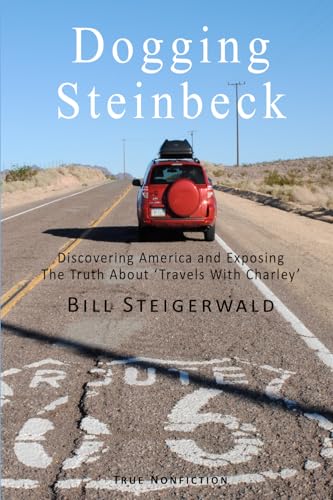
Dogging Steinbeck: How I Went in Search of John Steinbeck's America, Found My Own America, and Exposed the Truth about 'Travels with Char: Steigerwald, BillJohn Steinbeck's 'Travels With Charley' is a very warm book, which is exactly what you need when you're feeling a bit low. Charley is his big poodle of French extraction with a weak bladder. Steinbeck drove a three-quarter ton pick-up truck (which he named Rocinante after Don Quixote's horse), that was customised to his requirements so he could sleep, drink and cook outback and welcome chatty guests who he might meet along the road. 

As an armchair traveller, following his observations, thoughts and conversations as he covers thousands of miles and hundreds of contrasting landscapes, its an absorbing and thought-provoking tale. It was 1960, Steinbeck was 56 and not in the best of health. His wife Elaine was worried about him setting out on his own. He suffers homesickness on his trip and as the book progresses beyond a certain point, one definitely gets the feeling that all is not well.

Steinbeck admits he can't take in any more. He has driven from Sag Harbour at the tip of Long Island, up to Maine, into Canada, across the top of America to Oregon, then down the California coast to Salinas - his home town and territory - where he meets a few old friends (many are dead) and feels himself to be a ghost a place he once knew so well.

From here, he drives at speed over the Mojave Desert to Texas where he meets up with Elaine (his wife was a Texan gal). Separated again, he heads for New Orleans and the South before arriving back in New York. A hero's journey.

Fifty years later, three people (maybe more) decide to retrace his journey. Geert Mak, a Dutch historian and journalist of note, who'd made many trips to the US before, sets out to follows his tracks, in a Jeep with his wife in the cab for companionship. 

Steinbeck mainly slept in his truck but the Maks eschew that and bunk down in a range of dilapidated truckstops, lodging houses and hotels. In his 500pp+ book, Mak meticulously accounts for the meals they ate, the sights they saw. They walk round dusty towns, once throbbing with life, now abandoned. There's a dramatic chapter on the post-apocalyptic landscape of Detroit which sticks in the mind.  

The details of the journey and the constant references backwards and forwards to Steinbeck's original trip make great reading but this is two books in one. With his historian's hat on, Mak tells us the history of America. I am embarrassed by how little I knew of it. It's a great education. Mak is also carrying with him a library of other journalists and writers, most importantly John Gunther, whose meticulous accounts provide yet another level of thought and observation about the vast American landscape and culture.

Flipping from this book to listening to Trump and Clinton, the echoes from America's past flicker in one's mind. Take this powerful quote from Molly Ivins (now deceased) who Mak interviews in Texas. He describes her as 'a witty and astute columnist' for the Texas Observer and the Dallas Times Herald. They'd met before on a previous trip. He writes:
'I once interviewed her about the Bush family. I can see us now, sitting on a bench outdoors in Austin, laughing away. But I also remember she suddenly became serious: 
"Never, never underestimate the Republican machine, never underestimate their political skills, their immense network, the campaigning techniques, their capacity to pull off the most improbable tricks. You laugh at their show, not believing for a moment that people like that could ever run the world. Well, forget that. Don't underestimate them." 
It's clear to Mak that Steinbeck's original account is, to a certain extent, fictionalised. From the original book one gets the impression that Steinbeck was trying to stick to driving on back roads ( avoiding stretches of the new freeways, still being built at that time) and always stopping off at little towns (avoiding the cities). In fact, for much of his journey, Steinbeck was driving at least a couple of hundred miles a day, as he realises the sheer distances he has taken on and as his homesickness asserts itself.


ca_244_copy


But shadowing Mak's efforts is a much more hard-core traveller journalist Bill Steigerwald, who is travelling in a truck on his own, sleeping in the truck for the whole of his journey, and tracking down in forensic detail every move that Steinbeck made. The clue to his book is in the title: 'Dogging Steinbeck: How I Went in Search of John Steinbeck's America, Found My Own America, and Exposed the Truth about 'Travels with Charley'. 

In an article entitled 'Sorry, Charley: Was John Steinbeck’s Travels With Charley a fraud?' , first published on the Reason.com website in April 2011, he pulled no punches.
After nine months of fact checking and 11,276 miles of drive-by journalism, I can tell you for sure that:
• Steinbeck was almost never alone on his trip. Out of 75 days away from New York, he travelled with, stayed with, and slept with his beloved wife, Elaine, on 45 days. On 17 other days he stayed at motels and busy truck stops and trailer courts, or parked his camper on the property of friends.
• Steinbeck didn’t rough it. With Elaine he stayed at some of the country’s top hotels, motels, and resorts, not to mention two weeks at the Steinbeck family cottage in Pacific Grove, California, and a week at a Texas cattle ranch for millionaires. By himself, as he admits in Charley, he often stayed in luxurious motels.
'From what I can gather, Steinbeck didn’t fictionalize in the guise of non-fiction because he wanted to mislead readers or grind some political point. He was desperate. He had a book to make up about a failed road trip, and he had taken virtually no notes...At crunch time, as he struggled to write Charley, his journalistic failures forced him to be a novelist again. Then his publisher, The Viking Press, marketed the book as nonfiction, and the gullible reviewers of the day—from The New York Times to The Atlantic—bought every word.'

Steigerwald concedes that the book is, in many ways, 'still a wonderful, quirky, and entertaining book...That’s why it’s an American classic and still popular around the world.' But - and its a big but - he says 'there’s no denying Steinbeck got away with writing a dishonest book.'
'Not only did he fudge the details of his road trip, but he pulled his punches about what he really thought about the America he found. In Charley he fretted about the things he didn’t like about American society: pollution, early signs of sprawl, the rise of national chains, the increasing prevalence of plastic. But in private he complained directly about the failings of his 180 million fellow Americans: They were materialistic, morally flabby, and headed down the road to national decline.
'If Steinbeck sounds like a liberal who’d been living like a prince in New York City too long, it’s because that’s what he was. Fifty-eight and in poor health when he set out on his ambitious voyage of discovery, he quickly ran aground on his own loneliness and the realization that our “monster land” was too big and too complex for one man to understand.'

You can read Steigerwald's series of article about his trip here:  http://truthaboutcharley.com/travels-with-charley-timeline/

Finally, we come to the third traveller in Steinbeck's tyre tracks: Rachel Dry who drove from Vermont to Fargo, the geographical centre of America, with her mother as companion, and wrote a long piece for The Washington Post [November 12, 2010] called 'Following Steinbeck to Fargo'.

In a later Opinion piece in The Washington Post entitled: 'Steinbeck’s true enough ‘Travels With Charley’ [April 15, 2011] she writes:

'Journalist Bill Steigerwald has caught John Steinbeck in a lie. The Nobel laureate, according to Steigerwald, probably invented characters and embellished the hardships of the cross-country journey he made with his dog, Charley, in the fall of 1960, chronicled in his bestseller “Travels With Charley.”
I am a Steinbeck fan, and I happen also to have once been caught in a lie by Steigerwald — a lie linked to Steinbeck and his journey. This is a small part of the reason that...I think it doesn’t matter.'
'Steinbeck showed us postwar America as it looked from the window of his green GMC truck, custom-fitted with a camper. He may not have slept in the camper much (one of Steigerwald’s main contentions) or been alone with only a poodle for companionship (Steigerwald found that his wife was with him for a lot of the trip), but he gave us something we wouldn’t have otherwise. He showed us the country in a rich, kaleidoscopic view: one nation that included Swiss-cheese candy in Wisconsin, a New Yorker-reading aspiring hairdresser near the continental divide and the ugly invective that came with integration in New Orleans.'


In case you miss the much appreciated Comment below, received shortly after posting, from Bill Steigerwald :

Thanks to John May for the links and the nice things he said about me and my book, Dogging Steinbeck. But for the record, as we journalists like to say, it was I and not Geert Mak who first blew the whistle on Steinbeck's heavy fictionalizing and his dishonest account of his travels. Mak is a wonderful Dutchman, a great journalist/author and a historian who puts all us native history majors to shame. But he will be the first to acknowledge, as he so kindly and honestly did in his book, that he was tipped off by me about the many small and large fictions and fact-fudges in "Charley." As he and the Missus were traveling, he read the road blog that I was writing for the Pittsburgh Post-Gazette in the fall of 2010 as I followed Steinbeck's 1960 route. I was days and then weeks ahead of the Maks, who had a more leisurely but more expensive road trip. less . (Also for the record: Steinbeck was 58 when he made his trip and I drove, alone, a Toyota RAV4, which I slept in about 20 nights.)


PREVIOUS POSTS:

If you enjoyed this you might like my two posts on Truman Capote's 'In Cold Blood', widely claimed as the first non-fiction novel.As time has gone by, its clear that the book has more fiction in it than fact.


Also have written extensively on Jack Kerouac's journey 'On The Road'

Finally, recommending another cult book which I really love 'Blue Highways by William Least Heat Moon.


Sunday, March 20, 2016

INSIDE DOPE: LEE HARRIS / CANNABIS LEGALISATION UK


Lee Harris is one of the nicest fellas you'll ever meet and a personal friend. He is currently running in the London Mayoral race as the candidate for the Cannabis is Safer Than Alcohol party (Cista). He's 79 now and The Generalist has known him since the early 1970's when he first established the still-running 'Alchemy' drug paraphernalia shop in Portobello Road in 1972. 
[Photo: Buzzfeed]

Later in that decade he also published  'Home Grown' magazine which I edited for two issues. The Guardian claims it was the UK's first ever drug culture mag.

Shocked to discover from the paper's same profile that Lee was the trigger that lead to the introduction of the Misuse of Drugs Act:

Originally from South Africa, Harris fled to the UK in 1956, aged 19, after his left-wing politics and anti-racist views made him a target of the apartheid regime. He trained for the theatre and acted with Orson Welles. But his early adventures in the UK club scene left him horrified.
“I discovered all these kids in the West End who were on purple hearts [amphetamine pills], 80 or 90 a weekend, and I became a moral crusader and I helped change the law,” he said.
Harris wrote to the Labour backbencher Ben Parkin, who asked questions in parliament and passed his number to Anne Sharpley, a reporter on the Evening Standard. He took her around the West End clubs and she began the press hysteria that was to lead to the Misuse of Drugs Act in 1964.
“It was quickly hurried in, amphetamines were banned, and personal possession was made a crime,” Harris said. “Personal possession has been a crime since then. It’s one thing I bitterly regret."
He himself was busted under that law for a tiny bit of dope in February 1967
*


This news was followed by the announcement that the Liberal Party had adopted a policy to support the legalisation of cannabis in the UK. Their party leader Tim Farron told the Independent on Sunday: "This is about being really grown up about a massive issue and looking at the evidence. It contributes hugely to a criminal network that thrives off the illegality of the substance."  They calculate this would raise £1bn in tax revenue. 

You can read and/or download the report:
A Framework for a Regulated Market for Cannabis in the UK

It pains me to say this but the now tiny Lib Dem party have a flea's chance in hell of progressing the ideas in this document. It will perhaps be seen as trying to win back the youth vote the Party lost through backing student tuition fees. It's good to see policemen, drug scientists and other prominent voices joining together to lay out a plan but this is a worthy but unexciting document, presented in a boring text-heavy way that will not communicate to the general public. 

More importantly and strategically, they have started off on the wrong foot. If cannabis is ever going to be legalised in our lifetimes it will be through the issue of medical marijuana. The evidence for this is obvious through what is happening very rapidly in America.

See Previous Post: Inside Dope: The Green Rush/ Marijuana in the US, UK & Europe

The section of the report on 'medical cannabis' reads: 
We have not made a detailed case for reform or offered substantiverecommendations regarding the regulation of cannabis or cannabis based products for medical uses. This was beyond the remit of the panel and its terms of reference.
We do, however, acknowledge the urgent importance of addressing this issue and encourage government to actively engage with, and move forward with, the relevant questions.
It is clear that there is considerable cross over between the issues of medical and non-medical cannabis regulation, both in terms of practicalities of different regulation models and how they would interact, and the intersection of the political debates, specifically how the politics around non-medical cannabis use has created barriers to research and access to medicines.
As a starting point, however, the panel would like to express support for theimmediate rescheduling of cannabis in the UK (and at international/UN level) to a schedule 2 substance (to facilitate the cannabis research agenda), and also endorse the www.endourpain.org campaign to “change the law to allow doctors to prescribe cannabis where they consider it would help their patients; and for patients to have their prescription honoured at the pharmacy.” 


Back in July 2015, a petition calling for the total legalisation of cannabis in the UK was  signed by more than 125,000 people in just four days. Shortly after there was an excellent piece in The Guardian: 'The burning conservative case for legalising cannabis' by Avinash Tharoor. This sparky pitch reads in part:

'There is a solid conservative case for legalising cannabis. If there is one non-pejorative word that can define the past five years of Tory rule, it’s cuts. The legalisation and regulation of the cannabis trade could justify considerable spending cuts, as the current black market trade is a huge drain on our resources.
The government spends upwards of £2bn a year fighting the war on drugs in England and Wales, and the cannabis trade is undoubtedly a huge reason for that, as cannabis is – by far – the preferred illegal drug in the country (approximately 29% of Brits have consumed it). 
The money and resources being allocated to police – for stopping, searching and arresting stoners – could essentially be scrapped overnight. Simultaneously the courtroom hours and prison cells assigned to cannabis farmers and sellers could be used far more appropriately and efficiently.
Before May’s election, Cameron promised that he would create 2m jobs by 2020 and legalisation could contribute significantly to this. The government could create a new regulated industry with a pre-existing customer base of over three million. Five percent of the nation are regularly consuming cannabis and the revenue is being diverted to criminal gangs rather than legitimate companies or state coffers.'

There are great opportunities at this time to move away from the stupid and moribund approach to drugs in Britain. It remains to be seen whether the mood swing towards legalisation can overcome the ill-informed media machine and the stultifying political inertia that insists on viewing drug taking as a moral sin.

This article on the Open Democracy website is worth reading: 'Decriminalising drugs is not just talk – meet the countries actually experimenting with it' by Miamh Eastwood and Edward Fox.

Just put INSIDE DOPE in the search box at top left to find 26 Previous Posts on drug news.

One of those is about the myth of extra-strong cannabis. The Guardian's major G2 story on the subject by Blake Morrison was rubbished. He had got the simple maths completely wrong. See: http://hqinfo.blogspot.co.uk/2006/01/inside-dope-by-dick-tracy-cannabis.html