Thursday, April 21, 2016

THE STORY OF EMOJI


 'The Story of Emoji' by Gavin Lucas  is right on the button - a smiley button. 

Before language, humans drew pictures and created symbols with which to communicate. These early heiroglyphs and pictograms evolved into a written language of marks that, in turn and over time, became standardised letters and alphabets.

Some 40,000 years after the cave paintings and despite the sophistication of our written language systems, Lucas focuses on the fact that millions of us are still harnessing the potency of symbols, pictograms and ideograms in our everyday communication - thanks largely to a set of internationally recognised symbols,  called emoji -  a term derived from two Japanese words - e for image and moji for character.


Part of this journey from then to now forms the first 50 pages of this narrative. Back in the early days of printing, typesetters developed 'fluerons' or 'printer's flowers' to provide ornamentation on title pages. In a later development, printers used graphic elements that could be combined into typographic illustrations. When type moved from metal to digital, a huge variety of symbols were created as fonts. Typefaces like Zapf Dingbats or Windings allowed symbols and pictograms to be interspersed in bodies of texts.


 Other elements of the evolution towards emoji  include 'expressive punctuation' marks, developed to extend the possibilities of type. This 'percontation pont' (left) was designed by English printer Henry Denham in the late 16th century, to mark rhetorical or ironic questions that require no answer.  In the 1960s, the 'interrobang' - a combination of a question mark and an exclamation point was invented by Martin K. Speckter, the head of an American advertising agency who believed advertisements would look better if these various emotions could be expressed with a single mark. 


Another strand of the story is the emoticon (a portmanteau word and of 'emotion' and 'icon') - a combination of typographic characters that look like a face. The earliest so-far found is from the 17th century. The transcript of an Abraham Lincoln speech from 1862 records the audience's response to Lincoln's droll introduction as "(applause and laughter ;). These examples ( above) were published in Puck magazine in 1881. The  well-known smiley in computer communication was first used by Scott Fahlman in an online bulletin board post in 1982. 


"Never in the history of mankind has a piece of art, so simple and with such a positive message, reached so many people" - Harvey Ball (1921-2001)


Fahlman's emoticon came almost 20 years after the iconic “smiley face” designed in 1963 by American graphic designer Harvey Ball on the occasion of the merger of two life insurance companies - State Mutual Life Assurance Company of Worcester, Masachusett's and the Guarantee Mutual Company of Ohio. Morale was low and Ball was hired to create something that would cheer up the 
employees and could be distributed as buttons and posters. He was paid just $45. Ball never applied for a trademark or copyright and by 1971 more than 50 million smiley buttons had been sold. Frenchman Franklin Loufrani did register the image in 1971 and his son Nicholas now holds the SmileyWorld licence which generates millions of dollars a year. In 1999, Ball created the World Smiley Foundation which sells Smiley merchandise and used the profits to fund children's charities.

The 'smiley face' became a hippy symbol thanks to Bill 'Ubi' Dwyer, organiser of the Windsor Free Festivals. [This handout is from The Generalist Archive]

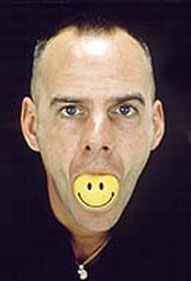


Fatboy Slim
 Later of course it became the icon of rave and acid house culture. I went round Fat Boy Slim's house to do an interview and kick myself that I didn't get a picture of him in front of the huge glass cases full of Smiley merchandise in his hallway.


The immediate precursor to the emoji came in 1995, when sales of pagers  were booming among Japan’s teenagers. The phone company NTT Docomo’s decided to add a heart symbol to the must-have 'Pocket Bell' devices. This allowed high school kids to inject a new level of sentiment (and cuteness) into the millions of messages they were keying into telephones every day.


Says  Gavin Lucas:  'But when new versions of the Pocket Bell abandoned the heart symbol in favour of more business-friendly features like kanji and Latin alphabet support, the teenagers that made up Docomo’s core customer base had no problem leaving for upstart competitor Tokyo Telemessage. By the time Docomo realized it had misjudged the demand for business-focused pagers, it was badly in need of a new killer app. What it came up with was emoji.'

 A young employee named  Shigetaka Kurita, following the idea of the heart symbol, came up with the idea of  creating simple faces to add tone to textual messages. He assembled a team who produced a complete set of 176 12-by-12 pixel characters that could cover the entire breadth of human emotion. The rest is history.

Lucas quotes Vyvyan Evans, a linguistics professor at Bangor University in Wales, who suggests that 'emoji are the fastest-growing form of language of all time. His research suggests that 72 per cent of people between the ages of 18 and 25 find it easier to express their emotions if they use emoji. Furthermore, 50 per cent of the people in this age group believe that emoji enable them to be better communicators.'

All this is a fascinating story that Lucas tells well but its only half the book. The second section 'Inspired by Emoji' is a wonderful visual cornucopia of work produced by artists and designers around the world. It's inspiring and underlines the global effect these tiny emblems of human emotion have become. They've sprung out of being just communication elements in the digital realm and spread into the worlds of art, fashion and beyond. There's 'the novel 'Moby Dick' rendered entirely in emoji and the main scenes of  the Cohn brothers cult movie'The Big Lebowski' ditto, plus political emoji, rings and cushion emojis, and a set of emojis designed for the World Wildlife Fund to raise awareness about endangered species. This cool and groovy seminal book will find and inspire a wide audience. It makes a valuable contribution to our understanding of the history of human communication.


(Left) Illustration created by Takakakura Kazuki using the emoji.ink web app.
(Right) MIND BLOWN by FL@33


*

ADDITIONAL 

Whilst waiting for this book to arrive, I did some research of my own on the web. here's a few interesting additions from Wikiedpia and beyond.


Image result for ambrose bierce
In 1887, according to Houston, the author Ambrose Bierce, best known for his satirical lexicon 'The Devil's Dictionary'  wrote a 'tongue-in-cheek essay on writing reform entitled "For Brevity and Clarity." 'In this, he 'presented a new mark of punctuation intended to help less fortunate writers convey humour or irony, which he called "the snigger point, or note of cachinnation." ("loud or immoderate laughter.") It looked like a line with the ends turned up ( ‿ )  which he wrote, "represents, as nearly as may be, a smiling mouth." Of course, his proposal was itself an ironic act, and unsurprisingly, the mark didn't catch on.'

In a 1936 Harvard Lampoon article, Alan Gregg proposed (-) for smile, (--) for laugh (more teeth showing), (#) for frown, (*) for wink, and (#) for "intense interest, attention, and incredulity".
According to science fiction writer Gregory Benford, emoticons were in use in sci-fi  fandom in the 1940s,
Keith Houston also reports that, in 1967, a Baltimore Sunday Sun columnist named Ralph Reppert was quoted in the May edition of Reader's Digest. Reppert, writing that his "Aunt Ev is the only person I know who can write a facial expression," explained that: "Aunt Ev's expression is a symbol that looks like this: —) It represents her tongue stuck in her cheek. 

Image result for NabokovIn April 1969, New York Times reporter Alden Whitman visited the world famous novelist Vladimir Nabokov  in Montreux  for an interview  shortly  before his 70th birthday. On request, he had sent his questions in advance. One of them was: "How do you rank yourself among writers (living) and of the immediate past?" 
Nabokov answered: "I often think there should exist a special typographical sign for a smile – some sort of concave mark, a supine round bracket, which I would now like to trace in reply to your question.

(^._.^)~ <(o.o )>

The widespread usage of ASCII art can be traced to the computer bulletin board systems of the late 1970s and early 1980s. The limitations of computers of that time period necessitated the use of text characters to represent image."
 See Wikipedia entries: Emoticon, List of Emoticons, ASCII art, 

*

A colon, followed by a dash, followed by a closing bracket. They resemble a smiley face.

The computer symbol for “not serious” or now more generally “happiness,” made up of a colon, dash and a right parenthesis, was born into existence at 11:44 a.m. on September 19, 1982, when it was posted on an online bulletin board by Carnegie Mellon computer scientist Scott Fahlman.
“If someone made a sarcastic remark, a few readers would fail to get the joke, and each of them would post a lengthy diatribe in response,” Fahlman explained in a post on Carnegie Mellon’s website about the invention of the sideways smile. 
“The problem caused some of us to suggest (only half seriously) that maybe it would be a good idea to explicitly mark posts that were not to be taken seriously,” he added. “In the midst of that discussion it occurred to me that the character sequence :-) would be an elegant solution ... So I suggested that.”
Fahlman also suggested the reverse — what has come to be known as a sad face — by using the other parenthesis marker.
“This convention caught on quickly around Carnegie Mellon, and soon spread to other universities and research labs via the primitive computer networks of the day,” he writes.
“I probably was not the first person ever to type these three letters in sequence, perhaps even with the meaning of ‘I’m just kidding’ and perhaps even online,” Fahlman wrote. “But I do believe that my 1982 suggestion was the one that finally took hold, spread around the world, and spawned thousands of variations.”

Image result for Scott E Fahlman

In a lengthier account about his invention of the emoticon, Smiley Lore, Scott Fahlman writes about the fact that the text of his original proposal had been lost.

'Several attempts to find the post on old backup tapes were unsuccessful. But in 2001-2002 Mike Jones of Microsoft sponsored a more serious “archeological dig” through our ancient backup tapes. Jeff Baird and the CMU CS facilities staff put in a heroic effort ...and they found the proper tapes, located a working tape drive that could read the ancient media, decoded the old formats, and did a lot of searching to find the actual posts. I am most grateful to all who participated in this successful quest, which I call the “Digital Coelacanth Project.”
Here it is:


19-Sep-82 11:44 Scott E Fahlman :-)
From: Scott E Fahlman
I propose that the following character sequence for joke markers:
:-)
Read it sideways. Actually, it is probably more economical to mark
things that are NOT jokes, given current trends. For this, use
:-(

*
FINAL NOTE

Back in April 1991, I read a review in New Scientist of this book, 'The Telling Image: The Changing Balance between Pictures and Words in a Technological Age.' It made fascinating reading then as it does now - but for different reasons. The original author Duncan Davies died before the book was published and his work was completed by Diana and Robin Bathurst who in the Preface write:
'Duncan Davies saw that great and influential changes are taking place in society as the balance of the means of communication tilts progressive from words and number towards pictures or images....'
'Duncan felt that too few people are aware of either the scale of the speed of this shift in the balance towards pictorial communication, or of the problems posed by the need to store and retrieve pictorial data, or of the possible consequences for the future. Adapting to this transformation would, he believed, require profound modification of attitudes and of the ways in which we prepare the young through education.'

In Chapter 1, Davies wrote the following:
 'There were 250 centuries when we had pictures alone and could not learn how to use them generally and effectively. Next there were 20 centuries when we learnt how to use formalised pictures (pictograms and ideograms) as message carriers. There followed some 15 centuries or so during which clerks made the great leap forward of alphabetic reading and writing. During the next five centuries, reading and writing thrust picture-communication into the background.
'However, over the past one-third of a century, the picture has suddenly and explosively become the main means for 'reading' and learning but not yet the main means for the ordinary person's 'writing'. Not surprisingly, we are reeling from the shock.
'The return of the picture, although it has been the subject of intense political concern and enquiry, has not been thought about or studied at all broadly. We now have a rich array of options for recording experience ideas and messages. We are suffering from indigestion and embarass de richesse. The time has come for a little therapeutic self-discipline.'


Monday, April 18, 2016

FAB LABS: A MAKING REVOLUTION


This post is about a revolution in the way we make things, not in huge centralised factories, but in distributed networks of small-scale digital manufacturing centres - Fab Labs.

Thanks to the efforts of Oliver Lowenstein and his organisation Making Lewes -  a community organisation that promotes the exchange of knowledge in the fields of Making, Architecture, Design & Sustainability -  this spring has seen three presentations on Fab Labs  here in our small town, of which The Generalist caught the third.
Tomas Diez is a Venezuelan-born urbanist, who specialises in digital fabrication and its implications on future cities. He is co-founder of the Smart Citizen project and StudioP52 in Barcelona, and director of Fab Lab Barcelona at IAAC, one of the main fabrication laboratories of the MIT global network. He is developing a new framework for cities to engage with digital fabrication and distributed sensing as urban development tools, to create positive social, economic and environmental impacts. He is a tutor in Design Products at the RCA.


Here is Tomas showing a slide was his Powerpoint presentation. This is about the different levels of small-scale manufacturing. In your house you might have a 3-D printer linked to your computer which could small-scale objects and parts. The second circle is the local fab lab which has more machines and computing power no doubt to fabricate objects using the same principles but on a larger scale. The bigger circles represent regional and national fabrication and remaking networks.

The Fab Lab Network is an open, creative community of fabricators, artists, scientists, engineers, educators, students, amateurs, professionals, of all ages located in more than 78 countries in approximately 1,000 Fab Labs. 

From community based labs to advanced research centers, Fab Labs share the goal of democratizing access to the tools for technical invention. This community is simultaneously a manufacturing network, a distributed technical education campus, and a distributed research laboratory working to digitize fabrication, inventing the next generation of manufacturing and personal fabrication.

The Fab Lab Barcelona is part of the Institute for Advanced Architecture of Catalonia and is also the headquarters of the global coordination of the Fab Academy program 

The  Fab Academy is a distributed platform of education and research in which each Fab Labs operates as a classroom and the planet as the campus of the largest University in construction in the world, where students learn about the principles, applications and implications of digital manufacturing technology.

This initiative is also supported by the Massachusetts Institute of Technology's Center for Bits and Atoms which studies how to turn data into things, and things into data. Why manufacture things in one country and ship it to another when you can just ship the data and they can make it there.


This is a Fab Lab House. 
The Fab Lab House, developed by the Institute of Advanced Architecture of Catalonia (IAAC), is a self-sufficient building that marks a new paradigm of energetic efficiency through its innovative ability to generate energy, food and utensils. The house produces three times more energy than it consumes, and thanks to its elevated structure – which naturally creates a patio/orchard/kitchen space underneath to provide for food. Also, it incorporates state-of-the-art machinery which can build tools and everyday objects by using the very same designs used in the general design of the space.

Buildings must be like trees, which are self sufficient, and must follow natural principles. Rather than built, the project was manufactured, as digital manufacturing machine tools (known as 3D printers) were used in the construction process. 


THIS IS A GREEN FAB LAB PROJECT
The Open Source Beehives project is a network of citizen scientists tracking bee decline. We use sensor enhanced beehives and data science to study honeybee colonies throughout the world. All of our technology and methods, from the hive and sensor kit designs to the data, are documented and made openly available for anyone to use. The primary goal is to determine the cause(s) of bee decline, to identify potential solutions, and to encourage networks of concerned citizens to study and redress the issue through the use of digital technologies in fabrication and information. 
Over the past two years a distributed team of developers have produced two open source beehive designs. Either hive can be freely downloaded, installed to a CNC router machine, and cut from a standard 4×8 sheet of material, such as plywood. The fabricated pieces are flat-packable and slot together without the need for screws or glues.  Both hives have been designed around natural beekeeping methods to lower stress factors on the colony, minimise exposure to artificial materials, and allow the bees more control over their living environment..

This is a Smart Citizen device

The Smart Citizen Kit is for Urban monitoring of ENVIRONMENTAL DATA
The Smart Citizen Kit is a piece of hardware comprised of a sensor and a data-processing board, a battery and an enclosure. The first board carries sensors that measure air composition (CO and NO2), temperature, humidity, light intensity and sound levels. Once it’s set up, the device will stream data measured by the sensors over Wi-Fi using the FCC-certified, wireless module on the data-processing board. The device’s low power consumption allows for placing it on balconies and windowsills. Power to the device can be provided by a solar panel and/or battery.


FAB CITY
A fab city made up of an interconnected community of neighbourhood fab labs to encourage entrepreneurship and interest in innovation that have already been present in Barcelona throughout centuries. Bringing factories back to cites will lead us through a new industrial revolution where production methods and social bonds will be transformed. 


INSIDE DOPE: FIRST IMAGES OF LSD EFFECTS ON HUMAN BRAIN


Imperial College London
These are apparently the first images showing the effects of LSD on the human brain. On the right, the brain's visual cortex has dramatically increased its connectivity with other regions of the brain under LSD's influence; in striking contrast the image (left) shows the limited effect on the human who has taken a placebo.

These studies, which are aimed at discovering how LSD produces its hallucinogenic effects, are being carried out by a team at  Imperial College in London. One of its leaders is David Nutt - a neuropsychophramacologist - who has also researched the effects of psilocybin , the hallucinogenic ingredient of magic mushrooms.

An interesting interview with David Nutt by Zoe Cormier, was published with these images in the journal Nature: http://www.nature.com/news/brain-scans-reveal-how-lsd-affects-consciousness-1.19727

Here are some brief extracts:

'We ultimately would also like to see LSD deployed as a therapeutic tool. The idea has old roots. In the 1950s and 1960s, thousands of people took LSD for alcoholism; in 2012, a retrospective analysis of some of these studies suggested that it helped to cut down on drinking. Since the 1970s, there have been lots of studies with LSD on animals, but not on the human brain. We need that data to validate the trial of this drug as a potential therapy for addiction or depression.'
'Before the 1960s, LSD was studied for its potential therapeutic uses, as were other hallucinogens. But the drug was heavily restricted in the United Kingdom, the United States and around the world after 1967 — in my view, due to unfounded hysteria over its potential dangers. The restrictions vary worldwide, but in general, countries have insisted that LSD has ‘no medical value’, making it tremendously difficult to work with.'
'We have plans to do separate experiments to look at how LSD can influence creativity, and how the LSD state mimics the dream state.
'More importantly, we have already completed a trial on psilocybin as a therapy for treatment-resistant depression funded by the UK Medical Research Council: not as a daily drug, but in targeted psychotherapeutic sessions.
'Our latest brain-imaging study suggests that LSD has similar effects — suggesting that it could be trialled therapeutically, too.'


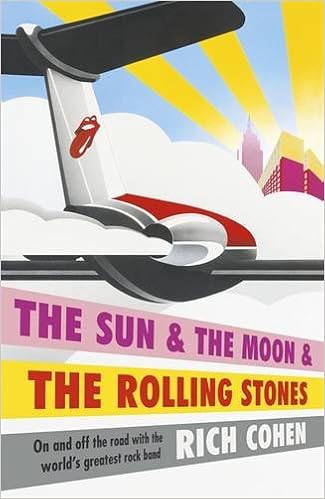
THE SUN & THE MOON & THE ROLLING STONES: A TASTER


Just when you thought there was nothing left to say about the Rolling Stones, along comes a new book by Rich Cohen, contributing editor to Vanity Fair.  

Its title comes from an interview he did with Keith who asked Rich when he was born (1968) and said: "What's its like to live in a world where the Stones were always there? For you, there's always been the sun and the moon and the Rolling Stones."

Rich Cohen was on the road with the Stones for Rolling Stone magazine back in 1994 when he was 26. After this he really landed on his feet, working for years with Mick Jagger and Martin Scorsese on a movie that became Vinyl, an HBO tv series, which started screening Feb 2016.

Cohen describes having three-course dinners in the grand dining room of Scorsese's house on Manhattan's Upper East Side and listening to the two reminisce. Jagger then gave a him a list of people to interview - legendary vets who'd seen it all from the inside of the music business.

Cohen recalls talking with Joe Smith who ran Warner Brothers Records, by the pool at the Mondrian in LA. 'He told me about buying Van Morrison's contract from the Mob. "I flew  to New York with a briefcase of cash. We made the exchange in a warehouse near the river: "You got the dough?". "Yeah, you got the contract?" Classic and real.

These details come from a warm-up piece for the book in the April issue of Vanity Fair. Cohen gets to sit in Keith and Ronnie Wood's "guitar room" which is replicated at every gig and arena they play at, with a snooker table, couches, coffee tables, ashtrays and loads of guitars. He describes it as 'the inner sanctum, the back room where the cardinals prepare for Communion. Poking through the doctor's bag he carried everywhere, Richards might look up, smile and say, "Tell me what's wrong. In Here, I've got a cure for whatever ails you."

He says Mick scares him but Keith is reassuring. 'He stands for survival. There's nothing you've done he's not overdone - nothing you've suffered he's not survived.' Mick, on the other hand, is one in a million, a force of nature who is unknowable. He is 'not understood because he does not want to be...mystery is power. Distance is charisma.... Mick Jagger is over-exposed and yet remains hidden...even his real name sounds like a pseudonym.

Cohn explains how the Stones began as a gang and then became 'like a bitter married couple who stay on for the kids. Only the kids are grown. Or maybe the money is the kids.' Cohen believes  'Exile on Main Street' was the pinnacle of their greatness and the death of their friendship explains the loss of their mojo. He believes 'Some Girls' to be the last great Stones' album: 'That record is pure New York in the late 70s. Fantasy Gotham. Cocaine and rats, mean streets at dawn. The licks as sharp as any Keith ever dreamed up.'

Full review to follow. 

'The Sun, The Moon & The Rolling Stones' by Rich Cohen will be published in the UK by Headline in May. 


Friday, April 15, 2016

MARKS IN MEMORIAM: HOWARD MAKING HEADLINES / THE OLD BAILEY DRUG TRIAL 1981


Image result for howard marks


A remarkable court drawing by artist Richard Adams illustrating aspects of the Howard Marks' drug trial at the Old Bailey in 1981. The accompanying piece was written by Tim Malyon and appeared in an issue of the London listings magazine City Limits dated November 27th - December 3rd 1981. Interspersed within the text are clippings about the trial from the Daily Mail


The case had everything. Britain's MI6, Mexican intelligence, the Customs, the police, the IRA, 15 tons of cannabis, and Howard Marks.

On the night of December 29 1979, the tugboat 'Karob' deposited the 15 tons on Scotland's West Coast, fresh from Colombia's dope fields. And it was that 15 tons that was to see Marks, Stewart Prentiss and Hedley Morgan on trial for eight weeks at the Old Bailey.

Last Friday they were acquitted of smuggling the dope - valued at around £20 million - and dealing in it. It was a stunning conclusion to a bizarre trial, and meant that Marks' tales of MI6 and Mexican intelligence and his claim that he was searching for the end of the dope trail had been accepted by the jury. Five others were found guilty on dealing and possession charges.


At the outset, prospects had looked bleaker for the defendants. From March 1980 the three men and their associates - who pleaded guilty - had been trailed by the authorities and they were arrested in May of that year. 

Marks was caught with detailed accounts of sales and income in his own handwriting.
Prentiss was accused of running the importation. He made a written confession.
Morgan was responsible for counting and banking the cash from the sales, just under £2 million by the time of the arrest.

The three responded in court. Prentiss claimed the Customs officers threatened to jail his wife - who had suffered a mental breakdown - unless he made a statement. Yes, he had transported some of the cannabis in his yacht 'Bageira' after the drop, but had done so because of threats from the American end of the deal. Either he co-operated or his children in San Francisco would be kidnapped.


Morgan explained that he thought the money had come from a tax avoidance scheme. He had been recruited by an old school friend, and Marks brother-in-law Patrick Lane.
Lane has disappeared. His role, said Marks, was 'banking the proceeds from cannabis, laundering it, and then transferring to investors and exporters.

Morgan's defence was assisted by leading prosecution witness - and prospective Liberal candidate -  Ron Banks. With his partner Barry Gregory he had channelled the banked cash out of the country on instructions from and in receipt of one per cent commission from Lane.

Banks admitted knowing that Morgan and Lane had used false names on paying-in slips. He had advised Morgan to use false payee names on certain occasions. Banks recalled that when Lane had first handed over the money, he'd been up all night counting and 'facing' £100,000 and needed his, and Gregory's assistance to finish the job. 'He had started to hallucinate whenever he saw pictures of the Duke of Wellington' said Banks.

But Marks was the pivot of the case. Before the trial he told the Customs that his work was 'of a secret nature'. he came out with 65 'no comments'.

During the trial Marks admitted that he had used false identities for the previous seven years. And he agreed that he smoked cannabis a great deal and had no moral objection to cannabis trading, apart from other drugs.

In the only outburst from a defendant during the trial, Marks vehemently denied an allegation by a custom officer that he had agreed that cannabis could lead users on to other drugs in some cases. 'No I didn't. That's a lie,' he shouted.

But if that sincerity was part of the reason for the verdict, other things may have entered the jury's mind, such as his involvement with MI6, the British external intelligence service, back in early 1973. At that time, he was approached by a fellow student from Oxford, Hamilton McMillan, by then an MI6 agent.

McMillan wanted foreign branches of Marks' dress shop 'Annabelinda', to be used as fronts for MI6 agents. And he knew, possibly through Dutch intelligence reports, that Marks was an acquaintance of Irish arms dealer James McCann.


MI6 wanted information on McCann. Marks obliged, but may well have told McCann of his MI6 contact.

In November 1973, Marks' long involvement with the law began. hew was arrested by the Dutch police for possession. Shortly before this, the prosecution claimed at the trial, MI6 severed contact. Marks denies this.

The British authorities were already interested in Marks for alleged drug offences. So two British Customs officials went to Holland to interview him, and Marks agreed to return. He didn't have to, since he couldn't have been extradited under Dutch law for a drugs offence. Perhaps he believed that MI6 would protect him.

Back home, Marks was charged with exporting cannabis from Europe to the United States. Out on £50,000 bail, he disappeared looking a very frightened man,on April 19, 1974, eleven days before his scheduled trial.

Marks says he was kidnapped and the police agree he was very probably frightened into not appearing. Both agree that the United States 'dealing' organisation to which those charges are related was involved.

Two somewhat conflicting stories now emerge about the attitude of the relevant police force, Thames Valley, to Marks at that time. Last weekend the Sunday Times  claimed the force were suppressing reports from an informant about Marks constant involvement with cannabis in Oxford.

Not so, says Martin Pritchard, who was then an undercover officer with the Thames Valley drug squad. They knew little of Marks then, but from early 1971 Dutch secret police records were being sent to England about Marks. The reports were concealed from both the Central Drugs Intelligence Unit and British Customs.

Whatever the truth, Marks' disappearance attracted immense interest. It was the time of the Lennon and Littlejohn affairs. Lennon had been murdered, allegedly by the IRA for being a double agent. The Littlejohn brothers had been arrested in the Republic on robbery charges linked with British intelligence.

The press pumped out reams about Marks, much of it straight from police sources. Heading the queue was the Daily Mirror's Edward Laxton. He printed letters from Marks to his girlfriend 'in possession of the police in Britain'. he tracked down and pestered Marks' sister Linda in Italy, and he reported an alleged finding of the supposedly secret 'Fairweather Report.' Superintendant Fairweather of Thames Valley police had prepared a lengthy dossier on the case.

So where was Marks? Italy had been his apparent destination but by 1975 he was back in London and living under an assumed name. In April 1975 the Customs hit the flat, accompanied by Laxton. Marks wasn't there.


Yet the Daily Mirror managed to print a picture of Marks, captioned 'on the run in London last week.' One wonders who was talking to whom. Marks was forced to change his identity yet again and was to remain out of the public eye for four more years. But his name didn't.

Mirror Books published 'Busted' on Martin Pritchard's career. Co-written by Edward Laxton and Pritchard, the Thames Valley drugs officer. An entire chapter was devoted to Marks and Pritchard referred to the 1975 customs raid. 

By 1979 Marks had become Donald Nice and was working on a film 'Life After Elvis' with P.J. Proby. But others were making films too. London Weekend television for one. It was about Howard Marks. At the last minute the programme was dropped, with LWT explaining they needed more time 'to consider the advice of their lawyers'.

LWT had managed to establish Marks' presence in Britain. A researcher went drinking with one of Marks' friends, who denied having seen him. The researcher slipped a photograph of Marks across to the barman. He recognised a regular customer.

LWT also relied on Dick Lee, former head of Thames Valley Drug Squad and colleague of Martin Pritchard, as a researcher. Lee who had run the 'Operation Julie' LSD investigation quit the force in disgust because neither the investigation nor his squad were continued after the massive trial. Lee was apparently fascinated by Marks.

None of which helped Marks' movie making. He dropped the film and changed name once more. He feared, he says, reprisals from the IRA or McCann.

McCann had troubles of his own. In August 1979 he was arrested in Naas, County Kildare. The police claimed he was seen armed next to a load of bananas and 850 pounds of Thai Sticks.

So how did McCann get into such an unfortunate predicament? He claims he was set up by British intelligence and that Marks had been involved in drug dealing in Ireland. McCann has frequently boasted of his arms dealing exploits to the press but denies the dope charges.

During his trial, Marks came out with a different story. He had been told, he said, by McCann's associate Michael Clarke, that McCann was planning to import cannabis into Ireland from Thailand and Colombia.

Marks claimed that he passed the information on to his alleged MI6 contact. This was Anthony Woodhead, former husband of Anna Woodhead, the 'Anna' in 'Annabelinda'. Hence the arrest of McCann.

Marks told Clarke that he 'would be looked after'. Arrested at the same time as McCann, he pleaded guilty to cannabis possession and received a one year sentence. And what of McCann? 

In March 1980 Justice Gannon directed a Dublin jury to acquit him. It does appear that McCann's alleged cannabis links have angered the IRA. He was badly beaten up in jail while awaiting trial.

But things were soon complicated for Marks. He claims that, having heard from Clarke that McCann had planned to import 30 tonnes of Columibian marijuana into Ireland, he was particularly interested to hear from his sister-in-law Natasha - sister of Patrick Lane - that there were plans to import 30 tons of Colombian grass into Scotland.

Marks explained that he wanted to find out who was behind the shipment, and suspected McCann. He was asked to do the accounts for the operation, he told the court, by Patrick Lane, because of a serious financial dispute between the American dope ring investors and the British distributors.

Why was Marks interested? He told the court that from 1976 he was working not only for MI6 but also for Mexican intelligence, tracing connections between right-wing organisations and the arms, heroin and cannabis trade.

'I'm a fanatic advocate of the legalisation of cannabis,' Marks testified. I feel it is essentially harmless and because of the illegality of it, we have a situation  whereby extremist terrorists can fund themselves from it.'

The jury's view may also have been influenced by the absence of any of the American 'investors' at the trial.

The trial hovered between theatrical tragedy and high farce. When 28 pounds of Colombian and two kilos of black hash were escorted into court, the judge, Peter Mason, known in the trade as 'Penal Pete' sniffed one of the cigar-shaped buds and complained of the lack of aroma. 'That goes off after a while' explained  the prosecution.

'How do you get the drug into the system? asked the judge. A couple of jurors barely concealed grins, whilst a solicitor's clerk asleep at the back of the court with his head in a briefcase sat up with a start.

It wasn't just theatre. Last Monday, five players, the accountant and storekeepers for the organisation, were sentenced to a total of 22 years. Penal Pete said he was being lenient. Marks was sentenced for two years, the maximum for his passport offences. Lord Hutchinson, counsel for Marks, summed it up. 'If ever there was a case for the legalisation of cannabis, this is it.'