Saturday, March 12, 2016

KEITH EMERSON: MY ADVICE IS CHECK OUT THE NICE


Like many others, sad to hear of Keith Emerson's death in Santa Monica. Although Emerson, Lake & Palmer were the biggest band of his career, always preferred The Nice - seen here in a page from the official Isle of Wight Festival programme [29th-31st August 1969]. 
NiceNice.jpgWe saw the band live at the Assembly Hall in Worthing in the same year methinks when their third album was released. It was fantabulous fiery performance from a local boy - Keith lived near Worthing at that time and I believe stayed in East Sussex for many years. [Just found out from Wikipedia that one of the daggers that Emerson used to thrust into the keys of his Hammond organ was given to him by Lemmy]. That same summer, The Nice headlined the final night of the Ninth National Jazz & Blues Festival at Plumpton Racecourse in East Sussex [8-10th August].. I met a girl who knew Keith and she took me into the rehearsal room on the Festival site where The Nice practiced with a full blown orchestra. Brilliant. Their finale performance included also Scottish pipers as I remember. Pic from original programme.
T


Worked on-site for a week or more at the second Isle of Wight Festival 1970. Witnessed the arrival of Emerson, Lake & Palmer. They were all on Harleys and drove in without stopping, with their access passes held in their teeth. They became a huge band particularly in the States but, as the 70's wound on, their massive stadium style made them a target for the new punk sensibility which saw them as pompous and overblown. No doubt a younger audience will discover their work and make up their own mind, Keith was a dynamic and  powerful stage performer, a virtuoso player and electronic pioneer. Check out The Nice is my advice.

Bumped into Keith in the public bar of The Crown in Lewes in the 90's with his son, who was in a band at that time and we talked about those earlier days. Good Times.

ADDITION: Just discovered that the cost of the album pictured is £38 !! More importantly, the sleeve notes by Keith, on The Nice's second album 'Ars Longa Vita Brevis', end as follows:

 'Tomorrow is yesterday's history and art will still be there, even if life terminates'.

Wednesday, March 09, 2016

SMARTPHONE REVOLUTION, APP ADDICTION, CAPTOLOGY, DEVICE PEOPLE


People walk on a sidewalk in Chongqing featuring one lane for cellphone users and one lane for walkers not using cellphones.Zuma Press/Wall Street Journal China.


Source: societyinkorea blog
THE GENERALIST is in the minority in not owning a mobile phone let alone a smartphone. According to an valuable article by Jacob Weisberg in the New York Review of Books, which we will examine in detail, 'not carrying a smartphone indicates eccentricity, social marginalization, or old age.' Yahboo to you! 

This post examines the rise of the smartphone and the social implications of this rapid upsurge in their ownership and usage -  internet anxieties, empathy decline, app addiction, plus captology and the emergence of  'device people' or 'proto-cyborgs'.


Smart device penetration in Europe by Flurry Analytics

SMARTPHONE STATS

The map above accompanies an article by Richard Firminger posted on Wallblog (Jan 4th 2016) entitled ' More devices than people! A snapshot of smartphone and tablet use in the UK'. It reads in part:
'According to ZenithOptimedia, 2016 will see global mobile ad spend overtake newspaper ad spend, and is on course to outstrip desktop as soon as 2018. 
'New research from Yahoo’s Flurry shows how device usage and preferences can vary dramatically by region, even within Europe....The UK comes in third, with 130% penetration, behind the Netherlands (136%) and Sweden (150%); all are far ahead of fourth place Spain at 81%. These staggering rates of adoption actually mean these countries boast more smart devices than citizens, as households typically have multiple devices including tablets and phones.'
He reports that mobile devices are now the preferred channel for online browsing and that  90% of the time is spent on apps as opposed to mobile web. 
'It appears that UK consumers are prioritising staying in touch, as messaging and social apps take up 41% of our total app time – almost twice as much time as gaming, and four times as much as music, media, and entertainment apps.'
Firminger, who is VP of business development at Yahoo, says their research shows that 'smartphone users are twice as likely as other consumers not to care if the content they read is an advert, provided it’s engaging and well targeted.'


university lecture smartphone addiction


*
In the UK, OFCOM's 2015 Communications Market Report (August 2015) claims that smartphones have overtaken laptops as the most popular device for getting online. On average they are used for nearly two hours every day to browse the internet, access social media, bank and shop online. 

The report claims that 'smartphones have become the hub of our daily lives and are now in the pockets of two thirds (66%) of UK adults, up from 39% in 2012. The vast majority (90%) of 16-24 year olds own one; but 55-64 year olds are also joining the smartphone revolution, with ownership in this age group more than doubling since 2012, from 19% to 50%. 

*

Phone-Addiction1

Source: The Digital Divide Podcast: Smartphone Addiction

‘No-mobile-phobia’: There is a name for the feeling of anxiety caused by separation from one’s smartphone.Nomophobia—literally, “no-mobile” phobia—is the fear of losing or being without a cellphone. It’s not an official, clinical diagnosis, and you can’t find an entry for it in the most recent edition of the Diagnostic and Statistical Manual of Mental Disorders (DSM-5), but there is reason to believe that it is a growing problem. Source: Inside a Smartphone Addiction Treatment Center/PC World. 

SMART PHONES/EMPATHY DECLINE


Jacob Weisberg's review of a number of books on the smart phone phenomenon points out the 'unprecedented suddenness' of their arrival.  The first iPhones went on sale in June 2007 with Android phones arriving in 2008. He asks 'What does it mean to shift overnight from a society in which people walk down the street looking around to one in which people walk down the street looking at machines?'  He writes;
Smartphones went from 10 percent to 40 percent market penetration faster than any other consumer technology in history. In the United States, adoption hit 50 percent only three years ago.
'Americans spend an average of five and a half hours a day with digital media, more than half of that time on mobile devices, according to the research firm eMarketer. Among some groups, the numbers range much higher. In one recent survey, female students at Baylor University reported using their cell phones an average of ten hours a day. Three quarters of eighteen-to-twenty-four-year-olds say that they reach for their phones immediately upon waking up in the morning. Once out of bed, we check our phones 221 times a day—an average of every 4.3 minutes—according to a UK study. This number actually may be too low, since people tend to underestimate their own mobile usage. In a 2015 Gallup survey, 61 percent of people said they checked their phones less frequently than others they knew.'
So much for the statistics. Weisberg's main focus is on 'Reclaiming Conversation', a recently published book by Sherry Turkle, a psychologist and sociologist who teaches at MIT, which is about the 'troubling aspects of social and mobile media'.

'She presents a powerful case that a new communication revolution is degrading the quality of human relationships—with family and friends, as well as colleagues and romantic partners. The picture she paints is both familiar and heartbreaking: parents who are constantly distracted on the playground and at the dinner table; children who are frustrated that they can’t get their parents’ undivided attention; gatherings where friends who are present vie for attention with virtual friends; classrooms where professors gaze out at a sea of semi-engaged multitaskers; and a dating culture in which infinite choice undermines the ability to make emotional commitments.'
'Turkle finds the roots of the problem in the failure of young people absorbed in their devices to develop fully independent selves, a topic she began to explore in Alone Together (2011)... She argued that phones and texting disrupt the ability to separate from one’s parents, and raise other obstacles to adulthood. 
'In her new book, she expresses a version of those concerns that is as much philosophic as psychiatric. Because they aren’t learning how to be alone, she contends, young people are losing their ability to empathize. “It’s the capacity for solitude that allows you to reach out to others and see them as separate and independent,” Turkle writes...Continuous digital performance leaves teenagers experiencing what ought to be the satisfactions of solitude only as “disconnection anxiety.”
 Turkle cites a study that shows a 40 percent decline in empathy among college students over the past twenty years as measured by standard psychological tests. Based on hundreds of interviews she's done with the youth she concludes:

'The thing young people never do on their smartphones is actually speak to one another. Their comments about live conversation are telling: “I never really learned how to do a good job with talking in person.” “Even when I’m with my friends, I’ll go online to make a point…. I’m more at home.” 
Another excellent piece based on Turkle's book is 'Log out, switch off, join in' by Financial Times columnist Simon Kuper. He writes: 'As one young man told Turkle: "Conversation? It died in 2009". That year, smartphones went mainstream. Turkle claims most teenagers in the US send 100 texts a day.

*
internet-addiction-test-free-internet-addiction-checklist-ipredator-inc.-michael-nuccitelli-psy.d.


INTERNET ADDICTION DISORDER

In 'Reading the Comments'  Joseph M. Reagle Jr., a communications professor at Northeastern University in the US,  focuses on 'the way people relate to one another through the digital genre that he defines as social, reactive, short, asynchronous, and pervasive. To him, this “bottom of the Web” includes everything from Facebook sharing to bulletin board systems (BBS) to user-generated product reviews on Amazon.'

Weisberg writes: 'In the main, the Web conversation Reagle considers suffers from tendencies similar to the ones Turkle identifies: narcissism, disinhibition, and the failure to care about the feelings of others. It’s a world devoid of empathy.
*
Much of what we do on the Internet is, it seems, harmful to us and others but there's an even deeper aspect: we're hooked. Apparently in 1995, there was parody of an academic article going the rounds about "Internet addiction disorder". Certainly, it's habit forming.
 'The simplest habitual activities are checking for updates in one’s social streams and affirming the contributions posted by friends. You do this by tapping on various permutations of the “like” button that Facebook launched in 2009: they include +1s on Google+, pins on Pinterest, hearts on Instagram, first stars, then hearts too on Twitter. The most successful mobile apps create distinctive, repetitive hand movements, like swiping on Tinder (left to reject), double-tapping on Instagram (to indicate approval), pressing down to view imploding doodles on Snapchat, and stroking down to catapult angry birds on Angry Birds.'
'When Turkle writes that “the Net teaches us to need it,” she is speaking metaphorically. But while the Internet itself may lack intentions, those designing our interactions with it have a purpose very much like the one she describes.' 
* 

CAPTOLOGY


It is disturbing to learn that some of the most successful app designers in Silicon Valley are alumni of a place called the Persuasive Technology Lab at Stanford which was founded in 1998 by B.J. Fogg. This is where it gets real creepy. Fogg not only teaches students but also runs "persuasion bootcamps" for tech companies. Weisberg writes:
'He calls the field he founded “captology,” a term derived from an acronym for “computers as persuasive technology.” It’s an apt name for the discipline of capturing people’s attention and making it hard for them to escape. Fogg’s behavior model involves building habits through the use of what he calls “hot triggers,” like the links and photos in Facebook’s newsfeed, made up largely of posts by one’s Facebook friends.'

BJ Fogg in person

One of Fogg’s students, Nir Eyal is the author of 'Hooked: How to Build Habit-Forming Products.'
A successful app, he writes, creates a “persistent routine” or behavioral loop. The app both triggers a need and provides the momentary solution to it. “Feelings of boredom, loneliness, frustration, confusion, and indecisiveness often instigate a slight pain or irritation and prompt an almost instantaneous and often mindless action to quell the negative sensation,” he writes. “Gradually, these bonds cement into a habit as users turn to your product when experiencing certain internal triggers.”
 Eyal thinks Facebook’s trigger is FOMO, fear of missing out. Instagram is even itchier. He writes: “Instagram is an example [of the work] of an enterprising team—conversant in psychology as much as technology—that unleashed a habit-forming product on users who subsequently made it part of their daily routines.”  Its genius, in his view, is moving beyond generalized FOMO to create angst around “the fear of losing a special moment.”

Instagram was so damned addictive that Facebook had to buy it. Weisberg  writes:
'Turkle argues against using the term “addiction” because it implies that “you have to discard the addicting substance,” and we aren’t very well “going to ‘get rid’ of the Internet.” But in describing what they’re doing, many of her subjects fall naturally into the language of substance abuse, abstention, and recovery. People colloquially describe sessions online as getting a fix, or refer to disconnection from social media as detoxing or going cold turkey. The industry can’t help talking that way either, about “users” and “devices.” The toll of technology is emotional rather than physical. But the more you read about it, the more you may come to feel that we’re in the middle of a new Opium War, in which marketers have adopted addiction as an explicit commercial strategy. This time the pushers come bearing candy-colored apps.'
*

THE ATTENTION ECONOMY

One person who is attempting to address these problems is Tristan Harris, a former B.J. Fogg student and until recently Product Philosopher at Google. 

Image result for Tristram harris'Harris argues that an “attention economy” is pushing us all to spend time in ways we recognize as unproductive and unsatisfying, but that we have limited capacity to control. Tech companies are engaged in “a race to the bottom of the brain stem,” in which rewards go not to those that help us spend our time wisely, but to those that keep us mindlessly pulling the lever at the casino.'

His website says that he co-founded a movement for “Time Well Spent,” to spark a whole new ecosystem of software, websites and incentives built to help people spend their time, and their lives, well – not built to maximize engagement or screen time.'

Weisberg  doesn't buy into this. He concludes: 'As long as software engineers are able to deliver free, addictive products directly to children, parents who are themselves compulsive users have little hope of asserting control. We can’t defend ourselves against the disciples of captology by asking nicely for less enticing slot machines.'

 Read the complete piece: 'We Are Hopelessly Hooked' 
*

PROTO-CYBORGS


Source: Pinterest

This post concludes with another related piece, this time from the science journal Nature entitled 'Time to expand the mind: Thoughtful use of ubiquitous technology can improve mental ability more than drugs and devices', say Nicholas S. Fitz and Peter B. Reiner. In a section entitled 'Perspective Shift' they write:

'It is hard to overstate the degree to which information technology has permeated today’s world. For many, reliance on technology  begins when they awaken, continues throughout the day and ends only when they drift off to sleep.
'Nearly half of the adult population worldwide owns a smartphone.But to call these devices phones is a misnomer; the functions they carry out are incredibly diverse, including storing information,sending and receiving messages, and videoconferencing. 
'Sometimes it feels as if technology is supplanting thinking, but this worry is somewhat misdirected. Rather, these devices are extending the reach of our cognitive abilities, so much so that a statement that once seemed radical is increasingly realistic: we have become proto-cyborgs.
'We are still a long way from the transhumanist fantasy of upgradingour brains with implantable computer chips. But we have entered a transitional era in which we are commingling our cognitive space with technology. In doing so, we have enlisted the assistance of what might be termed technologies of the extended mind.'

          Sweet dreams.        


Monday, March 07, 2016

DADA 100

DADA was invented 1oo years ago and celebratory events are happening around the world.

It's a delight to delve into DADA again. It's inspiring and I feel its something that I've been looking for. You may feel the same way.

This post begins with 'Memoirs of A Dada Drummer' by Richard Huelsenbeck - which is widely regarded as one of the most influential accounts that has shaped our modern understanding of Dada. 

He believed that Dada is the only appropriate philosophy of our age. In 1949, he wrote that "Dada was the beginning of the revolution of the suppressed personality against technology, mass media, and the feeling of being lost in an ocean of business cleverness." He saw the threat of a new totalitarianism in technology.


This book has special personal meaning for me because it was a 50th birthday present from Mike Edwards, a fine artist who was also the first drummer in my band BoHo. I really like that two drummer thing. It's inscribed: 'Many Happy Returns from a BoHo drummer and his Missus.' Cool.

The book is like box of magic tricks. It begins with a quote from Huelsenbeck, that reads in part:

'Have we ever had more reasons for blowing red-hot smoke out of our noses or being prouder? We killed a quarter of a century, we killed several centuries for the sake of what is to come. You can call it what you like: surgery, kleptomania, calligraphy; for all we can say is: We are, we have worked some - revolution, reaction, extra! extra! we are - we are - Dada first and foremost - first and foremost a word, whose fantasticness is incomprehensible.'

Then comes a Foreword to the Paperback Edition by Rudolf E. Kuenzli of the International Dada Archive in Iowa City - an extraordinary resource. Its a stunner. Here's the opening quote and Kuenzli's opening comment:

In his essay entitled "Dada Lives," Richard Huelsenbeck predicts that "everywhere, throughout the world, where forces are at work to turn back the wheel of history, Dada will be hated. Therefore it is not difficult to predict a great future for Dada."

' Dada's aggressive, vital, scandalous spirit has indeed been activated by writers and artists throughout the twentieth century in their opposition to stultifying, moribund institutions and social value.'

Tristan Tzara, a Dada founder who we'll come to in a minute, describes Dada as a "virgin microbe" which, says Kuenzli, 'has infected artists and writers throughout the century.' Tzara also called Dada a "chameleon of rapid, interested change."

Dada begins in the middle of World War 1, then becomes part of the Surrealist revolution and, in Germany, joins both the Communist movement and Constructivism. During and after World War 2, it activates existentialism and Abstract Expressionism amongst other movements. In the 1950s/60s, 'Neo-Dada' emerged though Pop Art, Fluxus and Happenings and through the Situationists in Paris. In the 1970s, Dada was discovered by counter-culture punk and rock musicians. Dada later played its part in eastern bloc oppositional movements and, writes Kuenzli, 'Dada tactics have been used 'to expose and critique the cultural codes and values propagated in advertising.' Its still active today as we will see later.


To cut a long life story short, Huelsenbeck emigrated to New York in 1936, where he became a psychiatrist and later founded the Association for the Advancement of Psychoanalysis. He also changed his name to Charles R. Hulbeck. He was the only living Dadaist in America from 1936 to 1969 who had been in Zurich and Berlin at the beginning. He distanced himself from Dada for many years until, in 1949, he began producing his reinterpretations of the meaning of Dada, its history and constructed a new manifesto. 


These accounts completely suppressed the political aspect of Berlin Dada, which had embraced Bolshevism. This was because of the rise of McCarthyism and his very real fears that he might be deported. He had changed his name to Charles R. Hulbeck but he was still investiagted by the FBI.

Huelsenbeck redefined Dada's goal as being "human development, towards spirituality and freedom."  He said his new manifesto is "a free declaration of men who have recognised the need for a constructive movement and discovered to their joy that they have never been far removed from such a movement. The worst that can be said is that the world has indeed come to a sorry pass if even the Dadaists feel it necessary to stress the positive and constructive aspect if their nature and principles."

He also described Dada as being the individual's revolt against general banality and stupidity and as a "struggle for a creative life, for growth and becoming, for what may be only divined."

In the end, Huesenbeck left America and his alter ego behind and spent his last years in Europe (where he died in 1974) because he did not feel that Dada could exist in America. He said:  

"I  wanted to be a hippie again, a dadaist hippie in my own style with short hair and with a good fitting suit - but a hippy anyway. My desire to be disorderly, chaotic and malfunctioning...became overwhelming. I wanted to go back to some kind of chaos: not a chaos that kills, but a chance that is the first step to creativity."

The Introduction by Hans J. Kleinschmidt is fascinating. It begins with a 1970 lecture to young students, many of whom were actively protesting against the Vietnam War and for civil rights in which he talks about Dada being  "a collective struggle for individual rights."

Kleinschmidt gives an excellent history of Dada which leads into Huelsenbeck's own wonderful account, In brief, Huelsenbeck met Hugo Ball in 1912 in Munich, a gifted writer and poet, and they founded the magazine 'Revolution.' together. They both then moved to Berlin in 1914 where, when war broke out, they organised meetings and readings for poets killed at the front. In 1915 Ball left for Zurich and Huelsenbeck followed.


A few weeks before his arrival, Hugo Ball and his muse Emmy Hennings founded the Cabaret Voltaire. Two Romanians Tristan Tzara and Marcel Janco joined the party. Other founder members are considered to be Hans (Jean) Arp  and Sophie Taeuber-Arp.

Although Tzara mad claim to having coined the term Dada, Kleinschmidt says categorically that 'there can be no doubt that Huelsenbeck was the one who came upon the magic word in an edition of Larousse.' In January 1917, Huelsenbeck left for Berlin because his father was  seriously ill and there joined forces with others to found  Dada in the city

There we will leave this marvellous book. So much more in it to explore and enjoy. I hope I have whetted your appetite.

In THE GENERALIST ARCHIVE, I am fortunate to have a copy of the English version of the DADA ALMANAC that was edited by Huelsenbeck and originally published in Berlin in 1920 to coincide with the end of the First International Dada Fair. The English version, presented by Malcolm Green, was published by the Atlas Press in 1993. The Almanac is a wonderful collection of Dada publications, artworks and portraits. In his Introduction, Green says Dada means 'hobby-horse' or 'gee-gee' and it 'was found by chance in a French dictionary [the Larousse referred to earlier] whilst looking for a title for the group's magazine.' Dada was also the name of a range of Swiss toiletries. Green says the discoverer of the word is a subject of much debate.


Another treasure from the library is this Dada monograph, published by Academy Edition in London and St. Martin's Press in New York in 1975, from which these portraits and the one above of Marcel Janco come.

Celebratory exhibitions and events:


DADA 100 Zurich 2016: www.dada100zuerich2016.ch/en/


Dada Universal/National Museum Zurich

Dadaglobe Reconstructed/Kunsthaus Zurich: 

Dadaglobe Reconstructed/Museum of Modern Art New York:

 CABARET VOLTAIRE


In February this year, the actual month of Dada's 100th anniversary, Adrian Notz, the  director of the  Cabaret Voltaire in Zurich, announced that it was facing financial crisis. As a result, he said that they would be attempting to sell the club as a $13.1 million sculpture. He told Art Net News: "It would be nice to offer the sculpture as a living space for artists who would manage the house and run it as a slightly more international meeting place. The art market is currently so crazy that it might actually work!" 

This is not the first time that the building at Spiegelgasse 1 has been threatened. In 2002, conceptual artist Mark Divo  led an occupation by artists calling themselves neo-Dadaists, to protest against a plan to convert it into luxury apartments. The Cabaret Voltaire reopened as a cultural venue in 2004.

The building is owned by the huge insurance company Swiss Life who may or may not be willing to sell. In the past, the theatre had been subsidized by the city government but, in 2008, the right-wing UDC party opposed this funding and Swatch withdrew its financial sponsorship. As a result, the Cabaret Voltaire has had to rely on its shop, bar, events and performances for funding.

Another account  by Tony Perrottet from the Wall Street Journal [Jan. 19, 2016]
'By mid-1916, unable to afford the rent, the Dadaists were forced to move to other venues. Cabaret Voltaire was turned into a bingo parlor in the 1920s and a series of pubs in the 1980s, enjoying a strange half-life among Dadaism’s admirers as a shrine. Its fate looked grim by the 1990s, when the structure was abandoned, then bought by an insurance company to convert into luxury apartments. Swiss artists were outraged, and in 2002, squatters occupied the site and staged vaguely Dadaist events, such as throwing 2,000 francs from a window to attract supporters. The Swatch company offered to fund its operation as a cultural center if the city council would pay the rent—315,000 francs a year—allowing Cabaret Voltaire to reopen in 2004 and become a fixture on the lively Zurich art scene. Recent visitors include Marilyn Manson and the satirical performance artists Reverend Billy and the Yes Men, who were inspired to dress up as human mops and “clean” a local bank by rubbing themselves on the walls and floor. “They were a bit disappointed nobody called the Zurich police,” says Notz.'
Is Lady Gaga the face of 21st-century Dada? 'An  exhibition at the Cabaret Voltaire asks what Dada looks like in the 21st century—and Lady Gaga is one potential answer. 
“We have extended an open invitation to Gaga” to be blessed in a “Holy Catholic Mass”, says Adrian Notz, the director of Cabaret Voltaire. 

Should the pop star affirm her commitment to Dada, Notz will baptise her in a nearby pool. “She can finally become art,” he says.'

[The Art Newspaper]


Friday, March 04, 2016

CULT BOOKS: JOHN STEINBECK & RICHARD ZIMLER


These two remarkable books, picked up at random, deserve to be reviewed together for reasons that will become apparent.

'The Moon is Down' is a Steinbeck work that I'd never heard of let alone read. Its a brilliant and timeless tale, deserving to stand alongside 'Nineteen Eighty Four' and 'Brave New World'. There's a war on and enemy troops have invaded and taken over a small riverside town in an unnamed country that could stand for anywhere. Several of the citizens die in the fierce fight to take over the town. The invaders then settle in and plan to subjugate the inhabitants by force and fear. What they hadn't bargained on was the strength and spirit of the people. This metaphorical and symbolic story will never age. Which reminds me of something the great late foreign correspondent Ryszard Kapuscinski said to me: "Human nature doesn't change. That's why Machiavelli and Shakespeare are contemporary works." 

The book was initially published in 1942 at the height of the Second World War and the Introduction this Penguin edition by Donald V. Coers, explains in some detail the extraordinary impact the book had in the Occupied Territories of Europe. He writes:

'In spite of the Nazis' efforts to suppress The Moon Is Down, hundreds and thousands of copies of the Norwegian, Danish, Dutch and French clandestine editions circulated through the occupation. It was easily the most popular work of propaganda in occupied Western Europe. The efforts put forth by the resistance and by ordinary citizens to distribute the novel within their respective countries, and the risks they took doing in doing so, bear witness to the importance they attached to it.'
'The Seventh Gate' by Richard Zimler is about a very specific time and space: Berlin in the period during the rise of Hitler, the establishment of the Nazi state and the persecution of the Jews. Its a riveting tale by a master story-teller told through the thoughts and experiences of a young Aryan girl who hates the Nazis and befriends a group of Jewish intellectuals and circus performers. The characters live and breathe and the atmosphere of the times are skilfully and movingly portrayed. There are love affairs and deeply disturbing violent episodes that bring home the terrors and horrors in a visceral non-cliched manner. Beautifully written, full of darkness and beauty, magic and brutality, its a book that will live on in my imagination.


Monday, February 22, 2016

VIRTUAL REALITY IS GOING BIG IN 2016


'VR is shared and objectively present like the physical world, composable like a work of art, and as unlimited and harmless as a dream. When VR becomes widely available, around the turn of the century, it will not be seen as a medium used within physical reality, but rather as an additional reality. VR opens up a new continent of ideas and possibilities. At Texpo '89 we set foot on the shore of this continent for the first time.'

 - VPL Research (1989)

This story of 'virtual reality' (VR) should perhaps start with the man who is credited with
coining the term in 1987 - Jaron Lanier. In the 80s/90s, he became the spokesman/ philosopher/ poster boy of the VR movement. 

In partnership with Tom Zimmerman – the inventor of the first data glove - he founded  VPL Research in 1984 in Palo Alto, California, which pioneered research into virtual reality and 3D graphics and sold the first virtual reality gear such as virtual reality glasses, data gloves and  a relatively inexpensive head mounted display (HMD) - the EyePhone.

These and other developments - like the Virtuality  video arcade games - led to a huge interest in the possibilities of VR but the limitations of the existing technologies soon became apparent and VR died on the vine.


VPL Research filed for bankruptcy in 1990 and in 1999, all of its patents were bought by Sun Microsystems, which was active in VR research and development but no VR products have emerged from the VPL patents.

A sense of where VR was at that time can be gained  the 'Mondo 2000 User's Guide to the New Edge' (1992), a spin-off book from the anarchic/subversive Californian Mondo 2ooo mag, which covered cyberpunk, Virtual  Reality, Wetware, Designer Aphrodisiacs, Artificial Life, Techno-Erotic Paganism and more. According to Wikipedia:
Mondo 2000 originated as High Frontiers in 1984, edited by R. U. Sirius (pseudonym for Ken Goffman). He was succeeded as Editor-in-Chief by Alison Bailey Kennedy, a.k.a. "Queen Mu" and "Alison Wonderland". Sirius was joined by hacker Jude Milhon (a.k.a. St. Jude) as editor and the magazine was renamed Reality Hackers in 1988 to better reflect its drugs and computers theme. It changed title again to Mondo 2000 in 1989. Art director and photographer Bart Nagel, a pioneer in Photoshop collage, created the publication's elegantly surrealist aesthetic. R. U. Sirius left at the beginning of 1993, at about the same time as the launch of Wired [Jan 2nd 1993]. Mondo continued until 1998, with the last issue being #17.

These two books from that period also make interesting historical reading:'Virtual Reality' by Howard Rheingold is an extremely valuable and well-written journalistic journey through the world of VR research. Of course decades before Lanier there were computer scientists working on elements of what would make up virtual reality systems. Simulation of reality has a long history. Right up front in Chapter 1: Grasping Reality Through Illusion. Rheingold speculates on the future:
'One way to see VR is as a magical window onto other worlds, from molecules to minds. Another way to see VR is to recognise that in the closing decades of the twentieth century, reality is disappearing behind a screen. Is the mass marketing of artificial reality experiences going to result in the kind of world we would want our grandchildren to live in ? What are the most powerful, most troubling, least predictable potentials of VR? If we could discern a clear view of the potentials and pitfalls of VR, how would we go about optimizing one and avoiding the other? The genie is out of the bottle, and there is no way to reverse the momentum of VR research; but these are young jinn, and still partially trainable. We can't stop VR, even if that is what we discover is the best thing to do. But we might be able to guide it, if we start thinking about it now.
'Computers as Theatre' by Brenda Laurel was discerned early on as a classic work. In 2014, a totally upgraded 2nd Edition was published which should make it essential reading. I like this brief Amazon summary
  Brenda Laurel's Computers as Theatre revolutionized the field of human-computer interaction, offering ideas that inspired generations of interface and interaction designers-and continue to inspire them. Laurel's insight was that effective interface design, like effective drama, must engage the user directly in an experience involving both thought and emotion. Her practical conclusion was that a user's enjoyment must be a paramount design consideration, and this demands a deep awareness of dramatic theory and technique, both ancient and modern.

The original edition, published in 1991, ends with a chapter entitled 'New Directions in Human-Computer Activity' and largely concentrates on virtual reality. She writes:
'The notion of virtual reality is a continuum that is older even than science fiction. Enactments around prehistoric campfires, Greek theatre, and performance rituals of aboriginal people the world over are all aimed at the same goal: heightened experience through multisensory representation. Sketchpad, Pong, and cyberspace are all stops on the same route. Murray Kruger's groundbreaking work on VIDEOPLACE and other video-based interactive environments, as well as many of the "media room" projects  developed at the MIT Media Laboratory, demonstrate other approaches to the creation of mimetic environments with sensory richness. What we have in today's virtual reality systems is the  confluence of three very powerful enactment capabilities: sensory immersion, remote presence and tele-operations. These capabilities do indeed hold enormous promise, but they will not make the central challenge go away - that is, designing and orchestrating action in virtual worlds.'
 VIRTUAL REALITY IS GOING BIG IN 2016

Gabo Arora and Barry Pousman's Clouds Over Sidra puts you inside a Syrian refugee camp in virtual reality. Images courtesy the artists

By Kel O'Neill — Feb 3 2015
[The Creators Project @ Vice.com]


Nobel Peace Prize winner Muhammad Yunus experiencing “Clouds Over Sidra” at Davos. Photo: Socrates Kakoulides
by 
Ben Luke in The Art Newspaper
With the ground-breaking Oculus Rift virtual-reality headset hitting the mainstream later this year, a growing number of artists and museums are incorporating this and other new technologies into their work 


In our last post David Hockney talked about trying to escape the rectangle - the box in which we view all images.
 VR is immersive and panoramic and is ringing bells in many areas of culture - obviously gaming but also art and porn (which is always an early adopter of new tech). Being able to film content using multiple cameras means that VR could place you in the front row of any major events - music, sport, theatre, opera etc. There will be a huge number of visitor attractions incorporating VR and a blizzard of apps which, with a smart phone in a holder, can deliver things like NASA's trip to Mars and you'll be there. VR has huge educational potential and is already in use by the military.  But there's also so much more.


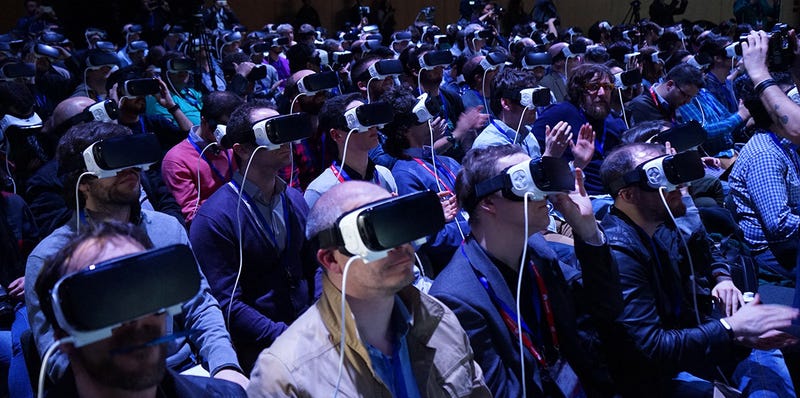
Today was weird. Samsung’s events are not something that usually fall under the definition of normal, but today was particularly crazy. See, I sat in a gigantic dark room filled with 5,000 other people while we watched the new Galaxy S7 phone being revealed—through a VR headset. It was terrifying and cool, but mostly terrifying.


The problem is it will just increase the number of people escaping from ER (Everyday Reality) and the amount of time they spend there. Did I really say that?


By Fritz Nelson, Marcus Yam (30 APRIL 2014)
Very useful round-up of history and developments up to 2014
[Tom's Hardware Tech site]


ENGADGET has lots of up-to-date video interviews with techies working on VR projects

[See Previous Post (2008): THE MILITARY ENTERTAINMENT COMPLEX ]