Saturday, October 13, 2012

ART NEWS

ART NEWS262 

I love this paper. A broadsheet sharply printed on great paper, beautifully designed and packed with interesting stories, what’s not to like? The price of a subscription – beyond my means. You can read some material from the latest issue for free on their website. Happily Elizabeth got me a freebie sample issue and these are some of the things I learnt from it.

 Faking It: Manipulated Photography Before Photoshop


BFEORE PHOTOSHOP: For some time I’ve been thinking that a book of this title was needed to get people to understand that photo manipulation has a history as long as the medium itself. So was interested to read about ‘Faking It’ a current exhibition at the Metropolitan Museum of Art in New York, open until 27th May next. It contains 200 photographs from 1940 to the 1990s. Its curator Mia Fineman told Art News: ‘Photographs have never represented the unadulterated truth. Photographic manipulation is part of a long tradition that has never been examined closely because there has always been a desire to believe photographs represent the truth.’ Interestingly the exhibition is sponsored by Adobe. There is also an ancillary exhibition: ‘After Photoshop: Manipulated Photography In The Digital Age.’


THE END OF KUNSTHAUS TACHELES: This giant derelict artist’s squat in Berlin, occupied since the fall of the Berlin Wall, was finally shut down in September. Art News writes: ‘Its the end of an era, as Berlin loses loved alternative cultural spaces to property speculators and the well-heeled.’ More on this story can be found here on mutualart.com and freedomspark


STEVE POWERS/A LOVE LETTER FOR YOU: This documentary is about street artist Steve Powers and his huge mural project In Philadelphia. See details at ghostrobot.com
 
You can view a trailer and buy a download at their Facebook site.


Background according to freenewsprojects.com

In 1984 Steve Powers started climbing rooftops in his neighbourhood and painting his alias ESPO as a dues paying member of the ICY graffiti club. 25 years later he returned home to Philadelphia in the summer of 2009 to write a love letter across the same rooftops facing the Market-Frankford line. The letter, meant for one, with meaning for all, encompasses 50 walls on a 20 block stretch of market street. Drawing input, inspiration, and work from the community Powers created a letter to and from west Philly. This unprecedented public art project was a collaboration of Powers, The Mural Arts Program, and the Pew Center for Arts and Heritage. It required 1200 cans of spray paint, 800 gallons of bucket paint, and the skilled hands of 20 of the finest spray painters in America, who Powers put into the legendary ICY club.

EXPERIMENTAL FILM: Pip Chodorov was a new name to me but have discovered he is not only an experimental film maker in his own right but has also directed the documentary ‘Free Radicals: A History of Experimental Cinema’ (due out on DVD shortly), established the first art gallery (in Paris) devoted to experimental film [see: http://www.re-voir.com/) and is  curating a show of Jonas Mekas work at the Serpentine Gallery. [There is a section called Experimenta as part of this year’s London Film Festival which opens this month.


http://www.ibiblio.org/wm/paint/auth/klimt/klimt.adele-bloch-bauer.jpg

KLIMT’S 150TH BIRTHDAY: Klimt’s original studio has been restored and is now open to the public, says Art News. Take a virtual tour here: www.klimt.at

My interest in Klimt was revived recently when I discovered this remarkable book  - The Age of Insight: The Quest To Understand the Unconscious in Art, Mind and Brai8n, from 1900 to the Present’ by Eric R. Kandel.The book is huge and expensive but there are substantial extracts which can be read for free on Amazon.

Particularly interesting is the section  on the painters Klimt, Schiele and Kokoschka and the effect that science had on their work. thanks to the salon culture of Vienna of that period which provided a ready interchange between art and science.  Klimt in particular was fascinated by Darwin’s ideas and arranged a slide show for fellow artists of the latest scientific images showing for the first time how a human embryo developed. He attended autopsies and incorporated scientific imagery into his paintings.

SILVER SCREEN/ONCE UPON A TIME IN ANATOLIA

This is a truly great film. I have watched it three times over the last 10 days and each viewing reveals more subtlety. Set largely in the steppes of Turkey over one long night, as a group of men search for a dead body, its based on real story known to one of he screenplay’s co-writers, who was a doctor in the area where the film is set.

Why is it so good. The landscape is a major player and the cinematography is brilliant and original, both the colours and the framing. It is shot in Cinemascope which gives it a really widescreen feel.

The story itself is as rich as a good novel. The main storyline is accompanied by at least four others that interweave. The director pulls off this trick in several occasions of showing you something whilst the actual dialogue is happening somewhere else.

Like the long opening segment of ‘No Country for Old Men’ - the Coen Brothers best film to date -  there is virtually no music which means that the film has incredible intensity and focus. The actors are superb and believable with no false notes.

At more than 2 1/2 hours, this is a gripping ride with real depth. A truly great film -  a tribute to its director Nuri Bilge Ceylan.

Official film site: www.nbcfilm.com/anatolia/anatolia.php?mid=1

Sunday, October 07, 2012

CURIOUS FACTS: Military Camouflage & Deception 1


A mobile tank dummy created by magician and illusionist Jasper Maskelyne. Source: warandgame.com

THE GENERALIST has long been fascinated by this topic, This post was triggered by a feature by Allan Mallison in The Times concerning a new book - ‘The Phantom Army of Alamein: How the Camouflage Unit and Operation Bertram Hoodwinked Rommel’ by John Stroud [Bloomsbury].

The Camouflage Unit, Mallison writes, was ‘ a small army of painters and carpenters, many of them straight from the West End Theatre, Ealing and Elstree, photographers and draftsmen “kidnapped from every part of the Army”. Also the flamboyant stage magician Jasper Maskeleyne ‘whose imagination, inventiveness and technical skill was matched only by his ability at self-publicity.’

Operation Bertram’s main role was to convince Rommel that the British were going to attack from the wrong direction. To this end, they needed to disguise 600 tanks to look like lorries and create ‘the illusion of 600 tanks in an entirely different area. Thy had ‘exactly 25 days to complete their work and pull off an unprecedented military coupe de theatre.’

CAMOUFLAGE1263

This picture shows how they disguised the real tanks; picture of dummy tank at top. They also succeeded in ‘conjuring up two divisions, field guns and supporting vehicles with wood, string and straw.’ The deception worked perfectly and made a major contribution to the British victory at El Alamein.

Many of these techniques were subsequently used in the run-up to D-Day.

According to Wikipedia, the Americans had their own thing going – The Ghost Army:

The Ghost Army was a United States Army tactical deception unit during World War II officially known as the 23rd Headquarters Special Troops. The 1,100-man unit was given a unique mission within the Army to impersonate other U.S. Army units to deceive the enemy. From a few weeks after D-Day, when they landed in France, until the end of the war, they put on a travelling road show, using inflatable tanks, sound trucks, phony radio transmissions and playacting. They staged more than 20 battlefield deceptions, often operating very close to the front lines. Their mission was kept secret until 1996, and elements of it remain classified.

ghostarmy 227

A documentary ‘The Ghost Army’ by Rick Beyer, due for screening on the US network PBS in 2013 makes the story sound even more fascinating.

‘In June 1944, a secret U.S. Army unit went into action in Normandy. The weapons they deployed were decidedly unusual: hundreds of inflatable tanks and a one-of-a-kind collection of sound effects records. Their mission was to use bluff, deception, and trickery to save lives. Many were artists, including some who would become famous, including a budding fashion designer named Bill Blass.  They painted and sketched their way across Europe, creating a unique visual record of their journey. The story of what these men accomplished was hushed up by the Pentagon for more than forty years.’

CHECK OUT THE AMAZING TRAILER


LNKS:

Military Hoax Collection

CURIOUS FACTS: Military Camouflage & Deception 2

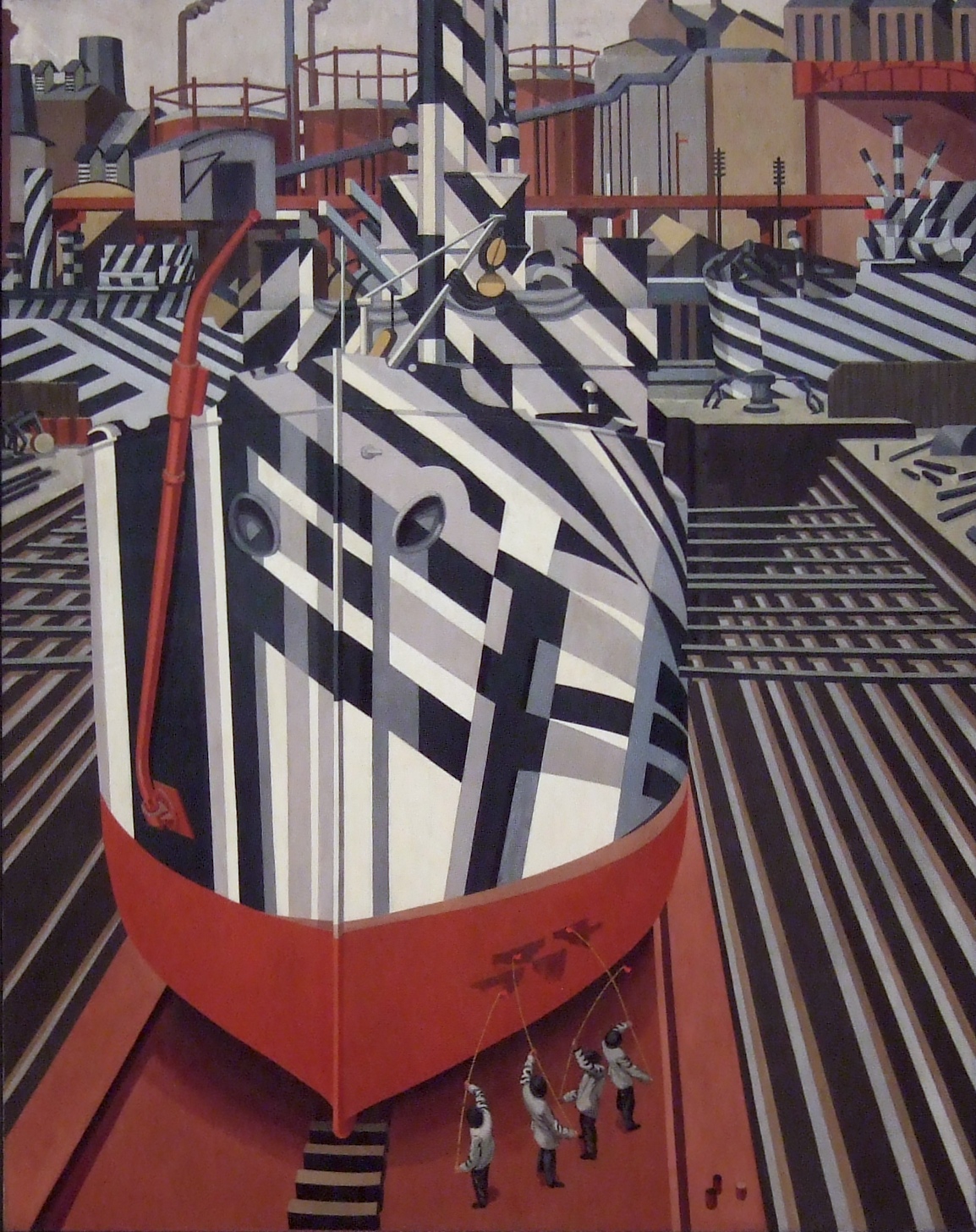
File:Dazzle-ships in Drydock at Liverpool.jpg

‘Dazzle-ships in Drydock at Liverpool’ By Edward Wadsworth [National Gallery of Canada] Source: Wikipedia.

My original interest in this topic stems from the paintings of Edward Wadsworth. The concept of ‘Dazzle painting’ was invented by the artist Norman Wilkinson in 1917 as a way ‘of using stripes and disrupted lines to confuse the enemy about the speed and dimensions of a ship.’ According to Wikipedia:

All British patterns were different, first tested on small wooden models viewed through a periscope in a studio. Most of the model designs were painted by women from London's Royal Academy of Arts. A foreman then scaled up their designs for the real thing. Painters, however, were not alone in the project. Creative people including sculptors, artists, and set designers designed camouflage.The Vorticist artist Edward Wadsworth supervised the camouflage of over two thousand warships, and his post-war canvases celebrated his dazzling ships.

Wikipedia also claims that ‘Dazzle attracted the notice of artists, with Picasso notably claiming that cubists had invented it.’

Click here to return to the story.

One of the British Dazzle design. Source: Razzle Dazzle

One from a recently rediscovered set of 455 plans for ‘dazzle’ camouflage for US merchant ships in World War 1, first exhibited in 2009 at the Rhode Island School of Design in the US. Browse a big selection of them here: http://dazzle.risd.edu/

If you’re interested in exploring further, check out the fantastic BEDAZZLED blog. Its a great source.


(image credit: Jim and Jamie Richter. This picture is just one extraordinary image from this fantastic post - ‘Modernist Art in Camouflage’  - on the excellent www.darkroastblend.com

ADDITIONAL LINKS

Aircraft Camouflage

CUROUS FACTS: Military Camouflage & Deception 3


Full-color reproduction in The Sphere magazine (3rd August 1918) of a World War I painting (by an artist named S. Ugo of British soldiers applying disruptive camouflage to the surface of a cannon. Source: camoupedia blog

This third post draws on material from the CURIOUS FACTS ARCHIVE - ‘Camouflage: A History of Concealment and Deception in War’ by Guy Hartcup [David & Charles 1979] and an article tucked inside it - ‘General Pattern Army’ by John Windsor [The Independent on Sunday [4th August 1996].The latter was partly based on the first comprehensive history of camouflage uniforms – ‘Brassey’s Book of Camouflage’ by Tim and Quentin Newark, published that month. The following year, the Imperial War Museum staged an exhibition entitled ‘Camouflage’. Read the BBC News account and listen to audio interview with the curator here. Tim Newark’s pictorial history ‘Camouflage’ was published by Thames & Hudson the same year.

Beginning in the First World War, British, French and Germans employed artists as camouflage designers. Windsor writes:

‘The German Expressionist Franz Marc…. was released from the German frontline cavalry and let loose on nine tarpaulins intended to hide artillery from spot­ter planes. He wrote ecstatically to his wife that he had painted them with pointillist designs and that they represented his artistic develop­ment "from Manet to Kandinsky!" Neither Marc nor the Kandinskys survived the war.

The leader of the first military camouflage section, the fashionable Parisian portraitist Guirand de Sceuola, was always seen in white kid gloves as he supervised the work of 20,000 painters in French camouflage workshops.

CAMOUFLAGE AND CUBISM

‘In order to deform totally the aspect of an object, I had to employ the means that cubists use to represent it.’ —Lucien-Victor Guirand de Scévola

‘I well remember at the beginning of the war,’ Gertrude Stein wrote in 1938, ‘being with Picasso on the Boulevard Raspail when the first camouflaged truck passed. It was at night, we had heard of camouflage but we had not seen it and Picasso, amazed, looked at it and then cried out, yes it is we who made it, that is Cubism.’ Stein went on to suggest that the entire First World War had been an exercise in Cubism.’

- Patrick Wright [London Review of Books/23rd June 2005]


Detail from "The 40 Camofleurs", a 1916 French cartoon on camouflage artists attributed to Drevill (Imperial War Museum)

A different account of the French camofluers in Wikipedia:

Lucien-Victor Scévola is considered one of the inventors of military camouflage during World War I, together with sub-officer Eugène Corbin and painter Louis Guingot. At the start of the war, in September 1914, de Scévola, serving as a second-class gunner, experimentally camouflaged a gun emplacement with a painted canvas screen. On February 12, 1915, General Joffre established the "Section de Camouflage"  at Amiens.  By the end of 1915, de Scévola became commander of the French Camouflage Corps, employing cubist artists such as André Mare, a specialist in camouflaging lookout posts. By 1917, de Scévola's team had grown to 3000, taking in artists including Jacques Villon, André Dunoyer de Segonzac, Charles Camoin and Charles Dufresne.

More interesting information from the French Wikipedia on Camouflage [amended translation via Google Translate].

* The French Camouflage Corps had a chameleon badge as their official symbol. One of these creatures – a master of natural camouflage -  lived freely in the workshop of Louis Guignot.

* It claims that Guirand’s camouflage factory employed 1,200 men and 8,000 women.

* The Guinness Book of World Records dates the first use of modern camouflage as February 12th 1915

* It was during the First World War that foreign armies began using the French word ‘camouflage’ – which didn’t exist in their native languages.

Camouflaged German steel helmet from World War I (image: Imperial war Museum)

Source: Imperial War Museum

* In 1916, German soldiers adopted a new steel helmet – the Stahihelm – which they painted with geometric shapes and bright colours in order to hide their silhouettes ‘when looking over the parapet’.


OBSERVATION POST TREES

CAMOUFLAGE3265

Plan for constructing an observation post tree. Source: Imperial War Museum.

According to Hartcup’s book, de Sceola was the first to disguise observation posts as trees.

Trees stripped of their branches by bombardment were cut down at night and dummy trees substituted in which men could sit protected by steel plate and connected to base by telephone. The first dummy tree was set up near Lihors in May 1915 during the Artois battle.’

The English artist Solomon J Solomon, a Royal Academician and portrait painter led Britain’s camouflage section. He was instructed to follow the French example and make an observation post on the Yver Canal. Hartcup writes:

The banks were lined with poplars, willow and birches and Solomon made some drawings, at the same time as undergoing his baptism of fire, eventually selecting a willow.

He then returned to England to supervise the construction of the OP. The steel core, made of sections bolted together, was just large enough to hold and observer who mounted a ladder to his perch from where he could observe the enemy. Solomon design it so that the part facing the enemy would appear too small for a man to ascend the tree…The outside of the core was now covered with bark from a  decayed willow in Windsor Great Park, after permission had been obtained from the King to cut down the tree. When ready for final assembly the trunk was screwed into a steel collar which would be embedded in the ground. The whole equipment weighed about 7cwt [355.6kg] and required twelve men to lift it.’

CAMOUFLAGE4266

Solomon J. Solomon’s own painting of his first observation post tree which was erected on 22nd March 1916 [Imperial War Museum]


CURIOUS FACTS: Military Camouflage & Deception 4

British World War I sniper's suit (image: Imperial war Museum)

Left: Elaborate camouflage smocks created for snipers in World War 1 [Imperial War Museum]

‘Camouflage for personnel was not intro­duced until the Second World War,’ writes John Windsor.’ The "brushstroke" patterns of Second World War personnel camouflage show artist-designers still to the fore. Brushstrokes were standard issue in Britain, France and Thailand until the 1980s. It is modern collectors who have given patterns nicknames, not the army. There are probably 100 serious camouflage uniform collectors in the world, mostly in the US and Canada.’ Mass produced infantry camouflage had to wait until advances in textile printing,

"In Britain the army quite likes to see camouflage being used in fashion because at the end of the day it doesn't want to be different from the people it is fighting for and likes to be understood and appreciated by them. At one stage, the British Army thought of making their own street wear which they could sell and which would encourage interest in the military."

-Tim Newark

The crossover from military camouflage wear to street fashion is one that Tim explores in his book but the man who has done to most to not only investigate the subject but also manufacture and design camouflage fashion through his label maharishi is Hardy Blechman.


According to his website: Hardy Blechman is head designer of maharishi, the company he founded in 1994. Blechman, whose former experience lay in the international military and industrial clothing surplus trade, started maharishi by producing hemp and other natural fibre clothing as well as recycling workwear and military surplus.

In 2000, Blechman was named Streetwear Designer of the Year by the British Fashion Council. A second line, MHI,was launched by Blechman in 2001. In 2003, Blechman also set up a company producing non-violent toys. His flagship MHI store, DPMHI, opened in 2004.

In his first book published the same year, Blechman explored the subject of camouflage in great depth. ‘DPM: Disruptive Pattern Material’

An extensive review of the book  - ‘Cubist Slugs’ by Patrick Wright  - appeared in the London Review of Books/23rd June 2005.  If you have enjoyed reading these posts there is a great deal more historical information to be found here, particularly about Solomon J. Solomon and the American pioneer Abbott Thayer.

Here is some extracts:

‘It was only after 1945 that camouflage leaked into civilian society in the form of printed fabrics and army surplus garments. Far from being dissolved back into its ‘natural’ or ‘artistic’ constituents, camouflage carried military symbolism into civilian life. It was favoured by the hunter, the code-scrambling hippy, the survivalist, the anti-federalist fantasist. It became the unofficial uniform of diverse malcontents who went off to build shelters, real or symbolic, in the woods of the late 20th century.’

As the founder and ‘creative director’ of a company called Maharishi, he associates wearing ‘camo’ with conscientious objection and looks forward to ‘nullifying’ the military associations of the many camouflage designs illustrated in his book. Encouraged by the extent to which other items of clothing – he mentions the tie, the T-shirt and the cardigan – have made the journey from military to civilian use, he would like to convert the beauty of camouflage patterns by ‘taking them out of their practical context of concealment in battle’. Across many cultures, as he explains, green is felt to be ‘an inherently “good” colour’. It can reduce stress and ‘engender calm’ among psychiatric patients, and it comes with a long history dating ‘back to mythical figures such as the Green Man’.

Blechman, who started trading from a friend’s floor in Chelsea Harbour but soon moved east to establish his headquarters on Hackney’s Kingsland Road, acquired stocks of surplus utility clothing from the military and British Telecom. To begin with he bought and adjusted stuff he liked – changing the cut, adding screenprints or computerised embroidery – but soon he started to design his own clothes, using synthetic microfibre fabrics to create the ‘combat chic’ on which his success as a seller of streetwear is based. He feels, most ardently, that the military should not be allowed to ‘maintain its dominion over these patterns that were originally influenced by artists’ interpretations of the natural world’. He argues that the more camouflage is used outside the military, the less likely it is that camo-clad civilians like himself will continue to attract abuse.

articleimg_DPM_book

See the website for ‘DPM: Disruptive Pattern Material: An Encyclopedia of Camouflage’ here.

Hardy Blechman continues his researches and writing on this subject on his excellent blog Camoupedia

Tuesday, September 18, 2012

MUSIC BOOKS: BUDDY BOLDEN, ALEXIS KORNER, CAPTAIN BEEFHEART & FRANK ZAPPA

MUSIC BOOKS1257 MUSIC BOOKS2258

MUSIC BOOKS3259 MUSIC BOOKS4260

Books arrive at The Generalist HQ from all quarters and sometimes they arrive in groups. Hence a quarter of music books, all of which are worth investigating. 

    The Buddy Bolden Band. Buddy is second from left in the back row. Source: www.mikeballantyne.ca

‘Coming Through Slaughter’ by Michael Ondaatje, most famously known as the author of ‘The English Patient’ is a stand-out experimental fiction (a first novel, first published in 1979) which imaginatively extrapolates from the scraps of knowledge known about the life of Buddy Bolden – a legendary cornet-playing pioneer of jazz. Ondaatje’s prose tries to mimic Bolden’s playing and the patchwork of different texts gives the whole work a musical feel. No recordings of Bolden exist and few photographs. This book has an incredible raw intensity to it matching Bolden’s raw life; he suffered from schizophrenia, was put in a mental hospital after an episode of ‘acute alcohol psychosis and died one year later in 1931 and at the age of 54. It stands in my mind alongside Geoff Dyer’s ‘But Beautiful’ as one of the greatest imaginative books on jazz.

in the book we meet the real life photographer  E.J. Bellocq, a strange distorted figure who haunted the brothels of New Orleans, almost a parallel figure to Toulouse Lautrec. He may have photographed Bolden. Bellocq destroyed most of his work and the only surviving glass slides were uncovered and rescued by Lee Frielander in the 1960s. See: iconic photos

*

Source: www.serdanoite.blogspot.co.uk

Alexis Korner was without doubt one of they key figures in the evolution of British music in the ‘50s and ‘60s as I now understand after reading Harry Shapiro’s thorough and absorbing biography.

His background was a mix of cultures and languages, his youth troubled, his appearance never less than striking, his voice distinctive. Along with Chris Barber and the short-lived pugnacious Cyril Davis, he certainly introduced blues to Britain through his clubs in Ealing and Soho. He was also a pioneer of rhythm and blues and his band Blues incorporated was a training ground and showcase for some of the great musicians of his time – including Jack Bruce, Ginger Baker, Phil Seamen, Zoot Money, Dick Heckstall-Smith, Long John Baldry et al.

[Keef acknowledges his importance on p88 of ’Life’. Mick Jagger, Charlie Watts and Ian Stewart had all played with Alexis and he also became great friends with Brian Jones.]

Alexis played with a bewildering number of line-ups, often assembled on the same day as the gig, and extended his musical repertoire to include jazz, gospel and many other forms. He may not have been good at managing money but virtually no-one has a bad word to say about him. He had a natural talent for bringing people together and bringing out the best in them. His London flat where he lived with his wife and partner Bobbie and kids was Number One crash pad and social meeting place for a galaxy of great musicians from Charlie Mingus to Bob Dylan.

Alexis Korner

Source: www.bluesstammtisch.de/memorie.php

Alexis had a huge career also in broadcasting, hosting numerous radio and tv series on the music he loved. Later he toured restlessly all over Europe, triggering a blues boom on both sides of the Iron Curtain. Yet he never fully achieved either the celebrity or the financial rewards he deserved. This book celebrates a very special man, who died too young (at 55 on Jan 1st 1984). He deserves greater recognition. [There are lots of CDs available, videos on You Tube, online discographies and further info. Get surfing]

[I once had breakfast at the same hotel table with Alexis Korner, in Amsterdam at the first international Legalise Cannabis Conference, which I was covering for the NME and I also had the privilege of sharing a coach from London to Brighton and back with Captain Beefheart and he Magic Band in the early 70s.]

Source: louderthanwar

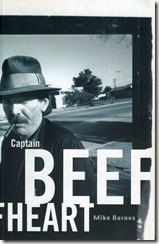
The Captain Beefheart bio is a stonker. Mike Barnes is not only intensely meticulous but his prose has a real zing in its step which brings Beefheart’s ‘out there’ music to life. A frenzied mixture of deep blues, rock, old Weird Americana  and free jazz, exemplified and crystallised in the acknowledged masterpiece of Beefheart’s ouevre ‘Trout Mask Replica’, Barnes relishes in its fury, complexity and intricate word play. He writes;

‘On the opening song, 'Frownland', the new universe of Trout Mask Replica is glimpsed in a one-and-a-half-minute microcosm. For the listener, at least, the tortuous rehearsals, hardship and deprivation had all been worth it. The standard role of the two guitars, bass and drums rock line-up is subverted to the point where nothing ever settles or is repeated to any extent. Stuttering drums vie for space with an angular bass and atonal guitar motif in a different metre, and soon a keening lead guitar line rips its way out of the tangled undergrowth. Less than fifteen seconds in, it dissolves into a torrent, the instruments thrashing around each other in complex contrapuntal patterns. But the music carries an inexorable forward motion - it rocks, in other words. The last piece in the puzzle is Van Vliet's vocal roar. He bellows out a yearning, soulful blues which further warps the already warped structure, pleading, 'I want my own land', realizing that his wish is becoming fulfilled as he sings the words.’

Barnes’ book provides a valuable key to understanding Beefheart the man and his often seemingly impenetrable music. As you will imagine, Don van Vliet’s life was a strange one. As a precocious child, he locked himself in his bedroom for three weeks whilst he modelled all the known mammals of the Northern hemisphere. Once hooked into music via his connection with Frank Zappa (they both lived in the same desert town), he proceeded to follow his unique musical path. He drilled his Magic Band obsessively, giving them alternative identities (Zoot Horn Rollo, The Mascara Snake etc) and browbeating them into learning complex musical pieces which he whistled but never wrote down. Kept in a permanent state of penury and hunger, the musicians stuck with his radical methods and produced music that has had a huge influence on a wide range of subsequent musical genres, analagous  to the effect William Burrough’s work has had on modern culture.

Source: http://home.gwi.net/~drrknrl/fzappa.html

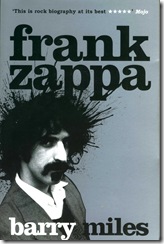
Barry Miles bio on Zappa makes an idea companion piece. Zappa and Beefheart had the proverbial love/hate relationship for all of their lives yet each stimulated the other to produce landmark recordings.

By Miles’ account, the key event in Zappa’s life was when he was set –up by a cop who, in the guise of a used-car salesman, offered Zappa and his girlfriend to make an ‘exciting’ tape for a party, including ‘oral copulation’. Zappa spoofed the whole thing but when it came time to make the deal, he was busted on suspicion of conspiracy to manufacture pornographic materials and sex perversion – both felonies. Most of his six-month sentence was suspended but he did spend a hellish 10 days cramped together with 44 men in Tank C of the San Bernadino County Jail. Miles writes:

‘By the time he got out, he no longer believed anything the authorities had ever told him. Everything he had been taught at school about the American Way of Life was a lie. He would not be fooled again. He made sure that his pornographic tape was heard by everyone – he remade it time and time again…rubbing it in the face of respectable society, making America see itself as it really was: phoney mendacious, shallow and ugly.’

Zappa was blessed with a musical genius which he used to blend the ideas of the avant-garde composers Edgar Varese and Igor Stravinsky with 50s doo-wop to produce a vast catalogue of music that remains a unique body of work. His seeming lyrical obsession with sex and the underbelly of US society provided an odd counterpoint to the complex musical backgrounds, further pushing the boundaries at a time when busts for obscenity were common.

He doesn’t come across as a likeable characters. He treated his musicians with cold disdain and spend a large part of his life sequestered away in his own recording and film editing studios, living on a diet of hot dogs, coffee and cigarettes. His jail time put him off drug use completely but his sexual obsessions were given free reign. A control freak, he built intricate business empires and held court in ever-expanding homes where anything went.

Miles doggedly follows in detail the complexity of Zappa’s multivarious enterprises and brings to life most vividly the 60s musical scene in Los Angeles, both on Sunset Strip and Laurel Canyon, where a stellar cast of seminal musicians snorted, puffed, partied and played their way to stardom.

‘Coming Through Slaughter’ by Michael Ondaatje [Picador.1984] ; ‘Alexis Korner: The Biography’ by Harry Shapiro [ Bloomsbury 1996]; ‘Captain Beefheart’ by Mike Barnes [Quarto 2000]; ‘Frank Zappa’ by Barry Miles [Atlantic Books. 2004]

SOME PREVIOUS POSTS ON MUSIC BOOKS:

LED ZEPPELIN: TRAMPLED UNDER FOOT

KEEF LIFE
ELECTRIC EDEN: BRITAIN’S VISIONARY MUSIC

ROLLING STONES: PAST AND PRESENT

PHIL SPECTOR: TEARING DOWN THE WALL OF SOUND

SILVER SCREEN: JAPAN/AKIRA KUROSAWA & HIROKAZU KOREEDA

Dersu Uzala cover art Akira Kurosawa is considered one of the world’s great film directors, best known for his samurai epics – Rashomon, Seven Samurai and Throne of Blood. He made 53 films including these three, my current favourites.

Dersu Uzala (1975) is the only film he produced and financed outside Japan. After his early success, Kurosawa was involved in a failed Hollywood project and his subsequent Japanese productions failed to ignite the box office. In a fit of depression, he tried to commit suicide in Dec 1971 and it was unsure whether he would work again. But in 1973 he was approached by the Russian Mosfilm studios and he proposed to them an idea he had been thinking about for thirty years – to make a film of the memoirs of the Russian explorer Vladimir Arseniev, who surveyed huge areas of uncharted wilderness in Ussuriland in the Far East of Russia in the 19th century. During this expedition he met a nomadic tribesman Dersu Uzala who became the group’s guide and Arseniev’s personal friend. Shot in colour over the course of a year in  challenging conditions, it is a moving and beautiful film which has become a personal favourite.

Stray Dog cover art My other two favourites are amongst the earliest and best detective and police procedural films in Japanese cinema.

‘Stray Dog’ (1949) stars a young Toshiro Mifune – who was to appear in 16 Kurosawa films – as a rookie detective whose pistol is stolen. Trying to track it down leads him into the illegal weapons market and the hunt for a young gangster. Kurosawa brings alive the streets of a sweltering Tokyo and both acting and cinematography are brilliant.

High And Low cover art

Also great is ‘High and Low’ (1963), in which the son of wealthy industrialist (again played by Mifune), is kidnapped for ransom. The film’s interesting twist in the story should stay as a surprise. What I find fascinating is the way he documents the police investigation (reminds me of Fritz Lang’s ‘M’), again beautifully filmed with great characters. Based on an Ed McBain novel, it bears comparison with the great Hollywood film noir.


After Life cover art A Japanese director you may not have heard of, from a younger generation than Kurosawa, is  Hirokazu Koreeda. ‘After Life’ (1988) was his first feature film after making a string of documentaries and its a great one.

Set in and and around a dilapidated institution, this it seems is where the dead go before passing on to the other side. Here in less than a week, a trained team helps then isolate their one defining memory of their lives. This is then re-enacted and filmed; once screened the person disappears carrying that single memory only into an eternal future. From this unusual premise Koreeda builds a fascinating and truly original film, drawing on his documentary background and including real-life people alongside professional actors. Its genuinely moving and thought-provoking.

Sunday, September 16, 2012

HISTORY OF ART: WILL GOMPERTZ/ROBERT HUGHES

ART HISTORY250  Let me begin by saying I am not the average reader of this book. I have been reasonably obsessed by the history of art since I was at school (a long time ago when, on school trips I first saw Ucello Brueghel, Pollock and Dali – all of which blew my mind).

In recent years I have spent an inordinate amount of time on three projects – one to find a diagrammatic way of representing individual artistic groups, second to find a way of mapping the history of art and three, collecting together pictures and paintings of artistic groups for a proposed book project. Thus when this new book appeared I devoured it in a couple of days.

John William Godward, RBA  (British 1861-1922) Violets, sweet violets tondo, 92 cm. (36 1/4 in.)

John William Godward, RBA (British 1861-1922) Violets, sweet violets tondo, 92 cm. (36 1/4 in.). Source: Bonhams

Gompertz was a former director of Tate Modern, responsible for their website and the Tate Magazine and is now head of BBC Arts. A thin voluble character with large specs and  flyaway hair, judging by a promo video on YouTube, he did a stand-up whiz through on modern art at the Edinburgh Festival which led to the commission for this book.

The book is, as you would expect, a chronological journey through the main artistic -isms of the last 150 years prefaced by one of his main treatises – that much modern art stems mainly from one man – Marcel Duchamp and his infamous urinal (signed R. Mutt and titled ‘Fountain’), a ready-made everyday object that by being exhibited in an art gallery became art. Thus art was no longer about painting on canvas or making sculptures but could be anything you could think of in any medium.

This is certainly the most accessible and unintimidating popular history of art available and is a great starting point as an introductory text to this fascinating subject. Its very readable, packed with interesting stuff and I learnt a lot by reading it.

I suspect his audience may be divided between those who would consider this work a dumbing down of art history and others, probably a younger readership, who would find his approach excellent and invigorating – and funny. They will, I think appreciate his contemporary references and jokey analogies and his determined attempt to blow the dust of art history and try and bring it to life for a contemporary audience. He writes: ‘There are times when those of us involved in the arts talk and write pretentious nonsense. Its a fact of life: rock stars trash hotels, sportsmen and women get injured, arts folk talk bollocks.’ His attempt to demistify the impenetrable and communicate his undoubted enthusiasm for his subject are to be applauded.

Now here come some caveats as the book is not without its problems which are worth examining, the most important being the relative shortage of illustration – limited to two 8pp colour sections, 39 black and white illustrations peppering the text and some very weak cartoons. This means that Gompertz has to describe in words a great many of the artworks he talks about which can get tedious and are difficult to visualise particularly if you haven’t seen the original before. There is also not a single picture of any of the artists themselves. Presumably the publisher would argue this is to keep the price down to make it affordable. The hardback edition as it stands is £20.

The book contains a fold-out which uses the London tube network graphic as the basis for mapping the art history the book contains  This time-honoured informational graphic has been used so many times to chart other subjects as well that it has become a bit of a cliché. But it works well with book to underline its strengths and weaknesses.

To follow the analogy, this is a main-line view of art history. The bid to create a strong narrative arc inevitably leads to simplification in the service of creating a tidier story – dominated by great men (Gompertz devotes one chapter to women artists), key moments, art groups and the –isms.

In actuality, a better model for the history of art would be a biological one – perhaps an unruly unpruned irradiated bush with thousands of interconnections growing from numerous root stocks which as it grows, mutates into unexpected formations and cross-pollinates with other plants to produce strange new fruit. (the intertwined nature of art and photography is still waiting to be properly evaluated and communicated).

The book ends with BritArt,  discussed in a fairly non-critical fashion, and the rise of street art (and, inevitably Banksy). Gompertz believes now that modern art is very market orientated and is dominated by a new –ism: Entrepeneurialism (a term he has personally coined) with its new emperors being  artists like Damien Hirst and Jeff Koons and  the ‘Big Daddy’ of contemporary art dealing Larry Gagosian, who now has galleries in New York, Beverley Hills, Paris, London, Hong Kong, Rome and Geneva.

In a significant paragraph Gompertz writes:

‘For the most part, contemporary art has been devoid of a hard political edge, save for the odd intervention that has generally had the look of a bandwagon hastily being jumped upon. On the whole, even when the avant garde artists of our age have been at their most aggressive and challenging, they have tended to present their work with a cheeky grin rather than an angry scowl. The inclination has been to entertain not campaign. The big shifts in society that have taken place over the last twenty five years have been largely overlooked by high-profile artists.’


20120331_BKP510

Source: ‘Art in the Middle East’  Prospero

This may be true at high-end of art but it certainly is not true in general terms. What the book lacks is a real understanding of the impact of digital technologies on art making practices, forms and styles. It also ignores the flood of work now emerging from Brazil, India and Egypt to name but three. Increasingly multimedia in form, totally global, permanently connected and fully engaged with the problems of our time – both aesthetic, cultural and political – the new art defies easy classification as its struggles to find ways of describing our post 9/11 world. Rauschenberg famously said something about that apocalyptic moment, that it was the greatest work of art created by the Devil. Time to bring on the angels.

*

Having given Gompertz his due, you’ll be thirsty for the deeper insights, wise judgment and sonorous language of what I and many others consider the greatest art writer and critic of our time – the recently departed Robert Hughes who died in August this year.

Fortunately all the episodes of his classic tv series ‘The Shock of The New’ are now available on YouTube. As is the remarkable ‘The New Shock of The New’ made in 2004. Everything that is good about Hughes is in this programme which starts with 9/11. Enjoy.


Sunday, August 26, 2012

CULT BOOKS: GAO XINGJIAN & BAO NINH

This is a still from the amazing video portrait of GAO XINGJIAN by ROBERT WILSON – a pure and perfect work of art – on the amazing DISSIDENT INDUSTRIES INC site, whose body of work looks extraordinary and exciting. 
 
In 2000, Gao Xinjian became the first Chinese writer to win the Nobel Prize for Literature for a body of work that includes this masterpiece which was begun in Beijing in the summer of 1982 and completed in Paris during September 1989. Known also for his plays and his large black and white ink paintings which have been exhibited widely. Out of all his work, since 1987 only one play has been published in China. He is now 72 and is a French citizen living outside Paris.   
Following a health scare when he was misdiagnosed with lung cancer and under pressure from the 'oppose spiritual pollution' campaign at the time. 'he absconded to the remote forest regions of Sichuan province and then wandered along the Yangtze river from its source down to the coast'. a journey of 10 months and 15,000 kilometres.
'Soul Mountain' draws on this experience but is also about one man's quest for inner peace and freedom. The book is experimental in style and is made up of many levels of thought and speech which, whilst initially confusing, soon flow into a remarkable river of stories and feelings. Gao writes like a painter and also looks deep into the soul of human nature. Reading this book is a mesmeric journey into both magical landscapes and deep emotions. Harrowing and beautiful by turn, this profound work will touch your heart and inspire your imagination.
Gao_Xingjian.jpg
‘After the Deluge’ by Gao Xingjian. Source: artnews.org

'The Sorrow of War' is a novel about a man writing his experiences of the Vietnam War, written by Bao Ninh who served with the Glorious 27th Youth Brigade of the North Vietnamese army and is one of only ten survivors of the 500 who set out in 1969 to fight the war. 
The book's protagonist Kien feels a burdensome debt as if he's 'carrying with him the history of his generation.' and he is forced to relive in flashbacks the horrors he witnessed, scribbling at night as if his life depended on it. The opening jungle chapter catapults you into a visceral, surreal world of darkness and danger - one of many vivid scenes of front-line conflict that pepper a story which also encompasses a intense and tragic love affair. To cut to the chase, this is as powerful, visceral and moving as Michael Herr's 'Dispatches'. It is an outstanding work that provides a valuable insight and perspective on the War from the North Vietnamese side – a much-needed corrective.


Thursday, August 09, 2012

MOVIES: THE FILM VS DIGITAL DEBATE


Due for release in the US this month is what looks to be a fascinating documentary, produced by Keanu Reeves called SIDE BY SIDE The Science, Art and Impact of Digital Cinema. Blurb reads:

For almost one hundred years there was only one way to make a movie — with film. Movies were shot, edited and projected using photochemical film. But over the last two decades a digital process has emerged to challenge photochemical filmmaking. SIDE BY SIDE takes an in-depth look at this revolution. Through interviews with directors, cinematographers, film students, producers, technologists, editors, and exhibitors, SIDE BY SIDE examines all aspects of filmmaking — from capture to edit, visual effects to color correction, distribution to archive. At this moment when digital and photochemical filmmaking coexist, SIDE BY SIDE explores what has been gained, what is lost, and what the future might bring.
 This is a real live issue. Check it out.

 Tribeca: Film vs. Digital in ‘Side by Side’By Mekado Murphy (New York Times). Interview with the director Chris Kenneally. 


MUSIC: ROUGH TRADE ALBUMS OF THE MONTH

Rough Trade have come up with a neat Album of the Month scheme whereby you get what they consider the best new release with added RT exclusive extra track or disc, plus the heads up on another nine interesting albums. There’s download options and a no-fuss exchange system. Given the ocean of new music out there, its great to receive a random disc through your door that somebody else has chosen for your listening pleasure

Top left is ‘Manifest!’ by Friends, a Brooklyn quintet who pump out a punked-disco melange of New York sounds, including their two hit singles ’Friend Crush’ and ‘I’m His Girl’. Not blown away but entertained and, after a few drinks, would certainly jig around to it.

Chilly Gonzales is a class act. This is, would you believe, a solo piano record of originality and class. Ideal early morning or late night music. Chill out with Chilly.

Adrian Younge Presents Venice Dawn (great name) on an album entitled ‘Something About April.’ which is ‘an eclectic mix of heavy, psychedelic soul and soundtrack-ready instrumentals’ according to their label Wax Poetics. I’m grooving to it as I write these words.

artworks-000025583626-te3juq-original

I have son Louis to thank for this thoughtful gift so here’s a shameless plug for the first single from his new band Hands Make Fire featuring ‘Parting Shot’ and ‘Waiting for the Echo’. Released yesterday, check it out on I-Tunes.

COMIX: THE SOMEDAY FUNNIES

 
 This unusual xtra-large format comic compilation is legendary in the comic book world as it took some 40 years before it was finally published in 2011 by Abrams ComicArts. It's creator Michel Choquette was originally commissioned in the early 1970s by Jann Wenner, publisher of Rolling Stone, to produce a comic supplement for the magazine on the 1960s. When the project expanded it was going to be a book published by Wenner's Straight Arrow Press. Then the whole deal fell through. The full saga of what happened next is fully documented in the links below.
What makes it so special is the line-up of writer's and artists who produced work for the project - 169 in total from 15 countries including Tom Wolfe, Frederico Fellini, William Burroughs, Jack Kirby, Tuli Kulferberg of The Fugs, Frank Zappa, Art Spiegelman, Ralph Steadman, Pete Townshend, Goscinny and Urderzo of Asterix fame and Will Eisner.

Pleased to see work in there by several comrades from the British underground press including Mick Farren and Edward Barker, Malcolm Livingstone, Richard Adams and Roger Hutchinson. 

Now available at a reasonable price from your usual internet outlets, its a valuable international showcase of a wide variety of comic and graphic talents from the 70s, each bringing their own style to the book's grand theme.  

Frame from Harry Buckinx's 'Titul and the Burning '60s'.

'Michel Choquette's Astounding, Iconic 1960s Time Capsule' by Tim J. Luddy (Mother Jones). Contains audio interview.

Review by Dan Nadel in The Comics Journal


Saturday, August 04, 2012

KAPUŚCIŃSKI REDUX

 'To what extent may one distort reality in order to reach the deeper truth that refelects the 'heart of the matter'? Where are the lines that mark the borders between fiction and non-fiction? By introducing elements of invention, by processing reality, do we shift our text from the 'journalism' shelf to the one marked 'literature'? Is literary reportage - as Kapuściński thought....a legitimate literary genre...?'
These questions haunt this  truly remarkable biography of an extraordinary writer, hailed by the likes of Salman Rushdie as one of the great foreign correspondents of the 20th century but whose reputation since his death in 2007 has been seriously besmirched by revelations that he fabricated many of the facts and accounts in his most famous books and embellished the story of his own life.

I was the first British journalist to interview Kapuściński when he arrived in the UK for the publication of 'The Emperor'. In 2007, I wrote a series of posts about the various meetings I had with him in London - at one of which I had the pleasure of introducing him to Bob Geldof, at another we met at the Royal Court Theatre and saw a performance of 'The Emperor' directed by Jonathan Miller - and about our correspondence over several years. There is also a reprint of the piece I wrote about him for 'The Face'. In 2011, I wrote a piece about this book (sight unseen) and collected a great many links which followed the original Polish publication of the book.

 All the above is accessible from this Previous Post: Kapuściński Revisited

That post, in turn, links also to a further series of investigative posts on Truman Capote's 'In Cold Blood' - widely and wrongly hailed as the first non-fiction novel. As the years have past, the 'factual' content of the book has been seriously questioned and it is now clear that much of the work was the product of Capote's heated imagination. In other words, a useful historical parallel to the Kapuściński story.

I call this book remarkable for a number of reasons. Firstly, Domosławski, a personal friend and a celebrated journalist in his own right, considered K a maestro and a mentor so it was with growing unease that, following K's death, he uncovered the secrets of both K the man and K the writer. The scrupulouseness of his investigation threatens the reputation of a man he loved and admired. 

He writes: 'Not for the first time I catch myself fearing that, without meaning to write an expose, I am discovering facts about the master's life which I would rather not know at all, and that I am creating a platform for massively negative opinions of him.'


Secondly, the translation by Antonia Lloyd-Jones is especially good as it captures the Polish style of prose, full of author's thoughts and rhetorical questions, which makes this intimidatingly long and detailed book really fascinating, unexpected and gripping to read.


Thirdly, Domosławski sets K's adventures - he is always the real centre figure of his books - in the broader context of the extraordinary birth of the Third World that K witnessed at first hand and the modern post-war history of Poland.

K was an enthusiastic communist until 1981, had friends in the Central Committee and wrote briefing papers and reports of utmost fidelity and factual accuracy for various branches of government. His groundbreaking expose of working conditions at the Nowa Huta steel works won him national acclaim and gained him the golden opportunity to travel the world.


The books that emerged from these experiences were written in a powerful literary style, a form of 'New Journalism' that was compelling, visceral, atmospheric and fresh. For obvious reasons Domosławski's revelations have seriously affected K's standing in the eyes of his fellow journalists for betraying his profession -  which he told me personally was, in his eyes, 'a vocation.'. 

Yet despite K's conrfabulations - he may have met Salvador Allende but he certainly didn't meet Che Guevara or Patrice Lumumba as has been widely claimed - there is still a wealth of excellent reporting and writing that will survive as great literature.

What he was certainly great at was 'capturing the essential mechanisms of any authoritarian power'. After all, he did witness twenty or so revolutions, uprisings and coups d'etat in the Third World. Both 'The Emperor' an 'Shah of Shahs' can also be read as metaphors for the reality of the Polish political structure which he was so adept at working within. He told me personally: "Human nature doesn't change that's why Machiavelli and Shakespeare are contemporary works."


Thanks to Domosławski, we now see K as a real-life complex figure - traumatised child, unfaithful husband, absent and cruel father, passionate communist - and as his own fictional creation. Finishing the book, walking through K's personal library and following K's final notes on his last journey to another world, one is left with a profound sense that his exploits and writings will continue to fascinate far into the future.


'Ryszard Kapuściński : A Life' by Artur Domosławski is published by Verso Books.

See also: Interesting audio assessment of the book on The Economist website: http://www.economist.com/node/21557299

The Guardian review