Saturday, July 06, 2019

PLANTING TREES COULD TACKLE CLIMATE EMERGENCY


Land available for forest restoration (excluding deserts, agricultural and urban areas; current forestland not shown). (Image: Crowther Lab / ETH Zurich)

Tree planting 'has mind-blowing potential' to tackle climate crisis

Research shows a trillion trees could be planted to capture huge amount of carbon dioxide
This remarkable report, first published in the journal Science,  offers what appears to be our best single hope of tackling the climate emergency.

A worldwide effort to restore trees would be the single biggest and cheapest way to pull carbon out of the atmosphere. Researchers have found that there is 1.7 billion hectares of treeless land on which 1.2 trillion trees could grow without sacrificing crop land or urban areas. In 50–100 years, those trees would remove 200 billion tonnes of carbon — two-thirds of all emissions from human activities so far. But every year, we are pumping out tens of millions of tonnes more carbon, so new trees are just part of a solution that must also include slashing greenhouse-gas emissions (and protecting the trees we’ve already got).


Earth has more trees than it did 35 years ago - but there’s a huge catch

Sunday, June 30, 2019

REVOLUTIONARY THINKING and PROTEST MOVEMENTS / BEAT AND COUNTER CULTURE MEMOIRS


THE GENERALIST has found over the years that books arrive in clusters, either by chance or by following a chain of connections. These titles all seem important in their own way, mirroring the zeitgeist of our times.

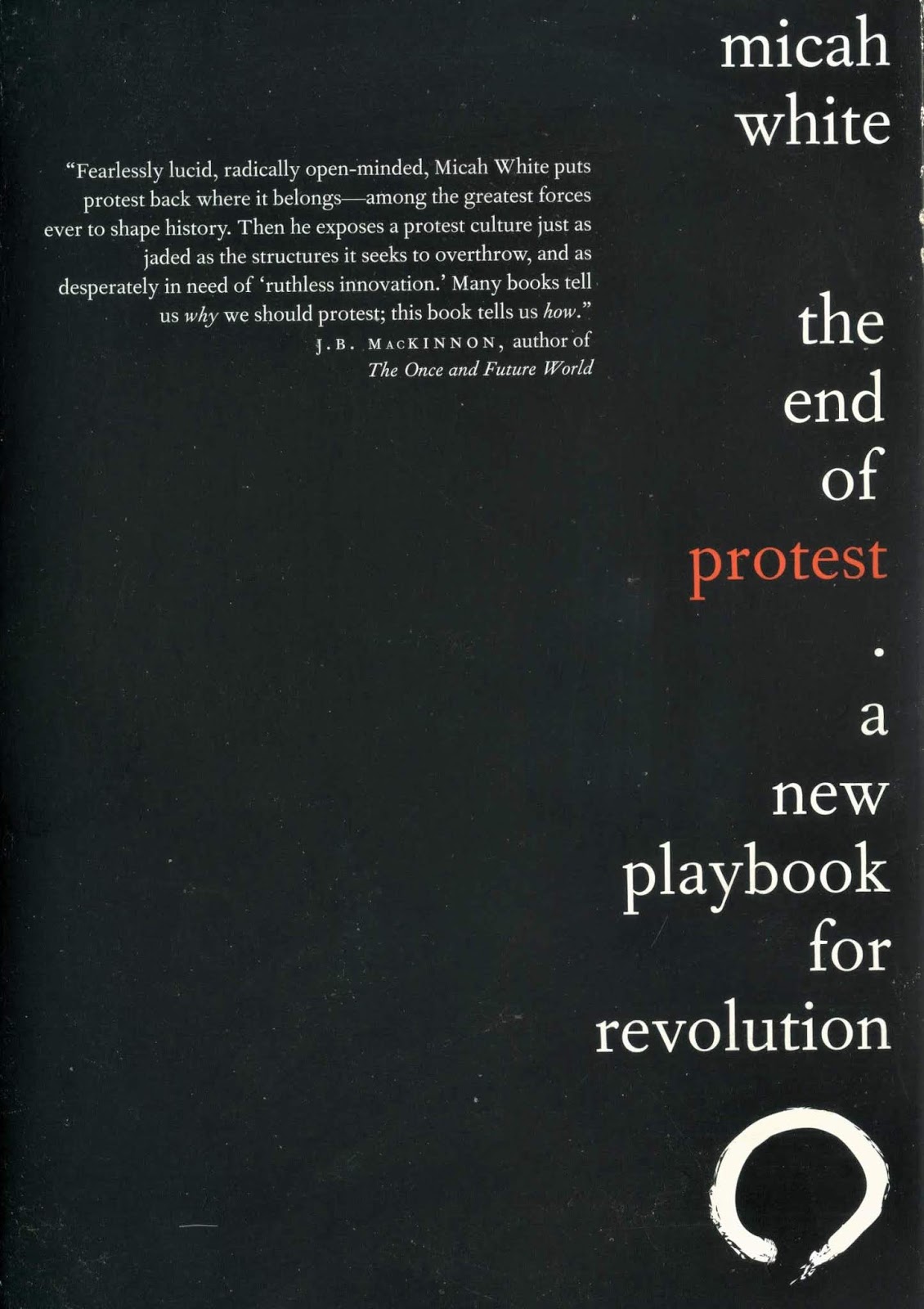
Micah White's 'the end of protest' is about new beginnings. MW was the co-creator of the #occupy meme. Hatched in Canada in the offices of 'Adbusters' magazine, the idea spread to 100 countries.
His book is partly a thought-provoking history of protest and revolutions examining their philosophies and forms of action and partly a set of new ideas on how we should run such matters in future. He looks back on Occupy Wall Street as a "constructive failure", something to learn from. He urges us not to use tactics that have already been discredited - like mass marches.  
Published in 2016, he might need to reassess this view in the light of Extinction Rebellion, whose carefully staged theatrical protests in London successfully catapulted concern about climate change into the mainstream media and conventional politics.


On May 1st, the UK became the first country to officially approve a motion to declare an environment and climate emergency. The BBC reported:
 'This proposal, demonstrates the will of the Commons on the issue but does not legally compel the government to act, [It] was approved without a vote....Dozens of towns and cities across the UK have already declared "a climate emergency".There is no single definition of what that means but many local areas say they want to be carbon-neutral by 2030.'

Mica White was one of the speakers at an OECD conference in Paris this June which was also attended by another speaker Alev Scott who wrote a diary piece for the Financial Times. The theme of the conference was Emotion which, Scott writes, 'is fuelling global politics now more than ever.' 

He discussed with others  'the long-term strategy of the Extinction Rebellion organisers, whose slogan “respectful disruption” signals their ambition not to overstretch the patience of the public.

'Do they represent a new era of canny protesters? Are they leading the way not just for protest movements but for future political parties with their stated agenda of “breaking down hierarchies of power”? The conversation felt immediate and far-fetched all at once.'

You can find out a helluva lot more about Mica White on his website

Extinction Rebellion was established in the United Kingdom in May 2018 with about one hundred academics signing a call to action in support in October 2018 and launched at the end of October by Roger Hallam, Gail Bradbrook, Simon Bramwell, and other activists from the campaign group Rising Up!  See the main website here: https://rebellion.earth/

*

Rules for Radicals: A Pragmatic Primer for Realistic Radicals is a 1971 book by community activist and writer Saul D. Alinsky about how to successfully run a movement for change. It was the last book that Alinsky wrote and was published shortly before his death in 1972. His goal for the Rules for Radicals was to create a guide for future community organizers, to use in uniting low-income communities, or "Have-Nots", in order for them to gain social, political, legal, and economic power.Within it, Alinsky compiled the lessons he had learned throughout his experiences of community organizing from 1939–1971 and targeted these lessons at the current, new generation of radicals. [Source: Wikipedia]


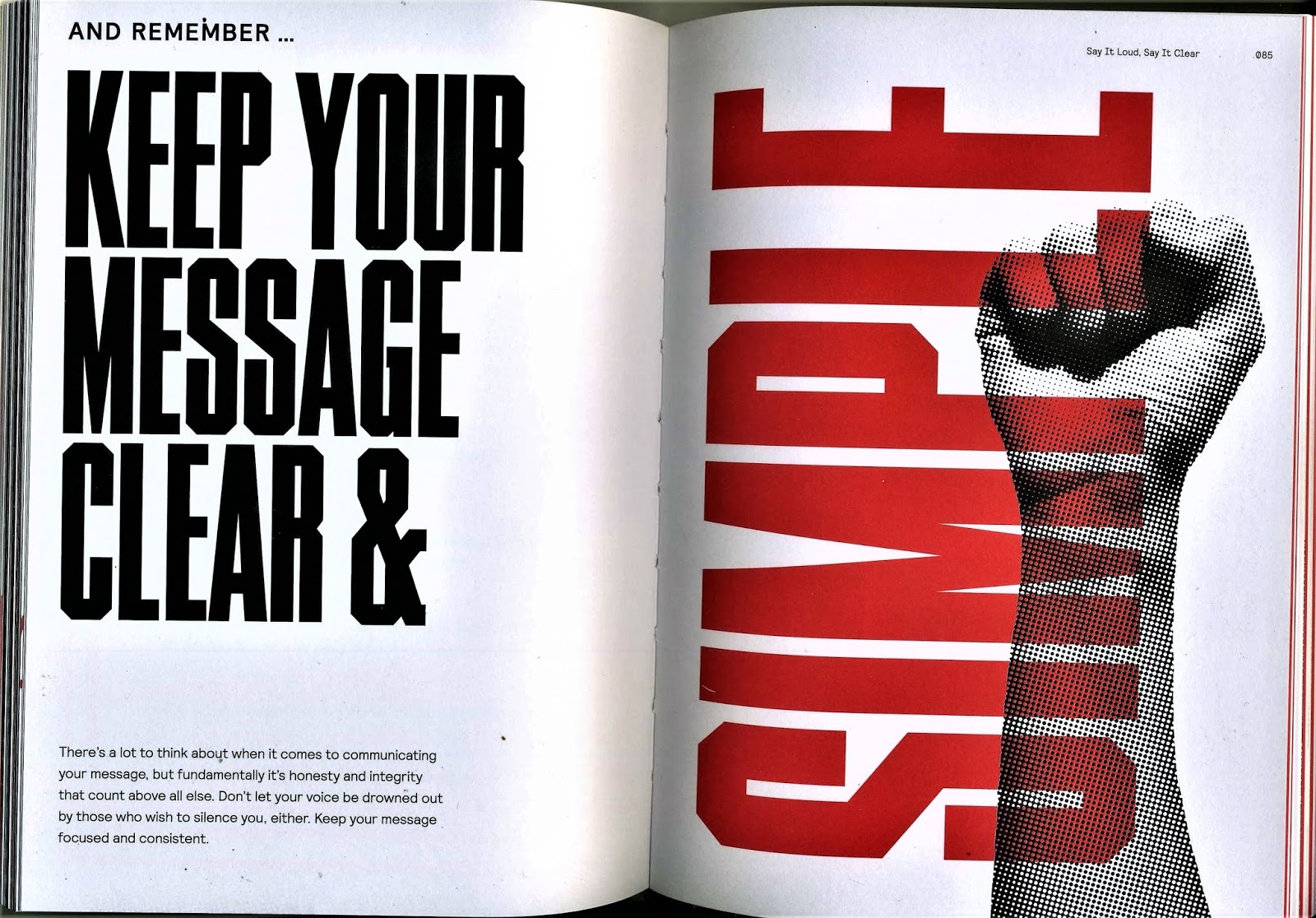
Published in 2018, 'Resist' is a punchy primer for would-be-activists. Its author Michael Segalov claims that we're living in an Age of Defiance, a time when taking action has never felt so necessary. It's about turning your ideas into actions - targeting those in power, getting press and social media attention, understanding your legal rights. There's also many activist stories to inspire.

What makes the book zing is the red and black graphic design by Oliver Stafford, the Art Director at Huck magazine


*


Two absolute gems for anyone interested in Beat Culture. The great poet Lawrence Ferlinghetti, owner of the City Lights bookstore in San Francisco, has written a remarkable autobiography at the age of 100. Its a triumph. The first part is the detailed story of his extraordinary real life childhood. He then swings into a huge poetic river of consciousness that roams and rambles and inspires, as if he was channeling Kerouac's monstrous feat of typing 'On The Road, on one log scroll of paper, while sitting in the john on benzedrine. The sweep and majesty of his mind will set your brain whirling. This is seriously deep food for thought and elightenment.

This relatively rare book, originally published in 1959 by Julius Messner in New York and republished by Martino Publishing in 2009, The Holy Barbarians by Lawrence Lipton is a remarkable portrait of the beat scene in Venice Los Angeles in the 1950s. In the preface he writes: 'In the case of the holy barbarians it is not an enemy invasion threatening the gate, it is "a change felt in the rhythm of events". Lipton and the writer Kenneth Rexroth met in Chicago in the late 1920s and they, he says, 'were as beat as any of today's generation...We have had to wait for the world to catch up with us, to reach a turn, a crisis. What that crisis is and why the present generatioin is reacting to it the way it does is the theme of this book.'

'Newer than the North Beach, San Francisco scene or the Greenwich Village scene, Venice has afforded me an opportunity to watch the formation of a community of dissaffilliates from its inception.... It is a deep-going change, a revolution under the ribs.'

This is an intimate picture of a lost world, cool as shit daddyo, stuffed with poets, artists, jazz musicians and pot. Here's a little sniff of the book's general vibe. Lipton brings it to life brilliantly.

The Joint is Jumpin' 
'By the time Chuck Bennison arrived, red-eyed after an all night session at bassist Phil Trattman's pad exploring "other realities" with the help of pot and jazz rhythms, a poetry reading was under way. Angel Dan Davies was holding forth with his latest jazz-inspired "open line," free form pieces, Nettie was in the kitchen again preparing a buffet supper, and the chairs, divans, floor — every square inch of sitting, lounging, squatting and sprawling space in the house — were full up. Beer cans, lemonade glasses, wine glasses, ash trays, sketch pads and notebooks made for precarious footing. The doorbell kept sounding every few minutes as the party got really swinging, for it had gotten around that Les Morgan, the popular Negro trumpet man, might fall in sometime during the evening and maybe bring along a couple of men from his quintet for a jam session of poetry and jazz. I had talked to Lester early in the week and he had eyes to make the scene, but you never could tell about Les and his boys; they didn't know quite what to make of this poetry and jazz thing and besides, they might get hung up at somebody's pad and not show up till around midnight, if at all.' 

*

 I was tipped off to the Lipton book by this other gem 'Dancin' In The Streets', [Charles H. Kerr. 2005] a fantastic history of two mimeographed magazines of the 1960s - The Rebel Worker' edited by Franklin Rosemont in Chicago and 'Heatwave' edited by Charles Radcliffe in the UK. These guys were far left and far out, as interested in comics as they were anarchism. They absorbed surrealism, followed the activities of he Situationists and the Provos and played a big role in revitalising the International Workers of the World (IWW) known affectionately as the Wobblies. Here are two extracts from Rosemont's brilliantly detailed account:


[Generalist Archive]
'It was the Beats, however, who gave us—my high-school friends and me—our first glimmer of poetry as a living, breathing, here-and-now activity. Serious students of the work of Kerouac and his comrades—Gregory Corso, Bob Kaufman, Diane di Prima, Gary Snyder and others—we went on to read the work of authors they admired: Rimbaud, for example, and Baudelaire, and D. T. Suzuki's writings on Zen. Such reading was actively discouraged by our so-called teachers, but we couldn't have cared less. How excited I was when Okakura Kakuzo's Book of Tea (cited in The Dharma Bums) arrived in the mail! For months afterward several of us would get together at odd moments and sit around a circle in the full-lotus position in our own version of the tea ceremony. The spirit of the thing was surely closer to the Marx Brothers than to Buddhism, but that didn't bother us. Breaking out of the repressive machinery of suburbia wasn't easy, and we tried to make use of anything that came our way.
*
'On the first of these adventures, I lived for several weeks in San Francisco's North Beach. Those who had arrived there a year or two earlier assured me that the "scene" in 1960 was in an advanced state of disintegration. For me, however, and for others my age who had made their way there from points all over the map, North Beach was so much livelier than anything we had known before that we found it hard to imagine how it could have been better. 
The neighborhood was hit hard by the massive publicity the Beat Generation was receiving—almost all of it hostile, some apoplectically so, like Alfred Zugsmith's ugly movie, The Beat Generation, which fostered the ludicrous misapprehension that the Beats were dangerous criminals. Ironically, this disinformation campaign brought square tourists by the thousands, especially on weekends, as well as "hippies," a term then used by Beats to designate the uncreative camp-followers who parasitically attached themselves to the Beat scene. 
Even worse, anti-Beat propaganda gave the police a pretext to escalate their war on all nonconformists. Police persecution, much of it aimed at interracial couples or groups, was an everyday fact of life in North Beach. I spent a large part of every day at two of the main Beat hangouts of those days: the Co-Existence Bagel Shop, a bar/deli at the corner of Grant Avenue and Green Street, and Lawrence Ferlinghetti's City Lights Bookstore a few blocks away, where I was able to relax in an armchair and read hundreds of poems as well as every book they had on surrealism and Zen. 
My San Francisco sojourn retains a special luster in my memory as one of those rare experiences that are truly worthy of one's child-hood dreams. My first sight of the Giant Redwoods, a couple of days climbing in the Sierras, hearing Ornette Coleman and John Coltrane live for the first time: How can one measure the impact of such priv-ileged moments? Intersecting with all the rest was a strong ancestral dimension, for my father's family were San Francisco pioneers...,  
It was a season of lucky breaks; small incidents had a way of adding up to something grand. With two friends—bass-player John R. White and a black street-philosopher from New York, known only as Ike—I went to Monterrey for the Jazz Festival. By mid-afternoon half the population of North Beach was there. John, Ike and I took seats before the tickets went on sale, so we enjoyed the whole program for free. (None of us had the price of admission in any case.) The music that night had all the magic of dreams; I hear its golden echoes to this day. It was there that I first heard Ornette Coleman live. After listening to his rip-roaring oracular sounds we wandered off in the darkness dizzy with joy. 
Brightest of all in my memory of that period is the unparalleled experience of community it provided. Life in North Beach was the closest thing to marvelous anarchy it has ever been my pleasure to enjoy. Despite battles with landlords, harassment by tourists, and mounting police terror, the Beats and their allies—old-time hoboes, jazz musi-cians, oyster pirates, prostitutes, drug-addicts, winos, homosexuals, bums and other outcasts—maintained a vital community based on mutual aid, and in which being different was an asset rather than a liability.'
 *


Charlie Radcliffe produced his own mag Heatwave and wrote for the Rebel Worker. His own two-volume set of memoirs are epic in proportions, a masterpiece of memory, bringing much needed alternative views of the history of youth culture from the 50s onwards: the politics, the music, the drugs, the Peace Movement, the Situationists, LSD. The extraordinary amount of detail in these two volumes is awesome, informative and totally entertaining.

On his website, the works are trailered as follows:
Arguably one of the quintessential ‘60s figures Charles Radcliffe sat down with the anti-bomb Committee of 100, edited one of the most influential revolutionary magazines, Heatwave, joined and resigned from the Situationst International, was a hashish dealer, edited an underground magazine, Friends, became an international drug smuggler and served a long prison sentence. A lifelong enthusiasm for blues and friendships with Murray Bookchin, Chris Gray, Eric Clapton, Franklin and Penelope Rosemont are also dealt with in this stunning autobiography.
The book versions are currently out of print but are available in a Kindle edition here. Described on this site as follows:
In his seminal socio history of Punk, “England’s Dreaming”, Jon Savage makes the bald assertion that “Charles Radcliffe laid the foundation for the next twenty years of sub-cultural theory”, referring in particular to his 1966 piece “the Seeds of Social Destruction’ that appeared in the first of two issues of Radcliffe’s co authored, insurrectionary street-zine, ‘Heatwave’ 
Teddy Boys, Ton Up Kids, Mods and Rockers, Beats, Ban the Bombers,The Ravers ( jazz heads) : Radcliffe argued that the bank holiday bust ups, the demos, the riots, the sex drugs n rock n’ roll, these were all part of a “youth revolt… (that ) has left a permanent mark on this society, has challenged assumptions and status, and been prepared to vomit its’ disgust in the streets. The youth revolt has not always been comfortable, valid, to the point or helpful. It has however made its first stumbling political gestures with an immediacy that revolutionaries should not deny, but envy.”
Radcliffe joined the International Situationists within the year, alongside (English founder ) Chris Gray, but by the time 1968 had ended, and youthful revolt had fed into wide pockets of political turmoil globally, Radcliffe had started to drift towards other poles of late 60s’s counterculture. He ended the 60’s in long hair and loon pants, banged up in a Belgian prison on hash smuggling charges.
This epic ( 900 + pages) book follows Radcliffes’ trials and tribulations from public school beginnings, into the 60’s underground and the Mr Nice style large scale hash smuggling years (his friend, Howard Marks, pops up throughout) , on to prison, divorce, remarriage and beyond. It offers up important first hand perspectives on 60’s / 70’s counterculture, and an intimate portrait of a man who seemed to face the slings and arrows that fortune threw at him with a never ending supply of equanimity. And high grade hash.


Thursday, June 20, 2019

BUCKMINSTER FULLER: "REALITY" SHOULD ALWAYS BE IN QUOTES

THE GENERALIST  was woken this morning by a radio programme on Buckminster Fuller, the visionary thinker who invented the geodesic dome amongst many other visionary things and spent his life travelling the world and talking (at great length) to people about his ideas of Spaceship Earth and how we should be developing ideas and technology that were less harmful to the planet.

A true pioneer and generalist thinker, he inspired millions of people to think differently about creativity and what is possible.

Was fortunate enough to go and see him talk at the American Embassy in London (I think) in the 1970s. It was an extraordinary experuience even if I didn't quite understand a lot of what he was saying. I would be in my early 20s.

Here's links to a couple of radio programmes and a whole lot more.

An Operating Manual for Spaceship Earth                                 Radio 4 Extra: The writer Tom Dyckhoff looks at the life and work of eccentric polymath Richard Buckminster Fuller. From March 2013.

Great Lives: Buckminster Fuller  
Radio 4: John Lloyd selects the maverick American architect, Richard Buckminster Fuller, inventor of the geodesic dome, as his choice of a great life. Matthew Parris hosts, joined by futurist and business strategist, Hardin Tibbs, as they debate the charge that if Buckminster Fuller - who had a molecule named after him, for its resemblance to his geodesic domes - really was the Twentieth Century's answer to Leonardo da Vinci, then why is he so little known about today? A man, John Lloyd argues, who preached environmentalism before the term was coined, so in advance of his times, but yet whose time has come today.


'Bucky' was well know for his quotes and aphorisms. Here's a few of my favourites:
 Integrity is the essence of everything successful. 

You never change things by fighting the existing reality. To change something, build a new model that makes the existing model obsolete

Never forget that you are one of a kind. Never forget that if there weren't any need for you in all your uniqueness to be on this earth, you wouldn't be here in the first place. And never forget, no matter how overwhelming life's challenges and problems seem to be, that one person can make a difference in the world. In fact, it is always because of one person that all the changes that matter in the world come about. So be that one person

We are not going to be able to operate our Spaceship Earth successfully nor for much longer unless we see it as a whole spaceship and our fate as common. It has to be everybody or nobody.


THE BUCKMINSTER FULLER INSTITUTE. 

BUCKMINSTER FULLER, 1895 - 1983
Hailed as "one of the greatest minds of our times," R. Buckminster Fuller was renowned for his comprehensive perspective on the world's problems. For more than five decades, he developed pioneering solutions that reflected his commitment to the potential of innovative design to create technology that does "more with less" and thereby improves human lives

This biographical sketch is a great place to start exploring this great man's life.

HEY SILICON VALLEY—BUCKMINSTER FULLER HAS A LOT TO TEACH YOU              Sarah Fallon /Wired magazine/ 29th March 2016


Eight of Buckminster Fuller's most forward-thinking ideas   Eleanor Gibson | 27 August 2018 De Zeen.com


After reading the manuscript for Bucky's first book in 1936, Albert Einstein told him, "Young man, you amaze me! I cannot conceive anything I have ever done as having the slightest practical application, … but you appear to have found practical applications for it (Einstein’s theories)."

Bucky 'saved and archived every possible aspect of his life, creating his Chronofile and making his life the most documented of any “ordinary, average” (not a public official) person in the history of humankind.Although that experiment has yet to be fully examined, the success of Bucky's life is indisputable. After discovering the natural underlying principles that govern all Universe, Bucky applied them to every aspect of his work where he: 


Was granted 25 U.S. patents.
Wrote 28 published books and thousands of articles.
Received 47 honorary doctorates.
Was presented with hundreds of major awards.
Circled the globe 57 times working on projects and lecturing.
Presented an average of 100 "thinking out loud" sessions per year (often labeled lectures, they would range from two to six or more hours in length), even when he was in his eighties.

Bucky’s campaign on behalf of the success of all humans and life on Spaceship Earth was the focus of the last phase of his life from 1976 until his death on July 1, 1983. During this period, he was continually traveling, making presentations, writing and sharing as much of what he had learned as possible.  It was, in fact, a last ditch effort to make certain that his life was complete and that the had given everything possible in support of his mission to create “a world that works for everyone.”
*

Monday, June 17, 2019

BOB DYLAN/ ROLLING THUNDER REVUE

 THE GENERALIST has written extensively on Bob Dylan, a mercurial figure whose global influence continues to spread and deepen.                                                                                                                                       This remarkable new film om Netflix of the 1975 Rolling Thunder Revue tour in the run-up to the US Bicentennial draws the performances and other footage from Dylan's 4-hour 'Renaldo and Clara' movie that died at the box office and is currently unavailable.                                                                                                                                                      Dylan is at his beautiful best. He sings with an intensity that matches the power of his wonderful songs, the words of which seem eerily contemporary. Now 78, Dylan appears briefly with wry comments on this long ago circus-tour initially of small venues that involved Allen Ginsberg, Joan Baez, Joni Mitchell, Ramblin' Jack Elliott, Sam Shepard and many others.                                                                                                                           Having been genuinely stunned by this powerful film I then set out to read the back story of the making of this movie. What one discovers is that many of the episodes and characters in the film are actually made up. The clue is right at the beginning with a clip from an early silent film of an illusionist. Dylan invented his own persona and has spent his entire life wearing a variety of masks and identities. In the age of Trump and fake news this also seems highly contemporary.

There are no spoilers in this post. Enjoy the film before reading these excellent features in which all is revealed. Each writer has a slightly different take on these sleights of hand employed by Dylan and Scorsese one presumes. Knowing the truth does not in any way affect the wonderment of the film but adds other levels to what is moving and profound experience.

See Previous Posts: Type Bob Dylan into search box on top left of this site.

The Chaotic Magic of Bob Dylan’s Rolling Thunder Revue                              by David Remnick/ The New Yorker/ June 10, 2019


by Richard Brody/The New Yorker/ June 14, 2019

A Guide to What’s Fake in ‘Rolling Thunder Revue: A Bob Dylan Story’
By Andy Greene / Rolling Stone / June 12th, 2019


Why Rolling Thunder Revue is a Terrible Documentary But A Great Bob Dylan Film

Review on Aquarium Drunkard/14th June 2019


Monumental 14CD Box Set Includes 5 Complete Bob Dylan Sets From Rolling Thunder Revue Concerts Spanning October-December First Leg, Rehearsal Performances, Rarities And More


Saturday, May 04, 2019

EARTH ART: CULTURE EMERGENCY / BROKEN NATURE / MEXICO CITY MURALS

A part of the Extinction Rebellion protests in London which received less mainstream coverage was the launch of CULTURE DECLARES EMERGENCY aimed at rallying individuals and organisations in the UK's cultural sector. The horse and rider led a procession from Somerset House to Waterloo Bridge and the Southbank Centre where readings and declarations were made before moving on to the Tate Modern's Turbine Hall pictured here. Both the rider and the poet and performer Zena Edwards were wearing living grass coats made by the artists Ackroyd and Harvey. You can sign up to enlist here. See also fuller account on this Museums Association site.


BROKEN NATURE


Reliquaries, Paola Bay and Armando Bruno. 2018, 
A handful of soil, a drop of pure water, a starfish. The glass case protects and presents them as they were reliquaries for a future time in which they’ll possibly be seen as rare, precious things.

In Italy, the XXII Triennale di Milano [open to September 1st] features 'Broken Nature: Design Takes on Human Survival' which highlights the concept of 'restorative design' as a force for positive change. The curator Paola Antonelli has selected more than 100 projects, experiments and products that provide “efficient and non-predatory solutions” capable of healing the fractures between humans and the natural enviornment.
'In exploring architecture and design objects and concepts at all scales and in all materials, Broken Nature celebrates design’s ability to offer powerful insights into the key issues of our age and promotes the importance of creative practices in surveying our species’ bonds with the complex systems in the world'
Even to those who believe that the human species is inevitably going to become extinct at some point in the (near? far?) future, design presents the means to plan a more elegant ending. It can ensure that the next dominant species will remember us with a modicum of respect: as dignified and caring, if not intelligent, beings.
'In her exhibition opening press conference, Antonelli focused on the importance of becoming more aware of the fragile relationship between human beings and environment also by the means of our everyday behaviors, for example by learning and promoting a new approach to the objects we use and their life cycle.' She told The Art Newspaper that after the exhibition she hopes to draw up a manifesto with other institutions. "Rather than being one voice, maybe we will have a critical mass".

The entrance to “The Nation of Plants”, an exhibition curated by Stefano Mancuso (one of the highest authorities in plant neurobiology) part of “Broken Nature'


That image of a forest depicts an important and surprising fact to us, people of the Anthropocene; that 80 percent of the live biomass on Earth consists of plants while animals, including humans, account for just  3 percent of it.

Starting from those figures, Mancuso develops a simple concept: that one way to avoid a catastrophic future for mankind is to learn from plants since they have been on this planet for much longer. Plants are better adapted than us to it and will probably outlast humans because, during their evolution, they have found highly-efficient solutions to cope with their ecosystems.
*

ABSOLUT STREET TREES


In Mexico City, a campaign called
Absolut Street Trees, funded by the vodka company, has enabled the painting of three giant murals covering a total surface area of 2,000 square meters.

The artists involved are: Boa Mistura, a multidisciplinary group from Spain; Revost13, who creates imagery that connects oriental and prehispanic cultures, and Seherone, one of the most famous street artists in Mexico.

They used a special paint called Airlite which, when it comes into contact with light, emulates the process of photosynthesis and purifies the air by chemically reacting with pollutants, turning them into inert compounds. Each mural should neutralise the pollution created by some 60,000 vehicles a year. The paint lasts about ten years.

Invented, tried and tested in Italy since 2007, the Airlite Paint range reduces up to 88.8% of pollutants in the air, eliminates 99.9% of moulds and bacteria and prevents airborne dust and dirt from attaching to the surface. The company is planning to concentrate on large infrastructure projects like hospitals, schools and road tunnels. More info here.

Absolut Street Trees claim that if Airlight was applied to only 20% of the city it would drastically reduce the city's air pollution. According to a study in 2016, residents of the megalopolis collectively inhale 50,000 tonnes of toxic contaminants a year.
*


Monday, April 22, 2019

CLIMATE CHANGE: THE GREAT DERANGEMENT / HYPERTEXT HISTORY / LOSING EARTH / CLUB OF ROME

THE GENERALIST has spent Easter reading about Climate Change.

Type those two words into the Search box of this blog and you'll find a large number of Previous Posts on climate change and related subjects - especially the new industrial revolution of sustainable energy systems, circular economies and other important innovations in both thinking and technology which are emerging as we face up to the realities of our existence or extinction on this planet.

One of the best pieces is a review of The Great Derangement: Climate Change and the Unthinkable' by Amitav Ghosh

'Climate change..., is the unintended consequence of the very existence of human beings as a species. Although different groups of people have contributed to it in vastly different measure, global warming is ultimately the product of the totality of human actions over time. Every human being who has ever lived has played a part in making us the dominant species on this planet, and in this sense every human being, past and present, has contributed to the present cycle of climate change.'


In fact I've been involved with these issues since the early 1970s when I saw Buckminster Fuller speak at the US Embassy in London, I had also interviewed Gaia pioneer James Lovelock in 1986, His vision of the total connectiveness of all the earth systems and all living species (including us) as a web prefigured what is now called Earth Systems Science.

 I worked on the first major Greenpeace campaign on global warming in 1992 and discovered how hard it is to alert people and convince them of the reality of this existential view of a forbidding future. I bought Al Gore lunch in London on the eve of the Rio Eath Summit in 1992 when we discussed global warming. I was working for the UK national press Sunday Times, The Observer, The Guardian and even wrote an Op-Ed piece for the New York Times on the environmental damage being wrought on the French Alps due to the Winter Olympics. I suggest that a new ring needed to be added to the Olympic symbol signifying Earth.

Energised by Extinction Rebellion's mainstream media breakthrough and the interesting tactics they were using I felt duty bound to spend some time revisiting the issue and bringing myself up to date with the latest info. Maybe this is a good time to look back on the history of how we got to this point. As so often happens with the internet, I found what I was looking for in spades.

HYPERTEXT HISTORY

To start with, this essay published in 2017 is a useful 'in a nutshell' overview. A great starting point.
'The Discovery of Global Warming' by Spencer Weart is, he says, 'A hypertext history of how scientists came to (partly) understand what people are doing to cause climate change.'

"To a patient scientist, the unfolding greenhouse mystery is far more exciting than the plot of the best mystery novel. But it is slow reading, with new clues sometimes not appearing for several years. Impatience increases when one realizes that it is not the fate of some fictional character, but of our planet and species, which hangs in the balance as the great carbon mystery unfolds at a seemingly glacial pace."
— D. Schindler

LOSING EARTH

 New York Times magazine devotes a whole issue to one feature. 'Losing Earth: The Decade We Almost Stopped Climate Change' by Nathaniel Rich' which ran over 55pp in August 2018. A brilliant piece of work. It comes with this Editor's Note from Jake Silverstein. A great set-up for what is a stand-out piece.
It's not often the

'This narrative by Nathaniel Rich is a work of history, addressing the 10-year period from 1979 to 1989: the decisive decade when humankind first came to a broad understanding of the causes and dangers of climate change. Complementing the text is a series of aerial photographs and videos, all shot over the past year by George Steinmetz. With support from the Pulitzer Center, this two-part article is based on 18 months of reporting and well over a hundred interviews. It tracks the efforts of a small group of American scientists, activists and politicians to raise the alarm and stave off catastrophe. It will come as a revelation to many readers — an agonizing revelation — to understand how thoroughly they grasped the problem and how close they came to solving it.'

Interesting to read is a critique of the piece: 'The Problem With The New York Times’ Big Story on Climate Change' by ROBINSON MEYER, published in The Atlantic [August 2018]
By portraying the early years of climate politics as a tragedy, the magazine lets Republicans and the fossil-fuel industry off the hook.

CLUB OF ROME


In 1968, the Club of Rome was founded at the Accademia dei Lincei in Rome, Italy and is now
based in Switzerland. According to Wikipedia, it consists of current and former heads of state, UN bureaucrats, high-level politicians and government officials, diplomats, scientists, economists, and business leaders from around the globe.

They have published a Climate Emergency Plan: A Collaborative Call for Climate Action. available as a pdf download. It was launched on December 4th 2018 at the European Parliament. It begins:

'To put the situation into historical perspective, the Club of Rome alerted the world
to the environmental and demographic challenges ahead as long as fifty years ago. 

The central message of 'The Limits to Growth – A Report to the Club of Rome' published in
1972, was that the quest for unlimited growth in population, material goods and resources,
on a finite planet, would eventually result in the collapse of its economic and environmental
systems. Unfortunately, it seems this prediction is beginning to materialize and will
escalate, unless humanity radically changes course.

'Together with the mass extinction of species and the rise of inequality within
and between nations, climate change is human society’s most pressing global challenge.
Until recently, it was seen as a future threat; but today, increasing climate chaos is a reality
affecting the lives of millions. In the 21st Century, it will dictate the long-term prosperity
and security of nations and of the entire planet, more than any other issue. With this
emergency paper, the Club of Rome is attempting to respond to the direct calls for action
from citizens around the world, and to formulate a plan that will meet suitably ambitious
reduction targets and ensure climate stability.

'Acceptance of this reality will create the basis for a societal renaissance of
unprecedented proportions. This is the vision the Club of Rome and its partners offer - a
positive future where global inequalities are dramatically reduced, well-being rather than
growth is the economic norm, and harmony is reached between humans and nature.
Our historical recognition of the existential nature of this threat, the need for an
emergency response, and the opportunity such planning can present, is the unique
contribution which the Club of Rome wishes to bring to this debate. We are calling on
governments, business leaders, the science community, NGOs and citizens to rise to
the challenge of climate action, so that our species can survive and create thriving
civilizations in balance with planetary boundaries.'




SYMBOLS OF CHANGE: EXTINCTION REBELLION / CND / EARTH DAY

Add caption


Extinction Rebellion have created a paradigm shift in public awareness about climate change. For many in the UK it was blessed relief from wall-to-wall Brexit. We wait to see their next moves. The Generalist will continue to publish material of interest on this major issue of our times.
The Extinction Symbol was created eight years ago, in 2011, by an East London artist known as ‘ESP’. It was first exhibited on a road sign as part of a 'Human Nature'  project in East  London in 2014. ESP then worked with ceramic artist Carrie Reichardt on another Human Nature street art project entitled ENDANGERED13. Charlotte Webster interviewed ESP in Ecohustler

"I gradually realised that the issue was so big that I couldn't do this alone, and therefore it needed something simple that anybody could easily replicate. I was really interested in the history of symbols at the time anyway, such as cave art symbols, runes, medieval alchemy symbols, the peace and anarchy symbols, etc.
"My original hopes for it were that it would become widespread on the walls of cities as a kind of visual confrontation. A reminder to people who indulge in the hyper-consumerist lifestyle that their actions can have far reaching consequences, while also signifying the existence of an emergent resistance movement."
*
The first CND badge, made using white clay and black paint
In the late  1950s, the issue that brought marchers out in huge numbers was nuclear arms. In Britain the lead organisation was the Campaign for Nuclear Disarmament (CND). Their iconic logo was designed in 1958 by the late British designer Gerald Holtom (1914-1985).He hoped this graphic symbol would reinforce the mesasage of the protrestors who marched from London’s Trafalgar Square to the Atomic Weapons Research Establishment (AWRE) at Aldermaston, Berkshire.
Goya's The Third of May 1808
 (Execution of the Defenders of Madrid)


He said “I was in despair. Deep despair. I drew myself: the representative of an individual in despair, with hands palm outstretched outwards and downwards in the manner of Goya’s peasant before the firing squad. I formalised the drawing into a line and put a circle round it. It was ridiculous at first and such a puny thing.”


From this he finally settled on using letters from the flag semaphore system, superimposing N for 'nuclear' on D for 'disarmament' within a circle that symbolised the Earth.


The CND symbol was transported across the Atlantic and took on additional meanings for the Civil Rights movement, the counter-culture of the 1960s and 70s including the anti-Vietnam protests, and the environmental and equal rights movements.


Today as I write  these words, millions of people around the world are celebrating Earth Day. The world's largest environmental movement. https://www.earthday.org/
Earth Day claim that more than 1 billion people in 192 countries now take part in what is the largest civic-focused day of action in the world.

'It is a day of political action and civic participation. People march, sign petitions, meet with their elected officials, plant trees, clean up their towns and roads. Corporations and governments use it to make pledges and announce sustainability measures. Faith leaders, including Pope Francis, connect Earth Day with protecting God’s greatest creations, humans, biodiversity and the planet that we all live on.

Earth Day Network, the organization that leads Earth Day worldwide, has chosen as the theme for 2018 to End Plastic Pollution, including creating support for a global effort to eliminate primarily single-use plastics along with global regulation for the disposal of plastics.  EDN is educating millions of people about the health and other risks associated with the use and disposal of plastics, including pollution of our oceans, water, and wildlife, and about the growing body of evidence that plastic waste is creating serious global problems.'

Earth Day was founded by Gaylord Nelson as an environmental teach-in first held on April 22, 1970. Nelson later became a United States Senator and was later awarded the Presidential Medal of Freedom award in recognition of his work.

Below are three of the 1970 Earth Day badges. The first contains the Ecology symbol created by the American artist Ron Cobb and first published in 1969 It combined the letter “E” (for earth and environment), with the letter “O” (representing wholeness and unity) Read more about Ron Cobb and Earth Day at Art For A Change

.