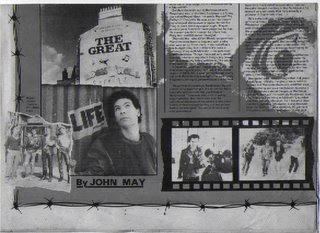
 This exclusive interview with Julien Temple, on The Sex Pistols film The Great Rock 'n'Roll Swindle, was the first major piece to appear on the subject. (The DVD version of the film has only recently been released). It ran over three pages - including the centre spread, in the NME on 27th October 1979. Itwas one of the few pieces I wrote for the paper that appeared under my own name. It makes interesting reading in the light of what we now know, particularly as Temple has subsequently remade the story in a different form in The Filth and The Fury - one of the greatest music documentaries ever made.Remember those fabulous '70s? Once upon a time, before Mod, before Sham 69, even before The Boomtown Rats... there were The Sex Pistols. You remember them, don't you? There was Sid, of course, and there was Ronnie Biggs and Steve Jones and Paul Cook and even, somewhere in there, the spindly looming presence of Johnny Rotten.
And who could forget their manager, sneaky snappy sleazy Malcolm McLaren and his enigmatic teammate Vivien Westwood? All those great names from the hallowed past... brings a tear to even the most hardened of noses. This is Our Heritage!
And now? Sid Vicious and Nancy Spungen are underground, roasted in the most spectacular flame-out in the history of the rock and roll banner headline: murder/heroin/punk rock'n'roll suicide.
Steve Jones and Paul Cook are on the ligging circuit, arousing themselves from the torpor for occasional bouts of running around in circles or —just for variation — barking up blind alleys. John Lydon has PiL and — in a manner unique to the survivors of the Pistols saga — his own career. Malcolm McLaren is in Paris, minding his own business and plotting yet another cataclysmic assault on the values and vaults of Western consumer capitalism.
Throughout the entire saga, vast amounts of McLaren's cash, creativity, concern and attention was lavished on the production of a Sex Pistols movie. The flick in question went through bewildering changes of title, format, subject matter, style, Inner Meaning and basic concept, passing through the hands of a weird assortment of writers, directors, backers and minders before emerging as The Great Rock ‘n’ Roll Swindle, McLaren's metaphor for the Pistols' career and rock and roll itself.
But is the movie simply the story of the swindle or is it (gulp) the crowning glory and final masterstroke of the swindle itself? The only person who really knows is Julien Temple, the man who wound up holding McLaren's baby.
Now 25 years old. Temple went straight from the National Film School to working with Malcolm McLaren at Glitterbest and ended up directing The Great Rock 'n 'Roll Swindle.
The movie, due for release before Christmas by GTO Films, takes the form of a fast and furious lesson in how to swindle money from the music business, delivered by Malcolm the Master and his petite sidekick Helen Wellington-Lloyd. Like The Sex Pistols themselves, the film has no taste and rockets along at the speed of sound, at any moment threatening to dissolve into pure anarchy. It combines concert footage with animation, newsreel with real life, and is guaranteed to raise a laugh and offend.
Julien Temple recently completed work on another film, a short feature entitled Punk Can Take It featuring The UK Subs. It's constructed like a wartime documentary, and was to have gone out as a short feature with Scum but was considered "too strong".
Temple is one of a number of young people currently working in film who are going to shove a stick of dynamite under the traditional cosy assumptions of the British film business. Anarchy is about to hit the one-and-ninepennys. You have been warned.
When we met. Temple was wearing a very red baggy suit and brothel creepers. We recorded the interview on the top floor of an editing studio in Covent Garden, squatting on cardboard boxes. Through the open window wafted the aroma of the drains below, tempered only by the large pair of white boxer shorts hanging on the sill.
JM: When was the film first proposed?JT: Malcolm first thought about the film when the group were banned The idea was if they couldn't be seen playing, that they could be seen in a film That was probably just after they got thrown off A&M in spring '77. Obviously with 'God Save The Queen' and that kind of global attraction that that whole episode had, he began to think more seriously about it and he approached Russ Meyer in early summer '77 and he went out to Hollywood and talked to him
JM Why Russ Meyer?JT: Well it was just thought that it would be a great idea to have that polar clash between American fascism, or whatever Meyer represents, and The Sex Pistols Big tits meets Johnny Rotten. Previous to that though, we had been filming the group. We'd done a little film called Sex Pstols Number 1 (sic) which was basically the group's appearances on TV including the Grundy show and so on, edited in a certain way, which was shown a couple of times at gigs. So we had a backlog of documentary material on the group that was separate, at that stage, from the idea of doing a featurefilm.
So Malcolm went out to Hollywood with Meyer and kind of dictated his ideas to a funny guy called Roger Ebert He wrote Beyond The Valley Of The Dolls. He was an extraordinary guy who iust slaves over a typewriter until a thing is done and stays up all night. Meyer actually pays him with the women that he has. He doesn't pay him money, he offers him Mary Ann and Cherie for the night.
They did the
Who Killed Bambi script which Malcolm came back to England with and a deal was set up from there. It started off as a low budget thing but — I think it's quite a common thing with Malcolm — he gets very grandiose ideas. Things that start very small escalate into very important things, big crowd scenes constantly being written in The whole thing went through about seven drafts. It became bigger and bigger and by the time that shooting was about to start, it was in the region of £800,000. It was getting bigger every day and Malcolm was changing the script very frequently, trying to get new ideas that he had in.
Meyer was increasingly freaked out by the virtual constant changes of a script that he'd basically written with this guy Ebert in Hollywood. There was also a lot of worry about whether the film would ever be completed because of the nature of the band and so investors kept pulling out and others had to be arranged. The whole finance was very precarious.
JM: What was the original concept for Bambi that Meyer had?JT: I think he intended it to be a Russ Meyer film using the Sex Pistols, whereas Malcolm obviously intended it to be a Sex Pistols film using Russ Meyer. So there was a basic conflict from the start. Meyer was very excited by it. He thought it would be the film that would crown his career.
JM: What sort of guy is he?JT: He's a most extraordinary character. He was a news cameraman in Korea. Really heavily into the whole US Army mythology. Spare weekends when he was in London, he used to fly to the continent to visit US war graves and things like this, and he was always accompanied by his sound man, who was an old Korean War buddy.
He's very Californian as well, a mixture of complete sentiment as well as bizarrely bad taste. His mother is a cripple and every Sunday he wheels her across the road into this topless restaurant to have brunch.
His other big thing is that he was a very famous pin-up photographer and he's always been into that kind of sexploitation number. He calls himself the King of the Nudies and he takes it very seriously that he's actually a pioneer of that whole thing.
He's extraordinary. In London he had his girlfriend Kitten with him. These huge tits. Whenever you saw them together she was just climbing all over him, kissing him all over the place as you were talking to him — and he is about 65, he's very old.
He violently dislikes Rotten because Rotten insulted him all the time. Rotten used to talk to him in words that he didn't understand, like English swear words. It was quite amusing to see Mever trying to make sense of it
Meyer took Rotten out to dinner and Rotten was incredibly rude and disgusting over his food. He was trying to alienate him because it was Malcolm's project. By that stage Rotten ready didn't get on with Malcolm, so the film was one of the major causes of a rift in the group that led to the break-up
Rotten felt very, very strongly that the group should play. Initially the group were heavily banned but Malcolm obviously used that as a publicity thing and as a mechanism to make a lot of statements about the group. Rotten as well as Vicious got increasingly frustrated, and they saw this film thing as Malcolm's number that they weren't into at all. As it became clear that they probably could play, it also became clear that Malcolm was spending 90 per cent of his time on the film and about 10 per cent on managing the group. That was the cause of the initial rift.
Rotten was just such a liability — and Meyer got very nervous about working with him because of the total gap of understanding between them. I mean Rotten was planning things like the clothes he'd wear. He wanted to be a hippie. He was buying these big old platform shoes and getting big, flared, flowery bell-bottoms to totally fuck you up because he was supposed to be there as the punk incarnate. So the task of actually making the film would have been very, very difficult.
JM: Where did the Bambi idea come from?JT: It was from Ebert actually. It was going to be called, at various times, Anarchy In The UK or God Save The Oueen but they had this crazy little plot about a pop star killing a deer in a forest, a kind of hunting estate, and it was the craziest kind of Disney thing. He doesn't really want it so he drives off with it and dumps it on a cottage doorstep. A little Hansel and Gretel girl finds it and it's her favourite pet or friend in the forest. At the end of the film this guy, who's a kind of cypher for Mick Jagger or Rod Stewart, is shot, and it turns out that it was the girl who shot him. Everyone thinks it's Johnny Rotten but it turns out that it was her. You see her with a smoking pistol and she goes "That's for Bambi" - which is very obscure.
After that it was kind of developed because it had a lot of notoriety as a name, and a song was written to try and make it into a thing about who was responsible for destroying punk. With Bambi there is a certain kind of innocence and that was used as a metaphor. Bambi being the anarchy of punk kids who are still in touch with being kids before they lose it and before the whole thing got commercialised and ruined. So it took on more than it had initially.
In
Rock 'n' Roll Swindle we were hoping to use Meyer's footage as a kind of Rosebud-like cypher throughout the whole thing, but we can't use that footage so it's even more enigmatic. Aflter this huge build-up and a lot of money being spent on sets being built and props being made and units being got together and Meyer being paid, they shot for three days and the thing caved in, with a lot of acrimony between Malcolm and Meyer. By that stage Meyer thought Malcolm was a mad Communist anti-American lunatic and he was demanding more money because the thing looked risky. Meyer was very, very angry when it fell through. Kept referring to Malcolm as Hitler. "Sue Hitler's ass" and all this stuff.
JM: What did the footage he shot consist of ? JT: Funnily enough, out of all that, it was just the killing of the deer, which Meyer shot himself with a pistol.
They did a lot of tricking them into pretending that it was some animal preservation film, I think. This was in Wales. Meyer was amazing directing this — I wasn't there but I've seen the rushes — and it's like a real military operation. He says, "ACTION! ACTION! RUN LIKE HELL!", really screaming it like they're going over the top in the trenches. Apparently they spent three days tracking down this deer until they found the right one, and Meyer shot it himself. The focus puller was thrown off for being squeamish about the thing. Meyer wouldn't have anyone anti-American on his set.
JM: So Meyer went back to the States and got a legal case together about being paid. What happened next?
JT: There were attempts to get in a replacement director, a guy called Jonathan Kaplan, who's done a couple of Corman pictures, and he came over with a scriptwriter called Danny O' Patashu and they did what was basically a kind of social-realist type script about punk — which was completely different from the ideas in the Bambi thing, which was a sort of mad fantasy, much more like a kind of perverted Disney thing and set in a very unreal Dickensian-type London. Much more exciting really than this thing that was more in tune with the Clash mentality — high rise blocks and poor kids on the dole and stuff. Johnny Rotten really liked it, so they stood no chance with Malcolm.
They were pretty bizarre. I remember going round and seeing them where they were staying in this flat off Baker Street and the writer guy was incensed. He was going roundthe flat saying “Look at this! Look at this!There are flies in the bath" And he opened the fridge and said, "Look at this dust, look at this dust" and it was just things that weren't there, complete hallucinations He kept wanting Sid Vicious' phone number, we couldn't workout why.
What had happened was that he was a junkie this guy, really strange junkie, and Sid had been taking his money and not delivering and the writer couldn't tell anyone because he’d get fired immediately. So they got the boot in the end, although they tried to come up with other mad ideas to kind of stay in the thing.
We developed one of them, the idea of a town taken over by punks. We were going to do it in Wales on Christmas Day and have The Sex Pistols, who were still supposedly banned, play and invite all these kids from all over the country to turn up and take over, and have lots of crews going around filming the occupation of this town. Anyway, that wasn't viable.
By this stage, the group were getting really near the end of the line This was just before Christmas, before they went to America. The last attempt to do something was with a guy called Pete Walker, who is an English exploitation film-maker. He was like a poor man’s Russ Meyer, English style, who has hundreds of films, made a lot of money from them as well, really straight from the barrel as a director.
They wrote a script that was a diluted version of
Who Killed Bambi, only it didn't have any of the guts, called
The Star Is Dead. It had some interesting little ideas in it but it really was not that strong. But by that stage, the band was in America and the problems in the group had come to a head and they broke up. Malcolm had really wanted them to break up. So we were left with nothing really at that stage other than this backlog of documentary footage we'd been gathering together.
JM: AT what stage had you become involved and on what basis ?JT: I'd become involved a long time before that on the level of just kind of recording the group. I think that's why Malcolm wanted me around really. I was involved a bit on some of the rewrites on
Bambi as well. But the thing about that whole company (Glitterbest) was that we were all working very much together, people had ideas collectively. It was obviously Malcolm's project but everyone there contributed a lot to what was going on in terms of promotional ideas and general theory about what the group should be doing.
JM: How had you linked up with Malcolm in the first place?JT: I was trying to do a film on Mods in '76 when I was at the National Film School and I just heard about this band who did a couple of crazy versions of Small Faces songs, and I went to see if they would be any good for this film. That was The Sex Pistols. There was no need to make a film about Mods anymore. I was really fascinated by it and I just started to make a documentary about the punk thing.
At that stage, in '76, I'd worked more with the Clash than the Pistols, but then I went filming on the Anarchy tour and it became very clear that The Sex Pistols were a lot more original and a lot more threatening and interesting than The Clash could ever be. So I spent some time talking to Malcolm and just started working.
I think everybody in that organisation just kind of drifted into it. One week you found that you were doing something and got paid and the next week you got paid again. It was totally chaotic, but everyone there was committed to the politics of the thing because it just did seem a very powerful weapon at the time, the access to the media.
I think Malcolm's greatest achievement really is the manipulation of the media. I don't think he manipulated The Sex Pistols at all, those guys are just themselves. What he did do was manipulate their image and manipulate the way the press received their image. He understood how gullible the press can be and how you can play the press off against each other in a fantastic way. I think that's a very interesting thing he's opened up. It was shock tactics. It was trying to get as much mileage out of shocking people into thinking about certain things; not actually saying what they should think but making them think.
When all these other films fell through I was pushing that we should use the stuff that we had, to continue and make the film regardless, do it ourselves.
Then we went to Brazil, because that was obviously a major event in The Sex Pistol’s history. The filming was finished within about ten days but I was actually stuck there – not against my will – but stuck there because there was a scene where they throw the gear in the sea and we’d rented all that equipment. So I had to wait for money to come out to pay for it.
The idea of Brazil, the idea of Biggs, was that he was another media headline. Of course it was a publicity stunt but the whole thing had been a series of publicity stunts or had been presented as such. It was totally in line with a great part of the group’s story, using that link-up with Biggs, because it put in perspective what they’d actually been doing – ripping all that money off record companies, exposing the workings of record companies. It was just fantastic to have a train robber in the Top Ten alongside all these other jerks like Rod Stewart, It was just wonderful each week reading Ronnie Biggs, John Travolta and stuff — purely people who've inhabited the headlines.
Biggs is actually less impressive than he should be. You go out there expecting to find some big bandit character hanging out, bandana and hairy chest and stuff, but he's actually quite a normal South London guy. He.'s regressed a bit being out there. It was very strange how well he got on with Steve Jones and Paul. They had exactly the same kind of background, the same kind of humour.
His main purpose in terms of the Sex Pistols story was his role as a media figure. The legend of Ronnie Biggs was all that really mattered. You don't really want to know how he feels in Brazil, that wasn't important to us. What was important was the image of the Great Train Robber and prison escapee singing with the band who'd swindled their way to the top.
By this stage, after the whole American thing, Sid was in a badway and he was going to Paris and we thought we'd film him. Sidwasvery difficult there because hewas very ill and he had Nancy with him who was very, very difficult to have around. I mean if we went out for a day filming with him, he'd come back in the evening and she'd be lying on the bed with a pool of blood next to her where she'd cut her wrists with a glass. She was in that kind of state. They were fighting all the time and it was very difficult.
One of the main problems was we'd happened to choose as a location for most of the stuff the old Jewish ghetto of Paris. Sid was wearing his swastika T-shirt and it did provoke really violent reactions from the local inhabitants there. Old women would come up to the cameraman in tears saying "What are you working with this thing for ?". As a result, the camera crews were very strained by this.
Sid was very ill and we had to stash him in a hotel, set up the shot outside the door, drag him out, do the shot, pull him back in, do another set, drag him out - which is a very difficult way of filming.
The cameramen were very unhappy about doing the whole thing, especially with knives and things like this on the street. One cameraman said: "I've been in the Congo, I've been in Vietnam, I've been everywhere but I've never had such a problem as Sid Vicious. The Vietnam War was nothing.'
After Paris we had the single ('My Way') and we really started to sit down and try and work out the ideas for the film. Malcolm and I spent a long time locked away, coming out with various different ideas; we had one complete script that got thrown out. We spent the first part of the summer doing that and by August we were ready to film. Well, we weren't really ready but we thought we'd better film or we'd never get it done.
We didn't really have the experience of making a large-scale film and there wasn't much money. Part of the deal with Warners when they signed the band as a recording act was to put up money for the making of a feature film. That money was an interest-free loan. It was a large amount of money, but it was mainly eaten up by the pre-production costs of the Meyer film and paying Meyer and paying off the crew who had been hired. It's a bit murky, the money side of it, because that's what Johnny Rotten's case was about.
The money kept kind of drying up and Malcolm would go out and score more money and we could film a bit more. He certainly raised money from Virgin and from Don Boyd as a finishing cost but mainly the thing was subsidised by Malcolm's money and the group's money. I'm not really clear. I'm not the person to talk about that really, how the finance was done. It was totally chaotic whatever the situation was.
We did a solid block of filming in August/September but then Sid went to America and things were dictated very much by events. By this stage the pressures were really building up on Malcolm with Sid's murder thing, and the ideas kept changing.
Malcolm wanted to change everything. Things that had already been shot, he wanted to try and edit them into something else, and film new stuff based on that premise. He kept ringing up from America with more editing plans. We did a final bit of shooting in January based on the series of changes that had gone on through the autumn. Then the Receivers were called in when Rotten sued Malcolm, the process came to an end and we just edited it — though Malcolm wasn't involved anymore.
One of the things that I thought — because we had so many different types of film like Super-8, video — that it would be nice to be as anarchic as possible in the type of film medium that we used.
The thing that sparked off the animation, although it was partly the idea of diversifying the look of the film as much as possible, was we wanted to get something in about Meyer and the famous incest scene that was one of the big problems on the Meyer film. The obvious way to do that was with a cartoon, to set up a Disney-type situation but with characters like Sid Vicious instead of Snow White. We did do this cartoon which, again, we were not able to use, of Meyer directing Sid and his mother in this incest scene. But from then on we decided to use cartoon to show some of the incidents that the group had been through.
JM: You must at some stage-have asserted yourself as director and developed the shape of the film.JT: Yeah, I did that during the shooting in the summer. Initially Malcolm and myself were working very closely and were very sympathetic in terms of what we were doing but it was a really strange film because it was determined so much by events.
If every film was like that I wouldn't bother doing a film because what you really need is a script that you start off with. It's an anchor and if you want to change it you change it, but you know where the hell you are. We were going through so many fluctuations in what we were doing and what we could do, that it was very difficult to impose a structure on it — other than the idea we had of presenting the thing as a swindle manipulated by a mad mastermind manager. We did settle on that at a certain point and stick with that.
Really I would say I could only assert what I wanted to do with what I had when Malcolm had stopped saying, "Let's do this this week". I mean it was his money, it was his project and, although we had worked very closely together, ultimately his were the decisions.
I think, in a funny way, it does reflect the pace of the history of the group and the anarchic nature of the group in a surprisingly accurate way. I do think it's very much a film about the Sex Pistols attitude — which is a very unique attitude, and one I don't think people have really understood.
I think that it was about a form of cultural terrorism It was a total attack on show business and the way in which show business and people's leisure time conditions what they think How people enjoy themselves seems to be more and more important in a political sense.
The Sex Pistols were a definite intervention in that scheme of things. The enemy that it was directed against was initially the record business, but it had to keep changing, once there was a danger of The Sex Pistols being a kind of celebrated cause for Time Out liberals. It was important to attack them as well because what the Sex Pistols were about was never being predictable, never being smug.
Other mainstream political acts like Tom Robinson or The Clash have this terrible smugness about their position, that this is black and white and we're on the right side and you're on the wrong side.
I don't think punk rock, in the real meaning of the thing, was anything to do with that. It was being nihilistic in a way, but it was there to shock people into realising certain things about what kids feel and what life is about. I think England is obscene in its stagnant kind of culture; the whole cultural feeling is morbid and incestuous. Punk rock was a great electric shock in the middle of that.
There's been a lot of real criticism from people saying it was just Malcolm selling out and making money and all this kind of thing. But what it was, really, was a move to cut the ground away from the people who were trying to build up The Sex Pistols into some kind of perfect, naive, innocent expression of punk rock. There was a definite change in the liberal media representation of punk from total abhorrence at the beginning, saying. "Oh God, they can't play" until it became very acceptable to like The Sex Pistols and to think Johnny Rotten was a saint amongst men.
The
Rock 'n' Roll Swindle idea was to say that the whole thing was just a swindle and that we conned everybody in the way that any other -recording star conned, people into buying their records. The Sex Pistols used that mechanism but want to point out that that's what it was —which is like exposing the seams of the thing and not worrying whether they're ugly or nasty, 'cause they are, they always are.
JM: So you think that McLaren's real achievement was in manipulating the media?JT: Well, I think that shows the way ahead really. A sit-in at a college, a demonstration doesn’t do that much. A folk singer in a club or The Clash singing about the White Riot only really gets through to a few hundred people in a hall or a few thousand people who read NME. If you can get through using the mass media that exists, your message doesn't have to be that explicit. If you can intervene and shock people and make that number of brains think about a certain thing, you're going to get a lot more interesting results than standing up and preaching to a few virtually converted people.
The whole history of the Left since the War has been very much one of telling people that this is right and this is wrong; it hasn't been 'actually throwing the initiative onto people themselves.
The mass media, which is obviously very carefully controlled, can be infiltrated in the way The Sex Pistols did, in order to make people think.
I think kids, because of The Sex Pistols, know a lot more about the structure of the record business than they ever knew before. They know the deals that have been done, the money that's been made, and the power that people have behind that bit of plastic that they're buying, in a way that they never knew before. That has been not by The Sex Pistols preaching. It's been by making kids interested and thinking for themselves. What excited the kids really, more than anything else I think, was the headlines. Each front-page headline was as good as a Number One record, and that's a fact.
Malcolm didn't originally want to be the rock and roll manager acting the ten lessons, but he certainly did get into it and developed it a lot. The idea was to blow out of all proportion the myth of him that had been around in the music press as some kind of manipulator and try and make him boastful and arrogant, claiming that he'd planned it for ages. And that the whole thing was just a con trick on everybody in order for people to try and put The Sex Pistols swindle up against their knowledge of the music business.
The rock and roll business is swindlingpeople every day. Every time someone goes into Virgin Records they're being swindled, as far as I'm concerned.
JM: With this film it seems that the battle The Sex Pistols fought with the recording industry isnow just moving to another quarter — to the film industry.JT: Well, it is part of the same thing, isn't it? They're both spectacles that are used to entrance people usually.
JM: It seems now that the film business is beginning to come under attack in the same way that the record companies were in the '50s. The film business in this country is run by old men with cigars but there's a lot of young directors, actors and so on who want to break through that system, and a lot of new wave bands getting into making films. Do you see any kind of parallel between the two situations?JT: I think there is a parallel. I don't think it's too watertight though because the main thing in the film business is that the villains of the piece are the distributors and exhibitors and the people who have made vast amounts of money out of the film business, the people who've sold out to America.
The young/old thing I'm not sure about because a lot of these supposedly young people are from the '60s. I certainly couldn't back them against the guys who've been working at Ealing and who've really done some good stuff. It's not quite as simple as Old Wave versus New Wave. There's been a criminal neglect of very able and interesting people who have been unable to work. I think that older way of making films is probably superior to that of the '60s people.
I don't know about new wave bands. I hate films about bands. The reason that I wanted to make a film about The Sex Pistols was that, for me, they weren't just a rock, and roll band, they were far more interesting than that. I think music in films is great, but without a really good context for it I don't like it because I think music itself is better than the film version of the music.
JM: Finally, what part of the film do you like most or comes closest to what you were trying to achieve?JT: I really like the bit where Sid shoots the audience, especially singing 'My Way'. It’s a very good example of The Sex Pistols' attitude. Especially given Sid's character as a kind of social actor, or whatever he was., with the annihilation of that song. To me it is tremendous. All the egotism and the individualism and the hypocrisy involved in that song and the audience lapping it up and getting shot to pieces is just wonderful to me.

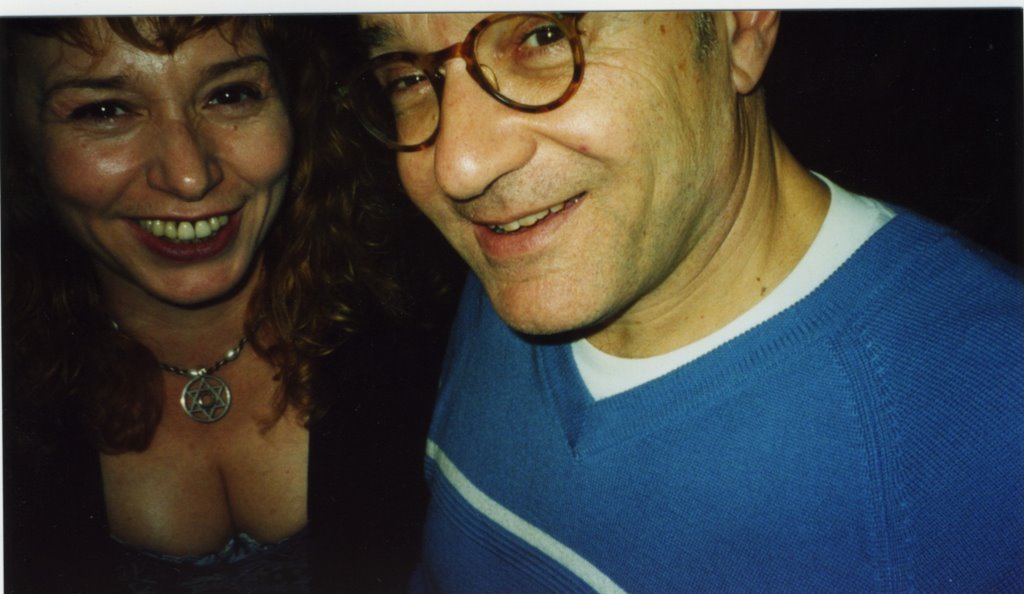
 (Below): Julien Temple doing a Q&A session at the Duke of York's in Brighton, May 2007. (Right): Julien Temple in central London, June 1982. Original photo by Adrian Boot.