Showing posts sorted by relevance for query charles Shaar Murray. Sort by date Show all posts

Sunday, November 05, 2006

TONY TYLER TRIBUTE

We are sorry to report the passing away of our dear friend and colleague Tony Tyler. What follows is a small tribute to him, a series of posts reflecting different parts of his life and times, his talents, his range, his intelligence, his humour - all of which we will miss greatly. [Pictures from the wake at The Royal Oak in Pett by Anna Chen]

To begin, two fine obituaries from colleagues Charles Shaar Murray and Chris Salewicz, in 'The Independent and The Guardian respectively:

James Edward Anthony Tyler, writer and editor: born Bristol 31 October 1943; twice married; died Hastings, East Sussex 28 October 2006.

In his time on the New Musical Express, Tony Tyler was one of those rare, inspirational editors who can see every element of a story in a one-sentence description, and commission it on the spot: lengthy lunches discussing the piece held no interest for such a meteoric, extraordinarily intelligent and encouraging mind. Besides, only half of his teeming brain was focused on the job, as Tyler feverishly moonlighted at home on The Tolkien Companion, published in 1976 under the name of J.E.A. Tyler, which intermittently funded him for the rest of his life.

Always hilariously funny in his writing, as a human being and in his editorial roles on the increasingly surreal NME in the mid-1970s, he arrived with a romantic past. "He was the only journalist on the music press who had carried a weapon in war," said Michael Watts, a rival editor on Melody Maker. Tyler used to love telling the story of how he had been wounded in the shoulder by a bullet from an ancient musket whilst serving in the Army in Aden: half-cut, he was carrying a beer-case and didn't realise he had been shot until another private noticed blood.

He had enlisted in the Royal Tank Regiment via a circuitous route. His father, from an upper-middle-class family, had been a fighter ace in the First World War. The experience had turned him into an alcoholic. Giving up drink, he married his nurse, who was much younger than him. Their only child, James Edward Anthony Tyler, was born on Hallowe'en night in 1943 in Bristol, during a thunderstorm punctuated by a German air-raid.

Tony Tyler grew up in Liverpool, where he attended Liverpool College, at the age of 16 turning on prefects attempting another of their habitual beatings, and leaving before he could be expelled: he had one O-level, in English Literature. His mother died the next year. He became a police cadet, but quit when told his stammer was so extreme he would never be able to give evidence in court. (When people asked him later what cured his debilitating stutter, Tyler would reply, "Acid.") He found more stimulating employment as a trainee reporter on a Merseyside paper.

But Tyler had decided to become a beatnik. His best friend Tim Craig (later the father of the actor Daniel Craig) was a merchant seaman. Tyler stowed away on his Hamburg-bound ship, aware that the Beatles - whom he vaguely knew - were resident in the German port. Tyler's Bohemianism resulted only in starvation; Gerry Marsden (of Gerry and the Pacemakers) bought him the occasional meal.

After he was hospitalised with pneumonia, Tyler was sent home in 1962 by the British consulate. Noting the healthy demeanour of squaddies, he decided to enlist - after first failing in his attempt to join the French Foreign Legion. A guitarist since he was 13 - he once played in a skiffle-group with Richard Stilgoe - he was promoted to the regimental band.

When his father died in 1966, Tyler came into an inheritance, which he quickly burnt through. First buying himself and two friends out of the Army, he purchased an AC Cobra off the stand at the motor show, totalling it on his way home. Taking a job in a London musical instrument shop, he found himself playing Hammond organ in a soul group based in Italy, the Patrick Samson Set; they had a No 1 there with a cover of "A Whiter Shade of Pale".

Back in London in 1969, after writing an article for a competition run by Beat Instrumental, a music trade paper, he was offered the job of editor. Soon he became publicist for EG Management, who cared for the careers of T. Rex, King Crimson and Emerson, Lake and Palmer.

He was brought into the NME in 1972 by the editor Alan Smith, who was re-launching the pop paper; Tyler's zest, hilarious verve and formidable energy made him a pivot of an editorial team that included Nick Logan, who succeeded Smith in 1973 and went on to found The Face, Charles Shaar Murray, Nick Kent and Ian MacDonald. With MacDonald, he formed a double act that informed the paper's humour. It was Tyler, who adored to debunk pomposity, who, when confronted with Bryan Ferry's latest sartorial extravagance, came up with the headline "How Gauche Can a Gaucho Get?"

In 1975, his first book was published, The Beatles: an illustrated record, an astute and amusing analysis of every recorded song by the group, a collaboration with Roy Carr, another NME editor. The next year Tyler, by now NME assistant editor, advertised for "hip young gunslingers" (his own phrase) and hired Julie Burchill and Tony Parsons. Two years later, when he learned he had both The Tolkien Companion and The Beatles in the New York Times Top Ten, he decided to give up journalism and be a full-time writer. His guide to J.R.R. Tolkien's Middle Earth was issued in new editions as The New Tolkien Companion (1979) and, again revised and updated, as The Complete Tolkien Companion (2002).

In 1982, Tyler married, as his second wife, Kate Phillips, an NME staff writer: at the time of his death they had been together for 31 years, with one of the happiest marriages any of his friends knew. He and Kate bought a house overlooking the sea outside Hastings.

Fascinated early on by the very notion of computers, Tony Tyler plunged into that emerging world, trying to bring the same sense of NME absurdity to Big K, a computer magazine he started in 1983, but which folded. He celebrated his new fascination with technology with I Hate Rock & Roll (1984). He began to write columns for the magazines MacUser and MacWorld. These were only intended to fund his efforts to be a fiction writer. He completed several novels, none of which was published. "They were so intelligent," said his agent Julian Alexander, "with incredible flights of fancy, that I don't think they were easily understood."

Tyler, who viewed life as a cosmic joke, was wryly philosophical about the failure to place these books with publishers. As he was when confronted with his cancer, diagnosed only 11 days before he died. "Shit happens, but I'm completely cool with this," he said, phoning his friends to come and visit him. He was annoyed, he said, that he would never get to see Casino Royale, starring his godson Daniel.

"I want you to know, for when your time comes," Tyler told his wife, her sister and mother two days before he died, his curiosity about the mysteries of life and death undiminished, "that this isn't really too bad. It's quite dealable with."

Chris Salewicz

Tony Tyler

NME talent spotter, Tolkien expert and computer pundit

Charles Shaar Murray

Wednesday November 1, 2006

If some of the New Musical Express's prominent writers were the faces of the 1970s paper, and editor Nick Logan and the late assistant editor Ian MacDonald functioned as its brain, then Tony Tyler, who has died of cancer aged 62, was its heart and soul. Features editor and later assistant editor during the early 70s, Tony, "the looming boomer", 6ft 5in in height with a resonant, drawling baritone, contributed irreverence and absurdist humour to the forging of the NME's identity.

Article continues

---

Advertisement

---

He was also an author who once had two radically different books, The Tolkien Companion (1976) and The Beatles: an Illustrated Record (1975) - the latter a collaboration with his NME colleague Roy Carr - appearing simultaneously in the New York Times best-seller lists. A gadget freak, he became the founding editor of Britain's first computer-gaming magazine, one of the earliest adopters of the Apple Macintosh and the liveliest, wittiest pundit in Macintosh journalism.

TT, as he was almost universally known, led a rich existence. During a spell in the army, he was the last British soldier to be wounded by a musket-ball. As a teenage stowaway to Hamburg, he was in an all-night card-game with a drunken, speeding pre-Beatlemania John Lennon. While working for a London musical instrument dealer in 1966, he accompanied a rented Hammond organ to the Royal Albert Hall, where he was backstage to see Bob Dylan, paralysed with stage fright, virtually thrown on stage for his legendary appearance with the Band. The same year, feeling that his Gibson Les Paul guitar deserved to be played by a better musician, he sold it to Peter Green, who had just replaced Eric Clapton in John Mayall's Blues Breakers and later founded Fleetwood Mac. Green sold it to the young Irish guitarist Gary Moore, who used it until last year. During his final week, TT was amused to learn that his old guitar was informally valued at $2m. His greatest triumph as a musician was to enjoy an Italian number-one hit the summer of 1967 as organist with the band who cut the Italian-language cover of Procol Harum's song A Whiter Shade Of Pale.

He was also godfather, albeit informally, to Daniel Craig, the new James Bond: TT had known the actor's father, Tim Craig, since they were seven years old. Since Ian Fleming was, along with PG Wodehouse and JRR Tolkien, one of Tyler's favourite authors, it was a major disappointment to TT to realise that he would not live long enough to see his godson play 007. "I'll never go to the cinema again," he said, "and I won't be around when the DVD comes out."

TT was born in Bristol, but raised around Liverpool. He attended Liverpool College but left at 16 with a single A-level. His adored mother died of cancer at the age of 39 when TT was 17, and his father, a veteran of the first world war Royal Flying Corps, not long after.

Feeling cast adrift, he signed up as a police cadet, but was told that his chronic stammer would prevent him from giving effective evidence in court. After stowing away to Hamburg on a merchant navy vessel, he hung out with soon-to-be-famous Liverpool bands such as the Beatles and Gerry and the Pacemakers, before contracting pneumonia and being shipped home by the British embassy. After recovering, he joined the Royal Tank regiment and was wounded in action in Aden. Because of his size, the army built him a bespoke bed, which dutifully followed him from posting to posting, but never caught up.

Back in civilian life, he sold instruments by day and played guitar and organ in groups at night, until an Italian band kidnapped him for several years on the European club circuit. On his return to London, he met and married an American student and moved to San Francisco, where he had a job as a piano salesman for 18 months, despite never selling a single piano.

Returning to London, he briefly edited the magazine Beat Instrumental before becoming a publicist for Emerson, Lake and Palmer - "I make no apologies," he later said, "though I would if I thought apology was sufficient " - but, finding both public relations and ELP uncongenial, he took the opportunity to join NME, then just about to start the radical rethink that transformed it from pop-picking chart fluff to a salon for gadflies. At the NME, Tyler demonstrated a keen eye for talent both musical and journalistic: an early champion of Roxy Music and Dr Feelgood, he was instrumental in the hiring of such writers as Nick Kent, Neil Spencer, Tony Parsons, Julie Burchill, Paul Morley, Vivien Goldman, Paul DuNoyer and Kate Phillips, with whom he fell in love and who subsequently became his second wife.

In addition to his NME duties, he wrote (as JEA Tyler) his Tolkien Companion, a massive concordance of all the people, places and things in The Lord of the Rings and its associated texts. The success of this and the Beatles book, co-written with Roy Carr, enabled him to leave the NME and retreat, with Kate, to a remote riverside cottage, which he soon filled with early personal computers. He became besotted with all things Macintosh, and his witty, anarchic punditry for magazines such as MacUser and Computer Shopper helped to keep him in fine wines and electronic keyboards for the remainder of his life.

His third book - a hilariously splenetic rant called I Hate Rock And Roll (1984) - was rather less successful, but remains a cult classic.

Outside his professional achievements, he will be remembered as a formidable autodidact who became expert on ancient and military history; as a right-wing libertarian who preferred to be surrounded by liberals and lefties "because most people who share my views are staggeringly unpleasant"; as a gourmet, oenophile and chef; as a genial host with unquenchable joie de vivre, determined to make sure everybody had fun; and as a man who remained urbane even on his deathbed. His last words, addressed to his 86-year-old mother-in-law, were: "I just want you to know, for when it's your turn, that this [dying] isn't actually so bad."

He is survived by Kate.

· James Edward Anthony Tyler, journalist, born October 31 1943; died October 28 2006

Sunday, August 04, 2013

MICK FARREN TRIBUTE 1


It is with great sadness that THE GENERALIST reports the death of Mick Farren, a long-time friend and elder brother figure to me, who was a key figure in the British underground scene in the 60s and 70s. Founder and lead singer of The Deviants, one-time editor of International Times,  noted NME writer, prolific author, great blogger, Mick had a big heart often hidden behind a tough troublesome front. Possessor of a big ego and an afro to match, he over-indulged in life with great abandon and pushed the pedal to the metal right up his final dramatic act - his death on stage at the Borderline in London.

Mick grew up in Worthing and us younger Worthing lads looked up to him as an iconic freak. We were the ground crew who helped create the stage and site for Phun City – the first great British free festival – which featured the first-ever performance in the UK by the legendary MC5.

Later I worked on the underground press, hung out in the Grove and saw Mick at gigs, parties and demos on a regular basis. Mick got me into the NME and I was regular writer for Thrills which he edited.

Lost touch with him during his long sojourn in New York and LA but reconnected when I helped  get a flat in Brighton for him (and the cat). Fortunately I promoted one of the last Deviant gigs at the Con Club in Lewes in Dec 2012.

I very recently reviewed his last publication – a fat anthology of his writings from Head Press here. This post has links to several other Previous Posts on Mick.

Mick was a stand-up guy, always  looking out for me and always buying me a beer when he knew I was virtually penniless. Fortunately I was able to tell him in person how much that meant to me before he died.

Mick was a tough nut, unafraid of speaking his mind and difficult to impress, who evolved a unique journalistic style that was pithy, sharp and dark. He loved bourbon, speed, smoke, leather jackets, cowboy boots, Gene Vincent and Elvis and he stood up with great courage to both the Establishment and his own demons. He was no angel and had no room for sentimentality. He created his own legend and in his version of events he was always centre stage.

Like many others, I miss him badly. He was a true rebel spirit.

MICK F 3130

MICK F 4131

Unpublished photos by yours truly of Mick doing a reading from ‘Give The Anarchist A Cigarette’ at Waterstones in  Brighton in 1998. Top picture is the after-show party in a room above a gay club off the Steine. Mick improvises whilst Tim Rundall (I think) plays guitar and son Louis tinkles on the piano!!


IMG_2099

Thanx to Richard Adams for sending over this pic of Mick at the Inn on the Green in Ladbroke Grove, snapped 28 May 2009. Richard comments: ‘I think he’d just arrived in England after America had taken its toll.’

Two great pictures taken by the legend that is Joe Stevens – one of them is a beauty of a colour shot of Mick and Ed Barker – together with a pithy tribute from Joe.

This is the uncut version of an article that appeared in The Guardian by Charles Shaar Murray: ‘Mick, we hardly knew ye…’

Miles Charles Shaar Murray Mick Farren Chalkie Davies

The pic, recently unearthed by Chalkie Davies, shows Miles, CSM, Micky and Chalkie in Brighton,summer of 1976.


OBITUARIES

The Telegraph

The Independent/Chris Salewicz

The Guardian/Richard Williams

The New York Times/Bruce Webber

Monday, September 05, 2016

RICHARD NEVILLE

News comes this morning that we have lost one of the most vibrant and charismatic figures of the 1960s underground - Richard Neville - who was an inspiration. This brilliant cover of his first major book 'Play Power' was  executed by the marvellous Martin Sharp.                                           

 [Left] Richard with girlfriend Louise Ferrier, London, 1970


You can read a 4-post reprint of my 1980 NME Dick Tracy interview with Richard Neville about his book 'Bad Blood' which tells the story of Charles Sobhraj, the hippy trail serial killer. Click here and scroll down: http://hqinfo.blogspot.co.uk/2011_02_01_archive.html


CHARLES SHAAR MURRAY'S TRIBUTE


Richard Neville changed my life.
I mean that in the most specific and literal sense: if it hadn't been for Richard first co-founding OZ and then throwing the magazine open to smart discontented teens for what became the 'Schoolkids Issue' in 1970, I would not have had what I laughingly refer to as the 'career' which has rendered me old, broke, crazy and mildly notorious. Without Richard (and Jim Anderson, and the equally late Felix Dennis, the other two points of the classic OZ editorial triangle), I'd've had to settle for librarianship or the duller bits of the Civil Service. And I'd probably never have left Reading.
Richard wasn't a great writer, and he knew less about everything (art and politics as well as sex, drugs and rock & roll) than he would have liked us to think, but he MADE STUFF HAPPEN. Not only that, but he used his devastating charm and energy to attract people who could get the work done. Jim had him beat on the literary end, and Felix on the Biz, but Richard was both front man and facilitator.
In many ways, his greatest talent was his ability to enthuse, inspire and unite seemingly disparate people. 'Charisma' doesn't even begin to cover it. (Thank the power that drives the universe that he never went into bourgeois politics.) Around Richard, everybody became more ... themselves.
He saw something in me which nobody else ever had, and he nurtured and encouraged me to get the bad writing (the embarrassing teenage waffle) out of my system so I could get to the good stuff. Without the encouragement, mentoring, coaching and opportunities I got from Richard (and Jim, and Felix) I'd never have developed the confidence to believe that I could ever have turned pro as a writer. They sussed that I had a talent, and that what I needed was craft and discipline.
Without Richard, I'd be nothing and no-one. (I still remember handing in some copy, in the margin of which he scrawled 'Bold' and 'Unjustified.' I thought that was a little harsh -- I was, after all, a beginner -- but he later explained to me that those were simply instructions to the typesetter.)
(Young folks -- ask your grandma what a 'typesetter' was.)
The last time I saw Richard (and no, that's not an OVERT Joni Mitchell reference) was at a book launch (no idea whose) sometime in the 1980s when he was flirting outrageously with Paula Yates. Or was it the other way around?
He was also the first Bowie fan I ever met, and he took me to see DB at The Roundhouse in 1970.
When a bunch of us were gathered together a year or two back to mark the passing of Felix Dennis, Jim was there, but Richard wasn't. He was, apparently, too unwell to travel from Down Under. I was massively disappointed, because I wanted to thank him for the life I've had.
Influence? Well, not an influence in the same way that Bob Dylan, Raymond Chandler, John Lee Hooker, HST, Norman Mailer, Pauline Kael or Jimi Hendrix were, but ...
The main reason that I am who I am (whoever THAT is) and did what I did (whatever THAT was) ... is because Richard Neville gave me a chance.
RIP. If (a) heaven exists, (b) we both get there and (c) they have weed and Rizlas, I'll roll you one.
Final thoughtage: if I can now successfully masquerade as a Grand Old Man Of The Counter-Culture, it's because so many of the Real Guys are gone now. No more Felix Dennis, no more Mick Farren, no more Lemmy, no more Bowie ... If you're fortunate enough to run into Barry Miles, John Sinclair, Jeff DexterDick PountainEd Ward, Wayne Kramer, Su Small or John May, supply them with stimulants and get them to Tell You Stuff.
Get the most out of all of us while we're still here.
Will the last person out of the Enlightenment please turn the light back on?


Thursday, December 01, 2005

NME: Adventures in the Music Press

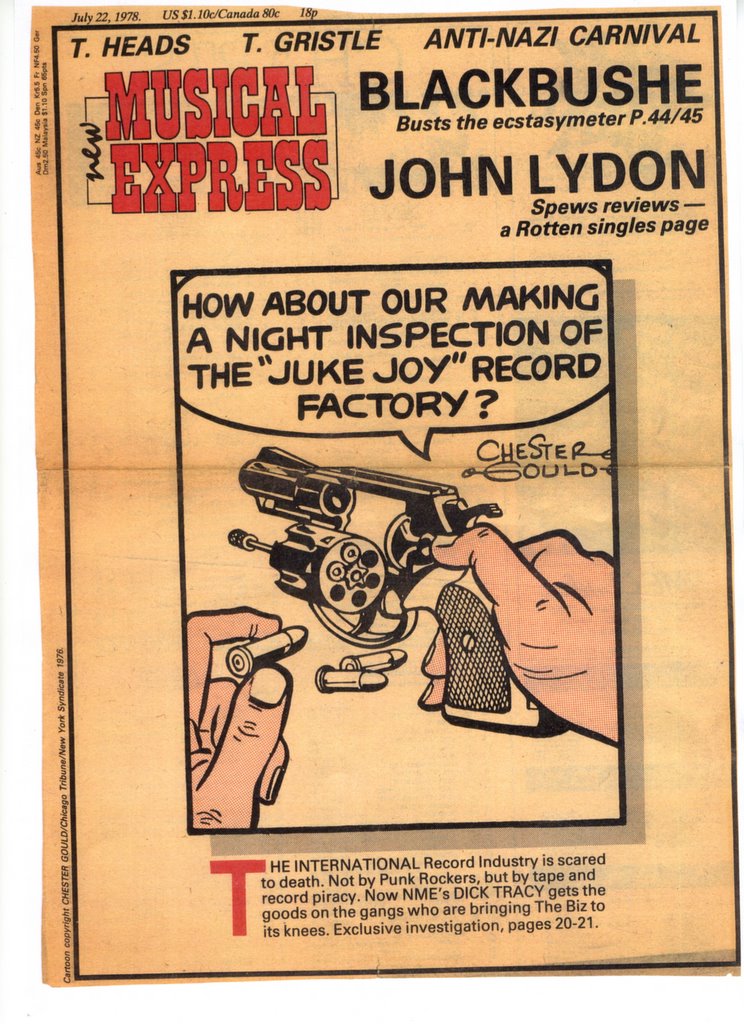
Dick Tracy's first and only cover story, investigating record
and tape piracy. July 22nd, 1978.


It was a recent weekend Guardian magazine profile of Tony Parsons that initially triggered all this off – a flood of memories. Tony, now a best-selling novelist and a regular columnist for The Mirror, was interviewed in connection with his just-published novel ‘Stories We Could Tell’ based on his time at the New Musical Express (NME). The least said about that the better. Paul Morley's review 'Those Weren't The Days' is right on the button I think.

My story begins back in the days of what was then called the ‘underground press’. I was part of Frendz magazine, one of a number of nationally-distributed haphazardly-produced mags and papers that documented the counter-culture of the period. It was here that I met Nick Kent who turned up and asked me if he could write some rock reviews for the papers. Good writers of any kind were hard to come by, particularly ones that didn’t want paying, and within a few weeks Nick was pumping out live and record reviews that immediately convinced that here was man with real talent. We became best mates

Within a few weeks it seemed, Nick was suddenly everywhere, hanging out with the Grateful Dead and Keith Richards. (He took me once to Richards house in Chelsea but he wasn’t in). I remember travelling down to Brighton with him on a coach with Captain Beefheart and the Magic Band, hanging out in Wembley with the legendary San Fran rock band The Flaming Groovies (later seeing them live with Nick at their appearance at the legendary Iggy Pop gig at the Kings Cross cinema)

Frendz, in its last incarnation, was being designed in Osterley by Pennie Smith (later to acquire legendary status as a rock photographer par excellence for the NME) in her funky converted railway station pad, helped by our dear departed friend Kevin Sparrow. I remember Roxy Music being the big thing at the time.

Inevitably Frendz came to a close – there was no money left and only a few survivors on the staff – and our last issue, designed by George Snow, featured news of an exclusive Lou Reed piece by Nick Kent which never materialised, we had to print a big apology in the paper. By now Nick and Pennie had migrated to the NME.

The New Musical Express (NME), founded in 1962, had begun recruiting from the underground press and Nick and Charles Shaar Murray, one of the schoolkids featured in the infamous OZ issue that became the subject of the longest obscenity case in British legal history, between them ushered in a whole new era of rock writing – inspired by Lester Bangs and Creem magazine – that made the paper a must-read for so many at that time. This was New Journalism of an irreverent drug-fuelled kind that captured the spirit of the times.

It must be remembered that, at that time, there was no coverage of music in the national press at all – except for headlines when one of the Beatles got married or such like. Hence the strength of the music press and feelings that attached to them. This was vital reading for music fans and the NME along with its rivals Melody Maker and Sounds saw their circulations rise rapidly during the 1970s with the NME way out on top in a dominant position before the decade was out.

Clustered here were the some of the best writers and editors around – the late great Ian McDonald, Tony Tyler and the editor Nick Logan, who would go on to found Smash Hits and subsequently his own magazine The Face, the style bible for the decade to come.

I was determined to get into the paper if I could and it was thanks to Mick Farren, former editor of International Times, who had also joined up, that I managed to get a gig around 1976. I believe my first piece was a three-line story about a guitar-plucking contest which carried my by-line. I remember leaping up-and-down with excitement. I had made it into the NME – the nearest thing we’ve ever had in this country to a national youth newspaper.

Amongst the great writers on NME were Tony Parsons and Julie Burchill, perhaps the best known now to a mass audience, but music journalist afficianados will recognise not only Kent, Murray and Farren but also the truly excellent Chris Salewicz, Vivien Goldman, Brian Case, Danny Baker, Paul Morley et al

The best source of information to date on NME and the other papers of the period is ‘In Their Own Write: Adventures in the Music Press’ by Paul Gorman [Sanctuary Publishing 2001], consisting entirely of interleaved interviews with the above mentioned and others.

What is missing from this account, and from other assessments I have read about the NME is the fact that although the paper carried principally music journalism, there was also a great deal of material on books, films and the general youth culture.

From my earliest days at the NME it was clear to me that I wasn’t going to be able to compete with the music writers but I found my niche as the person who wrote everything that wasn’t music. In the process, I became Dick Tracy, investigative journalist and, under that nom de plume, wrote a considerable amount of stories between 1976-82. A few pieces appeared under my own name but Dick Tracy acquired a bigger profile and cachet than my real identity.

So much so that the following small notice was run in the paper on May 20th 1978 in connection with a piece I wrote called ‘Cloning Papers’:

‘Contrary to popular belief, Dick Tracy is not the pseudonym used for NME team efforts. Tracy is one man who works alone, albeit with occasional help from both inside and outside NME central. The only journalist to unearth the covert activities of the Animal Liberation Front, the only journalist to present an alternative view of Operation Julie acid purge, Dick Tracy now offers the most convincing theory to date about The Man Who Was Cloned.’ [An interview with David Rorvik, author of ‘In His Image’ which claimed to be the true story of the first human cloning]

I don’t have a complete record of everything I wrote during this period so what follows is a fraction of the total but includes some of the most important stuff:

FILMS: During the mid-1970s cinema attendances had collapsed, to be subsequently revived by the new generation of sfx films led by Star Wars. The film industry was desperate to get coverage in the NME and I was, in the beginning, one of the paper’s principal film writers, with access to major film studios, artists and writers.

- Exclusive first- run interview with Julian Temple about the first Sex Pistols film
- The first piece, some six months before the film was released, on ‘Quadrophenia’ followed by interviews with Franc Roddam and Phil Daniels.
- Interview with Milos Forman about ‘Hair’.
- Interview with Steven Spielberg about ‘Close Encounters’
- Interview with Billie Hayes and Brad Davis, the actor who played him in ‘Midnight Express’
- Feature on the films of Clint Eastwood.
- UNPUBLISHED: Interview with David Mingay on the Clash film ‘Rude Boy.’

PLUS: Numerous reviews of movies beginning with ‘The Missouri Breaks’ (Jack Nicholson/Marlon Brando)

DRUGS: Wrote a regular drug column called Inside Dope. Major pieces on Keith Richard’s heroin trial, on British drug prisoners on foreign jails, on Operation Julie.

POLITICS:
- Worked as part of a team, with Angus Mckinnon, Ian McDonald and others, to produce the four-page NME Guide to the Nuclear Age. There was a nuclear explosion on the cover of that week’s issue. (June 11th 1977)
- Numerous pieces on the Animal Liberation Front and the birth of what has become a worldwide radical movement.
- Number of pieces on the Save The Whale movement and campaigns – the biggest environmental issue of that time. Also the seal culls in Newfoundland

Much of this sort of coverage was taken up in a more expansive form by Andrew Tyler, who now runs the excellent Animal Aid. Hats off to a great writer. See details of his latest campaign here.

MUSIC BUSINESS: I was one of the first journalists to write investigative pieces about the music industry itself, profiling major corporations and pillaging the trade papers of the times for juicy leads. This led to MY ONLY COVER STORY, on Record Piracy. Also did major piece on The Elvis Industry following the death of the King plus similar piece on the mass cross-marketing of Saturday Night Fever.

The NME years were genuinely exciting. The power and reputation of the paper was such that doors opened wherever you went. Johnny Rotten, Paula Yates, The Stranglers and the like would drop round the office, always full of the pressure cooker atmosphere of a weekly paper.

Yes, I spent a lot of time in the legendary ‘kinderbunker’ with Tony and Julie, who liked what I was doing and were real mates to me, inviting me to a number of punk events – like the memorable Johnny Thunders deportation party – encouraging me to go and interview Blondie but also supporting the animal liberation coverage I was writing for the paper.

I was not a major figure on the paper but I made a contribution. Thanks to Chris Salewicz for saying in ‘In Their Own Write’: ‘John May was very good as Dick Tracy. He started the film coverage with what was called Silver Screen and he was quite instrumental in changing the paper.’

Thanks also to Phil McNeill, who took a real interest in the investigative journalism I was writing and supported some very ambitious and difficult stories.

So much more to be said. Consider this a 1st Draft memory exercise.


Footnote:

1. Mick Farren’s account of those times can be found in his biography ‘Give The Anarchist A Cigarette’. I am covered by a sentence that reads: ‘Old underground press contacts came up with stories on bizarre media events, weird performance art, animal rights, the environment, recreational drugs and drug enforcement.’

2. For Neil Spencer’s recent account as his period as editor (1978-85), see here.

3 Am currently chasing up the ‘Inky Fingers’ documentary on the NME, shown on July 4th, 2005, on BBC4. Some of you lucky people who can get digital tv will have seen it already. Further comments to come.

4. A huge amount of journalism from the NME and other music papers can be found at
www.rocksbackpages.com. Highly recommended.

Thursday, April 04, 2019

REMEMBERING ANDREW TYLER [1946-2017]

It's sad to lose a friend - even sadder when you discover that he had died two years before and you didn't know that. Didn't also know that, such was the pain he was living with, that he elected to end his days at Dignitas in Switzerland.

Andrew and I met at the NME and were both freelancers. I had no idea, for some reason, of the large number of significant music pieces he wrote. I remember him much more for his superb and lengthy pieces on social issues. Our time at the NME overlapped. He was there from 1973 to 1980; I worked there under the name Dick Tracy from 1975-1982. Andrew wrote considerably more than I did, was often out on assignment and was a skilled feature writer. He graduated, as I did, to the national press,Time Out  and other magazines. His investigative work was first rate.

I shared his concern for animal rights. We published The Beast, the first (or one of the first) animal lib magazines in the UK or US. [See Previous Post] which ran from 1975-1981.


Andrew made his concern for animals into his full-time occupation as head of Animal Aid, one of Britain's leading groups promoting veganism and working for the welfare of animals on many levels.

His memoir 'My LifeAs An Animal' documents his working life in his own inimitable style, a book written whilst he was suffering with both Parkinson's disease and a degenerative condition in his back which meant he was in constant pain. It is a mark of the man that he is modest about his own achievements.

His long Kerouac-type meanderings with his guitar across the US in his teens was another whole chapter in his life that I was also unaware of.

He and his twin brothers grew up in a Jewish orphanage and he left school at 14 having read nothing but biblical texts and with minimal writing skills. He learnt on the job at small trade magazines. His background left him with a great concern for the poor, the dispossessed, the unloved, which he expressed in his work with difficult youths who he was able to communicate with on their level. Later he would write moving narrative stories about life on the street which few other journalists would have been able to.

Andrew's quiet and determined nature, his integrity, his focused anger always impressed, layered as it was with a great sense of dark humour. He was the finest of fellows who devoted so much of his life to fighting for the most mistreated of all - the animals.

'My Life As An Animal' is available from Animal Aid. Its existence is due to Sara who  wrote the book's last chapter and organised the whole production of the book, a huge learning curve for her and an exhausting experience. She wrote to me as follows:

'Andrew asked me to campaign for voluntary assisted deaths (VAD) after he'd gone - which I've done to the best of my ability.  I was very lucky and got a front page and two page spread in the Mirror for Andrew.  Because of that was then invited onto This Morning (which I had never seen or heard of as  we have had no TV for 20 years - also I was never an am TV watcher.  Never understood how people had the time!).  Anyway This Morning and Dignity in Dying put a clip of my interview on their FB Pages and I got over a million hits in a week - which I was told is basically unheard of for a non- celeb.  Just goes to show how this issue is in the zeitgeist, as I got over 3,000 comments mostly backing what I said.'
There's a fine obituary by Mark Gold in May 2017 in The Guardian 

Also another great tribute can be found on Charles Shaar Murray's blog


Andrew made 19 short videos in the last six weeks of his life. One of these is on his Facebook page in which he explains why he is off to Dignitas.  Check also this video on Vimeo.

Links to some of his printed works can be found on Wikipedia


ANDREW WITH STEVIE WONDER. He also interviewed John Lennon,
Leonard Cohen, Bruce Springsteen and many others.


Monday, August 22, 2011

CHECK OUT CHARLES SHAAR MURRAY

CSM12952 Charlie is a number one, A-list geezer who I’ve known off and on for almost four decades. He first came to prominence as one of  the wild children of School Kids Oz, graduated to the NME academy of new rock writing, hobnobbing with some of the greatest names around and writing extensive chronicles from the frontline of all the madness. The blues were in his bones. Blast Furnace and the Heatwaves was his band. As I recall, he generally wore a black leather jacket and had an bit of an afro thing going on. Words spilled out of him, long digressive thought waves, always worth listening to. Looking back on it, we were all crazy at that time, full of jumped-up juice and ready for action.

517VFSDTR6L._SL500_AA300_ 513GDYSK29L._SL500_AA300_ 417K0X7RQVL._SL500_AA300_

Charlie has produced two stone-cold classic books; ‘Cross-Town Traffic: Jimi Hendrix and Post-war Pop’ and ‘Boogie Man: The Adventures of John Lee Hooker in the American Twentieth Century’. An archive of his music journalism can be found on the wonderful Rock’s Back Pages site and there is a collection of his  journalism still available called ‘Shots From The Hip’. He’s done loads of other stuff, which is covered in Wikipedia.

So now we come to the purpose of this post – Charlie’s first novel ‘The Hellhound Sample’, recently published by HeadPress. Briefly its the story of James ‘Blue’ Moon, an old black blues guy, not long for this world, who gets it into his head that, for his last project on earth, he wants to make an album with his daughter Venetia ( a major music diva), his grandson Calvin Holland (rap producer with a multi-million dollar clothing business) and Mick Hudson, an English rock guitarist, who idolised Moon, learnt all his licks and has been thick with the old man for decades. Needless to say there’s a big back story behind this family and their intertwined fate and relationships. Making the album proves to be quite an adventure.

To cut to the quick, this must be one of the best music novels ever written. Its a totally assured and wonderfully realised piece of writing. What makes it so good: great premise, skilful plotting, full-blown characters that you really care about, brilliant set-piece scenes full of telling detail, believable dialogue. Charlie’s deep appreciation and understanding of music gives the book complete authenticity. In short, its a great read. The author’s end notes suggest that there’s more novels to come.

Someone somewhere will be smart enough to buy the film rights. In the meantime, waste no time in getting your hands on this little beauty. Hats off Charlie, you’ve pulled off a BIG ONE.

PS Look out for Charlie’s band  Crosstown Lightnin’ and check in with latest developments at his excellent website.


Tuesday, April 05, 2011

OUT AND ABOUT: MICHAEL CHAPMAN AND WILLIAM TYLER

MICHAEL CHAPMAN 097

Thanks to my friend Nick, took notebook and camera to The Hobgoblin in Brighton for a rare chance to see Michael Chapman, legendary British songwriter and guitarist from the 1970s. He’s not only still on the road but also booked up for three US tours as a result of this successful record on the Tompkins Square label. That’s because he is the real deal.

Michael Chapman began his career on the Cornish folk circuit in 1967. He signed to the Harvest label, home to Pink Floyd, Deep Purple and many others, recording four quasi-legendary albums. The influential ‘Fully Qualified Survivor’ was John Peel’s favorite record of 1970, and featured future Bowie collaborator Mick Ronson. (The album is set for reissue on Light in the Attic in February 2011). ‘Trainsong : Guitar Compositions 1967-2010′  is a 2CD collection of 26 recently-recorded solo guitar versions of tunes spanning his entire career. It is a fascinating look at one of the most prolific and profound guitarists of our time. This release should finally bring proper attention to this inspiring and masterful musician. Tompkins Square is truly honored to be releasing this album by one of our favorite musical heroes ! Song-by-song annotation and tunings by Michael Chapman. Liner notes by Charles Shaar Murray, Unseen photos.’

MICHAEL CHAPMAN 011

The Hobgoblin has had a make-over since my last visit and the walls are now plastered with covers and pages from underground newspaper of the 1960s and 1970s. I felt right at home.

First guy I spoke to was William Tyler, the support act on this tour, whose also has an album out on the Tompkins Square label entitled Behold the Spirit. With one electro-acoustic, two electric guitars + a raft of effects pedals, he conjured up hypnotic riffs and mesmerising soundscapes that earnt him solid and sustained applause from the enthusiastic (mainly young) crowd.

MICHAEL CHAPMAN 018 MICHAEL CHAPMAN 040

MICHAEL CHAPMAN 046 MICHAEL CHAPMAN 048

I pointed out to Will the underground papers and he said “I think I was born in the wrong era”. He says that his dad (a guitarist from Nashville as was  his father before him) always said 1968 was a crazy time, but the only rebellious thing his old man did was sneak a joint into a local screening of 2001. “He now smokes more grass than me,” says Will, now in his early 30s. We talk about John Fahey, that great earlier guitar maestro. On stage he says he is honoured to be touring with Michael and to be in Brighton; looking up at the underground papers, he tells the same story about his dad and says maybe some of the ghosts from that time will be in the room tonight.

MICHAEL CHAPMAN 071MICHAEL CHAPMAN 088

I catch up with Michael Chapman in the corridor just before he goes on stage. A no-nonsense low-key Yorkshireman with a sense of humour honed by almost 40 years of the road. He’s busier than ever and virtually his whole back catalogue is now available. He laments the fact that he still doesn’t get any royalties from his first four albums on Harvest/EMI.

On stage he’s all business. The instrumentals are complex, multi-layered with sprinklings of virtuoso licks and runs. They are no showy flourishes. Like the man himself, the tunes are cut the bone, road tested. When he sings his voice carries eerie echoes of John Martyn, Stealer’s Wheel and J.J. Cale but his style is all his own. Famed for using a wide range of tunings, he deftly alters pitch and tone. I kept thinking about the literally thousands of rooms and bars this man has seen. Dressed down in baseball cap, blue C.F. Martin 175th Anniversary t-shirt, jeans and cowboy boots, tinted aviator glasses, his whole set is measured, tight and flawlessly executed.

In between songs there’s banter. “This is the lo-tech end of the show” he says as he plugs in his one guitar. On audiences: “I hate it when they go quiet. They might be coming forward.” Of one tune he says: “I wrote this song when dinosaurs ruled the earth.”

Introducing his song ‘Memphis in Winter’, he tells the story of the experience behind the song, staying in the Peabody Hotel and witnessing five ducks emerging from a golden lift, the pets of a millionaire, while outside people were freezing to death in the streets. There’s a story about a woman from Louisiana he met in Guildford  and a dunk Brazilian he met in Bradford.

One instrumental, he says, was inspired by three churches – one in Trentino in Italy, one in southern Spain, another in Mexico. “It wasn’t the philosophy; it was just that the sound inside them was wonderful.”

He says: “I have a reputation for deeply miserable songs. Me and laughing Leonard Cohen.” He loves trains and they feature in several of his songs. The one he plays is about the Mallard  one of the most stylish and fastest British steam trains ever built, which he saw on Platform 5 of York station. “Sheer glamour” was the phrase he uses to describe it, wistfully.

SEE: www.michaelchapman.co.uk/

Michael Chapman

POST SCRIPT: TUNINGS AND GUITARS

'Dropped D is my favourite tuning,' Chapman reveals. 'I rediscovered it about five years ago and it's hard to get away from-it's an absolute beauty. My theory is that by just dropping it a tone you gain the use of all the bass string in that octave, which is difficult to do in normal tuning. Then you've got the top strings to play lead on with that rhythn facility on the bass.

‘I use DADGAD for things like Shuffleboat River Farewell; Mallard is dropped D and then on Caddo Lake it's DACCGE, which is a really odd one. When I started using tunings everything came into place. Before then I could hear things but couldn't play them. They make my life easier, there's no philosophy behind it.

'I've been using a Larrivee for four years- it's so young, it still thinks it's a tree! You can just plug it into anything and off it goes. I think it has a Fishman pickup, but if it works that's good enough for me. I've also got a '68 Martin D-18 that I bought in 1968 from Guitar Village when D-18s were £70. 'I've got a couple of Strats,including a '74 with a bullet-head truss rod that I love but no one else will tangle with. The neck's loose because I hit someone with it...it's a disgraceful looking thing.

‘Then there's a Telecaster-no home should be without one. I bought it for £40 in bits. I've got a 1958 Gibson ES-175 with a factory-fitted Bigsby, which spends most of it's time in the studio. Andru (Michael's partner) brought me home one of those map-shaped National Glenwoods from North Carolina...it just looks so cool and plays great. I only take one guitar out with me because i'm too lasy to cart more around.


'I use a '56 Fender Deluxe and a '65 Pro Reverb and a Korg A3 in the studio: all the sounds are on a card and you just dial them up. The Pro Reverb lives in the front room because my back is just not good enough to pick it up. I used to use three Fender Dual Showmans and play in a hotel room.'

Guitar & Bass Magazine/Interview Julian Piper/January 06

Sunday, January 31, 2010

NICK KENT: APATHY FOR THE DEVIL

Nick Kent

The Generalist is pleased to announce the forthcoming publication [4th March] of Nick Kent's 70's memoir 'Apathy for the Devil' - a phrase coined by Bob Dylan when referring to the Rolling Stones. On the phone from Paris, Nick tells me there's some major press extracts  and personal appearance sessions lined up in the UK during March. More news as it happens.  Here's the publishers Synopsis to whet your appetite.

Pitched somewhere between Almost Famous and Withnail & I, Apathy for the Devil is a unique document of this most fascinating and troubling of decades - a story of inspiration, success and serious burn out. As a 20-something college dropout Nick Kent’s first five interviews as a young writer were with the MC5, Captain Beefheart, The Grateful Dead, Iggy Pop and Lou Reed. Along with Charles Shaar Murray and Ian MacDonald he would go on to define and establish the NME as the home of serious music writing. And as apprentice to Lester Bangs, boyfriend of Chrissie Hynde, confidant of Iggy Pop, trusted scribe for Led Zeppelin and the Rolling Stones, and early member of the Sex Pistols, he was witness to both the beautiful and the damned of this turbulent decade.

CHECK OUT THE NICK KENT INTERVIEW ON THE AUDIO GENERALIST

Monday, March 05, 2012

NME IS 60: DICK TRACY

image

[Left: Dick Tracy's first and only NME cover story, investigating record and tape piracy. July 22nd, 1978.

In this second post related to the publication of Pat Long’s ‘The History of the NME’ I would like extend my personal gratitude to him for taking the space to include mention of the freelance work I did for the NME between 1975 and 1983 as follows:

NME5073The very first story I had published in the NME

‘ Under the auspices of IPC, NME carried on the ethos, style and content of the underground press well past punk, up to the end of the decade and beyond.

In 1976, John May, an old friend of Kent's from Frendz began to contribute to the paper, both under his own name and a pseudonym, Dick Tracy. May's forte was serious investigative journalism and NME readers soon found lengthy and well-researched pieces on human cloning, the recently founded militant Animal Liberation Front, record piracy or the environment running alongside the usual interviews with Graham Parker, Thin Lizzy or Pink Floyd.

Elsewhere the magazine ran a regular drugs news and information column called, perhaps inevitably, 'The Inside Dope', and providing in-depth coverage of Operation Julie, in which undercover officers disguised as hippies provided surveillance evidence leading to the closure of industrial-scale LSD laboratories across Britain.

John May also worked with Ian MacDonald to produce a special four-page NME Guide to the Nuclear Age, a serious and chilling examination of the effects of a disaster at one of Britain's nuclear power stations which made the front of the magazine in June 1977. It was a bold and even foolhardy choice of cover, followed swiftly by a return to business as usual in the form of a Stranglers interview on the front of the following week's issue.

But May and MacDonald's investigation reflected the broad range of interests held by the people who produced this paper each week and the high regard with which they viewed their readers.

In 1980, Andrew Tyler left NME to set up the charity Animal Aid, while the paper played a large part in the formation and promotion of the renewed anti-Nazi and and-Racism movement in Britain.

I do not want to be nick-picky but its important to try and get the historical record straight as follows:

1. For some time back, before I arrived, the NME had carried some non-musical features on films, books and the like. Further such material also formed part of Thrills – a lively ever-changing section with a mix of news, weird and wonderful stories, cartoons etc. During my time this was first edited by Mick Farren, who got me onto the paper and was one of my great supporters. When Mick left, the section was taken over by Phil McNeill. Phil really took a leap of faith to support some of the stories and investigative pieces I did.

2. I was the first journalist on the paper who wrote about anything that wasn’t music, although I did stray into that area from time to time. [I did review a Johnny Thunders & The Heartbreakers gig/w. Siouxie and the Banshees at the Music Machine in 1977]

NME6074

There was no tradition of investigative journalism in the paper’s history before. I was the first to investigate the music business, based on close reading of the music trades and my own research. For a time, I did a column called ‘The Biz’ by Shares Bono with others.

NME3071

3. I invented and wrote the column ‘Inside Dope’ which appeared sporadically for many years. At that time, the police were busting individuals for even minute amounts of dope and many young people were being imprisoned for minor drug offences. I regularly took phone calls from anxious mums all over the country whose sons had been busted. This was the first and last time there was ever a regular drugs column in a national publication.

I also wrote the feature piece on Operation Julie [See below] which was a serious piece of work that matched and challenged the coverage of the trial carried in the mainstream press.

NMW nuclear 014

4. Re the ‘NME Guide to the Nuclear Age’: Ian McD was certainly sympathetic to what we were doing but it was Angus McKinnon who was the lead editor and ( I believe) did some writing on the project. The main part of text was written by myself and my colleagues from the Index of Possibilities – John Trux, Michael Marten and John Chesterman. The supplement was half and half about nuclear weapons and nuclear energy and covered the work of CND and Friends of the Earth. It was published just days before the notorious Windscale Inquiry over the proposed expansion of the reprocessing plant. It may not have helped sales but it was a major publicity blast for the anti-nuclear movement. Hats off to Nick Logan for going with it. It’s an iconic moment in the paper’ history.

NME4072

5. Under Neil’s editorship, Andrew Tyler picked up the baton and wrote a steady stream of lengthy pieces on a wide range of important social and political issues. I had already written a string of pieces on the Animal Liberation Front and the Save the Whale movement in particular. On the back of the NME coverage, I was able to develop and launch an independent magazine ‘The Beast’ – one of the world’s first animal liberation mags. [SEE PREVIOUS POST]. Andrew did not found Animal Aid (it was started in 1977) but he did run it subsequently for many years.

6. One of the other main contributions I made to the paper was the film coverage, which I was initially in charge of.

NME7075

A new section called ‘Sideswipe’ was created which was used for not only for films but also books and other cultural stuff. My first review – of the Arthur Penn western ‘The Missouri Breaks’ with Marlon Brando and Jack Nicholson – was published on June 19th, 1976.

Its hard to think of it now but, at the time, just before the launch of Star Wars, cinema audience attendance figures were in serious decline. The whole British film industry was concerned. As part of this new role, I was taken up to the IPC Board room for a lunch with IPC executives and representative of the leading film distributors in Britain. I was given a promise of access to all areas and first-run exclusive interviews and news. That’s how I got  a major interview with Spielberg on the release of Close Encounters of A Third Kind. [See below]

Many of the paper’s writers did film reviews, features and interviews as well. Mick interviewed Kenneth Anger and I think Tony Parsons met Sylvester Stallone, for instance. I also did a regular Teasers-type film column initially called ‘Screen Dreem’ and later ‘Silver Screen’, mainly about upcoming films, with material I gleaned from Variety and The Hollywood Reporter.

7. There is another book to be compiled of all the non-musical material in the paper, written by many writers. Bear in mind, many of the musicians were also politically involved.

8. As well as the better-known names, what made the NME such a great place to work at that time, was the number and variety of great writers

PREVIOUS POSTS:

NME: Adventures in the Music Press A previous memory dump about my time at the NME

NME: Tony Benyon and Th’ Lone Groover

TONY TYLER   First of a 4-part post

NICK KENT

CHARLES SHAAR MURRAY

NME9077

DICK TRACY NME REPRINTS:

NME/The Stone With the Golden Arm              Keith Richard’s heroin trial

NME/ The Hills Are Alive With the Sound of Chaos Exclusive first-run piece on the Sex Pistols film

NME/Alien Visions  Interview with Steven Spielberg

NME/Interview with Gilbert “Furry Freaks” Shelton

NME/Andrew Loog Oldham

NME/Plastic People of the Universe

NME/Richard Neville on Charles Sobhraj          First of 2-part post

NME/ Pink Floyd Pig

NME/Operation Julie


NME IS 60: THE HISTORY

NME2070
This week the NME will be celebrating its 60th birthday, an occasion marked by the publication of this first full-length history of the paper by Pat Long, who served his time on the paper during the Noughties.
Both the anniversary and the book arrive at a time when questions are being asked about the relevance of the weekly paper in our digital world. [See: Michael Hahn’s piece in The Guardian].

According to this, NME’s weekly circulation has fallen to 27,650 whilst its website NME.com gets 7 million unique visitors a month. Krissi Murison, the current editor, remains bullish about the paper’s prospects, claiming that the print edition still brings in the major part of NME's revenues and denying that the paper will soon become a free-sheet.


Pat Long has a fascinating story to tell. It begins with the accordion boom of the 1930s when ‘Britain found itself in the grip of  an absolute mania for accordion music’. The movement had its own magazine – Accordion Times – first published in 1935. By the mid-1940s, the boom had bust and AW only narrowly avoided closure by merging with a brand-new 4pp black-and-white tabloid – the Musical Express, launched on the first Friday in October 1946. By the end of the decade it had become the biggest selling weekly music paper in the country on the back of the Big Band craze, outstripping its rival, the Melody Maker, which had been founded in 1926.


But by 1952, the Musical Express itself was in deep trouble. Circulation had fallen to 20,000 a week and the paper was haemorrhaging money. Enter a white knight in the rotund form of Jewish music impresario Maurice Kinn, who bought the title for £1000 (an estimated £20,000 in today’s money), found offices at 5 Denmark Street (Tin Pan Alley as it was known) and launched the New Musical Express on Friday 7th March 1952 with a cover featuring The Goons, Big Bill Broonzy and band leader Ted Heath.


The NME had a new hipper style and combined accessible and well-informed journalistic coverage of both showbusiness and popular music in an attractive pictorial format. Sales were modest until Kinn came up with the idea of publishing Britain’s first-ever UK singles chart. [The American trade paper Billboard published the first ever Hit Parade music chart in its 4th Jan 1936 issue. Long says this was a list of the most played songs on jukeboxes but I can’t find confirmation of this.]


The chart was based on sales from 20 London shops (later expanded to 53). Within a few weeks, circulation had leapt by 50%. ‘Crucially’, writes Long, ‘this new list reflected NME’s shift in emphasis from covering the writer of the song to its performer, simultaneously opening up a new market for the music press…record buyers and fans’.


Kinn managed to persuade Radio Luxembourg to use the NME charts via the auspices of Derek Johnson, then programme administrator for the station. He later worked for the NME as a freelance and then joined the staff as News Editor in 1957, a position he held until his retirement in 1986.


Kinn’s other innovation was The NME Awards ceremony, first staged at London’s Albert Hall in 1953; it became a annual highlight of the music calendar and survives to this day, albeit in a slightly different form. NME sales boomed during the rock ‘n’ roll era but peaked mid-decade. Sales and advertising headed in a downward spiral until, in late 1962, Kinn agreed to sell the title for £500,000 to the newly-formed International Publishing Co (IPC) – at that time the largest media conglomerate in the world, formed out of a rationalisation of the Mirror Group, which controlled a huge stable of magazines with interests also in printing, book publishing and tv. The NME was moved from its scruffy Denmark Street office to IPCs building in the Strand next to the Savoy where formality and suits & ties were required.


Kinn continued to be the paper’s Executive Editor and retained his gossip column (The Alley Cat) plus an expenses budget for showbiz parties. His close relationship with Brian Epstein (who had been to school with Kinn’s wife’s brother and was later to be the Kinn’s neighbour) ensured prime access to the Beatles and sales rose steadily despite increasing competition from not only its long-time rivals Melody Maker and Record Mirror (launched 17th June 1954) but also from new mags like Beat Instrumental (launched as Beat Monthly in 1963), Fabulous (launched 18th Feb 1964 with a Beatles cover and pull-out poster, which sold 1 million copies) and Rave (an A4-size monthly, also launched in 1964, which was selling a quarter of a million copies a month by 1966).


But from mid-decade on its circulation began to decline once more, mainly due to the conventional editorship of Andy Gray – a tubby pipe-smoking, golf-playing middle-aged man. The NME’s style, which had changed little since the 1950s was looking dangerously out-of-date and out-of-touch.


Further competition came from music mags and papers like Zigzag (16th April 1969) Sounds (10th Oct 1970),  and Bob Houston’s Cream but also from the Underground Press – the likes of OZ, IT and Friends. By the early 1970s, Melody Maker was still selling 200,000 copies a week while the NME’s sales were down to 130,000 and below. At the end of 1971, Alan Smith, an NME staffer since 1962, was summoned to IPC and told the paper was in the 'last-chance saloon' and that he had three months to reverse the NME’s decline.


They commissioned him initially to produce a new-look NME for distribution in London and the South-East only. With the help of Roy Carr and Nick Logan (later to be NME’s editor) they set out to change the paper’s direction. One new innovation was a Gig Guide and this really boosted sales. On the back of this, Smith was given charge of the national issue, which was re-launched on 5th Feb 1972. His editorial described the new publication as being ‘an intelligent weekly paper for music people who rate Beefheart but don’t necessarily slam Bolan’.


Smith and Logan then started hiring new blood from the underground press -  initially the two star writers Charles Shaar Murray and Nick Kent who between them established a new style of rock journalism, inspired by Lester Bangs and the New Journalism of Tom Wolfe, Hunter S. Thompson and Norman Mailer, that placed the NME on a fast-growing upwards curve.
From 1972-1977, under the editorship of Smith and his successor Nick Logan the paper became a legendary force, with rocketing sales and huge influence. By 1973 it was selling over 200,000 copies a week. {Smith claims, in a comment to this post, that he achieved an ABC circulation of 272,000)


Kent and Murray aside, the NME attracted a stellar cast of great writers and editors,  including  the legendary Mick Farren (IT/White Panther/Deviant), Tony Tyler (lofty polymath), Ian McDonald (NME’s Eno), Chris Salewicz and Vivien Goldman (pioneering writers on reggae, punk and African music), Tony Parsons and Julie Burchill (the hip young gunslingers of Punk) plus brilliant photographers like Pennie Smith, Joe Stevens (Captain Snaps), Chalkie Davies and later Anton Corbin and artists like Tony Benyon, Ray Lowry, Edward and Alan Moore.


For Long and many others these were the golden years when the lunatics took over the asylum, made merry and burned with a passion, Much of what happened at that time has passed into rock mythology – the fights, the busts, the battles with the corporation, the drugs, the excess. It was not to last and and for many it ended badly. But while it lasted, the NME became the closest thing this country has ever had to a genuine youth newspaper that for hundreds of thousands was absolutely required reading every week.


The story, 0f course, does not end there, Under Neil Spencer’s editorship, during the Thatcher Years, the paper became decidedly left-wing and politically active, through its support of initiatives like Rock Against Racism and Red Wedge. As the music shifted to post-punk and beyond, new writers like Paul Morley and Ian Penman emerged, applying the post-modern theories of French philosophers like Derrida and Baudrillard to bands like Devo and Talking Heads.


Between the 1980s and the 2000s, the NME continued to spark intermittently as new musical genres and scenes emerged, flared and died. The narrative reports a constant stream of battles, between members of staff, between staff and editor, between editor and corporation, between corporation and unions.
Little consensus remained. The soul boys embraced the emergence of hip-hop and rap; the rock lads went determinedly indie. The house/rave culture came and went. The Smiths and Morrissey dominated the paper for a while. Grunge lifted sales as did Britpop.


But music, which had once been the sole preserve of the music press had gone mainstream and all the papers suffered to a greater or lesser extent, Sounds and Record Mirror closed in 1991. In 2000, Melody Maker merged with the NME ending an 50-year era of rivalry. The digital age may well be the final blow to the paper’s long and glorious existence.


Pat Long’s account almost inevitably contains some flaws and errors. It was Mark Williams not Richard Williams who lost his editorship chance due to a coke bust. A big gap is the fact Nick Logan, one of the paper’s most creative editors, was not interviewed for the book. The chapter on the underground press needs a revise. The photo reproduction is poor. It seems strange that there are no NME front-cover images.


These small caveats aside, this is a really nice edition to have and to hold and Pat Long is to be congratulated. He’s a good story-teller with a clear, readable style. The book is well-researched and carefully constructed. It will appeal to several generations of readers and will shift a lot of copies. But it  will certainly not be the last word on the subject.


[The History of the NME by Pat Long is published by Portico Books.]