Sunday, July 12, 2009

TOM PAINE FESTIVAL: PAINE PRESS

painedance 100One of the most interesting aspects of Lewes' Tom Paine Festival has been to see Peter Chasseaud's Tom Paine Press - a beautiful specially-built replica of an original press from Paine's time, which would have been used to produce Paine's original pamphlets. The history of the whole project is documented in Peter's own site, which shows the press being made.

Here we see Peter printing two pages of the pamphlet that Paine wrote when he was in Lewes, arguing the case for a wage rise for the Excise Men.  Peter is shown here inking the metal type.

painedance 102

Here he is attaching a dampened piece of paper which is then brought over to make contact with the type.


painedance 104Peter then explains that he is going to print the left hand page first.


painedance 106It slides under the press and a good pull makes the print.


painedance 108 


Similar procedure for the second page.


painedance 111


Here is the finished page, fresh off the press.

painedance 113


Peter is printing a larger size for demonstration purposes. Here he shows the original size that such a pamphlet would be.


Copy of new2 018Peter's partner Carolyn Trant has produced an excellent bound book of prints, produced in the town by a group called the Paddock Printmakers,  showing the places in Lewes with which Tom Paine is TPILpvinvite revC associated.  

Below is one of her own beautiful prints from the book which shows the ante-room off Westgate Chapel, next door to Bull House where Tom Paine lived. Carolyn says: "Paine would have probably used the chapel - in fact he and Elizabeth Ollive took their wedding vows there before going through the legal ceremony in St Michaels church over the road. I think this little room is one of the nicest in Lewes, still smelling of the dust of the eighteenth century.'

westgateroom2

As chance would have it, I came across a 1989 review by Richard Bernstein in the New York Times of 'Revolution in Print: The Press in France 1775-1800', edited by Robert Darnton and Daniel Roche., which read in part:

'Mr. Darnton and Mr. Roche open the curtain with chapters on the world of publishing and censorship in the last years of the ancien regime, showing how the system of control, built on a proto-totalitarian thought police, was already teetering on the brink of collapse. In the 1750's, 40 percent of those sentenced to the Bastille (136 of 339 prisoners) were connected with the book trade. Smugglers of illicit publications often concluded their lives as galley slaves. And yet censorship failed to strangle the circulation of what the entire publishing industry called ''philosophical'' books, a code word for all materials, whether political or pornographic, that were banned by the thought police. These ''philosophical'' works were printed in Switzerland and brought into France by a host of clandestine methods. A market existed for both ideas and illicit entertainment, and risk-taking entrepreneurs found ways to satisfy it.'

This bears interesting comparison with the current situation in Iran. See recent story by Brian Stelter in the New York Times     See also Previous Post: IRAN: TECHNOLOGICAL DEJA VU

Wednesday, July 08, 2009

ROBERTO BOLAÑO

Roberto Bolano1562

This is one of the great books. It centres on a group of young poets - the 'visceral realists' of Mexico City in the 70s and is clearly based on the writer's own experiences. It is a book saturated with poetry and poets, all of whom are obsessed by every aspect of the poetic world. They consume poetry like water, like wine. They write feverishly.

The narrator, a young man yet to lose his cherry, discovers this world and becomes a part of it. He has adventures and sexual experiences which are described in amusing and intense detail. We meet the myriad characters and bathe in the atmosphere of the vast city at night, so vividly portrayed.

Some 200 pages in, the book takes a turn. In place of the single narrator, we have numerous characters telling stories relating to the main narrative we have just read but of course they view it from a different angle. Each interlocks and expands our understanding of the many levels of this meta story, the focus of which are two perfectly named central characters - Arturo Belano and Ulises Lima. The books final section, returns to our original narrator and a final road trip. More than that I don't wish to tell you.

dia-de-los-muertos-art-rj2-

Dia de los Muertos image by Thaneeya McArdle. Check out her beautiful artwork

When I first started reading the book I devoured some 40 pages straight and then could stand it no more. I put the book down and wrote eight poems. I determined there and then to take my poetry more seriously, made silent vows to sit down every day and find the passion that was driving these characters to write as if life itself depended on it. I read some more. I wrote some more.

This a truly great novel that envelopes you in its warm, sensuous embrace. Not since 'Under the Volcano' have I felt so immersed in the dream-world that is Mexico to me. Nor is that all. The characters travel to Barcelona, Israel, Africa, Paris, London. In each the smell of the street rises from the pages. And such characters, so beautifully realised they live like vivid creatures in one's mind with a beautiful balance between male and female sensibilities.

Then there is the sheet poetry of Bolaño's prose, which flows so mysteriously and unexpectedly at every turn, with a lightness and a humanity that tickles the senses, warms the heart, challenges prejudice, makes fun one minute, skewers pretensions at the next. Always so human. So knowing.

Justly celebrated as the greatest Latin American novel since 'One Hundred Years of Solitude, it also bears comparison with the best of the Beat novels. This is a work that will endure. It has already enthralled and inspired readers of many cultures. Furthermore, it will subtly change the way you think about the world - about life. Bolaño has found a way of telling new stories in new ways. His important place in world literature is secure.

bolano

Source: Full Moon Fever

More on Balaño to follow, about his life and times, including a reaction to his last giant novel 2666, which was published posthumously at the end of 2008, and which I am currently reading. It may take some time.

The Society for the Propogation of Visceral Realism proclaim they are 'Subverting Mystification in Art, Memory and Consciousness Intentionally.'

Monday, July 06, 2009

ENERGY EFFICIENT LIGHTING: THE INCANDESCENT STRIKES BACK

sexy_bulbs

Sexy light bulbs available from www.unitedmaskandparty.com/Props/props.htm

'I know light bulbs may not seem sexy'

539w

(AP Photo/Pablo Martinez Monsivais)

'First, the President announced changes to energy conservation standards for the manufacturing of household and commercial lamps and lighting equipment -- to make light bulbs more energy efficient.

"Now, I know light bulbs may not seem sexy, but this simple action holds enormous promise because 7 percent of all the energy consumed in America is used to light our homes and our businesses," Obama said, "And, by the way, we're going to start here at the White House. Secretary Chu has already started to take a look at our light bulbs, and we're going to see what we need to replace them with energy- efficient light bulbs."

The President estimated that between 2012 (when the standards take effect) and 2042, the new standards will save consumers up to $4 billion a year.'

PRESIDENT OBAMA PROMOTES ENERGY EFFICIENCY/29th June 2009.

GWBridge

Workers installing LED’s on the George Washington Bridge

The George Washington Bridge has become the first bridge in the New York metropolitan region to convert its light necklace to LEDs — light emitting diodes — a move that officials say will save an average of $5,000 a month in lighting and maintenance costs.

Back in 2008, I briefly became a 'virtual expert' on the subject of energy-efficient lighting.

First, I was hired by the Professional Lighting Designers Association (PLDA) to work on a campaign to question plans by the EU to ban incandescent light bulbs from sale and to help create a very strong public argument against such a move, on a wide variety of grounds. When it came to it, the PLDA decided not to proceed, though they pursued the issue vigorously in other ways, up and until the ban was passed earlier this year.

Following the decision not to pursue the campaign, I managed to place a good piece in Business Green, an efficient and well-informed website, which they published on 20th January 2009. The full original text can be read here.

Why it's time to throw some light on the energy efficient lighting row

With the Daily Mail attempting to whip up opposition to energy saving light bulbs, many businesses would be forgiven for asking if green bulbs really are such a good idea. BusinessGreen.com trains its spotlight on a surprisingly complex debate

The piece does a good basic job of presenting the key arguments for and against the ban. How this global shift originated with the International Energy Agency with report entitled 'the Big Switch Off.' How the global corporate lighting industry is organised and the dominant role of China in bulb manufacturing. The shortcomings and risks of CFLs (mercury), set against their claimed advantages. [Balancing arguments in the piece were added by the site's editor, which I had no problem with.]

It is a complex issue and an incredibly interesting one. I accumulated more than 3ft of files, reports, papers and clippings on the subject (plus of course a massive amount of links and data on the computer).

ice-cream-fluorescent-light-bulb-whippy

Whippy (2006) made by artists Alex Garnett and Nahoko Koyama of Mixko:

Now one of the key arguments against CFLs is that they are expensive transitional technology between incandescents and LEDs - and other more futuristic lighting concepts that would deliver even greater energy efficiencies, making CFLs obsolete.

At the time I wrote the piece, engineering giant General Electric had:

recently canned a project to develop high-efficiency incandescent lamps (HEI) in order to place greater focus and investment on LEDs and organic light-emitting diodes (OLEDs).

Now to the reason for this post - a news story from the International Herald Tribune

Incandescent Bulbs Return to the Cutting Edge

It seems that the obituaries for the death of incandescent bulb were premature, writes Leora Broydo Vestel. Instead the bulbs are being re-engineered to meet mandatory efficiency levels.

'Indeed, the incandescent bulb is turning into a case study of the way government mandates can spur innovation.

“There’s a massive misperception that incandescents are going away quickly,” said Chris Calwell, a researcher with Ecos Consulting who studies the bulb market. “There have been more incandescent innovations in the last three years than in the last two decades.”

51MlMhxo20L._SL500_AA280_ Philips Lighting’s Halogena Energy Savers are already on the market in the US - exclusively available through Home Depot and Amazon.com. Philips says that a 70-watt Halogena Energy Saver gives off the same amount of light as a traditional 100-watt bulb and lasts about three times as long, eventually paying for itself.'

What is making this possible is the development of specialised reflective coatings for incandescents which 'act as a sort of heat mirror that bounces heat back to the filament, where it is transformed to light.' One of the key companies in the field is Deposition Sciences Inc.

The big three lighting companies — General Electric, Osram Sylvania and Philips — are all working on the technology, as is Auer Lighting of Germany and Toshiba of Japan.

Other techniques include pitting the filament with lasers (makes it twice as bright with the same power consumption) or using a 'high-tech, iridium-coated filament that recycles wasted heat.'
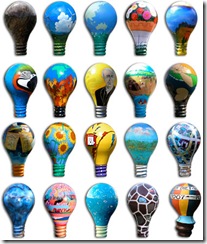
bulbsThe article argues that LEDs may not make it to the household environment anytime soon but says look out for a wide range of new energy-efficient incandescents instead.

Source: Painted light bulbs

SEE ALSO:

The Revenge of the Bulb -- and the Tube by Edward Tenner in The Atlantic

Welcome to the homepage devoted to the Longest burning Light Bulb in history. Now in its 108th year of illumination.

Funny, cool and amazing light bulb pictures

Friday, July 03, 2009

JOHN MICHELL MEMORIAL: 2 July 2009

   John Michell3560  John Michell1557                                                                                                  What must have been more than 400 of the great and the good - family, friends, colleagues, admirers - gathered in the unrelenting desert heat of Ladbroke Grove to celebrate the life new2 013and times of John  Michell - a remarkable and lovely man, to whom many speakers paid glowing praise. [See also: JOHN MICHELL: A TRIBUTE]

Prince Charles had sent a representative. Jools Holland played a New Orleans-inspired composition he had worked on in John's presence. 

Michael Horowitz spoke movingly:'When  questioned and talking about John both Copy of Copy of new2 058 before and since his death, I've found that whenever a single word is required to characterise him, it is Visionary that springs most immediately to my mind and lips. He was forever viewing and reviewing, uncovering and discovering, tracing and replenishing the old/new continuum ­ ley lines, directions, architectures, maps and sketch-plans, ancient texts and futuristic blueprints. He was at once as quintessentially English as Blake and Hughes and that other visionary friend, Kathleen Raine ­ yet supranationalist, heart in heart and hand in hand with Tom Paine, Whitman and Ginsberg.' He also sang a William Blake song in an experimental manner.

Christopher Logue (one of our greatest  English poets, scandalously unsung) was helped to the lectern, where he delivered a short poem in a voice that resonated like thunder.

john_michell

Keith Critchlow delivered the Eulogy. I took some pencil notes: He will find his place next to Goethe....birth of the Research Into Lost Knowledge (RILKO) organisation: Frederick Wybourne, Glastonbury cathedral, 'The Canon' by William Stirling....he had an aim 'to redirect the way people see the world, to effect a change in public consciousness, to change the premise of our age....Cosmology as a sacred science; the precious and sacred nature of Britain; the dimensions of Paradise.'

John Michell2a559

His son and brother both spoke in praise of him and made us laugh. Their comments are mixed-up in my notes but I think it was his son who said that John had encouraged him to accept the world as it is and not to interfere with the inscrutable, and his brother who described John as a 'conservative-anarchist' and said he trod lightly on the ground, he made you laugh and think, he saw the beauty of the world so clearly, he enjoyed the enigma of our short lives, and was quite beyond time.

new2 089 It was thanks to Richard Adams, who had been John's friend and creative collaborator for some 35 years,  that the whole event happened (thanks!); he read John's great poem 'How Lord Montague Gave Stonehenge to the Freemasons'.

Candida Lycett Green said John had compiled a list of 'Good Things' which included: people who say "Hello John. How's John". She described him a kind and noble man, fearless and innocent.new2 024

We left the church to the strains of  Chris Jagger's 'Stand Up for the Foot!', thus celebrating John's Anti-Metric campaign. The chorus goes: 'Stand up for the foot/ Its feeling the pinch/Stand up for the foot/And don't give an inch.'

The Scots piper led us down the road to the  new2 035Tabernacle where hours of conversation ensued, fuelled by Red Stripe lager. Old friendships were rekindled. Tenpole Tudor played. Stories were told.  New schemes were hatched. A classic and beautiful Grove moment.new2 039

new2 051

  new2 067


Tuesday, June 30, 2009

ANCIENT ART1: OLDEST HUMAN STATUES & MUSICAL INSTRUMENT / CAVE ART CHAUVET

gobekli-tepe-man
This 2m-tall cream-coloured limestone effigy with obsidian eyes, is the oldest human statue in the world, dated at 10,000 BC. It was officially named the 'Balıklıgöl Statue' (nicknamed the 'Snowman' by the press) and had been neglectfully displayed on a out-of-the-way shelf in a local museum for some years before its full importance was recently recognised.
It was first discovered in 1993 in the ancient Kurdish city of Sanliurfa in central southern Turkey, when foundations were 166369040_32bd408814_o being laid for a new bank, right next to an historic city attraction - the Balikli Gol, a beautiful fishpond surrounded by mosques and gardens.
The statue, which was found in the ruins of an undiscovered Neolithic temple (also dated at 10,000BC), is believed to represent the God of Eroticism or the God of Reproduction.
gobekli-tepe-lady

Above: The statue in situ Left: A small female figurine from the same site.
Sanliurfa is close by to the extraordinary archaeological dig at Gobekli Tepe where a fascinating neolithic temple complex has been uncovered in the last fifteen years, consisting of an estimated 20 stone circles (of which four have so far been excavated) that are dated at around 9,500 BC.
The stones are covered with remarkable carving of boars, 061017edenfoxes, lions, birds, snakes and scorpions, and their age. They are not on the same scale as Stonehenge (the largest are no more than 30m across), but they are 7,000 years older!
Sources: Red Ice Creations The First Post Mathilda's Anthropology Blog www.bibliotecapleyades.net/arqueologia/gobekli_tepe05.htm
The 'Snowman' may be the oldest 'statue' and the oldest known carving of a man but it is certainly not the the oldest carving of a human figure. That honour currently lies within another recent discovery.
earliest-statue
Discovered in 2008, the 'Venus of Hohle Fels' is believed to be at least 35,000-40,000 years old). It is currently considered the world's oldest known depiction of a woman - of any human being. Just over two inches long, carved from a woolly mammoth tusk by early Homo sapiens, it is named after the cave in southwestern Germany in which it was found.
Photo: H. Jensen/University of Tubingen
Sources: 'Pornographic' Statue Could be World's Oldest Piece of Figurative Art.' [Discover]
'A female figurine from the basal Aurignacian of Hohle Fels Cave in southwestern Germany' by Nicholas J. Conard [Nature]
Incidentally, in the same cave was discovered the world's 1224249576797_1 oldest musical instrument - a primitive flute, 20cm long, with five finger holes, made from a vulture's wing-bone. Three other flutes made from mammoth ivory were also found. The previous oldest musical instruments were a group of 22 flutes found in the French Pyrenees and estimated to be 30,000 years old.
Source: Irish Times 26 June 2009
Previous Oldest:
Venus_of_Brassempouy
The Venus of Brassempouy is a fragmentary ivory figurine from the Upper Paleolithic which was discovered at Brassempouy, France in 1892. About 25,000 years old, it is one of the earliest known realistic representations of a human face.
http://en.wikipedia.org/wiki/Venus_of_Brassempouy
The Venus of Willendorf, also known as the Woman of 319px-Venus_von_Willendorf_01Willendorf, is an 11.1 cm (4 3/8 inches) high statuette of a female figure estimated to have been made between 24,000 BCE – 22,000 BCE. It was discovered in 1908 by archaeologist Josef Szombathy at a paleolithic site near Willendorf in Lower Austria. It is carved from an oolitic limestone that is not local to the area, and tinted with red ochre. Since this figure's discovery and naming, several similar statuettes and other forms of art have been discovered. They are collectively referred to as Venus figurines, although they pre-date the mythological figure of Venus by millennia. http://en.wikipedia.org/wiki/Venus_of_Willendorf
Another ancient figurine:
lionman The Lion man is a 30cm-high lion-headed ivory sculpture, carved out of ivory with a flint knife. It is the oldest human-animal sculpture known.
Its pieces were found in 1939 in a cave in the Swabian Alb, Germany. Due to the beginning of the second world war, it was forgotten and only rediscovered 30 years later.
In 1997/98 it was reassembled and restored. It was determined to be about 32,000 years old. It was originally classified as a male, later as female.
Sources: http://ristorantemystica.wordpress.com/2008/10/
THE OLDEST PORTRAIT OF A HUMAN FACE cave372
The cave painting from Angoulême, France is dated c. 25000BC. Photograph: AP
Source: 'Old Masters' by Jonathan Jones [The Guardian. 6 June 2006]

Read this fantastic New Yorker piece on cave art.

080623_r17477_p465
'A frieze of horses and rhinos near the Chauvet cave’s Megaloceros Gallery, where artists may have gathered to make charcoal for drawing. Chauvet contains the earliest known paintings, from at least thirty-two thousand years ago.'

'First Impressions: What does the world’s oldest art say about us?' by Judith Thurman

UPDATE:

A woman's touch: Prehistoric cave paintings were made by women as well as men, scientists discover

SEE ALSO: ANCIENT ART 2

Sunday, June 28, 2009

TOM PAINE IN LEWES

Paine09a555

Copy of Paine09b556

Above: Latest issue of our excellent monthly Viva Lewes. Cover art: Neil Gower. (Right): Logo of the Thomas Paine in Lewes festival.

Tom Paine in Lewes makes the Washington Post today (and the Dallas Morning News) in an article by freelancer Matthew Hampton entitled ' Revolutionary Road: Thomas Paine's Path to American Activism Began in a Free-Spirited British Town', for which I was interviewed.

Article links Tom Paine and the spirit of Lewes with the Lewes Arms campaign, detailed in my blog: http://lewesarms.blogspot.com

For extensive Previous Postings on Paine, the Lewes Arms, use Search function.

The Lewes Tom Paine Festival runs from July4-12th: music, theatre, debates, lectures, dances, movies. Check out all the details.

Paine09b556

The Lewes pound note has had a redesign, courtesy of two local schools, and there will be three new denominations, a fiver, a tenner, and a twenty-one pound note (which has yet to be given a demotic nickname). To be launched July 3rd.

v3_note_00162

Saturday, June 27, 2009

NAKED LUNCH@50

Burroughs1552

(Left) Multiple exposure photo of Burroughs from The Generalist Archive. Photographer unknown.

The 50th Anniversary of the first publication of  'The Naked Lunch' will be celebrated by a series of events on the Left Bank of Paris, near to the Beat Hotel, where Burroughs completed writing his  book.

The Naked Lunch@50 site has all the details and much more on this fascinating and seminal novel.

Burroughs2553 Burroughs3554

See Previous Posts on Burroughs:

ARCHIVE: MEETING WITH BURROUGHS AT THE CHELSEA 

W illiam Burroughs & T.S. Eliot Fighting in the Captain's Tower

PHOTOGRAPHIC FUTURES 2

Florian KapsFlorian Kaps /The Impossible Project:

A Polaroid Revival. sounds unlikely doesn't it but that's just the plan of  The Impossible Project, established in January2009 by a group of businessmen and polaroidformer employees who have bought a Polaroid factory at Enschede in the Netherlands,  in the hope of resuming production of instant film for the existing ownership base of Polaroid owners, by 2010.  The name of the company comes from a quote from Edwin Land, the inventor of instant photography and the founder of Polaroid: 'Don't undertake a project unless it is manifestly important and nearly impossible.'

See: Paper chase the next stage of Polaroid revival

Florian Kaps, the company's Executive Director/Marketing & uodiana Business Development, has a great track record in this kind of enterprise. His official company bio says: 'Since his childhood attracted by the exercise of running into the opposite direction, he reacted to the digital revolution by founding a strictly analog company.


This was the Lomographic Society, whose website is awesome. Its an enterprise  built around the Russian analog camera - the LOMO LC-A, first launched in 1984.

about.timeline

The site says: Take one good look at a Lomograph and you’ll see that it holds a charm all of its own. Somehow everything is amplified and ordinary objects stand out, enhancing details that would normally go unnoticed. How can this be? We’ve narrowed it down to an ever-changing formula of certain variables like… shadowy vignetting that mysteriously frames the shot, light leaks, grain you could chip a tooth on, the magic of a great lens, deep saturation, just the right amount of contrast... to name but a few. A combination these factors and a healthy touch of the unexpected go into making each Lomograph unique. Essentially, Lomography embraces the element of surprise that only analogue film photography can bring and wholeheartedly celebrates the outcome.'

30f960c1873f15cb5488f6ff6de522feafced0

d65ac7e9078658b682008c8720aa7deba7a35b This multi-exposure lomograph was taken in Singapore by maxpinchers


Finally, Kodak will be discontinuing the production  of Kodachrome film later this year, as it now account for less than 1 per cent of the company's sales of still-picture films.  Kodak says that 70 per cent of its revenue comes from its retail and commercial digital businesses.

america-kodachrome Its most famous colour film, Kodachrome was first introduced in 1935. This new technology made it possible to capture action photography in color on 35mm film, a previously impossible feat.

Paul Simon immortalised it in a song in 1973.

Vintage Kodachrome from the Daily Kos via Neatorama

See Previous Post: PHOTOGRAPHIC FUTURES