
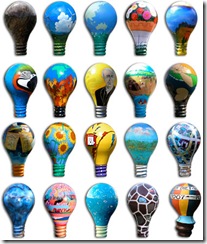
Sexy light bulbs available from www.unitedmaskandparty.com/Props/props.htm
'I know light bulbs may not seem sexy'

(AP Photo/Pablo Martinez Monsivais)
'First, the President announced changes to energy conservation standards for the manufacturing of household and commercial lamps and lighting equipment -- to make light bulbs more energy efficient.
"Now, I know light bulbs may not seem sexy, but this simple action holds enormous promise because 7 percent of all the energy consumed in America is used to light our homes and our businesses," Obama said, "And, by the way, we're going to start here at the White House. Secretary Chu has already started to take a look at our light bulbs, and we're going to see what we need to replace them with energy- efficient light bulbs."
The President estimated that between 2012 (when the standards take effect) and 2042, the new standards will save consumers up to $4 billion a year.'
PRESIDENT OBAMA PROMOTES ENERGY EFFICIENCY/29th June 2009.

Workers installing LED’s on the George Washington Bridge
The George Washington Bridge has become the first bridge in the New York metropolitan region to convert its light necklace to LEDs — light emitting diodes — a move that officials say will save an average of $5,000 a month in lighting and maintenance costs.
Back in 2008, I briefly became a 'virtual expert' on the subject of energy-efficient lighting.
First, I was hired by the Professional Lighting Designers Association (PLDA) to work on a campaign to question plans by the EU to ban incandescent light bulbs from sale and to help create a very strong public argument against such a move, on a wide variety of grounds. When it came to it, the PLDA decided not to proceed, though they pursued the issue vigorously in other ways, up and until the ban was passed earlier this year.
Following the decision not to pursue the campaign, I managed to place a good piece in Business Green, an efficient and well-informed website, which they published on 20th January 2009. The full original text can be read here.
With the Daily Mail attempting to whip up opposition to energy saving light bulbs, many businesses would be forgiven for asking if green bulbs really are such a good idea. BusinessGreen.com trains its spotlight on a surprisingly complex debate
The piece does a good basic job of presenting the key arguments for and against the ban. How this global shift originated with the International Energy Agency with report entitled 'the Big Switch Off.' How the global corporate lighting industry is organised and the dominant role of China in bulb manufacturing. The shortcomings and risks of CFLs (mercury), set against their claimed advantages. [Balancing arguments in the piece were added by the site's editor, which I had no problem with.]
It is a complex issue and an incredibly interesting one. I accumulated more than 3ft of files, reports, papers and clippings on the subject (plus of course a massive amount of links and data on the computer).

Whippy (2006) made by artists Alex Garnett and Nahoko Koyama of Mixko:
Now one of the key arguments against CFLs is that they are expensive transitional technology between incandescents and LEDs - and other more futuristic lighting concepts that would deliver even greater energy efficiencies, making CFLs obsolete.
At the time I wrote the piece, engineering giant General Electric had:
recently canned a project to develop high-efficiency incandescent lamps (HEI) in order to place greater focus and investment on LEDs and organic light-emitting diodes (OLEDs).
Now to the reason for this post - a news story from the International Herald Tribune
It seems that the obituaries for the death of incandescent bulb were premature, writes Leora Broydo Vestel. Instead the bulbs are being re-engineered to meet mandatory efficiency levels.
'Indeed, the incandescent bulb is turning into a case study of the way government mandates can spur innovation.
“There’s a massive misperception that incandescents are going away quickly,” said Chris Calwell, a researcher with Ecos Consulting who studies the bulb market. “There have been more incandescent innovations in the last three years than in the last two decades.”
 Philips Lighting’s Halogena Energy Savers are already on the market in the US - exclusively available through Home Depot and Amazon.com. Philips says that a 70-watt Halogena Energy Saver gives off the same amount of light as a traditional 100-watt bulb and lasts about three times as long, eventually paying for itself.'
What is making this possible is the development of specialised reflective coatings for incandescents which 'act as a sort of heat mirror that bounces heat back to the filament, where it is transformed to light.' One of the key companies in the field is Deposition Sciences Inc.
The big three lighting companies — General Electric, Osram Sylvania and Philips — are all working on the technology, as is Auer Lighting of Germany and Toshiba of Japan.
Other techniques include pitting the filament with lasers (makes it twice as bright with the same power consumption) or using a 'high-tech, iridium-coated filament that recycles wasted heat.'
 The article argues that LEDs may not make it to the household environment anytime soon but says look out for a wide range of new energy-efficient incandescents instead.
Source: Painted light bulbs
SEE ALSO:

Welcome to the homepage devoted to the Longest burning Light Bulb in history. Now in its 108th year of illumination.
Funny, cool and amazing light bulb pictures


 Peter's partner


 and times of John Michell - a remarkable and lovely man, to whom many speakers paid glowing praise. [See also:


