Showing posts sorted by relevance for query 'Truman Capote'. Sort by date Show all posts

Tuesday, July 25, 2006

TRUMAN CAPOTE: TRUTH AND LIES

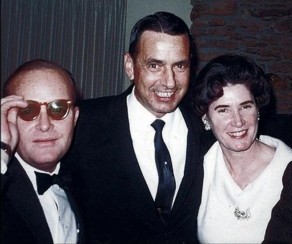
Truman Capote with Alvin Dewey Jr, the Kansas Bureau of Investigation's lead detective on the Clutter family murder case and his wife Marie.
'Dewey gets much of the credit for an investigative effort that involved law enforcement agents from Washington, D.C., to Nevada. But 45 years after the Clutter murders in Holcomb, it's difficult to separate where Dewey's involvement in the case ends and other lawmen's begins. Furthermore, for all Dewey's experience, some Garden City, Kan., residents are critical of his relationship with Capote and how that affected what ended up in the book.' Full story here.

Belatedly, I sat down to ‘Capote’ on Sunday afternoon and now look what’s happened. I can’t stop thinking about it. Let’s get one thing straight right away. I hate biopics, hence my reluctance to see this film. However Philip Seymour Hoffman does a great job, for which he won the 2006 Best Actor Oscar, the script, based on the 1988 biography by Gerald Clarke, is well-crafted, its elegantly shot and well-directed. The character of Harper Lee, played by Catherine Keener, is beautifully drawn and strikes a perfect note in the unfolding drama. There are false notes but not many. By and large, it works.

History tells us that ‘In Cold Blood,’ – the writing and researching of which is the subject of this film – was the first nonfiction novel and blazed the trail for what has come to be known as New Journalism (see previous posting: The Archaeology of New Journalism). If one wanted to be flippant, you could certainly says it certainly launched the true-crime market.

More importantly and interesting to me was the fact that Capote claimed to have 94% recall of conversations and never used a tape. So how non-fiction was this breakthrough book? Had the years since the book's publication and the author’s death in 1984, revealed new insights as to the veracity of Capote’s account?

A good place to start is in an early chapter of Marc Weingarten’s Whose Afraid of Tom Wolfe ?, which carries an interesting four-page account of the making of In Cold Blood. It confirms that Capote never tape-recorded or recorded any conversations during his six years of research but, for much of that time, Harper Lee (actually Nelle Harper Lee), worked as his stenographer. After each day’s work, Weingarten says, Capote would head back to his hotel room, type everything up from memory and Lee’s notes, and all this was then filed and cross-referenced.

Weingarten also claims that Capote had ‘taught himself to be his own tape recorder’ and that the fact checker at The New Yorker magazine, which had commissioned the story, ‘found Capote to be the most accurate writer that he had ever worked with.’ This, despite the fact, says Weingarten, that ‘Capote was venturing into unknown territory for The New Yorker, writing about events that he didn’t witness, dialogues that he had received second-hand, interior monologues that could only be stitched together from his interviews and a fair amount of creative licence on his part.’

(The magazine published it in four consecutive issues beginning 25th September 1953 and says James Wolcott in Vanity Fair: ‘It was the closest thing the publishing world had seen to Beatlemania.’)

The New Yorker also published a review by Thomas Mallon [Sept 13th 2004] of ‘Too Brief A Treat: The Letters of Truman Capote’ by Gerald Clarke. Mallon writes: ‘And yet, with this collection of letters, as with each biography that has come along, the fictional quotient of Capote’s ‘nonfiction novel’ has to be revised upward…the effect of these small revelations is always dismaying, and diminishing. The more artistry we espy, the less artistic seems the book, which Capote always touted as a miracle of scrupulosity.’

According to ‘Truman Capote's In Cold Blood: The Nevada Connection’ by Guy Louis Rocha: '‘Capote was a novelist using a reporter's approach, and In Cold Blood suffered from the difference. While Capote claimed in a well publicized interview with George Plimpton in the New York Times Review of Books (January 16, 1966) the book was "immaculately factual", the novelist side of him, many times, permitted great liberties with the facts. And some would say he abused both conventions. For example, we know Capote invented the book's final dramatic scene…

"By insisting that 'every word' of his book is true," Phillip K. Tompkins wrote in the June 1966 issue of Esquire, "he has made himself vulnerable to those readers who are prepared to examine seriously such a sweeping claim." Interviewed by George Plimpton, John Richardson, an acclaimed biographer of Pablo Picasso, claimed that "Truman had absolutely no respect for the truth." Richardson continued, "He felt that as a fiction writer he had license to say whatever came into his head as long as it had a surprising point or shape to it, or an unexpected twist to its tail."

Mallon’s New Yorker review of Capote’s letters goes on to say that Capote claimed to be ‘in closest daily contact with some seven or eight Kansans’ in order to nail down the story. That material, says Mallon, is not in the letters ‘but the serious devotee of ‘In Cold Blood’ would like to see them anyway, if only to measure the gradient of the slippery slope that Capote rolled down towards ‘Handcarved Coffins (1980), a superfictionalised ‘nonfiction’ account of another American crime he’d heard about from Alvin Dewey.’

He’s referring here to the centrepiece of Capote’s collection of journalism and short stories called Music For Chameleons’– a lengthy story entitled ‘Handcrafted Coffins’, written in a similar style to ‘In Cold Blood’, about a strange and unsolved series of murders in another small but unidentified Midwestern town.

It was serialised over several weeks in the Sunday Times, but was later exposed by the very same newspaper two years later, as a hoax. In ‘Hoax: Secrets that Truman Capote took to the grave’ by Peter Gillman, published on June 21, 1992, Capote’s account was revealed to be a weaving together of pieces from various cases he had been told about by Alvin Dewey, the very Kansas detective who is the main investigator portrayed in the ‘Capote’ movie. (Dewey was miffed by the book’s publication as he himself had hoped to write a book of his own memoirs, including the real stories that Capote had confected into his own ‘real crime’ story).

According to Wikipedia: ‘In Cold Blood brought Capote much praise from the literary community, but there were some who questioned certain events as reported in the book. Writing in Esquire (1966), Phillip K. Tompkins noted factual discrepancies after he travelled to Kansas and talked to some of the same people interviewed by Capote. In a telephone interview with Tompkins, Mrs. Meier denied that she heard Perry cry and that she held his hand as described by Capote. In Cold Blood indicates that Meier and Perry became close, yet she told Tompkins she spent little time with Perry and did not talk much with him. Tompkins concluded: 'Capote has, in short, achieved a work of art. He has told exceedingly well a tale of high terror in his own way. But, despite the brilliance of his self-publicizing efforts, he has made both a tactical and a moral error that will hurt him in the short run. By insisting that “every word” of his book is true he has made himself vulnerable to those readers who are prepared to examine seriously such a sweeping claim'.

The Book That Changed A Town
In autumn 2004, a class of seven reporting students, a photography student and four documentary film students at the University of Nebraska-Lincoln spent the season studying Capote's work and its impact on literature and journalism, the community where the story unfolded and some of its principal characters. The students obtained exclusive interviews from people who had refused to talk publicly about the crime or the book. The four-part series based on their investigations was published in the Lawrence Journal-World, a Kansas newspaper, to mark the 40th anniversary of the original publication of the book. These and the documentary film are available for download. http://www.ljworld.com/specials/incoldblood/

In an introductory essay: ‘Holcomb still deals with the pain and attention by Truman Capote's novel’ journalist Van Jensen notes: ‘Without In Cold Blood the murders probably would be forgotten to all but those who lived through the suspicion and fear. And that, in part, fuels the lingering pain so many in Holcomb and Garden City feel. But, West says, Capote harmed the people here in another way. West and many others share stories of Capote misquoting people, describing things incorrectly and making up scenes.’

FINAL NOTES
Adam Mars-Jones wrote an interesting piece in The Observer about Capote's long-lost first novel Summer Crossing, first published in November 2005. He notes: 'Capote claims to have turned himself into a human tape recorder for the purpose of In Cold Blood, since witnesses would be put off by recording equipment or a note book. This always seemed a preposterous claim, making the authority of the book rest entirely on his say-so (and the mystery remains of why anyone said anything whatever to this worldly pixie), but his ear was always good.'

MORE MOVIES

‘Infamous’ (previously named ‘Have You Heard?’), written and directed by Douglas McGrath, covers the same territory as ‘Capote’. Starring English actor Toby Jones as Capote, Sandra Bullock as Harper Lee, the movie also features Sigourney Weaver, Peter Bogdanovich and Gwyneth Paltrow making a cameo appearance as Peggy Lee. The film is adapted from George Plimpton’s oral biography Truman Capote: In Which Various Friends, Enemies, Acquaintances and Detractors Recall His Turbulent Career. It is due to be released by Warner Independent in September 2006.

In Cold Blood was filmed twice. Richard Brooks directed the 1967 movie which starred Scott Wilson and Robert Blake as the two murderers Dick Hickock and Perry Smith. It was filmed at the actual Clutter house and other locations around Holcomb, Kansas. The "semidocumentary" received four Academy Award nominations in 1968, including one for original music score by jazz/pop-legend Quincy Jones. (Ironically, actor Robert Blake was recently put on trial for murder - and acquitted.)

More recently, a TV miniseries, directed by Jonathan Kaplan and starring Anthony Edwards (Dick Hickock) and Eric Roberts (Perry Smith), aired on US tv in 1996.

CAPOTE FACTS:

*Capote grew up in a small town in Alabama, next door to Harper Lee whose famous book ‘To Kill A Mockingbird’ has a character based on him.

*Capote was hired as a copy boy at The New Yorker when still in his teens.

*Capote considered Bob Dylan an unspeakable phony and said of Kerouac’s work: ‘That’s not writing, that’s type-writing.’

*Capote died in the Los Angeles home of Joanne Carson, one of Johnny's ex-wives, on August 25th 1984.
The official cause of death was liver diseas but he had likely overdosed on drugs including Valium, codeine and barbiturates. (Tim Engle, Kansas City Star)

*In an interview with the novelist Edmund White (‘Sweating Mirrors’/After Dark, Sept 1980.) he says that he thinks the most perfect story in his collection ‘Music for Chameleons’ was ‘Then It All Came Down’, which records the visit he made to Robert Beausoleil in prison, ‘the mystery man in the Charles Manson cult.’ [The hired photographer, whose entrance is recorded in White’s reportage, was Robert Mapplethorpe]

*In ‘Tru Grit’ [Vanity Fair /October 2005] James Wolcott says of Capote that he 'looked and sounded like a stunted child – or a hermaphrodite.’ Capote said of himself: ‘I’m about as short as a shot-gun and just as noisy.’

* Capote was, incidentally, forever peeved that this book was overlooked for a Pulitzer Prize which was awarded, a couple of years later, to Norman Mailer’s ‘The Armies of the Night,’ a book which also won the National Book Award. Capote was furious: ‘Norman Mailer, who told me that what I was doing with ‘In Cold Blood’ was stupid and who then sits down and does a complete ripoff.’

Monday, November 16, 2009

IN COLD BLOOD AT 50

CAPOTE3

Truman Capote with Alvin Dewey Jr, the Kansas Bureau of Investigation's lead detective on the Clutter family murder case and his wife Marie.

The 50th Anniversary of the murders at the Clutter farm at Holcomb, Kansas would have long ago faded into obscurity had it not been that the writer Truman Capote used the story as the basis of his book 'In Cold Blood', which has been  read and published all over the world  ever since.

The Guardian  today used the opportunity to run a piece by Ed Pilkington, who visited the town and talked to some of the key characters involved.

But no mention was made of one of the most interesting aspects of the book and the circumstances surrounding its creation. Widely claimed as the first 'non-fiction novel', as time has gone on its become clear that there was great deal more fiction than fact in Capote's telling of the story.

The Generalist's story on this theme TRUMAN CAPOTE: TRUTH AND LIES has been one of our most popular posts since it was first published on July 25th, 2006. Check out the story behind the story.

Thursday, March 11, 2010

KAPUSCINSKI REVISITED

Kapuscinski 

Two of the most visited and downloaded stories on The Generalist are:

*A piece I wrote on Truman Capote and the writing of 'In Cold Blood' - supposedly the first 'non-fiction novel'

TRUMAN CAPOTE: TRUTH AND LIES

*A  lengthy series of posts on my friendship and encounters with the great Polish journalist Ryszard Kapuściński, - a mentor, widely considered one of the great foreign correspondents of our time.

  • KAPUŚCIŃSKI : INTRODUCTION
  • KAPUŚCIŃSKI 1: MEMORIES of a MENTOR
  • KAPUŚCIŃSKI 2: THE FACE
  • KAPUŚCIŃSKI 3: CONNECTIONS THROUGH TIME
  • Both stories have gained an added relevance due to the publication of a biography of Kapuściński - ' Kapuściński-Non Fiction' -   written  by Artur Domoslawski that has just been published in Poland that suggests (according to the British press at least)  that Kapuściński,was a dishonest reporter who made up stories and invented quotes. What follows is a miscellany of thoughts and perspectives, from many countries, on this important subject - the line between fact and fiction.

    Bearing witness is a sacred trust

    Every writer of reportage ought to learn from the Kapuściński controversy. Creative non-fiction is a slippery slope.

    Timothy Garton-Ash [The Guardian 10 March 2010

    Poland: Ryszard Kapuściński - Fiction or ‘Non-Fiction'?

    By Sylwia Presley. [Global Voice] Interesting aggregator of blog comments, many from Poland. 10 March 2010

    The Lying Traveler: The Kapuściński Case 

    Binoy Kampmark [Scoop Independent News/NZ 10 March 2010]

    Fact, Fiction and Kapuscinski

    By ROBERT MACKEY [The Lede/The New York Times blog 8 March 2010] This is an incredibly interesting corrective to the UK press coverage and contains a long interview with Artur Domoslawski.

    Poland Not Ready for Flawed Heroes

    by Malgorzata Halaba [The Wall Street Journal blogs. 8 March 2010]

    Liquidating the borders between fact and fiction

    Polish reporter Ryszard Kapuscinski's amazing stories may have been just that, a new book suggests

    Ian Jack [The Guardian 6 March 2010]

    Why Believe Kapuscinski's Biographer?

    Patrick Galey [The Huffington Post/6 March 2010]

    A brilliant writer who mistrusted clarity

    Ryszard Kapuściński's work may drift into fiction – but adherence to fact in war reporting can start to feel impossible and pointless

    Lara Pawson [The Guardian 4 March 2010]

    Kapuscinski biography flies off the bookshelves

    [Polish Radio website. 4 March 2010]

    Ryszard Kapuściński was a great story-teller, not a liar

    Critics of Ryszard Kapuściński's books miss the point – there is no sharp frontier between literature and reporting

    Neil Ascherson [The Guardian 3 March 2010]

    I suspected Polish reporter was a fake

    Jon Snow [Channel 4 blog. 3 March 2010]

    Ryszard Kapuscinski: He was hailed as the greatest reporter of his time. But how much did he make up?

    Ryszard Kapuscinski said he knew Che Guevara. He recounted how he met Patrice Lumumba. But according to a new biography, his books were more fiction than fact. Tony Paterson reports

    [The Independent  2 March 2010]

    Poland's top reporter accused of lying and spying in new biography

    Ryszard Kapuscinski, the late Polish journalist, has been accused of collaborating with Poland's communist government and of making factual errors.

    [The Telegraph 2 March 2010]

    Kapuscinski biography to be censored?

    [Polish Radio website. 16 Feb 2010]


    I was the first journalist in the UK to interview Kapuscinski. You can hear that interview on The Audio Generalist

    Wednesday, March 23, 2016

    JOHN STEINBECK: TRAVELS WITH CHARLEY / TRUTH AND FICTION


    Life coincides and all you have to do sometimes is follow the connections. So a week and half ago I took to my bed for three days whilst fighting some bug or other - lots of sneezing fits - but fortunately I had a radio and two books to take my mind off things. 

    At night the radio was following the Republican and Democratic election trails across America and so, in-between reading I'd switch on and listen to the latest news - most memorably on the night of March 11th when Donald Trump's roadshow hit Chicago and Chicago hit back with protests and demonstrations - the first big protests against his vile rhetoric. Of course it reminded me of Chicago 1968 when Mayor Daley let loose his brutal attack police with their tear gas, guns and clubs. And Steinbeck was on the road, searching for the America he loved but finding much that had been swept away.


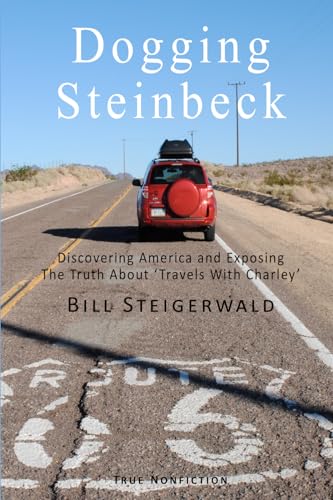
    Dogging Steinbeck: How I Went in Search of John Steinbeck's America, Found My Own America, and Exposed the Truth about 'Travels with Char: Steigerwald, BillJohn Steinbeck's 'Travels With Charley' is a very warm book, which is exactly what you need when you're feeling a bit low. Charley is his big poodle of French extraction with a weak bladder. Steinbeck drove a three-quarter ton pick-up truck (which he named Rocinante after Don Quixote's horse), that was customised to his requirements so he could sleep, drink and cook outback and welcome chatty guests who he might meet along the road. 

    As an armchair traveller, following his observations, thoughts and conversations as he covers thousands of miles and hundreds of contrasting landscapes, its an absorbing and thought-provoking tale. It was 1960, Steinbeck was 56 and not in the best of health. His wife Elaine was worried about him setting out on his own. He suffers homesickness on his trip and as the book progresses beyond a certain point, one definitely gets the feeling that all is not well.

    Steinbeck admits he can't take in any more. He has driven from Sag Harbour at the tip of Long Island, up to Maine, into Canada, across the top of America to Oregon, then down the California coast to Salinas - his home town and territory - where he meets a few old friends (many are dead) and feels himself to be a ghost a place he once knew so well.

    From here, he drives at speed over the Mojave Desert to Texas where he meets up with Elaine (his wife was a Texan gal). Separated again, he heads for New Orleans and the South before arriving back in New York. A hero's journey.

    Fifty years later, three people (maybe more) decide to retrace his journey. Geert Mak, a Dutch historian and journalist of note, who'd made many trips to the US before, sets out to follows his tracks, in a Jeep with his wife in the cab for companionship. 

    Steinbeck mainly slept in his truck but the Maks eschew that and bunk down in a range of dilapidated truckstops, lodging houses and hotels. In his 500pp+ book, Mak meticulously accounts for the meals they ate, the sights they saw. They walk round dusty towns, once throbbing with life, now abandoned. There's a dramatic chapter on the post-apocalyptic landscape of Detroit which sticks in the mind.  

    The details of the journey and the constant references backwards and forwards to Steinbeck's original trip make great reading but this is two books in one. With his historian's hat on, Mak tells us the history of America. I am embarrassed by how little I knew of it. It's a great education. Mak is also carrying with him a library of other journalists and writers, most importantly John Gunther, whose meticulous accounts provide yet another level of thought and observation about the vast American landscape and culture.

    Flipping from this book to listening to Trump and Clinton, the echoes from America's past flicker in one's mind. Take this powerful quote from Molly Ivins (now deceased) who Mak interviews in Texas. He describes her as 'a witty and astute columnist' for the Texas Observer and the Dallas Times Herald. They'd met before on a previous trip. He writes:
    'I once interviewed her about the Bush family. I can see us now, sitting on a bench outdoors in Austin, laughing away. But I also remember she suddenly became serious: 
    "Never, never underestimate the Republican machine, never underestimate their political skills, their immense network, the campaigning techniques, their capacity to pull off the most improbable tricks. You laugh at their show, not believing for a moment that people like that could ever run the world. Well, forget that. Don't underestimate them." 
    It's clear to Mak that Steinbeck's original account is, to a certain extent, fictionalised. From the original book one gets the impression that Steinbeck was trying to stick to driving on back roads ( avoiding stretches of the new freeways, still being built at that time) and always stopping off at little towns (avoiding the cities). In fact, for much of his journey, Steinbeck was driving at least a couple of hundred miles a day, as he realises the sheer distances he has taken on and as his homesickness asserts itself.


    ca_244_copy


    But shadowing Mak's efforts is a much more hard-core traveller journalist Bill Steigerwald, who is travelling in a truck on his own, sleeping in the truck for the whole of his journey, and tracking down in forensic detail every move that Steinbeck made. The clue to his book is in the title: 'Dogging Steinbeck: How I Went in Search of John Steinbeck's America, Found My Own America, and Exposed the Truth about 'Travels with Charley'. 

    In an article entitled 'Sorry, Charley: Was John Steinbeck’s Travels With Charley a fraud?' , first published on the Reason.com website in April 2011, he pulled no punches.
    After nine months of fact checking and 11,276 miles of drive-by journalism, I can tell you for sure that:
    • Steinbeck was almost never alone on his trip. Out of 75 days away from New York, he travelled with, stayed with, and slept with his beloved wife, Elaine, on 45 days. On 17 other days he stayed at motels and busy truck stops and trailer courts, or parked his camper on the property of friends.
    • Steinbeck didn’t rough it. With Elaine he stayed at some of the country’s top hotels, motels, and resorts, not to mention two weeks at the Steinbeck family cottage in Pacific Grove, California, and a week at a Texas cattle ranch for millionaires. By himself, as he admits in Charley, he often stayed in luxurious motels.
    'From what I can gather, Steinbeck didn’t fictionalize in the guise of non-fiction because he wanted to mislead readers or grind some political point. He was desperate. He had a book to make up about a failed road trip, and he had taken virtually no notes...At crunch time, as he struggled to write Charley, his journalistic failures forced him to be a novelist again. Then his publisher, The Viking Press, marketed the book as nonfiction, and the gullible reviewers of the day—from The New York Times to The Atlantic—bought every word.'

    Steigerwald concedes that the book is, in many ways, 'still a wonderful, quirky, and entertaining book...That’s why it’s an American classic and still popular around the world.' But - and its a big but - he says 'there’s no denying Steinbeck got away with writing a dishonest book.'
    'Not only did he fudge the details of his road trip, but he pulled his punches about what he really thought about the America he found. In Charley he fretted about the things he didn’t like about American society: pollution, early signs of sprawl, the rise of national chains, the increasing prevalence of plastic. But in private he complained directly about the failings of his 180 million fellow Americans: They were materialistic, morally flabby, and headed down the road to national decline.
    'If Steinbeck sounds like a liberal who’d been living like a prince in New York City too long, it’s because that’s what he was. Fifty-eight and in poor health when he set out on his ambitious voyage of discovery, he quickly ran aground on his own loneliness and the realization that our “monster land” was too big and too complex for one man to understand.'

    You can read Steigerwald's series of article about his trip here:  http://truthaboutcharley.com/travels-with-charley-timeline/

    Finally, we come to the third traveller in Steinbeck's tyre tracks: Rachel Dry who drove from Vermont to Fargo, the geographical centre of America, with her mother as companion, and wrote a long piece for The Washington Post [November 12, 2010] called 'Following Steinbeck to Fargo'.

    In a later Opinion piece in The Washington Post entitled: 'Steinbeck’s true enough ‘Travels With Charley’ [April 15, 2011] she writes:

    'Journalist Bill Steigerwald has caught John Steinbeck in a lie. The Nobel laureate, according to Steigerwald, probably invented characters and embellished the hardships of the cross-country journey he made with his dog, Charley, in the fall of 1960, chronicled in his bestseller “Travels With Charley.”
    I am a Steinbeck fan, and I happen also to have once been caught in a lie by Steigerwald — a lie linked to Steinbeck and his journey. This is a small part of the reason that...I think it doesn’t matter.'
    'Steinbeck showed us postwar America as it looked from the window of his green GMC truck, custom-fitted with a camper. He may not have slept in the camper much (one of Steigerwald’s main contentions) or been alone with only a poodle for companionship (Steigerwald found that his wife was with him for a lot of the trip), but he gave us something we wouldn’t have otherwise. He showed us the country in a rich, kaleidoscopic view: one nation that included Swiss-cheese candy in Wisconsin, a New Yorker-reading aspiring hairdresser near the continental divide and the ugly invective that came with integration in New Orleans.'


    In case you miss the much appreciated Comment below, received shortly after posting, from Bill Steigerwald :

    Thanks to John May for the links and the nice things he said about me and my book, Dogging Steinbeck. But for the record, as we journalists like to say, it was I and not Geert Mak who first blew the whistle on Steinbeck's heavy fictionalizing and his dishonest account of his travels. Mak is a wonderful Dutchman, a great journalist/author and a historian who puts all us native history majors to shame. But he will be the first to acknowledge, as he so kindly and honestly did in his book, that he was tipped off by me about the many small and large fictions and fact-fudges in "Charley." As he and the Missus were traveling, he read the road blog that I was writing for the Pittsburgh Post-Gazette in the fall of 2010 as I followed Steinbeck's 1960 route. I was days and then weeks ahead of the Maks, who had a more leisurely but more expensive road trip. less . (Also for the record: Steinbeck was 58 when he made his trip and I drove, alone, a Toyota RAV4, which I slept in about 20 nights.)


    PREVIOUS POSTS:

    If you enjoyed this you might like my two posts on Truman Capote's 'In Cold Blood', widely claimed as the first non-fiction novel.As time has gone by, its clear that the book has more fiction in it than fact.


    Also have written extensively on Jack Kerouac's journey 'On The Road'

    Finally, recommending another cult book which I really love 'Blue Highways by William Least Heat Moon.


    Saturday, August 04, 2012

    KAPUŚCIŃSKI REDUX

     'To what extent may one distort reality in order to reach the deeper truth that refelects the 'heart of the matter'? Where are the lines that mark the borders between fiction and non-fiction? By introducing elements of invention, by processing reality, do we shift our text from the 'journalism' shelf to the one marked 'literature'? Is literary reportage - as Kapuściński thought....a legitimate literary genre...?'
    These questions haunt this  truly remarkable biography of an extraordinary writer, hailed by the likes of Salman Rushdie as one of the great foreign correspondents of the 20th century but whose reputation since his death in 2007 has been seriously besmirched by revelations that he fabricated many of the facts and accounts in his most famous books and embellished the story of his own life.

    I was the first British journalist to interview Kapuściński when he arrived in the UK for the publication of 'The Emperor'. In 2007, I wrote a series of posts about the various meetings I had with him in London - at one of which I had the pleasure of introducing him to Bob Geldof, at another we met at the Royal Court Theatre and saw a performance of 'The Emperor' directed by Jonathan Miller - and about our correspondence over several years. There is also a reprint of the piece I wrote about him for 'The Face'. In 2011, I wrote a piece about this book (sight unseen) and collected a great many links which followed the original Polish publication of the book.

     All the above is accessible from this Previous Post: Kapuściński Revisited

    That post, in turn, links also to a further series of investigative posts on Truman Capote's 'In Cold Blood' - widely and wrongly hailed as the first non-fiction novel. As the years have past, the 'factual' content of the book has been seriously questioned and it is now clear that much of the work was the product of Capote's heated imagination. In other words, a useful historical parallel to the Kapuściński story.

    I call this book remarkable for a number of reasons. Firstly, Domosławski, a personal friend and a celebrated journalist in his own right, considered K a maestro and a mentor so it was with growing unease that, following K's death, he uncovered the secrets of both K the man and K the writer. The scrupulouseness of his investigation threatens the reputation of a man he loved and admired. 

    He writes: 'Not for the first time I catch myself fearing that, without meaning to write an expose, I am discovering facts about the master's life which I would rather not know at all, and that I am creating a platform for massively negative opinions of him.'


    Secondly, the translation by Antonia Lloyd-Jones is especially good as it captures the Polish style of prose, full of author's thoughts and rhetorical questions, which makes this intimidatingly long and detailed book really fascinating, unexpected and gripping to read.


    Thirdly, Domosławski sets K's adventures - he is always the real centre figure of his books - in the broader context of the extraordinary birth of the Third World that K witnessed at first hand and the modern post-war history of Poland.

    K was an enthusiastic communist until 1981, had friends in the Central Committee and wrote briefing papers and reports of utmost fidelity and factual accuracy for various branches of government. His groundbreaking expose of working conditions at the Nowa Huta steel works won him national acclaim and gained him the golden opportunity to travel the world.


    The books that emerged from these experiences were written in a powerful literary style, a form of 'New Journalism' that was compelling, visceral, atmospheric and fresh. For obvious reasons Domosławski's revelations have seriously affected K's standing in the eyes of his fellow journalists for betraying his profession -  which he told me personally was, in his eyes, 'a vocation.'. 

    Yet despite K's conrfabulations - he may have met Salvador Allende but he certainly didn't meet Che Guevara or Patrice Lumumba as has been widely claimed - there is still a wealth of excellent reporting and writing that will survive as great literature.

    What he was certainly great at was 'capturing the essential mechanisms of any authoritarian power'. After all, he did witness twenty or so revolutions, uprisings and coups d'etat in the Third World. Both 'The Emperor' an 'Shah of Shahs' can also be read as metaphors for the reality of the Polish political structure which he was so adept at working within. He told me personally: "Human nature doesn't change that's why Machiavelli and Shakespeare are contemporary works."


    Thanks to Domosławski, we now see K as a real-life complex figure - traumatised child, unfaithful husband, absent and cruel father, passionate communist - and as his own fictional creation. Finishing the book, walking through K's personal library and following K's final notes on his last journey to another world, one is left with a profound sense that his exploits and writings will continue to fascinate far into the future.


    'Ryszard Kapuściński : A Life' by Artur Domosławski is published by Verso Books.

    See also: Interesting audio assessment of the book on The Economist website: http://www.economist.com/node/21557299

    The Guardian review

    Thursday, November 04, 2010

    GORE VIDAL’S PALMIPSEST

    GORE VIDAL3713

    GORE VIDAL2712

    PALIMPSEST: A manuscript (usually written on papyrus or parchment) on which more than one text has been written with the early writing incompletely erased.

    The unusual cover mirrors the title. The book itself has the 1964 photo of Vidal on front and back. This is wrapped with a thin transparent plastic cover on which all the text has been printed. Maybe only used on the Abacus UK paperback edition [1996]

    Always been rather fascinated by Gore Vidal. First encountered when I read his strange book ‘Messiah’ back in the 1970s. He was often seen on tv chat shows and debates where it was impressive the way he cut people off at the knees.

    This book records the first 39 years of his life, recalled from 29 years later. He jokingly suggests that the most ‘persuasively apt’ title for a memoir should be Tissue of Lies.

    ‘A memoir is how one remembers one’s own life, while an autobiography is history, requiring research, dates, facts double-checked. I’ve taken the memoir route on the ground that even an idling memory is apt to get right what matters most. ‘

    Vidal wrote novels of many kinds – including a landmark series documenting, in a fictional form, the the birth and growth of the American Republic, alongside plays and screenplays for the theatre, tv and film. He was intensely involved in politics and ran for office twice (without success). His patrician background gave him an entre into the highest levels of power within America – he was related to Jackie Kennedy – and he travelled through the worlds of entertainment meeting Jack Kerouac, Marlon and a thousand others.

    His posse, if you like, were Tennessee Williams, Truman Capote, Norman Mailer – they fought and bickered with each other and Gore captures it all brilliantly.

    Gore famously wrote the first major US novel with a homosexual theme (‘The City and the Pillar’)and throughout this book he is frank and open about his own proclivities and activities – and of course those of others.

    The book is a grandstand piece of writing: incisive, full of electrifying phrases and needlepoint descriptions, telling phrases and marvellous anecdotes, masterfully told. There is high drama and low jinks, catty prods and belly laughs.

    Vidal is a naked singularity who remains constant to his principles and continues to this day to  fulminate against the widespread corruption of America’s political traditions and body politic, and the pomposities of power.

    The second volume stands waiting to be read.

    Monday, December 17, 2007

    THE GENERALIST AUDIENCE

    This is a snapshot of The Generalist's global audience, courtesy of Stat Counter, a wonderful service for all bloggers. Stories being accessed in this view of my blog's global traffic (16th December 2007) include stories on the Bering Bridge, on Arthur Brown, Tony Tyler, Mike Horowitz, Truman Capote, Al Gore, Johnny Depp, Joy Division etc etc

    In case people wonder why anyone would spend 2 1/2 years writing hundreds of thousands of words - for free - the answer is in this image. After decades of working for mainstream newspapers and magazines, my blog gives me complete freedom to write about what I think is important, in a way of my own choosing. Equally important is the oppotunity to reach out to a genuinely global audience, of all cultures, backgrounds and thoughts.

    Imagine if there was some global system whereby, when you wrote a book, you could log on to the internet and get a map of everyone who had taken your book to bed that night and was reading it. This blog gives me a feeling of real connection with an incredibly diverse global world.

    I have written stuff every month since June 2005 - except for three months surrounding my mum's death - and the possibilities keep opening up before me.

    Thanks to you all - past and present readers. Output is variable but consistently so. The plan is to keep this baby going until I run out of road. Hope you will join me for the ride.

    Check out the Audio Generalist here

    Thursday, November 24, 2005

    The Archaeology of New Journalism

    Who’s Afraid of Tom Wolfe: How New Journalism Rewrote the World by Marc Weingarten [Aurum Press 2005]

    The New Journalism
    – Tom Wolfe and E.W. Johnson
    [Picador 1975]

    The New New Journalism: Conversations with America’s Best Nonfiction Writers on Their Craft – Robert S. Boynton [Vintage Books. 2005]

    Jack London: A Life – Alex Kershaw [Flamingo. 1988]

    Can anything be 'new' I guess is the first question. When Tom Wolfe ‘invented’ New Journalism and launched it on the world in the early 1970s, his aim was to supplant the novelists and literature practitioners in the Cultural hierarchy with journalists producing what he considered ‘the most important literature being written in America today.’

    New Journalism, writes Boynton – ‘uses complete dialogue, rather than the snippets quoted in daily journalism, proceeds scene by scene, much as in a movie, incorporates varying points of view…’

    ‘The New Journalism,' he writes, ' was a truly avant-garde movement that expanded journalism’s rhetorical and literary scope by placing the author at the centre of the story, channelling a character’s thoughts, using non-standard punctuation, and exploding traditional narrative forms.’

    Wolfe claimed that the true progenitors of New Journalism were the ‘literary realists’ of the 19th century – Fielding, Sterne, Dickens, Zola. Boyd and Weingarten both hold the view that, in a sense, ‘new journalism’ was always there in the ‘old journalism’. Campaigning journalism by Stephen Crane and Jack London, Lincoln Steffens and Jacob Riis represents its first 19th century flowering, says Boyle.

    Its second came with a generation of writers centred around The New Yorker in the 50s and 60s – John Hershey, Lillian Roth and others – who Wolfe writes off as ‘Not Half-Bad Candidates’. He was also to memorably dismissed the magazine itself, in a stunning NJ performance for Esquire entitled ‘Tiny Mummies.’

    Wolfe’s New Journalists included Hunter S. Thompson, Michael Herr, Norman Mailer, Truman Capote, Joan Didion, Gay Talese, Terry Southern. The famous anthology also contains material from Garry Willis, Robert Christgau, ‘Adam Smith’, John Gregory Dunne, James Mills, George Plimpton, Barbara L. Goldsmith, Nicholas Tomalin, Joe Eszterhaus, rex Reed and Richard Goldstein. Interestingly there is no Jimmy Breslin, who Wolfe admired enormously.

    Weingarten probes the mags, editors and antics behind classic works like ‘The Electric Kool-Aid Acid Test, Hell’s Angels, Dispatches. Boynton’s book profiles the ‘New New Journalists’, through brief summaries of their careers and extended interviews about their craft and technique.

    ‘Contrary to the New Journalists’ this new generation experiments more with the way one gets the story,' he writes. 'To that end they’ve developed innovative immersion strategies ' typified by Ted Conover, who lived as a hobo to write his book Rolling Nowhere and worked as a prison guard for Newjack.

    He calls it ‘the literature of the everyday’ and says it is often focused on impoverished subcultures, ‘drilling down into the bedrock of ordinary experience, exploring what Gay Talese calls ‘the fictional current that flows beneath the streams of reality.’

    Other writers featured in the book are: Richard Ben Cramer, Leon Dash, William Finnegan, Jonathan Harr, Alex Kotlowitz, Jon Krakauer, Jane Kramer, William Langewiesche, Adrian Nicole LeBlanc, Michael Lewis, Susan Orlean, Richard Preston, Ron Rosenbaum, Eric Schlosser, Gay Talese, Calvin Trillin, Lawrence Weschler, Lawrence Wright.

    Both Tom Wolfe and Hunter S. both read Jack London when they were kids. London himself read Kipling and Stevenson.

    Jack became the most successful writer in America in 1903 with The Call of the Wild, based on his own extraordinary real-life adventures. Less well-known is the fact that he wrote two non-fiction prototype new journalism books: one of the first books about drifting across America called simply The Road, and his impassioned study of poverty in London’s East End – The People of the Abyss – which deeply influenced George Orwell in his writing of Down and Out in Paris and London.’

    He was possibly the first journalist to write about surfing and, says Kershaw, 'to turn the natural drama of sport into stirring fiction.’ He was also a passionate pioneer organic farmer.

    Kershaw’s masterful biography of Jack London (1826-1924), is approachable and sweeps you along expertly, revealing an extraordinary man who, for once, fits that old overworn phrase ‘larger than life.’

    Jack came from the streets, ran away from home, became an oyster pirate, shipped out on a sealer with a vicious captain and lots of blood on deck, travelled to the Yukon, on a memorable, miserable, extreme journey that would have killed a lesser man and almost did for Jack.

    Resolving to write stories and get them published if it killed him, Jack did almost expire once more before luck and fortune smiled and he rapidly became the biggest writer in America through his adventure stories such as the memorable ‘White Fang’ and ‘The Sea Wolf.’ From poverty he found riches, living in a huge house on the hills above San Francisco, from where he was to witness the destructive earthquake and fire that razed his birthplace to the ground.

    In other mad adventures, he became a war correspondent in the Russian/Japanese war and sailed across and around the Pacific with an untrained crew.

    London was, of course, a troubled man of gargantuan appetites, a huge physical presence, out of whom poured stories that still resonate, a man of enormous industry who suffered genuine tragedies and weathered personal loss and great pain and suffering. He was a socialist who genuinely believed that Anglo Saxon races were superior to other men. Yet he knew what it was like to be poor.

    There are many interesting parallels and connection between London and Guthrie, whose autobiography ‘Bound for Glory’ contains, in Chapter One, a powerful ‘new journalistic’ account of a long and frightening ride inside a boxcar full of cement dust with a lot of desperate men with no heating and little water. Both had a driven ability to write copiously, both escaped from grinding poverty that left its scars.

    New journalism or old, these books make you want to rush out to write right now, to see the world with new eyes, to ravish it, consume it and regurgitate every single last detail in torrents of vivid prose that inspire and entertain the reader. Why else would we all do it? As for what’s new. We’ll let the historians argue over that one.

    Thursday, September 20, 2007

    'ON THE ROAD' IS 50: The Scroll

    Left: The British edition of 'On The Road: The Original Scroll' by Jack Kerouac. Edited by Howard Cunnell. [Penguin Classics. £25.00]

    Fifty years ago this month (on Sept 5th, in fact) saw the first publication of 'On The Road' by Jack Kerouac, an event that has been widely celebrated in the US and around the world. The Generalist, like millions of others, was first infected with the Beat spirit through reading this marvelous book.

    ''On The Road: The Original Scroll', which I purchased yesterday at The Travel Bookshop in Ladbroke Grove, is an event in itself. Began reading it in a bar as the light faded into the early autumnal evening, continued on the late-night train home (fell asleep and almost missed my station by a whisker) and read some more late into the night, began again this morning over coffee and croissant and have now reached San Francisco. The book has me under its spell once more.

    Some explanation is required here.

    Part of the huge myth surrounding 'On The Road' is do with the actual process of writing of it. Legend has it that it was written while Jack was high on benzedrine and that he wrote it all in three weeks in April 1951 on a long roll of Teletype paper, with no punctuation, while listening to bop on the radio.

    In fact the story is a great deal more complicated than that, as we discover in this new edition of the book thanks to an excellent long introductory essay by Howard Cunnell (a Visiting Lecturer In Creative Writing and American and English literature in the University of Kingston), the man who also had the responsibility of preparing the 'scroll' for publication. [The book has three other introductory essays by various authors, each of which add something to the party]

    To begin: Kerouac had written at least three proto-novels of 'On The Road' of varying lengths - big chunks of long-form fiction - and had myriad notebooks and travel journals and letters in which he can be seen to be developing the work.

    During the writing jag when he produced the scroll he later told Cassady: 'I wrote that book on COFFEE, remember said rule. Benny, tea, anything I KNOW none as good as coffee for real mental power kicks.'

    He was writing in a large, pleasant apartment in Chelsea, New York. He did the writing on long, thin sheets of drawing paper but its not known whether he stuck them together first and then typed, or vice versa (typed then stuck). Whichever way, Kerouac shaped and cut the paper into different lengths to fit into the typewriter. 'A long roll of paper,' writes Cunnell, 'like the remembered road that he could write fast on and not stop. So that the paper joined together became an endless page.' The scroll is, for the most part, conventionally punctuated.

    Cunnell says something really exciting and inciteful about Kerouac's scroll typing: 'Kerouac's clattering typewriter is folded in with Jackson Pollock's furious brushstrokes and Charlie Parker's escalating and spiraling alto saxophone choruses in a trinity representing the breakthrough of a new postwar counterculture seemingly built on sweat, immediacy and instinct, rather than apprenticeship, craft and daring practice.'

    Kerouac's first book 'The Town and the City' had been published on March 2nd 1950. After writing the scroll in April 1951, Kerouac undertook extensive revisions of it and in Oct0ber that year, also wrote his third novel 'Visions of Cody'. Cunnell says intriguingly that 'the scroll is the wildflower from which the magic garden of 'Visions of Cody' grows'.

    It would be a further six years before 'On The Road' was finally published in what can now be seen as a bowdlerised version, in which Kerouac changed people's real-life names to pseudonyms and also either took out or altered virtually all the sex scenes and sex talk within the book.

    So now finally we have the original version, as typed by the 29-year old Jack Kerouac, lightly edited in ways that are explained but basically intact. It reads like a dream. The actors now have their masks off and the whole book has a rougher and darker feel.

    This new edition is a beautiful piece of book making - cover, binding, choice of paper and type, all excellent.

    (Right: The cover of the very first edition of 'On The Road', published by Viking in 1957. This comes from a site that shows a marvelous selection of Jack Kerouac book covers from around the world. Also links to covers of works by Burroughs, Cassady et al.)


    The beat goes on: Tracing Kerouac's tracks 50 years later: A restless spirit and 'holy' pie endure by Charles M. Sennott [Boston Globe July 15, 2007]. He writes: 'With Jack Kerouac in the rearview mirror, I set out for a road trip. The idea was to retrace the first leg of the coast-to-coast odyssey chronicled in Kerouac's classic 1957 novel, "On the Road." A map drawn by the writer in a notebook unearthed from the Kerouac archives in his hometown of Lowell served as my compass. It showed a crudely sketched shape of the United States and a ragged line that traced the journey due west by Sal Paradise, the novel's narrator and Kerouac's alter ego.' See his animated slideshow of his journey with photographer Dominic Chavez.


    'The Scroll of Jack Kerouac' by James Elmont describes how in 2001 he went to see this beat artefact for himself at Christie's in New York, who sold it that year to Jim Isay, owner of the Indianapolis Colts football team, for $2.43m. Isay told the Associated Press: "My goal all along was to have it and share it with all those who want to see it, whether it's in this country or other countries," After the scroll was intially displayed in a museum in Indianapolis, it set out in January 2004 on a journey of its own - a 13-stop, four year national tour of museums and libraries. It is currently on exhibit in Kerouac's hometown of Lowell at the Boott Cotton Mills Museum, Lowell National Historical Park until October 14, 2007.


    PREVIOUS POSTS

    Was 'On The Road' the first 'non-fiction novel' - years before 'In Cold Blood' was claimed to be? See 'Truman Capote: Truth and Lies'

    See interviews with 'Allen Ginsberg' and 'William Burroughs'


    Thursday, December 03, 2009

    ARCHIVE: MONTGOMERY CLIFT

    This is an article I wrote that was published in Issue 9 of The Face magazine [ January 1981]. More on this important magazine to come.

    Clift1391

    THE RIGHT PROFILE

    Montgomery Clift

    (Oct 17, 1920- July 23, 1966)

    ‘That’s….Montgomery Clift, Honey!’  

    – The Clash

    He was the first. A bisexual intense, isolated loner. The first of a completely new breed of film actors to seem obsessed. He was disturbing, a chameleon of the emotions. An overnight sensation, he became the most powerful actor in Hollywood yet remained a total enigma.

    If he had died young he would have been a huge cult figure; instead he became, in the words of one observer, "the slowest suicide in show business."

    He influenced Brando and Dean, de Niro, Pacino and a hundred other young bucks yet he has since been erased from the public memory. Now The Clash sing about him and two major movies are planned on his life. So who was Montgomery Clift?

    place_sun_1

    Edward Montgomery and Roberta Clift were twins, born to Bill, a Southern gentleman and born salesman and Ethel, an unstable woman who was to dominate Monty's w hole existence. A deeply sensitive child, he spent his early life travelling from one exotic location to another as a result of his parents' disintegrating marriage but was always surrounded by high culture and the things that money can buy.

    BeforeandAfterMontgomeryClifta He began acting early and, by the age of 14, had reached Broadway and was attracting attention with his fine features and intense manner. Already a dedicated professional, he was much impressed by another boy in his theatre company, Morgan James. James not only took him to burlesque shows but also fired his imagination with a story about how he once had to play a rough sailor type with a hangover for his acting class. James deliberately stayed out all night, wandering around the docks and came to rehearsal, unshaven, to play the part.

    Clift became fascinated with this idea and long preparation, the accumulation of subtle details, was to characterise every part he played.

    Offstage his life was an emotional minefield. His mother was smothering him and, when he did make the break from her, it was only to take up with two mother substitutes: Mira Rostova, who became his acting coach, and Libby Holman, a rich society queen with two dead husbands behind her. But by the time he was 19 Monty had realised he was primarily gay —a career killer at that time—and the fact that he was forced to lie and compromise his own sexuality set up dark internal tensions.

    He began pulling an increasing number of "pranks", such as hanging by his fingertips from a window ledge 13 stories up and he developed a growing fascination with drugs. Longtime friend Kevin McCarthy, later to star in the original Invasion Of The Bodysnatchers, tells how he used to accompany Clift to Powders, a big drug store on Madison Avenue, where Monty would engage in serious analytical discussions with the pharmacist on the merits of downers.

    The first of many serious illnesses - crippling dysentry contracted on a Mexican holiday - prevented him seeing active service and he spent the war playing soldiers on Broadway. In 1945 he got his first starring role as a fighter discharged from an Army hospital for mental cases in Foxes and he became a matinee idol.

    Soon the Hollywood offers began rolling in. Monty flew to California but told the moguls straight that his artistic conscience would not allow him to sign away control of his career. There was a part of him that simply didn't care and this gave him negotiating power.

    His Broadway acting got more daring, more innovative and the film offers got better. Finally, in the summer of 1946, he accepted Howard Hawks' deal to play opposite John Wayne in a tough western, Red River, shot on location in Rain Valley, Arizona.

    monty3

    Hawks, who discovered and made Lauren Bacall and Carole Lombard, admired Clift but couldn't shape him. Wayne thought Clift an "'arrogant little bastard". Yet all agreed his performance was powerful and Clift knew the implications. He later said: "I watched myself in Red River and I knew I was going to be famous, so I decided I would get drunk anonymously one last time."

    In fact. Red River was delayed in release for one and a half years as Howard Hughes sued, claiming Hawks had stolen the climactic scene from his infamous picture The Outlaw. Clift The Search

    In the meantime Clift had made The Search for Fred Zinnemann, a post-holocaust refugee drama in which he came across as a hero with a conscience, vulnerable, realistic, disillusioned.

    When this powerful image hit the screens, Clift became a star. Bobby soxers - that first postwar manifestation of teen fervour - worshipped him for his aura of sexless romance. With that single film, he suddenly had more power in Hollywood than even Clark Gable and the moguls needed him badly.

    It was the time of the Actor's Studio, the Method, of strange new masculine images and Monty went partway in search of this new macho, discarding his breeding, good manners, cultured airs and straight suits in favour of being beat. He lived in a shabby hotel, was awkward and Bohemian, wore t-shirts and blue jeans and walked with a sexual swagger.Brando190

    He met Brando around this time. Like Clift, Brando was born in Omaha but there the resemblance ended. Four years his junior, Brando was a muscular hothead who played bongos, rode bikes, kept a racoon in his apartment and was defiantly AC-DC. Brando may have accused Clift of having "a Mixmaster up his ass" but, to their mutual embarassment, they were both heavily influenced by each other.

    lizmonty1

    Elizabeth Taylor was another seminal figure in Monty's life. At the age of 17, she played a wealthy society girl for whom Clift killed his pregnant girlfriend (Shelley Winters) in A Place In The Sun, which was to transform him from a teenage idol to the biggest young film star bar none. Their love scenes, shot in intimate close-up with a six-inch lens, were startling at the time and captured their deep feeling for each other, which extended off-screen. When Taylor discovered Monty was gay their romance ended but they remained friends for life.

    KubrickClift

    An amazing picture of Clift shot by Stanley Kubrick. This and several other pics here from the brilliant site  If Charlie Parker Was a Gunslinger, There'd Be a Whole Lot of Dead Copycats

    Supremely successful, Clift was emotionally screwed. He began seeing a psychiatrist and had a legendary 14 foot long medicine cabinet installed in his home, which he stocked with pills of all colours of the rainbow. For some two years he turned down every film offer and spent his time between nights of high society living with the likes of Garbo, Chaplin and Aldous Huxley, and nights of slobbish dementia with rough trade picked up off the Hollywood streets. For the record, Clift had a tiny penis, which led Kenneth Anger to nickname him "Princess Tiny Meat" in the unexpurgated version of his book Hollywood Babylon.

    Montgomery_Clift_in_I_Confess

    He began work again with Hitchcock, in the summer of 1952, playing a priest in I Confess and then followed this with the peak film of his career. From Here To Eternity, based on the powerful novel by James Jones. He played Prewitt, a boxer and bugler, so Clift threw himself into mammoth preparations, working out with pros in the gym and taking bugle lessons to get mouth and throat movements right. Later Deborah Kerr recalled this detailed obsessiveness: "He spent two days figuring out how to say "Who's that?'"

    Frank Sinatra played Maggio in the film and Monty worshipped him. They would go off with James Jones and drink like there was no tomorrow. The press agent on the film recalls: "They were a motley trio. Jones looked like a nightclub bouncer with his thick neck and broken face. And there's this edgy cocky little wop Sinatra always spoiling for a fight, and then Monty who managed to radiate class and high standards even when pissing in the gutter."

    montgomery-clift-from-here-to-eternity

    Clift's intensity affected everyone on the set, stimulating them to raise their standards, and it soon became clear that the film would be a big smash. Yet the nightly binges began affecting Clift and, for the first time, alcohol began to interfere with his work. Filming over, the friendship with Sinatra was not to survive. One night Monty came on sexually with a guy at a party in Bel Air and Sinatra had his bodyguards throw him out on the street and he never spoke to him again.

    Eternity established that Clift was in a league of his own but he retreated from his fame into aberrant behaviour. He became prone to a mental state termed "hebephrenic schizophrenia", a reversion to the childhood state, characterised by crawling around on all fours and eating food with his hands. During this period he turned down 163 movie offers including On The Waterfront, East Of Eden and Cat On A Hot Tin Roof, which established Paul Newman, who was described as the new Clift.

    JamesDeanPicture

    James Dean was one of many young actors w ho idolised Clift. He obtained his unlisted phone number and would call him up just hear the sound of his voice. For his part Monty thought Dean was weird but when he heard of his car smash it shook him. He later said: "Dean's death had a profound effect on me. The instant I heard about it I vomited, I don't know why." This was an eerie statement as events turned out.

    place It was Elizabeth Taylor who, in 1956, persuaded Clift to start work again and star opposite her in Raintree County, described by one critic as a "pathological Gone With The Wind". The whole project was dubbed with trouble from the start. The author, Ross Lockridge, an obscure English teacher, killed himself after selling the movie rights. The film was shelved then resurrected.

    Then, midway through the production on May 12, Clift was at one of Taylor's dinner parties in a house on top of one of those winding Los Angeles canyons. On the way home he missed a bend and crumpled his car like an accordion around a telegraph pole. When he was finally cleared from the wreckage his body was found to be virtually unharmed but his face was a disaster area. His head was swollen as wide as his shoulders, he had severe concussion, his jaw was broken in four places, his nose in two, his cheekbones were cracked and his front teeth were missing.

    After hospitalisation the doctors wired his jaws together and he somehow finished the film. He took amphetamines, downers, alcohol, anything to dull the pain. He sweated so much with the effort that he had to change his shirt eight times a day. When the movie came out a ghoulish public flocked to see if they could notice which bits were shot before and after the accident. Astonishingly Clift finished the whole film before he would dare look in a mirror. He believed his career as an actor was over.

    Montgomery_clift_from_young_lions_trailer

    Despite the fact that the left side of his face was now paralysed he managed to keep working. The following year he played opposite Brando in The Young Lions, portraying a character named Noah which he based on a picture of Kafka taken the year of his death.

    During shooting Brando lived on a diet of amphetamines and seconal while Clift was never seen without his hip flask containing a lethal mixture of bourbon, crushed Demerol and fruit juice. Brando tried to get him to enlist with Alcoholics Anonymous. He told him: "In a way I hate you. I always hated you because I want to be better than you, but you're better than me - you're my touchstone, my challenge, and I want you and me to go on challenging each other . . . and I thought you would until you started this foolishness."

    Clift did not or would not respond. In his private life he became a "superchild", constantly causing scenes and in constant need of attention. In restaurants he would throw food around and was fond of greeting waiters by saying "Hello, fuckface". Guests at his apartment like Arthur Miller, Norman Mailer and Truman Capote stood it all with sadness.misf3

    When Marilyn Monroe met him she found a kindred spirit. They  starred together, along with Clark Gable, in The Misfits in 1960. By this time Monroe was so addicted to pills she could hardly function but she could still say of Clift: "He's the only person I know who's in worse shape than I am".


    RGbipALtcx5YVLv The director John Huston then persuaded Clift to star in Freud, one of the most disastrous and destructive movie projects ever conceived. It was to destroy Clift. The original screenplay was by Jean Paul Sartre but Huston didn't like the constant sexual references. It turned out that he didn't realise that this formed the basis of Freudian psychology. A sado-masochistic war developed between actor and producer. In one scene, Clift was required to climb a rope up a huge mountain set over and over, until his hands were a bloody mess.

    During filming Monty was hit accidentally in the eyes and developed cataracts as a result. In constant pain, suffering from deep fatigue and disturbing depressions, he finally-finished the film only to find himself embroiled in a lawsuit with Universal, who blamed him for the picture being over-budget.

    After this shattering experience no work was offered to him for four years. He was uninsurable, sick and desperate. One show business writer who met him wrote: "I saw him in 1964; his face had been altered by the terrible car crash he endured in 1956, his once lithe body was rigid, his movements constricted. And the face was a mask; the eyes were dull. He could hardly walk. A friend led him by the elbow. His hand trembled. He stumbled slightly as he moved along. He seemed as if he were in a trance, as if he were no longer with us, as if his overwhelming personal isolation was irremediable. And I remember thinking: he's a dead man."

    By the end of his life Clift, one of the great screen actors of all time, was being wheeled out as a curiosity at Andy Warhol parties. He was eating nothing but raw meat and canned baby food. After enduring enormous pain for ten years, he finally died of a heart attack on July 22, 1966.

    Hedda Hopper, the powerful Hollywood columnist, once asked him: "In one sentence, what is the story of your life."

    Clift replied: "I've been knifed."

    Links:

    The Montgomery Clift Shrine

    MontyClift.com

    Montgomery Clift

    Wikipedia