Wednesday, April 12, 2023

CHINA DOMINATES ELECTRIC VEHICLES & RARE EARTH METALS

 Back in January/February 2020 I wrote an extensive groups of Climate Crisis posts on the Greening of Transport: Aviation/Shipping/Railways and three posts on cars -Global Overview, Hydrogen Fuel cars and the Fall and rise of SUVs. 

This new post concentrates on Electric Vehicles, battery development  Rare Earth Metals and China's domination of all three.


CHINA/RARE EARTH METALS

      This is a  vital and important book. 
      China has a global hold on most of the world's Rare Earth metals.
      These have to be mined and this will create a new level of pollution.                                                           Pitron reveals that by breaking free of fossil fuels we are in fact                                                                 setting ourselves up for a new dependence on rare earths.
      These are essential to electric vehicles, wind turbines and solar panels                                                         as well as smartphones, computers, tablets and other technologies.


30th January 2021: China controls 95%of the rare earth metals market, making between 80% and 90% of the batteries for electric vehicles and more than half the magnets in wind turbines and electric motors. The production of rare metals will double every 15 years in order to satisfy demand from non-ferrous magnets and lithium-ion batteries. [The Rare Metals War' by Guillaume Pitron (New Scientist)

20th February 2021: Copper demand from renewables and electric vehicles is expected to grow more than seven times by the 2050s. [Financial Times]

3rd March 2021: Three North American companies are setting up a rare earths supply chain to cut dependence on China for the vital metals used in weapons, electric vehicles and other advanced technologies. New Performance Materials of Canada and Energy Fuels of US have found an efficient way to produce rare metals from radioactive monazite sands, a by-product produced from mining sircon, titanium and other, supplied by US based chemicals group Chermours. Energy Fuels has developed a method of extracting the radioactive element to use in nuclear fuel. Monzanite contains about 50% rare earths  and 0.3% natural uranium. It also contains 15 of the 17 of the rare earths. Fighter jets rely heavily on rare earths. A  Lockheed Martin aircraft contains 417kg of rare-earth materials and a nuclear submarine more than 4 tonnes. [FT]

24th December 2021: Three of the leading rare-earth companies in China have merged to form the China Rare Earth Group. It will control 70% of China's rare earth output of 17 minerals. [FT]

JAPAN]


7th July 2022: China's BYD ("build your dreams") overtakes the world's most popular battery car maker outpacing Tesla - a goal that Volkswagen, Ford and General Motors were aiming to do. BYD delivered  641,000 cars in six months, 300% higher than in 2021 and ahead of Tesla's 564,000. 

BYD began as manufacturer of rechargeable batteries and expanded into the car business in 2000. The fact that they make the batteries means they own the crucial supply chain. The company now has around 10 % of global capacity for EV battery production. They also have energy storage divisions and a computer chip unit. Sales are mainly in the domestic market but they have international ambitions. Half the cars they sell are plug-in hybrids which count as "new energy vehicles" [NEVs] as well as pure battery and hydrogen powered models [FT]

1 November 2022: BYD is backed by Warren Buffett and is one of a dozen Chinese brands preparing to storm Europe's markets. One in 20 electric vehicles sold in the region in the first six months of 2002 was a Chinese-owned brand. BYD will begin selling its three models before the end of the year. It is expected that the Chinese share of this market will be one in six cars by the middle of the decade. Nio, a premium brand was launched in Germany, Denmark, Sweden and the Netherlands with Norway to follow. It claims to have orders for 10,000 vehicles. [FT]


7 December 2022: China battery makers' clout raises fears in European motor industry.

China is turning itself into the battery workshop of the world. Europe is the second biggest market for EVs and it is predicted that China will have 322 gigawatt hours of production capacity there by 2031 than any other country. Some 40 % of the value of the electric vehicle is in its battery. In the new world, says  Volkswagen's tech head, the electric vehicle world will be defined clearly by battery costs. South Korea will be second largest with 192GWh followed by France and Sweden. the US is 5th thanks to a Tesla plant in Berlin, 6th is Germany, 7th is Norway and the UK is eighth with 20GWh,

VW is leading European manufacturers with plans for five factories in Europe and one in North America. Meanwhile it has a supply deal with China's CATL, the largest battery maker. Europe is planning to end the sale of combustion engines by 2035. 

Rising metal prices hinder car affordability

The price of lithium ion batteries rose for the first time in more than a decade. The car industry has long believed that a $100 per kWH battery pack was the point at which electric cars would be competitive price wise with combustion engine vehicles. However lithium prices have  increased 10-fold since the start of  2021, nickel has gone up 75 % and cobalt prices have doubled their 2020 average. Battery prices would have been higher if the Chinese industry had not switched to  cheaper lithium iron  phosphate (LFP) batteries These don't use  cobalt or nickel but have a shorter range.

Un 2022 there were 603 gigawatt hours of demand for lithium iron batteries, double that of the previous year. Supply chains are struggling to keep up. The world's largest lithium producers have warned about the difficulties of increasing production to cope with rocketing demand. Europe, US and other countries are making efforts to reduce their dependence on China.[FT]

2023 BYD and peers make their marque as Chinese car sector comes of age.

Chinese consumers will buy 8mn to10mn EVs in 2023 up from 6.5mn in 2022 and 3.5mn in 2021. Sales in Europe are projected to be3mn and 2mn in US. China had the largest sales with a 35% year-on-year rise of rapid growth. So 7 out of  every10 electric vehicles are now sold in China. The pace of growth means China is on the cusp of hitting 50 % of car sales being EVs by the end of 2025 - the first major economy to do so.

This would be far ahead of Europe,  The market share of battery cars is rising slowly. A third of sales in the final months of 2022 were fully electric or plug-in hybrid.

BYD  is spearheading a wave of overseas expansion. Exports are forecast to grow six fold to 300,000 units this year. Further plans to build factories in Asia, Europe and |South America. 

The US unveiled restrictions to stop US companies selling technology to China. It followed with state support in the US and Europe to counter China's rise. [FT]

30.3.2023: Tesla loses ground in China after price war.

 In the first two months BYD sold more than five times the number of units that Tesla did in China.

In 2022 Chinese car makers accounted for 47 % of total passenger sales volume. BYD's vertically integrated  structure - from mines to  batteries and chips has given it an advantage as the world transitions away from the combustion engine. BYD chair said he expected first quarter sales to jump   80 % year on year. The company reported a 400% surge in net profit for 2022. However sales are generally down as the country emerges from the pandemic. [FT]

Wednesday, April 05, 2023

GENERALIST ARCHIVE: NEW ADDITIONS

 Three valuable new additions to the Generalist Archive:


'Photography of Protest and Community' by Noni Stacey [2020]
Noni Stacey's valuable highly detailed academic source documenting street photography of radical collective photo groups in the 1970s, like the Hackney Flashers, pioneering Half Moon Gallery and The Photographer's Gallery and mag Camerawork.


Whole World In An Uproar: Music Rebellion and Repression 1955-1972 by Aaron J. Leonard [2023] Xcellent book . Deeply researched. Musicians' FBI files revealed. Sets the music into the background of Black Power, anti-Vietnam events, festivals, riots, Lots of busts. Valuable source.


GRAFFITI: 'Two Thousand Years of Wall Writing' [1971] by the late jazz writer Robert Reisner. 'They express the beliefs, hopes, aspirations, hang-ups, angers and obsessions of the common folk through the ages.' A great pub read.

Wednesday, March 08, 2023

HAIL SISTERS OF THE REVOLUTION


 It seems totally appropriate that a copy of 'Hail Sisters of the Revolution' by my dear friend writer/poet/musician Caroline Gilfillan with photographer Andrew Scott should arrive in the post on International Women's Day. They met in the 1970s when squatting was a big thing In London and shared a squat in Stepney.

During this period Caroline joined one of the very early women-only band The Stepney Sisters and subsequently went on to play with Sisterhood of Spit, Hi Jinx, The Ponytails and Crikey Aphrodite.

She writes the story of the squats and the band in poetic form and the excellent black and white shots by Andrew bring that world to life. This wonderful book is published by Cowslip Press at 9 Casson Street, Ulverston LA12 7JQ. The Poetry Society recommended it as one of the Books of the Year.

In 2001 The Stepney Sisters reassembled and made their first ever recorded album. Excellent article on all this here: www.theguardian.com/music/2021/mar/08/feminist-musical-trailblazers-the-stepney-sisters-we-changed-what-happened-next


Wednesday, March 01, 2023

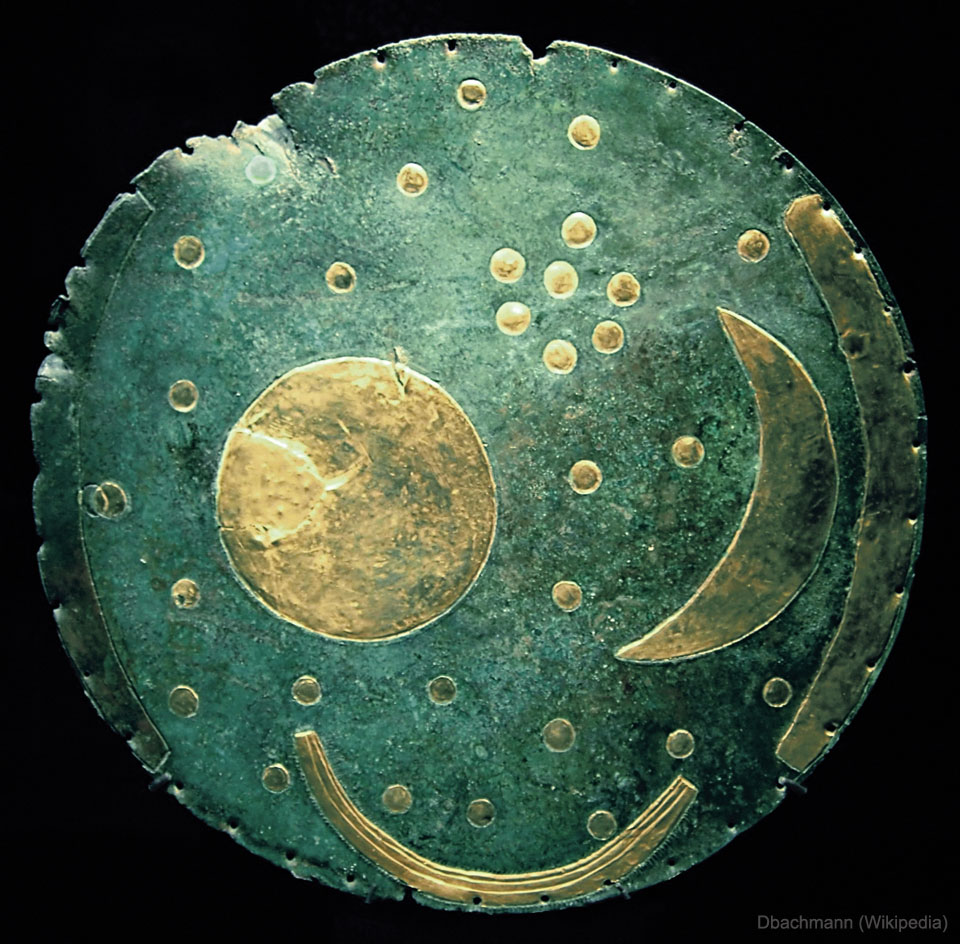
Nebra Sky Disc


This is the Nebra Sky disc, believed to be the oldest surviving representation of the cosmos. It was buried 3,600 years ago and was illegally excavated by two metal detectorists in Germany and is now in the State Museum of Prehistory in Halle. It is crafted in bronze and gold which originated in Cornwall.

It is the most valuable artefact yet discovered from the ÃšnÄ›tice civilization, a large group of early Bronze Age communities in central Europe - especially Bohemia, Bavaria, south-eastern Germany and western Poland - which is believed to have survived from 2,300BC to around1600 BC. 

The dots are thought to represent stars with the cluster being the Pleiades with the circle and crescent being the Sun and Moon.

There are various theories as the purpose of the disc - an astronomical clock, a religious symbol or a work of art.

Friday, February 24, 2023

LONDON ARTS LAB


.


'London's Arts Labs and the 60s Avant-Garde' by David Curtis.
The Worthing Workshop is mentioned in the list of Arts Labs across the regions. This an excellent book, fully illustrated, and deeply researched. It gives valuable picture of a time and a space when all the arts were able to intermingle. Reading it one feels that a new network of Arts Labs would be very valuable in the times we live in.


Monday, January 30, 2023

THE MARQUEE CLUB


 Harold Pendleton who died at the age of 93 in 2017 is perhaps a name not known to the general public but as this book shows he was a key figure in the development of music in the UK. A huge jazz fan he got the bug for promoting and staging bands in various venues leading to his establishment of the Marquee in 1958 which he ran for 30 years. The venue itself may have been pretty scuzzy but it became the place that every band wanted to play. In the prologue to the book his son explains why.

'A gig at the Marquee announced that a band has left the orbit of the suburban pub circuit and was on its way up. It was the place where agents managers and journalists went to check out new talent: contracts could be signed before the stage was cleared and a memorable performance could land a band their first notices in the music weeklies. It was the gateway to the big time.'

This classy book written by Robert Sellers is highly detailed and manages to give the reader a fantastic picture of this remarkable club that played host to literally thousands of bands of all types and styles. A Timeline at the end of the book highlights the standout nights and the most frequent performers. There is also a list of live recordings. The main text is peppered throughout with quotes from fresh interviews with leading figures in all the streams of music. 

To give some idea of the intensity of the task of compiling this history take the year 1977. Sellers writes: 'It saw first gigs for the Jam, Ultravox!, the Only Ones, the Motors, Generation X, the Vibrators, X-Ray Spex, The Police, Squeeze, the Boomtown Rats, John Otway and Wild Willy Barrett, the Damned, the Buzzcocks, Wire, Tom Robinson, Japan, Sham 69, Adam and the Ants, and XTC.

The catholic booking policy meant that the in the same year there were appearances from 'the influential folkster Bert Jansch, the reformed Pink Fairies, Medieval progsters Gryphon, the old school rock of Edgar Broughton and Wishbone Ash and a nostalgic two-nighter in the company of Georgie Fame and the Blue Flames. Not to mention what was supposed to be a farewell concert by Motorhead.'

Lemmy is quoted at the front of the book: 'The reason I liked the Marquee was because it was scruffy and a hellhole, and your feet stuck to the floor, and that's exactly what a rock and roll club should be like'

The book as a whole is beautifully put together with some great photos starting with a fab shot of Guns and Roses on their first gig in the UK. A valuable addition to the history of British music.

Saturday, October 29, 2022

MUSIC PRESS HISTORY

 This was the launch party on November 1st 2001 for Rock's Back Pages and Paul Gorman's oral history 'In Their Own Write'. Pictured are three of the very best music writers namely Charles Shaar Murray [with Anna Chen], Vivien Goldman and Chris Salewicz. I wasn't interviewed for the book but I was mentioned twice. There was Jonathon Green talking about Frendz :'Dick Lawson was the rock 'n' roll editor... and there was people like John May, who later worked for NME and was a real journalist, writing lots of very informed and radical stuff.' Chris said; 'John was very good as Dick Tracy. He started the film section with what was called Silver Screen and he was quite instrumental in changing the paper'.

Paul Gorman has returned to the subject with a 360 page whopper of a book that traces the whole history of music papers, magazines and fanzines starting with Melody Maker which was first launched in 1926. New Musical Express  came in 1952 and within a couple of years it had a circulation of 100,000 while MM was selling 97,000. They were soon joined by two other weeklies Record Mirror and Disc. All had a different take on the pop scene. MM was jazz, blues and folk and they were not interested in the new rock 'n' roll.

In the States there were two trade papers -Billboard and Cashbox and the jazz journal Downbeat which had been founded in 1934. In the 40s and 50s these were joined with a string of teen mags - Seventeen, Dig, 16 and Hit Parade, which switched from pop to rock 'n' roll.

By the 1960s there was a dozen weeklies aimed at the 5 million teenagers in Britain that made up 15% of the population who were using their spending power to buy records and record players.

In the States apart from the teen mags a new kind of music mag was emerging  which was more concerned with the aesthetics of rock. Paul Williams' Crawdaddy  lit the touch paper, says Gorman, 'for a cerebral strand of music criticism that was to play out for decades in the American press'. This led to Rolling Stone  which marked a real sea change with writers like Greil Marcus, Lenny Kaye, Lester Bangs, Ben Fong-Torres alongside the new journalism of Tom Wolfe and Hunter S. Thompson.

The underground press that emerged in the '60s in the US and the UK provided another platform for music journalism and record company advertising kept many of them in business. For a brief time there was a British edition of Rolling Stone which morphed into Friends then Frendz. Gorman judges it to be the best when it comes to music coverage. In the early '70s when most  of these papers closed down Nick Kent and photographer Pennie Smith left Frendz, Charles Shaar Murray left OZ, and all joined the NME to be followed by Mick Farren  from International Times and myself. Those were great times to be around. 

The great late Ian MacDonald said NME had most of the best writers and photographers, the best layouts, a sense of style and human and the feeling of real adventure. Mick Farren (now also no longer with us) said 'NME had an incredible pass-on rate. We could claim 900,000 readers at the peak'. 

NME ignored punk for a while but fanzines flourished and Sounds was on it with the great Jon Savage alongside Vivien Goldman on dub. Gorman is good on the subject of the women journalists who had to fight to hold their own in a very male driven atmosphere, Penny Valentine  being one of the pathfinders.

The inky papers were always in competition with each other as sales fluctuated and music styles evolved. But in 1978 when Nick Logan left the editorship of the NME he created the first of new kind of music mag which was a bigger threat to their survival.  Smash Hits  was a colourful magazine which combined glossy star shots with the actual lyrics of the new releases. Within a short time it was selling 100,000 copies, just 35,000 less than the NME and 10,000 more than the MM.

Post-punk had arrived and with that came Neil Spencer as the new editor of the NME and what Peter York called the'pale boys' a new generation of writers like Paul Morley and Ian Penman who used a style of literary criticism to write about experimental bands like Cabaret Voltaire, Human League, Joy Division and others. Readership figures fell by some 40,000.

Meantime Nick Logan used family money to launch The Face  a completely new styled mag combining music and fashion for the New Romantics. It's huge success marked a decisive shift away the previous music papers.

 In 1984 Smash Hits was selling 500,000, NME 120,000. Sounds 80,000, Record Mirror 70,000 and Melody Maker 68,000. 

Smash Hits was edited by David Hepworth who hired Mark Ellen as his Features Editor. This duo went on to create a string of successful titles including Q, (which lasted for 34 years) Mojo, Heat and The Word. They felt the post-punk bands had an inflated sense of their own importance and that pop stars were absurd.

Hard on their heels came a string of others: Blitz  was a challenge to The Face; Kerrang was the bible for metal heads, Collusion was for world music lovers. From the US came Details, Wet and Andy Warhol's Interview amongst many others.

The golden days of music papers has passed although my local newsagent still carries MojoUncut, Record Collector and expensive definitive magazines on major bands like Led Zep as well as punk and heavy metal titles. In his Epilogue Gorman writes: 'Despite the substantial odds stacked against them over the course of the 2000s and 2010s, music magazines continued to emerge, albeit on a micro level'.

This review can only skim the surface of this very large and detailed history which is a definitive work that will stand the test of time.

Visit the Generalist Archive and click on the Dick Tracy banner to see many of the stories I wrote for the NME     http://www.generalistarchive.co.uk/dick-tracy


Saturday, October 08, 2022

Rock's Diamond Year


This the fourth new book I have reviewed recently which documents the history of the pioneering musical venues, largely clustered around the Thames and South West London and Soho, which were to introduce electrified fock and blues music into Britain. This includes Eel Pie Island and other venues in Richmond, the string of Ricky-Tick clubs on London's outskirts and, most importantly, The Ealing Club where 60 years ago Alexis Korner and Cyril Davies began the British R & B scene with a band called Blues Incorporated on the 17th March 1962.The make-up of the band was fluid and many of its members went on to create other influential bands. Ronnie Wood is quoted as saying: 'The Ealing Club and Blues Incorporated were heavy influences of just about everybody, but especially of Fleetwood Mac, Cream, the Yardbirds, Manfred Mann, John Mayall and the Pretty Things.'

'Rock's Diamond Year' is a condensed and valuable collection of profiles and personal reminiscences about the venues and bands. This is the territory and the time when the Rolling Stones not only came into being but also played a huge number of gigs. The Crawdaddy Club in Richmond was particularly important in these early days as was Giorgio Gomelsky who had worked in the music industry in the UK Europe and the US and helped the band find their feet and build an audience. There's a really good profile of him here which adds fresh information to the story of the Stones rise to fame.

The Bull's Head in Barnes was another significate venue which was I was unaware of. It is described as 'a magnet to the cream of the British folk movcment' as well as R&B bands. The book ends with essays on the Ricky-Tick Clubs, The Marquee and the 100 Club. Illustrated throughout with some good black and white photos from the period, this is readable and valuable addition to the ongoing investigation into Britain's musical history.

Friday, October 07, 2022

2001/Rob Godwin/Space and Music

 Here at The Generalist Archive we love things like this email which arrived out of the blue from Rob Godwin in Toronto.

Hello John,

'Just watched your talk at the Printing conference on Youtube. Really interesting. It made me decide to reach out to you.[I didn't know at that time that a talk I'd given at the University of Westminster about mimeograph printers and the Underground Press had been filmed.]

'We have a few things in common. I briefly worked with Lucasfilm, ran Hawkwind's record label in the USA for five years, I have a pretty good collection of Friends/Frendz going way back to my misspent youth. I write and edit for a living, including books on science, spaceflight, science fiction and music. I'm also a historian on various aerospace history committees.

'About two years ago I decided to start writing a paper (not a newspaper, but a "paper" to submit at a conference) about the crossover between the Space Race and rock music in the 60s and 70s. The limit for such a paper was only 15 pages, and by the time I got to 50 pages I knew it would likely never see the light of day. However, I can't give it up because it has become too much fun. It roams around between primitive astronomy, pirate radio, underground press, alternative clubs, Kubrick, Ginsberg, Stockhausen and of course Hawkwind.

'I've drilled down to the point where I realised that Space Ritual was the nexus for all of this stuff and it has become the focal point of my essay. I believe you were on the road (and the stage) for some of the early shows.  I read about you in a copy of The Snail (I think) from the start of the tour. I missed the Space Ritual tour by a few weeks (I was at a show in Southampton the previous August). I wondered if you might share any anecdotes about those nights?'
All the best
Rob Godwin
(Toronto/Canada) 

***

 A day or so later we had at least a two-hour phone conversation which was followed by an exchange of further messages over the following weeks.

First stop was Rob Godwin's Wikipedia entry which is impressive and extensive and complete with References and numerous External Links. Rob set up his own music business and publishing operation and produced a large number of books and publications on space and music.

Between 1987 and 1998 Collector's Guide Publishing released books on many different rock artists including Pink Floyd, Led Zeppelin, The Beatles, Elvis Presley, Kate Bush, Alice Cooper, Wishbone Ash and Kiss.

In 1998, at the invitation of astronaut Buzz Aldrin, Godwin would begin his imprint Apogee Books.

Between 1998 and 2018 Apogee Books published over 150 book titles about space flight with contributions from Buzz AldrinSir Arthur C. ClarkeTom HanksRon HowardDavid R. ScottHarrison Schmitt and Wernher von Braun

In addition vintage science fiction and 40 NASA Mission reports

Action on TV/Video and web

***

Rob promised to send me two books both entitled '2001: The Lost Science'. Some while later a large package arrived from C.G. Publishing, 2045  Niagara Falls Blvd containing the two oversized books.

You can purchase copies here:

https://www.cgpublishing.com/prime/bookpages/9781926837352.html


2001:The Lost Science/Introduction


INTRODUCTION 

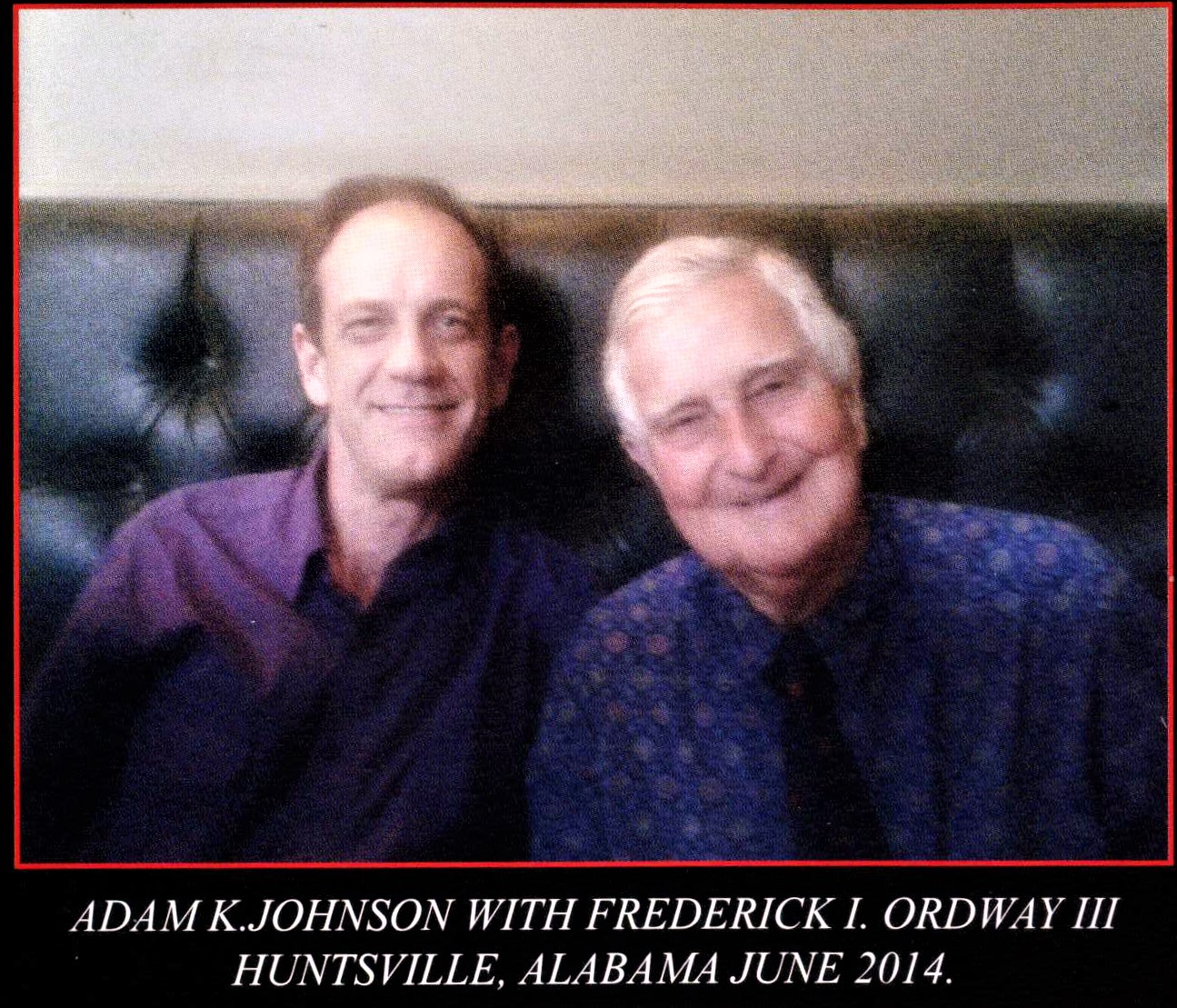
Adam K. Johnson

In January 1965, while staying at the Harvard Club in Manhattan. Frederick I. Ordway Ill arranged a social meeting with his 'old friend' Arthur C. Clarke. The next day, at Clarke's insistence. Ordway. and his associate Harry Lange, met with famed film director Stanley Kubrick who quickly invited Ordway to be the Senior Science advisor on his proposed new science fiction epic provisionally entitled 'Journey to the Stars'. Within two days. the project that would eventually evolve into the film '2001: A Space Odyssey' emerged from the meeting between the four men.

 In the following 2 I/2 years spent working on the film, Stanley and Frederick worked painstakingly on a daily basis to ensure scientific realism. Working at the zenith of the 'space race' their efforts drew upon the most current space travel 'hard science' available. 

Between January and August 1965, working from Stanley's New York Office "Hawk Films" (also known to the contractors as Polaris Industries). Fred contacted a multitude of companies known to be on the forefront of aerospace technology and asked for their assistance on the film. By Early 1966, over one hundred companies had submitted engineering and design proposals to aid the vision of Kubrick and Clarke. 

This book is intended as a companion to viewing the film 2001: A Space Odyssey, as well as a resource for modern day aerospace engineers interested in how the proposed 21st century technologies might have worked if so implemented. 

Creating the designs for the film involved over 2400 detailed schematics that were drawn 4 x 6 feet or 3 x 5 feet. These drawings were saved as blue-line prints using ammonia based blue ink that replaced the original pencil or ink lines. Over time. this blue ink fades, and if exposed to light, completely vanishes. The U.S. SPACE & ROCKET CENTER archives still possess about 100 of the known existing 200 blue-line prints (in various states of condition) created for 2001. 


2001: THE LOST SCIENCE/Scientists, Influences and Designs from the Ordway Estate


(From Left)Harry Lange: Spacecraft designer and Set designer
Arthur C. Clarke: Writer and researcher
Fredrick I Ordway III: Scientific consultant

Volume 2 of material from The Ordway archives profiles the space flight pioneers and the long history of space craft imagined if not built over many years. This book is packed with blueprints, backstage photos. Kubrick spent two years researching everything he could on the subjects of space flight and alien intelligence decided to have the top scientific minds interviewed for his film. He examined all past science fiction movies.

In this book's Introduction Adam K. Johnson writes:

Ordway and Lange bought a massive collection of rocket and space science data from the Future Projects office (Marshall Space Flight Center) in Huntsville, Alabama to Borehamwood studios. This was later referred to as 'NASA East' by the Kubrick team. Even after arriving in England, during the preproduction stages, the team continued to collect aerospace data from all of the British contractors. Much of the concept information is here in this second volume of 2001: The Last Science. It is important to know that the best scientific minds on earth contributed to these designs.

Fred Ordway created and sustained relationships and correspondence with all all the individuals described in this book. Through these connections he was able to document the history of rocketry and space travel accurately in his writings.


Fred Ordway's collection is extensive and has taken many years to collate, identify and catalog. For example, his 'pulp' science fiction and fantasy stories collection (over 900 editions) were donated to Harvard University. His 2001 collection went to the USSEC and the remainder...stayed hidden in his private residence until his passing in July of 2014. This book represents a glimpse into his private work, research and studies into the history of space travel. It has been a joy and honour to 'discover' all these well-hidden artefacts waiting for their stories to be told. Most importantly, it was an honor to spend time with Fred. Our similar backgrounds in aerospace and out interest in science  fiction made our relationship wonderful.'

2001: A Space Odyssey/Frederick I. Ordway III/Stanley Kubrick/Adam Johnson


THE SCIENCE AND TECHNOLOGY OF THE MOST IMPORTANT AND INFLUENTIAL FILM EVER MADE. 

In 1964 master film-maker Stanley Kubrick began his epic campaign to make the best science-fiction movie ever made. Already well-known for his remarkable ability to absorb and understand massive amounts of complex information, 

Kubrick set himself the goal of reading every book, and watching every movie available, on the subjects of space flight and alien intelligence. Having convinced himself that it would be possible to accomplish his unique vision he promptly surrounded himself with the best experts in the world. 

His main collaborator, scientist and fiction writer Arthur C. Clarke, had already sold Kubrick the rights to several of his short stories; one of which was named The Sentinel. Clarke's short story concerned mankind's first encounter with proof of extra-terrestrial life. Kubrick would use this as the template for his screenplay. 

In January 1965 good fortune would smile on Kubrick and Clarke when a chance meeting at the Harvard Club in Manhattan would lead to the recruiting of Fredrick Ordway III and Harry Lange. 

These two experts had been working in the office of NASA's future projects in Huntsville, Alabama and had coincidentally just completed a book called Intelligence in the Universe. Within two days Kubrick had persuaded Ordway and Lange to join his production team. 

Stanley Kubrick's meticulous attention to detail would be well-served by Ordway and Lange who were both connected at the most intimate levels with virtually every major aerospace company in the world. 

Drawing on an unprecedented well of talent and resources Ordway and Lange would bring the science to Kubrick's set. Whatever detail Kubrick needed, the contractors provided; from giant centrifuges, to robotics, to spacesuits. 

*

I asked Rob for more information as to who Ordway and Johnson were. He wrote:

I was very close friends with Fred for the last 15 years of his life. I met him at the 30th anniversary of the Apollo 13 mission. I had been reading his stuff for years before that. When Fred found out I was writing and publishing Space books he asked me if I would republish his NY Times bestseller "The Rocket Team", which I jumped at.

Fred used to be Wernher von Braun's speechwriter in the 1950s and 60s.

He was the absolute epitome of the American gentleman. Polite and dignified to a fault. I never heard him raise his voice or say a bad word about anyone.

Incredibly knowledgeable. He had one of the largest collections of space and science fiction books in America before he ever met von Braun. When America began its space program Fred got a job at Reaction Motors. At the time von Braun was still a prisoner in the US desert.

As progress began on rocketry Fred was writing journals and news sheets and magazine articles.

 Eventually when von Braun was "rehabilitated" and given work to do for the US Army he met Fred and asked him to come and work for him. For a young engineer it was the opportunity of a lifetime to be brought into the heart of the rocket and missile program. 

Von Braun quickly realised that Fred knew everybody, including the Soviets, because Fred was the only American in attendance at the first international astronautical congress in Paris in 1950.

He was one of the main people who brought the world's peoples together to explore space peacefully because he was an officer in US Air Force intelligence and he used to meet with Soviet colonels in Greenwich Village where they would feed him information about what they were doing. This allowed him to have almost unique perspective on every missile and rocket system in the world.

Eventually when von Braun was allowed to travel, and make appearances, he got Fred to prepare and write his speeches because Fred had both the knowledge and the clearance.

Later in his life Fred was condemned by some people for working with the "Nazi", which was very sad. Fred was a liberal democrat. Kubrick initially considered approaching von Braun for 2001, but for obvious reasons chose not to. When Arthur suggested to Kubrick that he call Fred, that's what he did. The rest is history.

I introduced Adam to Fred. Adam was a keen 2001 enthusiast and had spent some time digging through Fred's enormous archive, which Fred had donated to the US Space & Rocket Center. He asked me to help him, so I did.

 I am currently writing Fred's biography which he asked me to do before he died.

Cheers
Rob

 ****

When 2001 opened in 1968 the critical reviews were mixed. Kubrick had deliberately understated every single message in his story, often leaving his viewers and the critics baffled. But as time has passed the critics have honed their observational skills and gradually come to realize that 2001: A Space Odyssey is truly one of the greatest accomplishments in cinematic history. 

In the last four decades Kubrick's triumph has been dissected in books and theses from every conceivable perspective and until humanity actually encounters extraterrestrial intelligence, his movie will continue to draw attention to this most tantalizing subject. 

However, what is often overlooked in all of these critical studies is the almost flawless scientific facade constructed by Kubrick, Clarke, Ordway, Lange and the hundreds of other engineers and scientists who contributed to the production. 

Author and engineer Adam Johnson has spent years accumulating information, believed to have been long since destroyed, to create a detailed and unprecedented analysis of the technology envisioned in Kubrick's masterpiece. From British designers and model-makers to Soviet astronomers; from Canadian special effects wizards to German artists; from American spacecraft engineers and artificial intelligence scholars to French stylists; this is the Lost Science of 2001

Sleeve notes and email from Robert Godwin


Friday, September 30, 2022

BARNEY BUBBLES & PAUL GORMAN


Previous Posts

Friday, November 21, 2008

BARNEY BUBBLES BOOK LAUNCH EXCLUSIVE

https://hqinfo.blogspot.com/2008/11/blog-post_21.html

This post was written the day after the London launch of Paul Gorman's first  book on Barney Bubbles 'Reasons To be Cheerful'. Born and named Colin Fulcher on 30th July 1942,  he took is own life on the14th on November 1983. For more than a decade his work was neglected. He is now revered as a marvellously imaginative graphic designer and artist in his own right who pioneered and opened up new worlds of vinyl art which inspired others.

'The Generalist was in London last night, attending the book launch of 'Reasons to be Cheerful: The life and Works of Barney Bubbles' by Paul Gorman, held at Paul Smith's shop on Park Road, just off Borough Market. For those of us who knew him, the book will bring back memories of the impish delight Barney took in his friends and colleagues, his electric enthusiasm for his work, his constant innovations and unending search for the new and above all his inspiring and fun-filled presence. For those coming fresh to his work, particularly young artists, illustrators and graphic designers, they will find a huge source of inspiration and marvel at the effort and industry involved in achieving many of his finest artworks in that pre-digital, hands-on age of yore.

This book was designed by Paul's partner Caz Facey and was published by Adelita, a limited company with Paul and Jenny Ross as directors. The company folded in 2019. When I looked only two copies are currently available on Amazon priced at £470.19.

 BARNEY BUBBLES REVIVAL

Posted Monday, February 02, 2009 https://hqinfo.blogspot.com/2009/02/barney-bubbles-revival.html

This second post sketches in the stages of rediscovery of his work by others in Ladbroke Grove before Paul Gorman. Much of Barney's work was unsigned or credited using pseudonyms, so much of his huge creative achievement was obscured.

Monday, September 12, 2022

BRAINSPOTTING Adventures in Neurology by A.J. Lees [Notting Hill Editions]


Back in  May 8th 2016 I posted one of the first reviews of 'Mentored By A Madman: The William Burroughs Experiment by A.J. Lees - a striking and important book by one of the world's leading experts in the treatment of Parkinson's. Burrough's writings drew on his experiences with a wide variety of mind-altering substances and his search for an addiction cure helped Lees find a new treatment for his patients.

'Brainspotting: Adventures in Neurology' his newly published work. is a valuable follow-on providing a detailed picture of his career in neurology and the techniques that he used to diagnose a wide variety of neurological problems. He says it was ten years of apprenticeship before he felt confident enough distinguish a healthy person from an ill one.

He estimates that he has treated about 30,000 patients in NHS clinics and several thousand more in consulting rooms at the University College Hospital and the National Hospital in Queen Square, London. He has also taught undergraduate and post-grad students and lectured to colleagues all over the world.

He provides valuable profiles of the historic greats in the world of neurology who had influence on him and helped him treat and understand neurological problems. Interestingly another mentor was Sherlock Holmes whose intense attention to details and unusual thought processes influenced Lees approach to the complex problems. Lees includes a opening quote in which Holmes says to Watson; 'life is infinitely stranger than anything which the mind of man could invent.'

Conan Doyle repeatedly said that Holmes was inspired by the real-life figure of Joseph Bell, a surgeon at the Royal Infirmary of Edinburgh, whom Conan Doyle met in 1877 and had worked for as a clerk. Like Holmes, Bell was noted for drawing broad conclusions from minute observations. However, he later wrote to Conan Doyle: "You are yourself Sherlock Holmes and well you know it". [Wikipedia]

In 1972 Lees expanded his medical training by enrolling for a year with a hospital in Paris which, in the 19th century, was led by the skills and ideas of Jean-Martin Charcot. Lees says Charcot's 'second sight had allowed him to see patterns of disease that no one before him has ever noticed.' When Lees arrived the chief man was Francois Lhermitte. 'His approach was often just to listen, observing the body language and analysing every move the patient made with endless fascination...His insatiable curiosity and innovative ways of thinking about neurology would leave a lasting impression on me,'

Back in Britain Lees followed a scheme taught and perfected by The Dublin-born British neurologist Dr Gordon Holmes in the year between the two World Wars. He punctiliously examined  each of his patients from top to toe and then double checked their clinical history. Lees says 'His infallible method hinged on practiced, organised common sense.'

Lees  underlines his belief that detailed physical examination 'is neither outdated or obsolete and it is far more efficient in localising the site of the neurological problem than any single machine. 

'The laying on of hands - the intimate bond of touch he says, changes the dynamic between patient and doctor forever'.

'It also  serves as a  transcendent comforting force that promotes trust and reduces loneliness, anxiety and despair. Touch comes before words and is the first and last language. It is an essential constituent of healing and another way of listening that never dies.' Beautifully expressed.

William Gooddy one of his first teachers at University College Hospital, said to him 'Lees, neurology is deadly serious but it must also be full of soul'

The book is filled with interesting real-life cases and characters. I love Robin Osler Barnard who every day arrived wearing a bowler hat, smart navy-blue overcoat..in summer a boater, blue blazer with an umbrella to hand. His tutorials always began with his secretary offering them Earl Grey Tea and a slice of Dundee cake. Lees says; 'He was a quaint traveller from an antique land determined to preserve falling standards but what he taught me about pathology was of immense contemporary value.'

'With a wry grin he told me that the number of neurones in the brain was the same as the number of stars in the Milky Way.' A few pages later Barnard is in the mortuary conducting a post-mortem investigation, a process that is described in some grim detail.

Another chapter is based on Sherlock. He says 'The unreal universe of Sherlock Holmes was my primer in neurology and it became a bridge to Dr William Gowers, arguably the great neurologist that ever lived.' He was interested in the commonalities between neurologists and criminal detectives. 'They both seek hidden truths and meanings in complicated and often contradictory data'.

In a final and fascinating end chapter, Lees examines the recent history of machine learning, brain scans and other new technological developments. He concludes: ' The less time I spend trying to decipher the latest medical science, the better listener - and better neurologist - I become.'


Friday, August 12, 2022

STRANGE ATTRACTOR PRESS: OBSOLETE SPELLS and CITY OF THE BEAST/ THE LIVES OF VICTOR NEUBURG AND ALEISTER CROWLEY


The Strange Attractor Press is an independent publishing house founded in 2003, based in London and run by Mark Pilkington and Jamie Sutcliffe. The Generalist has reviewed a number of their books over the years which are a celebration of unpopular culture as they call it. The books are of high quality and their back catalogue is worth examining. See: http://strangeattractor.co.uk/  

Obsolete Spells is for me a book of great importance. I first discovered the poet Victor Neuburg in the 1980s when I returned to live in Steyning in West Sussex where I had been a  boarder at Steyning Grammar in the 1960s. I learnt that the poet Victor Neuburg  had lived just opposite where I went to school. Using a hand cranked printing press The Vine Press published many books of poems and prose 'that reflect his love of local lore and landscapes' writes Richard Mcneff in the Foreword.

Section Two  of the book is a fascinating 35-page turner by Justin Hopper, an American writer who has also published a book on his personal journey through the Sussex downland and its history. He writes:

' Neuburg's adult life can be split into three parts, which (almost) neatly divide by decades into the 10s, 20s and 30s. From his start at Cambridge in 1906 until his recovery from the First World War in 1919, it was Aleister Crowley and his tantalising occult circle that dominated Neuburg's life. It was with Crowley and friends that he began his career as an editor and publisher, working to create The Equinox, modest house organ of Crowley's magical movement. In the 1930s, until his decline and eventual death in 1940, the London poetry world was Neuburg's domain, as he edited first Poet's Corner in  the Sunday Referee, and. afterwards his own arts, politics and poetry newsweekly Comment. But in between the two, as London experienced the roaring twenties and the dawn of the modern world, Neuburg  hunkered down in the sleepy town of Steyning with his own creation The Vine Press.'

A talented poet himself, Victor has always been in the shadow of Crowley and Dylan Thomas (who he discovered). Hopper writes that both men loved him but also held him in utmost contempt. Victor was physically damaged and often beaten by Crowley whilst enacting ancient magical practices,

 The bulk of the book is a excellent compilation of sections from Vine Press books he published between 1920 and 1930 with an additional text published after his death. SWIFT WINGS; Songs in Sussex and SONGS OF A SUSSEX TRAMP and THE WAY OF THE SOUTH WIND & TEAMS OF TOMORROW are pure gold for us Sussex folk but there are also many other riches, including, in particular THE STORY OF THE SANCTUARY by Vera Gwendolen Pragnell. 

In 1923, she established, on a plot of land at the foot of the South Downs near Storrington in West Sussex, a ' makeshift community of icons and hoboes; communists, proto-fascists and aging anarchists; free thinkers and free lovers'. Arthur Calder-Marshall said: ' was an asylum for almost every kind of refugee, not a workshop for those who found life in the city too distracting'. [Illustration: Eric and Perrcy West, woodcut illustration]

The book's back cover notes are interesting, beginning with 'Victor Neuburg had two claims to fame; he discovered Dylan Thomas and Aleister Crowley once turned him into a camel.'

'As a printer and publisher, Neuburg acted as a conduit for bohemian writers and art luminaries and those dedicated to experimental living.... He was a fixture at his local utopian free-love community, the Sanctuary. Through it all he turned the handle on the Vine Press, publishing books of nature writing and folksong, neo pagan poems and utopian philosophy hymns to Old Gods and paeans to love and wonder.'

*


This is not a walking guide which is a relief from the overflow of psychogeographical journeys of that kind. It presents itself as 'a biography of sites (93 locations), revealing a man, an era and a city.

Phil Baker writes; 'I have drawn extensively on Crowley's unpublished diaries, dense with London detail, which give an exceptionally intimate and human pictures of his day-to-day life'

It was here that Crowley joined the Golden Dawn considered  'probably the most influential magical order that has ever been'. W.B. Yeats considered it his church and university.

Crowley was  largely short of money but nevertheless managed to live in the better parts of the city, to dress well and to maintain his drug habits. He writes about his favourite chemist where, before the passing of the Dangerous Drugs Act in 1820, he was able to score heroin, cocaine and cannabis in his search for the Holy Grail of drugs.

He and another were expelled from the Golden Dawn by Yeats. Crowley later wrote 'In 1900, the Order in its existing form came to grief and nobody has ever been able to picked up the pieces.' Baker comments. 'The Glory days of the Golden Dawn were over' Some years later Crowley and two others formed a new occult group known as A.A [Argentaum Astram]. His ceremonial outfit was a cloak embellished with a Rosicrucian cross and the eye of Osiris together with a red hood. 

Before that he left London and bought a house by Loch Ness. In Scotland he married Rose Kelly with bad outcomes and they divorced in 1909. 

In the intervening period he largely lived abroad, travelling around the world, visiting Mexico via New York, Ceylon, Burma, India, Vietnam, Hong Kong, China, Japan, and Tangier. Mountaineering was one of his other hobbies.

This restlessness permeated Crowley's life and the book is a dizzy and fast-moving account of his constant perambulations and his extraordinary appetites - for food, for women and for the dark occult world which he wrote about extensively. For those who you who read Dennis Wheatley's The Devil Rides Out - which was the greatest popular occult novel of the 20th century - it's not surprising that Crowley was the model for the main character.

In reference to the diaries Baker writes:  'In a world of trigger warnings I should add they have something to offend everyone, even to appal, and that I don't intend to labour this aspect.' He remained defiantly transgressive and deliberately provocative throughout his life.

He also consulted the I Ching every day.

*

Two stories I particularly like

One of his favourite hangouts was the Café Royal which he attended from 1897 to 1940 rubbing shoulders with  the likes of Aubrey Beardsley, Oscar Wilde, Walter Sickert, Augustus John, Max Beerbohm and others. 

When Wilde died and was buried in Père Lachaise in Paris his tomb was covered with a monumental naked winged angel figure by the American sculptor Jacob Epstein which featured unusually large testicles. The Parisian authorities considered it indecent and  covered the genitals with plaster. Epstein was told he must either castrate it or fig leaf the genitals. Epstein's response was to hack off the plaster. On his return to Paris to complete his  work he found the statue was covered with tarpaulin and guarded by gendarmes. Regular protests were made by groups of artists until finally it was agreed that a bronze plaque made in the shape of a butterfly should be affixed to cover the offending portion of the statue.

In early August 1914 the statue was finally unveiled in a ceremony led by Crowley which Epstein refused to attend.  Crowley in front of a crowd of twenty people recruited from the Left Bank, uncovered the statue with their help and hacked off the plaque. 

A few weeks later the sculptor was the sitting in the Café Royal when Crowley walked up to him and told him his work was now as he conceived it. Around his neck was the bronze butterfly plaque on a very long cord.

[More detail is provided in 'An Angel For A Martyr' By Michael Pennington (1987). This statue means a lot to me as I went to see it in Père Lachaise one Sunday afternoon on my birthday in April 1995 and sat there alone drawing the statue's headdress. 


The Afterword to the book raises a very interesting comparison story. Phil Baker writes:

'Crowley's affinity with the culture of the 1890s was more obvious in his lifetime... Remembered as the time of Aubrey Beardsley, absinthe, The Yellow Book and the Café Royal, the Nineties were as significant in their way as the 1960s, a decade they prefigure with their sense of 'liberation', more open sexuality, critical social thinking drug use and an occult revival. London was central to both decades.'

A fascinating book packed with much more than I have highlighted here. There are extensive notes and source material which makes it a valuable book to enable further exploration,