Music and money are always trouble, the music business being littered with tales of crookedness, chicanery and underhanded behaviour. Two stories this week make interesting contrasts on this theme.
First, dear old Leonard Cohen, the 71-year-old Zen Buddhist, has filed suit in a LA court claiming Kelley Lynch, his manager for 16 years, has stolen $5m from his retirement fund, leaving only $150,000 - which Cohen can’t now access because of the legal dispute. As a result he has had to mortgage his house and faces a multimillion dollar tax bill.
Lynch who is a Tibetan Buddhist and former lover of Cohen’s denies all charges and is counter-accusing Cohen of conspiracy and extortion.
In addition, Neal Greenberg, Cohen's investment adviser of almost a decade, has also launched a legal suit which accuses Kelley Lynch of siphoning money from the songwriter and also accuses Cohen and his lawyer Robert Kory of conspiracy, extortion and defamation. It alleges the two, in an attempt to recover at least some of Cohen's lost money, threatened to besmirch Greenberg's reputation and concocted a plan to force Greenberg to give Cohen millions of dollars.
According to Macleans magazine: ‘The suit paints an almost preposterous picture of Cohen as an artist who led a lavish celebrity lifestyle and then turned bitter and vindictive when he discovered the money had run out. For example, the suit quotes Lynch describing how Cohen demanded she discuss business matters while he soaked in a bubble bath, and how later he was somehow involved in calling a SWAT team to her home, where she was handcuffed and forcibly taken to a psychiatric ward while in her bathing suit.'
Cohen is now planning to tour for the first time in 12 years, is releasing one album recorded with his current girlfriend Anjani Thomas this autumn, is recording a new solo one, and has a book of poetry due next year.
He told Macleans: ‘What can I do? I had to go to work. I have no money left. I’m not saying its bad; I have enough of an understanding of how the world works to understand that these things happen.’
Read the full and complex story here:
Elsewhere, John Densmore, the former drummer of the Doors, has turned down lucrative offers to use the band's music in adverts.
In 2004, Cadillac offered $15 million to lease the song ‘Break On Through (to the Other Side)’ to help sell its luxury SUVs. Densmore vetoed the idea and the company is now using Led Zeppelin's ‘Rock and Roll’ instead. Densmore also rejected a $4m offer from Apple Computers plus numerous other lucrative approaches.
"People lost their virginity to this music, got high for the first time to this music," Densmore told the Los Angeles Times: "I've had people say kids died in Vietnam listening to this music, other people say they know someone who didn't commit suicide because of this music…. On stage, when we played these songs, they felt mysterious and magic. That's not for rent."
Disagreements over this issue date back to the end of the 1960s when the Doors were offered $50,000 to allow their biggest hit, "Light My Fire," to be used in a commercial for the Buick Opel. Morrison was in Europe at the time and his bandmates agreed to the deal in his absence. When Morrison returned he was furious and vowed to sledgehammer a Buick on stage at every concert if the commercial went forward – which it didn’t.
As a result of that, in November 1970, the Doors agreed that any licensing agreement would require a unanimous vote. The band had previously agreed that the members would share equally in all music publishing rights.
During the 1970s Densmore did relent once when he agreed to let ‘Riders on the Storm’ to be used to sell Pirelli Tires in a TV spot in England. When he saw it he says he felt sick: "I gave every cent to charity. Jim's ghost was in my ear, and I felt terrible. If I needed proof that it was the wrong thing to do, I got it."
This current furore has intensified the bitter dispute between him and former band mates Ray Manzarek and Robbie Krieger over the rights to the band's name. Densmore and the Morrison estate had filed a suit in 2003 to block Manzarek and Krieger from using it or any permutation of same.
Last August, a Los Angeles County Superior Court Judge ruled that Manzarek and Krieger could no longer tour together as the 'Doors of the 21st Century.' The pair, who now tour with former Cult singer Ian Astbury handling the late Jim Morrison's vocal duties, switched the name to D21C and plan to continue as Riders on the Storm.
An audit is underway to determine how much money Krieger and Manzarek must turn over from their two years of touring with their old band name which grossed $8 million. "John is going to get about a million dollars for doing nothing," Manzarek said. "He gets an equal share as us, and we were out there working. A free million bucks. That's a gig I'd like."
The whole issue of classic rock music being used in adverts is still a contentious one which began when Nike used the Beatles' ‘Revolution’ for a sneaker ad two decades ago.
Currently Bob Dylan is singing ‘The Times They Are A-Changin' ‘ in a tv ad for healthcare giant Kaiser Permanente, a Rolling Stones track features in an Ameriquest Mortgage ad and Paul McCartney music is being used for Fidelity Investments.
Bruce Springsteen, the Eagles, Neil Young and Carlos Santana amongst others continue to say no to commercials.
In The Nation, Tom Waits wrote the following letter in praise of Densmore views expressed in an article "Riders on the Storm".
'Thank you for your eloquent "rant" by John Densmore of The Doors on the subject of artists allowing their songs to be used in commercials. I spoke out whenever possible on the topic even before the Frito Lay case (Waits v. Frito Lay), where they used a sound-alike version of my song "Step Right Up" so convincingly that I thought it was me. Ultimately, after much trial and tribulation, we prevailed and the court determined that my voice is my property.
'Songs carry emotional information and some transport us back to a poignant time, place or event in our lives. It's no wonder a corporation would want to hitch a ride on the spell these songs cast and encourage you to buy soft drinks, underwear or automobiles while you're in the trance. Artists who take money for ads poison and pervert their songs. It reduces them to the level of a jingle, a word that describes the sound of change in your pocket, which is what your songs become. Remember, when you sell your songs for commercials, you are selling your audience as well.
'When I was a kid, if I saw an artist I admired doing a commercial, I'd think, "Too bad, he must really need the money." But now it's so pervasive. It's a virus. Artists are lining up to do ads. The money and exposure are too tantalizing for most artists to decline. Corporations are hoping to hijack a culture's memories for their product. They want an artist's audience, credibility, good will and all the energy the songs have gathered as well as given over the years. They suck the life and meaning from the songs and impregnate them with promises of a better life with their product.
'Eventually, artists will be going onstage like race-car drivers covered in hundreds of logos. John, stay pure. Your credibility, your integrity and your honor are things no company should be able to buy.
Hear Waits talk about this issue here:
http://www.npr.org/templates/story/story.php?storyId=4633751
Wednesday, October 12, 2005


Tuesday, October 11, 2005
Deconstructing Dylan
 'Dylan Lexigraph' is a digital print on canvas by Brighton-based artist Mike Edwards. Lexigraphs are literally 'word portraits' - where the image is created from relative text. For more examples of his work see www.mikeedwards.co.uk
What follows is some kind of analysis of Scorsese’s 3 ½ hour documentary ‘No Direction Home’ screened simultaneously in the US and the UK on the 26/27th September 2005.
I was invited to a special Arena screening at the NFT in London the week before, as a result of my work on Douglas R. Gilbert’s ‘lost’ Dylan photos (see earlier story). This screening allowed me to view the whole work for the first time with just a ten-minute break between parts and on the big screen with superior sound. It was prefaced by a specially shot mini-intro by Scorsese himself, sitting in his director’s chair on the set of his latest movie. The experience was overwhelming and emotional.
The following week at the Lewes Arms, we managed to get the house tv installed in the side room and a bunch of us sat down together and watched it two nights running. A real beat time was had by all, with Guinness on tap nearby, and one or other of us breaking out into song throughout.
Today I watched the DVD which, disappointingly, has no additional interviews - which I was hoping for.
It was only later that the questions started to arise.
Let’s begin with what we know about the film, the best source I have found so far being Mick Brown's article 'Definitive Dylan' in The Daily Telegraph. The story begins ten years ago when Jeff Rosen, Dylan's manager, began assembling material - rare performance footage, news clips etc - with view to making a film. This included 60 hours of colour footage shot by D.A. Pennebaker (of which more later) plus a number of specially filmed interviews (credited in the film to Michael B. Borofsky) and eight hours of original interview with Dylan himself by Rosen and others.
In 2000, Rosen approached Nigel Sinclair who had directed 'Masked and Anonymous' , the feature film starring and co-written by Dylan, and the duo then approached first Anthony Wall of the BBC TV series Arena and then Scorsese who, apparently, agreed on the spot.
Scorsese apparently spent four years realising the project, though how much time he spent on it is unclear. Certainly it is a triumph of editing technique and a prominent editing credit is given to David Tedeschi. In other words, Scorsese shot no original footage as far as one can discern.
Interestingly, it is Scorsese’s voice that reads out Bob Dylan’s speech at the political dinner of the Emergency Civil Liberties Committee in New York in December 1963, where he was given the Tom Paine award (previous recipient Bertrand Russell) and delivered a speech that managed to severely offend the majority of the audience, including as it did, remarks to the effect that he could understand and in a sense identify with Lee Harvey Oswald, remarks about Cuba, about elderly men in suits. A moment of high drama.
So this is a film largely composed of material assembled and controlled by Dylan's management - no doubt added to by Scorsese's own diligent researchers. We are told that Dylan let Scorsese get with things with no interference but the way things were set up meant that there were no hard questions asked - Dylan's private life, by and large, is ignored, particularly his relationship with his women (Baez excepted, where Dylan made a modest nod in the direction of an apology).
Yet one can't escape the feeling that Dylan himself is very much in control of the story-telling, myth-making process. The brilliance of ‘Chronicles’ displays his skills in this regard and the book’s themes suffuse ‘No Direction Home’ in the sense that Dylan portrays himself as the recipient of an ocean of Americn music, echoes of which can be found throughout his ouevre.
This knowingness is often in evidence. When talking about his earliest girlfriends Gloria Story and a girl named Echo, he says they brought out the poetry in me. Then he winks at the camera as if to say 'I’m in on the act'.
Obnviously the film is a shrewd move on behalf of the Dylan business empire, a prime-time advert for his back catalogue and a useful primer for audiences too young to have caught Dylan's early years. In such ways, music longeivty is maintained and Dylan, one feels certainly has one eye at least on how history will see him. I refuse to believe that such a monumental ego is not concerned about this. Important to remember also that Dylan's business organisation also licensed his music to Starbucks.
The film's storyline also follows a well-trodden path - the mythical Tom Sawyer journey from Hibbing to High Town, Greenwich Village adventures, the political years, the transition from folk to electric/pop balladeering, the rise to fame, the backlash of disapproval, the motorbike accident. Roll credits. This is, in other words, not the defintive Bob Dylan story, rather a simplified version of a much more complicated historical narrative.
One reason the film may have taken so long is because of the deals and copyrights at stake. Witness the unusual on-screen credits in the middle of the film for Pennebaker. I would say this film is certainly as much Pennebaker’s as it is Scorsese’s – his sense of camerawork is immaculate, the old colour film looks great as does '60s provincial England, and the actual performances are rivetingly captured on sound and vision equipment that would look totally primitive by today’s digital standards.
There are some interesting clips and fresh outtakes from Pennebaker's 1965 black and white documentary 'Don't Look Back' but more interesting and predominant is the colour footage Pennebaker shot in 1966 during the UK leg of an international tour. Apparently Dylan had allowed Pennebaker control over the previous film but not second time around. Pennebaker was hired in as cameraman only and paid a straight fee for this project and, out of the huge amount of film shot, a one-hour documentary called 'Eat The Document' was made, that was broadcast only once on a local New York tv station in 1979. This, incidentally, contained 30 seconds of a ten-minute sequence showing Dylan and Lennon 'fucked up on junk' in the back of a limo as it cruised through London. (The transcript of this sequence was featured as a cover story on the very first issue of Mojo).
Incidentally, the full details of all this can be found in the excellent 'Bob Dylan Behind The Shades: The Biography - Take Two' by Clifford Heylin (Penguin. 2001). He makes it clear that, in both films, more so in the latter, Dylan was certainly on speed and, by 1966, was definately showing signs of wear and tear due to drug use.
What puzzles me most about 'No Direction Home' is the exclusion of two important events during the time period the film covers 1960-66.
1. The meeting of Ramblin Jack Elliott and Dylan at Woody Guthrie’s bedside, January 1964. Bear this in mind. At the point where Dylan met Guthrie, the latter could hardly sing and couldn’t play. Jack had lived with Guthrie for years and Guthire had taught him his repertoire and skills. Dylan became friends with Jack and copied Jack’s act – Guthrie by proxy. Thus Jack is bound into the DNA of the Dylan story. Happily Dylan acknowledges this correctly in two places in ‘Chronicles’ but Jack is not interviewed for the film. In fact we glimpse him once in a full frame black and white still with his big black hat, and once indistinctly lying back next to Guthrie on a sofa. But that’s it. Jack is very much alive in California and available for interview I would imagine. But he is not in this story.
2. The meeting of Dylan with the Beatles at the Hotel Delmonico in New York in August 1965, when they smoked strong dope together. The meeting had been set-up by the late Al Aronowitz, who took Dylan there that night and supplied the grass. He died earlier this year, his story unrecorded except by himself, to my knowledge. Aronowitz always claimed that this is where the 60s began.
Obviously there are many other incidents and people that must be stripped away to construct a clean, highly structured and edited narrative of this kind, but real life is anything but clean. Its riven with interconnections and random events, with sub-plots and ancillary dramas. But the above episodes seem to important to exclude.
The other key missing subplot of the Dylan of this period is the relationship between Dylan and Baez with Mimi and Richard Farina, as brilliantly documented in ‘Positively Fourth Street’ by Davd Hadju. Another documentary we hope but please not a biopic.
High points: Odetta was stunning, Dylan’s piano playing on Ballad of A Thin Man, the photo of him with Johnny Cash, Cash with a big bear-like protective arm around the young Dylan who is beaming. When Cash recorded one of his songs, Dylan said, it was the greatest thrill of my life. Shame they couldn’t catch Cash before he passed on. I am hoping someone like Rick Rubin is making a major documentary on Cash before too long.
‘No Direction Home’ is not the definitive Dylan film, in other words, but it is a good one. Through ‘Chronicles’ and this film, Dylan is mastering his place in the Pantheon and reaching out to younger generations. He’ll be back in England soon, still on the road, still with his eyes fixed on that distant horizon, still chasing the ghosts of lost cowboys. A man who is too clever by half and who casts a long shadow.
Notes:
Dave van Ronk and Allen Ginsberg have both died since they were interviewed for this film. This morning's paper also carried the obituary of another important figure who we also see on screen - Harold Leventhal.
See: http://www.guardian.co.uk/obituaries/story/0,,1589084,00.html
Without doubt one of the most interesting books on Dylan is Mike Marqusee's, 'Chimes of Freedom: The Politics of Bob Dylan’s Art, New York' [The New Press, 2003] which sets Dylan's work in its political and social context and gives a very fresh perspective on many incidents featured in the Scorsese documentary. A new version of the book ' WICKED MESSENGER: BOB DYLAN AND THE 1960S ' has just been published by Seven Stories Press. [October 2005]. This new paperback edition includes a discussion of Dylan’s 'Chronicles' and 'Masked and Anonymous', as well as new material on Dylan’s relationship to country music, on Frank Zappa, Bruce Springsteen and Steve Earle.
See Mike Marquesee's blog http://www.mikemarqusee.com/ and his interesting piece on Dylan and the Starbucks deal here
Monday, September 19, 2005
Poem: A Journalist's Death of Socrates
Yo lo vi
And so we saw
The fragile sinews
Of his neck grow taut
The muscles there
Flicker and contract
Did he sip or gulp
Would sipping
Extend the life light
What would you have written
White colonnades
White clad figures jostling
Cries and silence
I’ve watched your carefulness
Your tenderness to others
You would have welcomed
His idea of an examined life
Of politics you would
Have recorded nothing
No mention of Critias or Alcibiades
But your instincts would
Have acknowledged
A moment of history
In the making and
How it would echo
Down the long corridors of years
You would have known
Journalism you say
Is your vocation
It bears witness
Echoes evocations.
Xenophon didn’t write
Man died by his own hand suicide
Socrates dead city youth saved
Questioner silenced for infinity
Sophists prevail
Heretic drinks hemlock
What would you have written
You walk the world
Observing
Your shoulders are bowed.
What would you have written
Death from hemlock
Starts in the feet
Paralysis slays the heart eventually.
What would you have written?
Now we are in the room
And Socrates has washed
To be no bother to the women after
How shall we bury you
As you will but I shall
Have slipped through
Your fingers
As softly
As silently,
As watered silk
Falling
Now come his children
Two little boys running
Running one bigger
Almost grown crying
Plato’s pages ring
With silence but
We hear their weeping
And the keening of the women
It is time
Says the man
With the poison cup
It is time
We say look how the sunlight
Lingers on the mountains
Wait until evening
When the shadows come.
Drink says the man
With the poison cup
Walk until your legs
Grow numb then lie
On your back and wait
For the creeping slow
Nothingness to come
Socrates drains the cup
In one gulp in one breath
Be peaceful at my death
We don’t cry out
Or sweep the
Poisoned chalice
From his willing lips
He hides his face
With a cloth
Pinch pinch
Go the fingers
Hard hard slowly,
So slowly slowly
Up Socrates’ legs.
No se puede mirar
At dead cold waist point
Socrates raises the cloth
Offer a cock to Asclepius
In case you forget that
Death really does heal life
Then all breath stops
His eyes are fixed
On the distant mountains
Socrates is dead
Has he eluded our love
What would you have written
Yo lo vi
Linda Heyworth
First publication
A DAY OUT IN LONDON
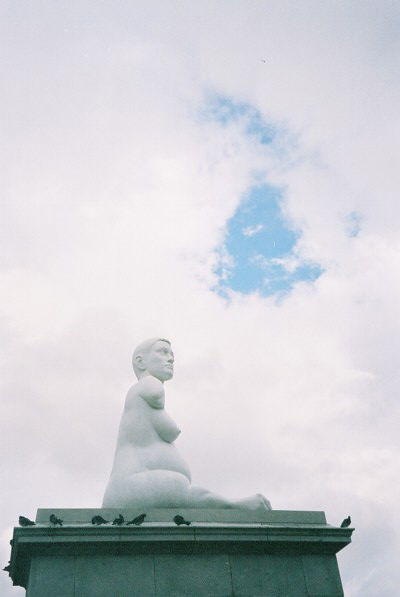
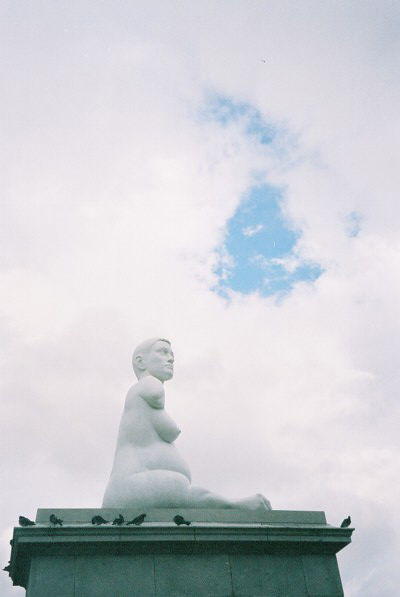
On the bus from Victoria, going past Trafalgar Square and the light flashed off the head of Marc Quinn's extraordinary statue, which had been unveiled for the first time that very day. Certainly a first in the history of sculpture, it sits impressively on its plinth, seemingly oblivious to the crowds below and the pigeons.
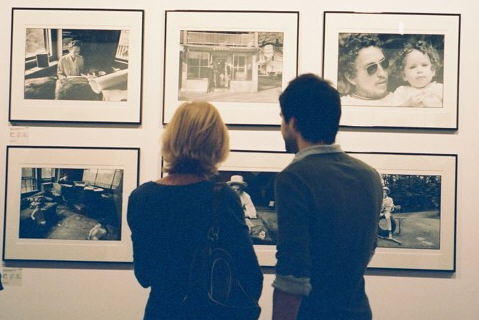

Down on Chalk Farm Road, visiting the Proud Gallery to see their Dylan Exhibition, linked to 'The Bob Dylan Scrapbook', published by Simon & Schuster. Met several beat characters and had a few Carlsberg's - as had many of the other revellers, especially the dude in the cowboy hat (there's always one).

Hot news I picked up in Snapper Books in Cecil Court, from a very bearded chap. The World Beard and Moustache Championships are being held in Berlin on October 1st. Not to be missed.
Sunday, September 11, 2005
Great Gigs I Have Seen
It has long been a plan of mine to try and list all of the major gigs and concerts I have seen in my life - just as a memory exercise if nothing else. Such events are amongst the most intense and important things that have happened, after personal relationships, and I often think that for our generations born after the Second World War, that the onslaught of music in the 60s and 70s was the biggest thing in our young lives. Not that that has changed in the intervening years.
What triggered me on this thought was the fact that last week my friend David was kind enough to give me a ticket for the Prome at the Albert Hall where we saw Zubin Mehta and the Vienna Philarmonic perform. I may never have seen a full classical orchestra live before (its hard to remember) but it's certain that such performances could be counted on the finger of one hand. The programme was in three parts - some Haydn (take it or leave it), extracts from Wozzeck by Berg (the last piece of which was mesmerising).
The orchestra increased in size between the two performances, then there was an interval, and an even bigger orchestra came back on stage for the piece de resistance of the evening - Stravinsky's 'Rites of Spring' - which is what I was waiting for. I had not realised that this would be one of the great musical experiences of my life.
Those familiar with the piece will know of its savage intensity, its deep emotion, its mixture of pagan and modern. I had not prepared for the effect that it was to have, reaching inside ones heart, stirring up deep and nameless emotions.
To see a vast orchestra at work is a wonderful thing - a big six piece percussion section, ranks of brass players and woodwinds, a rank of big double-bass cello players and, of course, a flock of violinists.
Mehta was like a demon. Working without score, he danced, gestured, jabbed, swooned and flourished his baton, bringing this swirling, disjunctive, poignant, frightening piece to life, by turns, with such elegance and splendour that it brought tears to the eyes and gasps to the throat.
One image in particular stays with me. Mehta, standing like a heron when he uses his wings outstretched to shade the water in his search for fish, surrounded on three sides by the string players, with what seemed like a thousand bows making short vibrant strokes, an urgent and scary sound of great intensity - the whole like some scene from 'Lord of the Rings' , like some vast rhythmic army, soon to be joined by the elephants and the war machines, until the whole orchestra became one vast percussive instrument. Breathtaking and electrifying by turns.
In the interval, I escaped from the hot interior of the hall to the cool wind outside, where members of the orchestra were smoking chatting and laughing, all dressed in the black tail coats, looking like a cross between a pianting by Degas and Jack Vetriano.
What gigs have I seen that could match that? There is a long list ( so here's some of them): the first electric band I ever saw, the original Californian Byrds at the Assembly Hall in Worthing; the Buena Vista Social Club at the Brighton Dome; the legendary Iggy Pop gig at the King's Cross Cinema; Ray Charles at the Royal Festival Hall; Led Zeppelin at the Bath Festival; Bert Jansch at the Gardner Theatre at the University of Sussex; Alice Cooper, Manassas, the Who and Steely Dan (separate gigs) at the Rainbow; Bob Dylan at the Brighton Centre; the MC5 at Phun City; the Rolling Stones in Hyde Park; Parliament at the Hammersmith Odean; Elvis Costello at the Dominion Theatre. My life is marked out by such moments.
On the Turntable:
Road to Ruin - Supergrass
The Rough Guide to Afro-Peru
The Best of Fela Kuti
Calcutta Slide Guitar - Debashish Bhattacharya
Where the Humans Eat - Willy Mason
Ballads - Omar Sosa
No Direction Home - Bob Dylan
500% Dynamite [Soul Jazz Records]
Enjoy
What triggered me on this thought was the fact that last week my friend David was kind enough to give me a ticket for the Prome at the Albert Hall where we saw Zubin Mehta and the Vienna Philarmonic perform. I may never have seen a full classical orchestra live before (its hard to remember) but it's certain that such performances could be counted on the finger of one hand. The programme was in three parts - some Haydn (take it or leave it), extracts from Wozzeck by Berg (the last piece of which was mesmerising).
The orchestra increased in size between the two performances, then there was an interval, and an even bigger orchestra came back on stage for the piece de resistance of the evening - Stravinsky's 'Rites of Spring' - which is what I was waiting for. I had not realised that this would be one of the great musical experiences of my life.
Those familiar with the piece will know of its savage intensity, its deep emotion, its mixture of pagan and modern. I had not prepared for the effect that it was to have, reaching inside ones heart, stirring up deep and nameless emotions.
To see a vast orchestra at work is a wonderful thing - a big six piece percussion section, ranks of brass players and woodwinds, a rank of big double-bass cello players and, of course, a flock of violinists.
Mehta was like a demon. Working without score, he danced, gestured, jabbed, swooned and flourished his baton, bringing this swirling, disjunctive, poignant, frightening piece to life, by turns, with such elegance and splendour that it brought tears to the eyes and gasps to the throat.
One image in particular stays with me. Mehta, standing like a heron when he uses his wings outstretched to shade the water in his search for fish, surrounded on three sides by the string players, with what seemed like a thousand bows making short vibrant strokes, an urgent and scary sound of great intensity - the whole like some scene from 'Lord of the Rings' , like some vast rhythmic army, soon to be joined by the elephants and the war machines, until the whole orchestra became one vast percussive instrument. Breathtaking and electrifying by turns.
In the interval, I escaped from the hot interior of the hall to the cool wind outside, where members of the orchestra were smoking chatting and laughing, all dressed in the black tail coats, looking like a cross between a pianting by Degas and Jack Vetriano.
What gigs have I seen that could match that? There is a long list ( so here's some of them): the first electric band I ever saw, the original Californian Byrds at the Assembly Hall in Worthing; the Buena Vista Social Club at the Brighton Dome; the legendary Iggy Pop gig at the King's Cross Cinema; Ray Charles at the Royal Festival Hall; Led Zeppelin at the Bath Festival; Bert Jansch at the Gardner Theatre at the University of Sussex; Alice Cooper, Manassas, the Who and Steely Dan (separate gigs) at the Rainbow; Bob Dylan at the Brighton Centre; the MC5 at Phun City; the Rolling Stones in Hyde Park; Parliament at the Hammersmith Odean; Elvis Costello at the Dominion Theatre. My life is marked out by such moments.
On the Turntable:
Road to Ruin - Supergrass
The Rough Guide to Afro-Peru
The Best of Fela Kuti
Calcutta Slide Guitar - Debashish Bhattacharya
Where the Humans Eat - Willy Mason
Ballads - Omar Sosa
No Direction Home - Bob Dylan
500% Dynamite [Soul Jazz Records]
Enjoy
THE LOST DYLAN PHOTOS

Finding a 'lost' set of Bob Dylan pics is like discovering the Holy Grail - in a way. Such was my luck in discovering the work of Douglas Gilbert earlier this year. Some of you may have seen my feature on the subject in The Times magazine this weekend - 'The Lost Dylan'. For them that missed it, here is the full unedited text.
This month is Dylan central in the UK, with the launch of major photo exhibition at the Proud Galleries in London, coinciding with the launch of 'The Bob Dylan Scrapbook: An American Journey 1956-66 [Simon & Schuster] and the screening of the two-part Martin Scorsese documentary on Dylan 'No Direction Home' on September 26 &27th on BBC's Arena programme. See: http://bobdylan.com/ndh.html
'In 1964, a 21-year-old photographer named Douglas R. Gilbert went on an assignment for Look magazine, to photograph the just-turned 23-year-old Bob Dylan.
In a couple of days in late June, he captured Dylan, in Woodstock, relaxing with friends – including the beat poet Allen Ginsberg - playing with kids, writing poetry, posing on his motorbike and jamming in the local café with John Sebastian (who later formed The Lovin’ Spoonful).
A week or so after, Gilbert spent a few further hours shooting Dylan getting drunk with Ramblin’ Jack Elliott at the legendary Kettle of Fish bar in Greenwich Village, examining fresh vinyl he had acquired from his recent European trip, and browsing in a local bookstore.
At the end of July, Gilbert is at the Newport Folk Festival, to record shots of Dylan appearing at the Friday opening song workshop, his surprise appearance at the end of Joan Baez’ set that night, and his solo set on the main stage on Saturday night, when Baez joined him for an encore.
Despite the quality of these elegant black and white photos, the story was subsequently rejected by Look as the editors felt Dylan was ‘too scruffy’ for a family magazine and the pictures were kept unseen in the photographer’s archive for the next 40 years, as Gilbert was unsure as to whether the copyright rested with him.
Reassured by a colleague and with encouragement from his daughter, the pictures have finally seen daylight – and the public acclaim they deserve.
A long tangled trail led me to these pictures, to Douglas Gilbert and eventually the whole set of contact sheets which proved to be the key to recapturing lost days in Dylan’s life by sequencing the pictures for the first time, identifying the key characters and researching Dylan’s life to give them a context. Thus the photos can now speak to us.
Firstly, they capture Dylan in a way we have never really seen him – relaxed, at peace, easy with himself and his surroundings. There is an innocence there but also the marks of the journey he has made from Hibbing to Greenwich Village to these images.
He is a young man who has already come a very long way. The summer before he had become the new star of Newport and had discovered Woodstock before it became ‘a zoo or a ‘nation’, in the words of Robert Shelton. Then Kennedy was shot. ‘The Times They Are A-Changin’ was released. He took a road trip across America (part Kerouac, part Fear and Loathing). He’d split up with Suze Rotolo (the girl on the cover of ‘Freewheelin’’ and was having an affair with Joan Baez. He played England, roamed Europe, hung out in Greece. On his return, he went into Studio A in New York and in one night recorded ‘Another Side of Bob Dylan’ between 7:30pm and 1.00am. That was just a couple of weeks before the first pictures you see here were taken.
In fact, we actually see Bob writing part of the liner notes for the album (says Gilbert), who captures Dylan at the typewriter in The White Room above the Café Expresso on Tinker Street, in a beautifully balanced image, full of resonant repeating shapes – the wooden mallet on the hook, the distinctive t-square shape on the drawing board, the adze-like black outline of the cover over the typewriter keys. Dylan sits, at an elegant wooden table, ashtray by his side. Cool in his suede jacket and boots of Spanish leather. A table in the foreground holds a tableaux of cigarette packets, corkscrew, French wine bottle and cup of coffee – the artist’s tools.
Some two weeks after the Newport Festival, Dylan gets taken to the Hotel Delmonico in New York by the recently deceased journalist Al Aronowitz to meet the Beatles. Al shared some heavy weed with the lads and claimed ever after that this was where the ‘60s began.
Ahead lies the legendary and explosive Dylan-goes-electric performance at the 1965 Newport Folk Festival, 'Like A Rolling Stone', mob attention, stellar fame, and the mysterious bike crash (the same Triumph we see in these pictures) on July 29th 1966. Press reports at the time said he had broken his neck and almost killed himself but this version of events does not now stand up to historical scrutiny. The incident did however enable Dylan to cancel his increasingly frenetic commitments and withdraw from performing for a time, his next live show being a tribute to WoodyGuthrie, one of his key mentors, on January 20th 1968.
The pictures of Dylan and Ginsberg are amongst the best ever taken of a friendship that had begun that previous December and which lasted until the poet’s death in 1997. Ginsberg, resplendent on cotton and sandals, had recently returned from a long spell in India; the photos actually capture Dylan showing him how to play the harmonium that Ginsberg had acquired in Benares.
There are no fans in these pictures. This was a different world. Sun-splashed images of a lost summer. Gilbert’s youthful assignment has captured for history another side of Dylan. A very human one. A young man about to make it big. But in a new way. Knowing what we now know gives these rediscovered images a powerful poignancy and allows us to see Dylan afresh. Once more.'
Due to my investigative work on the photos, I have an 'Additional Research' credit on the title page of the book of Gilbert's images. 'Forever Young: Photographs of Bob Dylan, 1964, is to be published by Da Capo Press on November 1st. The opening essay is by the legendary US rock writer Dave Marsh, biographer of Bruce Springsteen and The Who and founder of Creem magazine, where the legendary Lester Bangs was one of the star writers. It was a pleasure to work with him.
Adventures In Hyper-Reality (3): Pete Culshaw
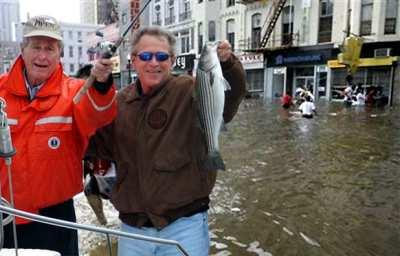
Bush Sr and Jr visit New Orleans
Original source: Dvorak Uncensored: The Personal Weblog of John C. Dvorak
The God of Hellfire in Residence
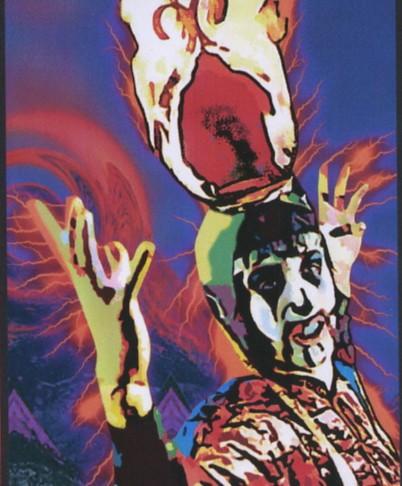
From time to time, chez nous functions as the Beat Hotel (excellent views and rates; as much olive oil as you can eat) and it has been a great pleasure to have the legendary Arthur Brown, the God of Hellfire in residence over the past month or so.
As chance would have it, he happened to have with him the proofs from the first full-length biography of his life and times, which I have been reading intermittently between dealing with the usual assortment of real-life problems that, inevitably, interrupt any kind of artistic activity.
Written by Polly Marshall, Shirley Collins’ daughter, ‘The God of Hellfire: The Crazy Life and Times of Arthur Brown’ is an eccentric narrative of great charm and interest, which weaves a tapestry of connections, anecdotes, press clips and extensive quotes from Arthur’s own memoirs (drafted in hand on yellow lined paper, as I recall) into a story that almost beggar’s belief.
AB introduced theatricality into rock in a spectacular and formative way in the mid-1960s. He and his two compatriots formed the tallest trio in rock, scaring and stunning their audiences, and became the most heavily booked university band of the time.
Their No 1 single ‘Fire’ remains an iconic memento of British psychedelia. Arthur has told me that he sung the song at Donald Trump’s casino in Atlanta, at a party for Edward Kennedy in early 1969 and was recently helicoptered into a stadium of 40,000 people to sing at the opening of a football game featuring a team named Rhinefire, who have adopted it as their anthem. He says it was ‘much discussed in India and appealed to the Mexicans because of the trumpets.’
Once memorably described as a cross between Screaming Jay Hawkins, Little Richard, Tom Jones and Maria Callas, Arthur Brown has lost none of his extraordinary vocal power and stage presence. I can vouch for this, having seen the man personally mesmerise audiences. Playing guitar and singing in my kitchen, his voice accelerates effortlessly and astonishingly from a primeval and subterranean bass growl to a high register vocal scream that rattled the plates in my kitchen and curls your eyelids. A hard act to follow.
Naturally someone of such great talent has been poorly treated by the music business (it has to be said, not an uncommon thing at that time - or today). He has also been largely sidelined by the music and mainstream press, except as a one-hit wonder.
Yet like many musicians of his originality and calibre, he remains constantly in demand for concerts, collaborations and events in many parts of the world. He runs his own regular nights at the Komedia in Brighton, stages an annual festival in Spain, and produces music and performances of great artistry and style.
Arthur’s importance as a pioneer cannot be underestimated. Witness this marvellous account in the beautiful intro of the book by Howard Marks (‘Mr Nice’ himself) who vividly remembers his first sight of Arthur:
‘Suddenly, a human cannonball wearing Sun God robes and a science fiction mask and with his head on fire arched through the auditorium….Spinning and thrashing his head, he tore off the mask to reveal a face plastered with woad. Everyone jumped up and down and bounced off the walls in frenzied relief. They were dancing to the Crazy World of Arthur Brown, the first psychedelic soul spectacle, a memory that neither experience nor drug could ever erase.’
Then there’s John Peel: ‘I’m ashamed to say it, I don’t remember the Floyd as vividly as I remember Arthur Brown, ‘cos I mean Arthur Brown, at that time, used to stand there and insult the members of the audience in much the same way as people like Johnny Rotten.’
I remember reading how James Brown had taken his whole band, when in Nigeria, to go and see Fela Kuti, who blew him away. Well check this quote from the Godmaster Of Funk and Totally Over The Top Theatrics, Mr George Clinton: ‘We saw Arthur Brown and his Crazy World and the whole thing was just an eye-opener to me. He used to sing ‘I am the God of Hell Fire’ and then he’d set fire to his fuckin’head. That told me a lot. I knew where I was heading from then on.’
According to a heavy metal website (furious.com), the Crazy World are ‘correctly identified as the daddy and granddaddy of all the latter ‘satanic rockers.’ Ozzy covered ‘Fire’ on his 4-CD box set, released earlier this year, as did Prodigy before him. Bruce Dickinson of Iron Maiden is both a friend and huge fan. Check out AB’s ‘Devil’s Grip’ to see where it all came from.
In short, Arthur is a unique figure in British culture who should be celebrated and acknowledged. Spread the word by reading this book, which also contains a rich fund of stories of Arthur’s spiritual travels to Rwanda and Turkey, his legendary painting and decorating business (named Black and Brown) in Austin, Texas, with Jimmy Carl Black from the Mothers, his friendship with Jimi Hendrix and why he stripped naked at the Palermo Pop Festival 70 (and what happened to him in a Sicilian prison as a result).
Arthur Wilton-Brown, born 1942 in Whitby, Yorkshire, to a father who developed the first fully automatic toothbrush — we salute you.
‘The God of Hellfire: The Crazy Life and Times of Arthur Brown’ by Polly Marshall is published shortly by SAF Publishing Ltd (www.safpublishing.com).
[ISBN: 0 9646719 77 2] £20.00.
See also:
http://www.godofhellfire.co.uk/
http://www.arthurbrownmusic.com/
Sunday, August 28, 2005
What the Dormouse Said: Counter-Culture and Computing

This image of the very first mouse, conceived by Doug Engelbart, taken from the chronological history on the site of The Bootstrap Institute, which continues to further his lifelong career goal of boosting individual and organizational ability to better address problems that are complex and urgent. More info and video clips of the work of Doug Engelbart and colleagues can be found at the Mouse Site.
The ubiquitous presence of personal computing and the Internet in our modern world is now so intense and pervasive that it will be hard for many to imagine a time when such tools didn’t exist.
There is of course a huge literature on the birth of computing but such is the dominance of figures like Bill Gates and Steven Jobs, young men who emerged at the beginning of the hobbyist era when the first kits to build your own computer were available, that perhaps most people believe this to be the true starting point of the modern world.
For those more deeply informed, the roots go back to Xerox’s legendary Palo Alto Research Centre in the early 1970s, from which came a computer called Alto - the forerunner of today’s desktops and portables.
In fact, as documented in ‘What the Dormouse Said ‘, a remarkable book by the New York Times science writer John Markoff [Viking Books. 2005], the roots of it all lie some ten to twenty years before that, in a California in which early computing labs and engineers were deeply intertwined and influenced by the ‘counter-culture’ activities swirling through American society at that time.
The book focuses on two government-funded labs – the Augumented Human Intellect Research Centre (later known as ARC) and the Stanford Intelligence Laboratory (SAIL) – the former driven by the visions of Doug Engelbart (best known for his invention of the ‘mouse’) who imagined augmenting human intelligence by giving people personal access to computers, the latter driven by the search for artificial intelligence.
At that time, computing meant giant mainframes, tended by teams of engineers and programmers, time-sharing these precious facilities, unable to readily communicate from machine to machine.
During this previously undocumented period, a network of far-sighted individuals began formulating the concept of personal computing alongside the development of ARPANET, which evolved into the Internet we know today.
It is well-known that in 1965 Intel founder Gordon Moore noted the phenomena now known as ‘Moore’s Law’ – the insight that the number of transistors on a chip would double every couple of years, that computing power would increase exponentially at an ever decreasing cost. In fact, says Markoff, this paradigm had been discovered at the beginning of the 1960s by an earlier group who recognised the profound economic implications of these technologies. [Check out also 'Moore's Law Is Dead, says Gordon Moore' by Manek Dubash at Techworld.}
The straight forward technical side of the story is gripping enough but perhaps of interest to a fairly technically-minded readership. What makes Markoff’s story of interest to the broader audience is how intrinsically this world was suffused with the social experimentation and political dissent of the time and the effect that this had on the direction the world of computing would take. For instance, open-source programming and software is just one fruit of this particular loom.
One of the, most surprising things is the pervasiveness of LSD. A very high proportion of the main characters in Markoff’s story were taking the drug in a highly structured and therapeutic manner, in order to help them visualise the kind of machines and inventions that would enable a new world of personal computing and connectivity to emerge.
Many were also involved in either the anti-war movement (the intensity of the Vietnam War was accelerating throughout this period) or spiritual and social experimentation (communal living, est).
One surprise of this narrative is the importance of Stewart Brand, best known as the originator of The Whole Earth Catalogue. Markoff writes: ‘Brand was the first outsider to catch a glimpse of this new cybernetic world and discern the parallels between mind expansion through the use of psychedelic drugs and through the new kinds of computing. ‘ He not only wrote the seminal article about the emerging computer scene for Rolling Stone in 1972 (‘Spacewar: Fanatic Life and Symbolic Death among the Computer Bums’) but also expanded this into the 1974 book ‘II Cybernetic Frontiers’ in which, says Markoff, ‘he became the first to popularise the term ‘personal computer.’ [See also 'The Epic Saga of The Well' ]
The theme of Markoff’s own book was prefigured by Brand in an article in Time magazine in 1995 entitled ‘We Owe It All to the Hippies’ in which he argued that ‘the counterculture’s scorn for authorised authority provided the philosophical foundations of not only the leaderless Internet but also the entire personal-computer revolution.’ (The other progenitor was a monograph by Theodore Roszak – ‘From Satori to Silicon Valley.’ [1986]. )
Doug Engelbart is a key figure in the narrative and this book certainly restores him to his proper eminence on the historical record. From the time he bizarrely first came across and read the extraordinary article – ‘As We May Think’ in Atlantic Monthly [July 1945] by Vannevar Bush while waiting to be demobbed, on an island in the Phillipines, in a little bamboo hut on stilts that served as a reading library for servicemen, he was hooked into a powerful new vision that he was to dedicate his life to.
Bush wrote: ‘Consider a future device for individual use, which is a sort of mechanised private file and library. It needs a name, and, to coin one at random, ‘Memex’ will do. A Memex is a device in which an individual stores all his books, records and communications, and which is mechanised so that it may be consulted with exceeding speed and flexibility. It is an enlarged and intimate supplement to his memory.’
Markoff’s book is a profound revisioning of the roots of our modern technological world, full of interesting and absorbing character studies and set against a landscape of turbulent dissent and mind-altering substances and concepts.
Interestingly, Markoff uses the term ‘hacker’ throughout this book in its old sense. You may not realise that the word dramatically changed its meaning in the early 1990s ‘when it came to refer to teenagers who used modems to hack into computers.’ The term, says Markoff, was originally applied to ‘a group of almost exclusively young men who were passionate in their obsession with computers and computing.’
Those were different days.
Tuesday, August 23, 2005
Douglas Adams: A Carbon-Based Bipedal Life Form

Douglas Adams: The Star of Broadcasting House
12 August 1982. Photo by John May
First publication
You might well ask what Douglas Adams is doing standing outside BBC Broadcasting House in London wearing a pair of deeley boppers on his head. It's my fault.
I was working on assignment for the NME, 'Life, the Universe and Everything' had just been published, and deeley boppers were that summer's craze. I thought it might be fun - and so it turned out to be.
As I recall it, we met in the hotel a few steps from the BBC and settled down in the upstair lounge area. When the waiter came, Douglas ordered a large champagne cocktail. It was around 11am. When he asked me what I was having, I decided it was wise to drink the same. I think we had three each during the interview; it may have been four. Douglas seemed in full control, except he began talking very intensely. I had problems focusing.
Afterwards, spilling out into the afternoon sun, I suggested photos and the deeley boppers and we had a laugh. The photo below was taken inside the lobby of Broadcasting House - illegally. I love the consternation of the security guards and the look on Douglas' face.
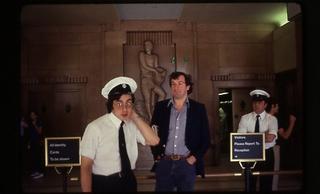
Douglas, now sadly deceased, has gone to comedy heaven. 'The Hitch Hikers Guide' and his other works are rightly viewed as classics and his work continues to delight a worldwide audience and new generations.
As far as I can ascertain, the three main biographies are 'Don't Panic' by Neil Gaiman (1988 Titan revised 1993/2002), 'Hitchhiker' by M.J. Simpson (2003. Coronet Books) and 'Wish You Were Here' by Nick Webb (2003. Headline)
Here for the historical record, is an edited version of the NME piece (which they didn't manage to publish until 2nd October 1982).'The Manic Depressive's Guide to Space Travel And How To Be A Successful Writer.
''I suppose I'm a terrible worrier,' says Douglas Adams, 'and by suggesting that underlying everyday events there are appalling explanations, that is my own way of attempting to justify that fact.'Douglas Adams is a carbon-based bipedal life form, well over six foot and burly with it, with what are politely called generous features. He's 30 and looks 40, this creator of Marvin, Zaphod, Ford Prefect, Arthur Dent and the other travelling companions in 'The Hitchhiker's Guide to the Galaxy.' What began as a radio series has now become a media industry in its own right with records, a tv series, three books, several stage shows - and a feature film to come.
[Editor's Note: Worth commenting that the movie did not appear for another 23 years ! Went to the opening night of the stage version at The Rainbow in London, which was a commercial disaster, but it did have the distinction of having Zaphod played by two seperate actors bound up in one costume. Very effective.]
Adams grew up 'feeling at a slight distance to the world' in a house with his grandmother and mother, which acted as a way-station for damaged animals. His mother remarried a vet, so animals, he says, 'form a major part of my consciousness.'This no doubt explains why his book postulates the theory that the earth was created by white mice as an experiment to find the Ultimate Question. A guy involved in behavioural research with mice actually wrote to Adams saying this was a worry and fantasy that he'd often suffered from.
Picture Douglas as a solitary boy with few close friends, a sister with whom he had little in common and a feeling that he was a strange, odd person - a fish out of water. University dispelled this notion and he became 'a thoroughly middle-class graduate and a radio producer.' In between, he worked as a chicken shed cleaner and as a bodyguard for an Arab royal family.
He recalls: 'I remember one group of family members had gone down to the restaurant in the Dorchester. The waiter had brought the menu and they said 'We'll have it.' It took a while for the penny to drop that they actually meant the whole lot, the entire a la carte menu, which was a thousand pounds worth of food. So they brought it, the family tried a little bit of it all and then went back to their room. They then sent one of their servants to bring back a sackful of Wimpys, whichwas what their real obsession was.
'While admitting to liking Dan Dare, Adams is not a science fiction buff. 'Saying I write science fiction is rather like saying the Pythons do historical movies. In a way it's true but it misses the point.
If he was stranded on a distant planet with a Sony Walkman, he'd take the following tapes: 'Magical Mystery Tour', Plastic Ono Band, Ry Cooder, Paul Simon, the new Elvis Costello and 'Requiem' by Gyorgi Ligeti, the monolith music used by Kubrick in '2001'.
Incidentally, the theme music for the radio series was originally by the Eagles, but the tune had to be re-recorded for the tv show (featuring Adams on rhythm guitar) as tv rights could not be obtained. This was due, Adams claims, to the 'impossibility of having any meaningful communication with anybody who lives in California.
'For Adams, The 'Guide' has been a lifesaver. he admits that when he wrote it he felt 'completely washed up and very demoralised.' He was broke, overdrawn, couldn't get work, couldn't pay the rent. The 'Guide' was 'definately an attempt to change perspective. The world at that time was a very alarming place for me. I couldn't handle it.'
Enter Marvin, the eternally depressed android with a brain the size of a planet. You might think he was a dead ringer given Adams' state of mind but it turned out he's based precisely and exactly on Andrew Marshall, one of the writers of the tv series 'End of Part One' and 'Whoops Apocalypse,' who is simply like that. Or was, as Adams' explains.
'Andrew has now left his wife, suddenly decided he's gay and is now living with a man in Milton Keynes and has cheered up a lot. It's curious.' So how does he feel about being immortalised as a robot? 'He tells me he's very annoyed about it but he makes sure that everybody else knows its him.
'People always ask Adams what he's on when he writes that stuff but he insists he writes straight, claiming control is the secret to succesful anarchy. He's a desperate writrer: 'The point at which I really get going is when I've passed the final absolute deadline. I spend a lot of time sitting around worrying.
'Having completed the trilogy of books, he now wants to write another completely different novel before rewriting the three books into one long integrated saga. 'The Once and Future King' by T.H. White was done in a similar way and its a novel he feels very akin to.
On our way out, Douglas almost forgets to pay the bill, stumbles over a man in the lobby, but agrees to pose with stars on his head. Gaucheness mingles with a career obsession. He desperately wanted to be successful and now he is. It doesn't appear to have made him much happier.
Footnote: One of the most famous legends about Douglas is that the idea for the 'Hitchhiker's Guide' came to him while lying drunk in a field in Innsbruck, one starlit night in 1971 - which is what he told me. Not so says M.J. Simpson in an Author's Afterword in his recent biography. According to an interview Simpson did with Adams' old friend Martin Smith after completing the manuscript: 'To Will and I it was first broached just after Douglas returned from Greece in, I am fairly certain, the summer of 1973. He had bought 'A Hitchhiker's Guide to Europe' and, whilst relaxing post-coitally (as he explained it, she was a Dutch girl), looking at the stars from a rock on the north side of Santorini, he thought it would be a pretty neat idea if there were an intergalactic version of the 'Hitchhiker's Guide'!'
Dying To Win

What follows is an extract from 'The Logic of Suicide Terrorism' by Scott McConnell, published in the American Conservative magazine. Worth reading the full interview.
Last month, Scott McConnell caught up with Associate Professor Robert Pape of the University of Chicago, whose book on suicide terrorism, 'Dying to Win', is beginning to receive wide notice. Pape has found that the most common American perceptions about who the terrorists are and what motivates them are off by a wide margin. In his office is the world’s largest database of information about suicide terrorists, rows and rows of manila folders containing articles and biographical snippets in dozens of languages compiled by Pape and teams of graduate students, a trove of data that has been sorted and analyzed and which underscores the great need for reappraising the Bush administration’s current strategy. Below are excerpts from a conversation with the man who knows more about suicide terrorists than any other American.
Your new book, 'Dying to Win', has a subtitle: The Logic of Suicide Terrorism. Can you just tell us generally on what the book is based, what kind of research went into it, and what your findings were?
Over the past two years, I have collected the first complete database of every suicide-terrorist attack around the world from 1980 to early 2004. This research is conducted not only in English but also in native-language sources—Arabic, Hebrew, Russian, and Tamil, and others—so that we can gather information not only from newspapers but also from products from the terrorist community. The terrorists are often quite proud of what they do in their local communities, and they produce albums and all kinds of other information that can be very helpful to understand suicide-terrorist attacks.
This wealth of information creates a new picture about what is motivating suicide terrorism. Islamic fundamentalism is not as closely associated with suicide terrorism as many people think. The world leader in suicide terrorism is a group that you may not be familiar with: the Tamil Tigers in Sri Lanka. This is a Marxist group, a completely secular group that draws from the Hindu families of the Tamil regions of the country. They invented the famous suicide vest for their suicide assassination of Rajiv Ghandi in May 1991. The Palestinians got the idea of the suicide vest from the Tamil Tigers.
So if Islamic fundamentalism is not necessarily a key variable behind these groups, what is?
The central fact is that overwhelmingly suicide-terrorist attacks are not driven by religion as much as they are by a clear strategic objective: to compel modern democracies to withdraw military forces from the territory that the terrorists view as their homeland. From Lebanon to Sri Lanka to Chechnya to Kashmir to the West Bank, every major suicide-terrorist campaign—over 95 percent of all the incidents—has had as its central objective to compel a democratic state to withdraw.
That would seem to run contrary to a view that one heard during the American election campaign, put forth by people who favor Bush’s policy. That is, we need to fight the terrorists over there, so we don’t have to fight them here.
Since suicide terrorism is mainly a response to foreign occupation and not Islamic fundamentalism, the use of heavy military force to transform Muslim societies over there, if you would, is only likely to increase the number of suicide terrorists coming at us.
Since 1990, the United States has stationed tens of thousands of ground troops on the Arabian Peninsula, and that is the main mobilization appeal of Osama bin Laden and al-Qaeda. People who make the argument that it is a good thing to have them attacking us over there are missing that suicide terrorism is not a supply-limited phenomenon where there are just a few hundred around the world willing to do it because they are religious fanatics. It is a demand-driven phenomenon. That is, it is driven by the presence of foreign forces on the territory that the terrorists view as their homeland. The operation in Iraq has stimulated suicide terrorism and has given suicide terrorism a new lease on life.
Other References:
Dr. Robert Pape is Associate Professor of Political Science at the University of Chicago specializing in international security affairs. His publications include Bombing to Win: Air Power and Coercion in War (Cornell 1996), "Why Economic Sanctions Do Not Work," International Security (1997), "The Determinants of International Moral Action," International Organization (1999). His commentary on international security policy has appeared in The New York Times , New Republic , Boston Globe , Los Angeles Times , and Bulletin of Atomic Scientists , as well as on Nightline , ABC News with Peter Jennings, and National Public Radio . Before coming to Chicago in 1999, he taught international relations at Dartmouth College for five years and air power strategy for the USAF's School of Advanced Airpower Studies for three years. He received his Ph. D. from the University of Chicago in 1988 and graduated summa cum laude and Phi Betta Kappa from the University of Pittsburgh in 1982. His current work focuses on the effect of technological change on conflict and cooperation among major powers and the theory and practice of suicide terrorism.
Wsahington Post: A Scholarly Look at Terror Sees Bootprints In the Sand
Elephants Can Mimic Sounds

Calimero, a male African elephant in a zoo, has learned to imitate the sounds made by female Asian elephants he was housed with. (Photo by Angela S. Stoeger-Horwath, University of Vienna)
An expert on marine mammal communication from the Woods Hole Oceanographic Institution in the US has confirmed that elephants have the ability to learn new sounds by imitating what they hear - a process known as 'vocal learning'. This uncommon ability was previously believed to be limited to songbirds and parrots, bats, cetaceans, and pinnipeds (such as seals and walruses).
WHOI biologist Stephanie Watwood was unexpectedly contacted by two elephant researchers who were both puzzled by strange sounds that their elephants were making. One called Mlaika, at the Amboseli Trust for Elephants in Kenya, appeared to be imitating the sound of trucks; the other, a male African elephant named Calimero, living in a zoo with female Asian elephants, was mimicking the chirping calls of his female companions. Watwood confirmed the elephants' previously unknown vocal talents.
Although elephants do make loud trumpeting calls, most of the sounds made by adults are low-frequency rumbles, below the human range of hearing. Like whales and dolphins, elephants have strong social structures and they use these sounds to communicate over many kilometres.
Watwood's analysis confirmed that the sounds that Mlaika and Calimero were making did not exactly match the trucks and the Asian elephants but it was clear that they were trying hard to mimic them to the best of their ability.
"Truck sounds are very low frequencies, well within the range of sounds that elephants produce,” Watwood said. “The truck sound that Mlaika imitated was a lo-o-o-o-o-ong sound—much longer calls than she normally would make.
"Calimero is much bigger than an Asian elephant female and so had a lower voice; he called at a lower frequency than females would.But he put more of his vocal energy in frequencies that were much higher than a typical elephant of his size would make. He was doing his best to sound like a smaller elephant.”
Source: Oceanus
Thanks to MB.
Source: Oceanus
Thanks to MB.
Wednesday, August 17, 2005
Arundhati Roy: Kashmir & The War on Terror
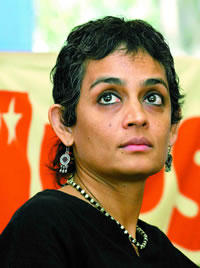
Arundhati Roy is one of the bravest and brightest writers on the planet. She has consistently and courageously spoke out in India and abroad about the pressing and dangerous issues of our time with little regard to her own safety. Her comments here are taken from a long interview with S. Anand, published in Outlook India.
You’ve travelled in Kashmir...
'It’s impossible to pronounce knowledgeably on Kashmir after just a few short trips. But some things are not a mystery. Hundreds of thousands have lost their lives in this conflict. Both Pakistan and India have played a horrible, venal role in Kashmir. But among ordinary Kashmiri people, Pakistan still remains an unknown entity — and for that reason it’s become an attractive idea, an ideal even, conflated by many with the yearning for ‘azaadi’. It’s ironic that a country that is a military dictatorship should be associated with the notion of liberation. The ugly reality of Pakistan is not something that most Kashmiris have experienced. The reality of India, however, to every ordinary Kashmiri, is an ugly, vicious reality they encounter every day, every ten steps at every check post, during every humiliating search. And so India stands morally isolated — it has completely lost the confidence of ordinary people. The Indian army is not in Kashmir to control militants, it is there only to control the Kashmiri people.'
And the prognosis for the War on Terror?
'Clearly, it’s spreading. Empire is overstretched. The Iraqis have actually managed to mire the US army in what looks like endless, bloody combat. More and more US soldiers are refusing to fight. More and more young people are refusing to join the army. Manpower in the armed forces is becoming a real problem. In a recent article, the remarkable un-embedded journalist Dahr Jamail interviews several American marines who served in Iraq. Asked what he would do if he met Bush, one of them says: “It would be two hits — me hitting him and him hitting the floor.” It’s for this reason that the US is looking for allies — preferably low-cost allies with low-cost lives. Because the media is completely controlled, no real news makes it out of Iraq. The world knows only a fraction of what’s going on. The anger emanating out of Iraq and Afghanistan is spreading wider and wider.... It’s a deep, uncontrollable rage that you cannot put a PR spin on. America isn’t going to win this war. '
Sunday, August 14, 2005
Inside Dope by Dick Tracy
 The first coffee shop or 'tea house' as it was then known was opened in Amsterdam in 1972 by Wernard Bruining and friends. at Weesperzijde 53 in Amsterdam, in a squatted bakery shop and called 'Mellow Yellow.' Nol van Schaik, is the owner of three successful coffeeshops in Haarlem, and the author of ‘The Dutch Experience’ , a history of this unique social experiment. Van Schaik opened the Dutch Experience coffeeshop in Stockport, England with Colin Davies, who is now serving a three-year sentence in a UK prison as a result. [Bruining’s paper ‘How to Avoid Criminalisation of Euro Cannbis: Learning from the Dutch Experience’ can be read here].
COFFEE SHOPS UNDER THREAT
According to a Reuters report (May 21st 2005), a new scheme set up by the Dutch Justice Minstry is being piloted in Maastricht, whereby people not registered in the Netherlands will not be allowed into coffee shops, in an effort to cut drug tourism.
The number of coffee shops has been cut to 754 nationwide in 2003 from 1,200 in 1997, according to the latest figures available from The Trimbos Institute , the Netherlands Institute for mental health and addocition studies.
According to Dutch Coffee Shops Facing Pressure, Greater Controls (11 March 2005) it is thirty years since the Dutch government pragmatically allowed so-called coffee shops to sell marijuana to adults even though Dutch law continues to make cannabis sales illegal. But pressure from the US and the European Union on the Dutch government has seen a crack-down in recent years.
It quotes August de Loor, an independent drug policy advisor to the government, who told 'The Independent': ‘In the past four years things have started to change and there is a more conservative approach. The control of coffee shops has become much more strict. The police are checking up on them more and there is much more strict interpretation of the rules. More and more mayors are banning coffee shops from their cities. I think in four or five years' time there will be no more coffee shops left in Holland,' he predicted. 'We have a conservative government at the moment but it's nothing to do with the left or right. It's a moral thing. It's a sign of the times.'
THE DEATH OF THE PUB?
According to 'Calling Time' by Paul Kingsnorth (23 July 2005), more than half the villages of England now have no pub, for the first time since the Norman conquest. The remaining rural pubs are closing at the rate of six a week. In 1900, there were more than 6,000 breweries in the UK. Only 500 are left. 33 have closed since 1990. Overall, 20 pubs close every month. Half of those that remain are in the hands of pub corporations.
MAGIC MUSHROOMS MADE CLASS A
The Transform Drug Policy Foundation has condemned the change in the UK law which gives fresh magic mushrooms the same legal status as heroin and cocaine. On July 18 th 2005, fresh magic mushrooms moved from being completely legal to possess, sell and consume, to being a Class A drug. This means that possessing magic mushrooms will be punishable with up to 7 years in prison, and supplying them punishable with an unlimited fine and up to life in prison. The change follows the rushed enactment of the Drugs Bill in the ‘wash up' week before the General Election.
See: Talk To Frank ( a government drug info site) for more details.
See: Full details of the new Drugs Act 2005
WAR OF THE WEED
Famous as the home of some of the biggest trees in the world, The Sequoia National Park has now got a new claim to fame – it has the greatest area of land being illegally cultivated for marijuana of any national park in the US. Large areas have become no-go zones for visitors and rangers as drug lords are cultivating pot on an agribusiness scale.
According to ‘War of the Weed’ by Joe Robinson in the LA Times (August 9th 2005): ‘Pot plantations have surged as Mexican-affiliated drug cartels adapt to increased border security since 9/11 and cash in on the rising price of high-grade weed, now more profitable than methamphetamine, according to investigators.’ The authorities have discovered giant farms, such as a 79,000-plant haul in Tulare County valued at $360 million.
’The cartels dispatch their troops down isolated roads in steep terrain in February and March’, says Robinson. ‘Growers bushwhack a couple of miles into the woods, carrying 25-pound tanks of propane, 50-pound sacks of fertilizer, pesticides and hoes. Periodic food drops supplement poached animals. The farmers clear the understory of foliage, leaving a canopy for camouflage; they cut terraces in the slopes, run irrigation hoses from creeks and rivers for miles and carve out a sprawling camp. For every five acres of marijuana, a grower will develop 180 acres of wilderness.’
A Black Hawk helicopter unit was used and discovered three major ‘gardens’ but was reassigned to the Mexican border this year. (The U.S. government has sent 60 helicopters and about $4 billion to Colombia since 2000 to eradicate coca farms). The special agent at Sequoia National Park requested $200,000 annually for Operation No Grow, a five-year plan to eradicate marijuana farms in the park but he got an extra $45,000.
Footnote: Dick Tracy wrote 'Inside Dope' - the first and only nationally published column on drugs in a British newspaper before or since - in the 'New Musical Express' from approximately 1976-1979.
Adventures In Hyper-Reality (2): Pete Culshaw

Message on Notting Hill Gate tube station, London. 26 July 2005
Message reads: 'Please do not run on the platforms or concourses. Especially if you are carrying a rucksack, wearing a big coat, or look a bit foreign. This notice is for your own safety. Thank you.'
See also: 'Theatre of the City' by Iain Sinclair (14th July 2005)
This Enchanted Isle: The Neo-Romantic Vision
There’s a book that’s been haunting my imagination off and on since I first read it some years ago and, not for the first time, I pulled it off the shelf last night to show Brian Hinton, who was on a brief and unexpected visit to HQINFO. Brian is Chairman of the Julia Margaret Cameron Trust and is the author, amongst other things, of 'Message to Love: Isle of Wight Festival, 1968, 1969, 1970' . He catalogued the Mike Moorcock collection for the Bodlean Library, is a friend and colleague of Ian Sinclair’s, and is an enthuastic biographer, historian, archivist and collector in a huge variety of interesting areas including modern poetry, the Beats, folk music, the psychedelic underground, the works of J.G. Ballard and on and on…Needless to say, we had a long and fascinating conversation.
The book in question is ‘The Enchanted Isle’ by Peter Woodcock, subtitled ‘The Neo-Romantic Vision from William Blake to the New Visionaires.’ This largish format fully-illustrated book has at its core the work of a group of artists in Britain, dubbed the ‘Neo-Romantics’ by Raymond Mortimer, who shared a similar vision were brought together by the war-torn circumstances of their age, but never became a movement or issued a manifesto.
Tow artists in particular inspired them – William Blake and Samuel Palmer. They key artist was Paul Nash, whose work is treated here in some depth. Next comes Graham Sutherland, John Piper, John Minton, Michael Ayrton, Keith Vaughan, John Craxton. They all had a sense of the ‘spirit of place,’
‘What distinguishes Neo-Romanticism from traditional romanticism,’ writes Woodcock, ‘is the feeling of danger, the juxtaposition of the urban with the countryside, the element of darkness, dissolution, an almost pagan reverie breaking through the ruins of post-industrialism.’
Woodcock maintains that, historically, Neo-Romanticism died in the mid Fifties but that the imaginative doorway opened by Nash at al was an inspiration to filmmakers like Michael Powell & Emeric Pressburger, David Lean, Carol Reed, Michael Crichton and Humphrey Jennings - who ‘captured both the realistic and imaginary world of Britain,’ in a body of work that is rightly seen as a ‘golden age’ of British film – as much as one loathes the term.
Similarly, there were the writers – John Cowper Powys, Arthur Machen, Denton Welch, Elizabeth Bowen, Geoffrey Household and, in recent times, PeterAckroyd and Ian Sinclair and Chris Petit - who shared similar sensibilities about the resonant power of the landscape, the psychogeography if you will.
Naturally the marvellous Derek Jarman is here, whose work delighted, inspired and provoked and gave a marvellous neo-rom edge to punk` amd Woodcock also profiles the painters David Blackburn and Derek Hyatt.
The book ends with a chapter ‘Re-Enchanting the Land’ that concludes: ‘The spirit of place is still deeply embedded in our national consciousness. Every new motorway is questioned, every ancient wood fought for. The old Neo-Romantic world has long gone, but the dream persists.’
All of which rings a loud bell with me, triggers off lots of connections, thoughts and reveries. Not least because I feel definitely more than a little neo-rom myself. The Sussex landscape, its mysteries and stories, entered my soul and consciousness from an early age, the world of W.H. Hudson and Richard Jefferies, of Conan Doyle and the Piltdown Man, of a murderer who was pursued across the downs by biplanes and shot himself in an oak grove.
Incidentally, this is just one of a range of interesting titles published by the admirably independent Glastonbury-based Gothic Image, including ‘The Traveller’s Guide to Sacred England’ by John Michell.
The book in question is ‘The Enchanted Isle’ by Peter Woodcock, subtitled ‘The Neo-Romantic Vision from William Blake to the New Visionaires.’ This largish format fully-illustrated book has at its core the work of a group of artists in Britain, dubbed the ‘Neo-Romantics’ by Raymond Mortimer, who shared a similar vision were brought together by the war-torn circumstances of their age, but never became a movement or issued a manifesto.
Tow artists in particular inspired them – William Blake and Samuel Palmer. They key artist was Paul Nash, whose work is treated here in some depth. Next comes Graham Sutherland, John Piper, John Minton, Michael Ayrton, Keith Vaughan, John Craxton. They all had a sense of the ‘spirit of place,’
‘What distinguishes Neo-Romanticism from traditional romanticism,’ writes Woodcock, ‘is the feeling of danger, the juxtaposition of the urban with the countryside, the element of darkness, dissolution, an almost pagan reverie breaking through the ruins of post-industrialism.’
Woodcock maintains that, historically, Neo-Romanticism died in the mid Fifties but that the imaginative doorway opened by Nash at al was an inspiration to filmmakers like Michael Powell & Emeric Pressburger, David Lean, Carol Reed, Michael Crichton and Humphrey Jennings - who ‘captured both the realistic and imaginary world of Britain,’ in a body of work that is rightly seen as a ‘golden age’ of British film – as much as one loathes the term.
Similarly, there were the writers – John Cowper Powys, Arthur Machen, Denton Welch, Elizabeth Bowen, Geoffrey Household and, in recent times, PeterAckroyd and Ian Sinclair and Chris Petit - who shared similar sensibilities about the resonant power of the landscape, the psychogeography if you will.
Naturally the marvellous Derek Jarman is here, whose work delighted, inspired and provoked and gave a marvellous neo-rom edge to punk` amd Woodcock also profiles the painters David Blackburn and Derek Hyatt.
The book ends with a chapter ‘Re-Enchanting the Land’ that concludes: ‘The spirit of place is still deeply embedded in our national consciousness. Every new motorway is questioned, every ancient wood fought for. The old Neo-Romantic world has long gone, but the dream persists.’
All of which rings a loud bell with me, triggers off lots of connections, thoughts and reveries. Not least because I feel definitely more than a little neo-rom myself. The Sussex landscape, its mysteries and stories, entered my soul and consciousness from an early age, the world of W.H. Hudson and Richard Jefferies, of Conan Doyle and the Piltdown Man, of a murderer who was pursued across the downs by biplanes and shot himself in an oak grove.
Incidentally, this is just one of a range of interesting titles published by the admirably independent Glastonbury-based Gothic Image, including ‘The Traveller’s Guide to Sacred England’ by John Michell.
Monday, August 08, 2005
Cocaine Pollution
According to a report in 'Nature': The 5 million people living around Italy's largest river consume 200,000 lines of cocaine a day.
'Ettore Zuccato of the Mario Negri Institute for Pharmacological Research in Milan and his colleagues took river and sewage samples from four medium-sized Italian cities. They analysed these samples for cocaine and its main metabolite, called bezoylecgonine, which is found in urine.They then scaled this up to estimate the total amount of drugs travelling through the water system in a day, using figures of overall water flow.This approach revealed that the 5 million people living around the Po, Italy's largest river, consume four kilograms of cocaine each day. This translates into at least 40,000 daily doses of this drug, or about 200,000 lines of cocaine, the team reports in Environmental Health1."It's higher than what we were expecting," says Zuccato. '
The fuill text an pdf of the entire article is on open access at:
http://www.ehjournal.net/content/4/1/14
In this it says: 'Official statistics for the year 2001 indicate that in Italy about 1.1% of young adults (15-34 yrs old) admit having used cocaine “at least once in the preceding month”, but the actual dosages and frequency of use are not known. Therefore, it is hard to estimate the amount of cocaine that is consumed by the population. If we consider that in the River Po basin there are about 1.4 million young adults, the official figures in this area would translate into at least 15,000 cocaine use events per month.
'We however found evidence of about 40,000 doses per day, a vastly larger estimate. The economic impact of trafficking such a large amount of cocaine would be staggering. The large amount of cocaine (at least 1500 kilograms) that our findings suggest are consumed per year in the River Po basin would amount, in fact, to about $150 million in street value (based on an average US street value of $100 per gram '
The broader implications are sketched out in 'The Lancet' : 'Therapeutic drugs can contaminate the environment because of metabolic excretion, improper disposal, or industrial waste. To assess the extent of this contamination, we listed drugs thought to be putative priority pollutants according to selected criteria, and measured them in Lombardy, Italy. Most drugs were measurable in drinking or river waters and sediments, suggesting that pharmaceutical products are widespread contaminants, with possible implications for human health and the environment. '
'Ettore Zuccato of the Mario Negri Institute for Pharmacological Research in Milan and his colleagues took river and sewage samples from four medium-sized Italian cities. They analysed these samples for cocaine and its main metabolite, called bezoylecgonine, which is found in urine.They then scaled this up to estimate the total amount of drugs travelling through the water system in a day, using figures of overall water flow.This approach revealed that the 5 million people living around the Po, Italy's largest river, consume four kilograms of cocaine each day. This translates into at least 40,000 daily doses of this drug, or about 200,000 lines of cocaine, the team reports in Environmental Health1."It's higher than what we were expecting," says Zuccato. '
The fuill text an pdf of the entire article is on open access at:
http://www.ehjournal.net/content/4/1/14
In this it says: 'Official statistics for the year 2001 indicate that in Italy about 1.1% of young adults (15-34 yrs old) admit having used cocaine “at least once in the preceding month”, but the actual dosages and frequency of use are not known. Therefore, it is hard to estimate the amount of cocaine that is consumed by the population. If we consider that in the River Po basin there are about 1.4 million young adults, the official figures in this area would translate into at least 15,000 cocaine use events per month.
'We however found evidence of about 40,000 doses per day, a vastly larger estimate. The economic impact of trafficking such a large amount of cocaine would be staggering. The large amount of cocaine (at least 1500 kilograms) that our findings suggest are consumed per year in the River Po basin would amount, in fact, to about $150 million in street value (based on an average US street value of $100 per gram '
The broader implications are sketched out in 'The Lancet' : 'Therapeutic drugs can contaminate the environment because of metabolic excretion, improper disposal, or industrial waste. To assess the extent of this contamination, we listed drugs thought to be putative priority pollutants according to selected criteria, and measured them in Lombardy, Italy. Most drugs were measurable in drinking or river waters and sediments, suggesting that pharmaceutical products are widespread contaminants, with possible implications for human health and the environment. '
The Poetry Olympics Twenty05 - Wholly Communion Renewed
The Poetry Olympics celebrates Three Birthdays with a Jamboree of stellar performances at the Royal Albert Hall
On September 25th, the Royal Albert Hall will once again host The Poetry Olympics. This event, known this year as The Poetry Olympics Twenty05, celebrates the 40th anniversary of the First International Poetry Incarnation [Filmed as Wholly Communion] which jam-packed the Royal Albert Hall in 1965; the 25th year of Poetry Olympics festivals; and the 70th birthday of Olympic torchbearer and coordinator Michael Horovitz.
This year’s line-up features diverse artists, singer-songwriters, actors and musicians including Pete Townshend; Jerry Hall; Beth Orton; Fran Landesman; Linton Kwesi Johnson; Grace Nichols; Christopher Logue; Sujata Bhatt; John Hegley; Annie Whitehead, and Horovitz, among others tbc – and will be co-hosted by the BBC’s James Naughtie.
“It was like I’d climbed Mount Everest, or jumped out of a plane,” said Kylie Minogue about her appearance in the 1996 Albert Hall Olympics. “So many things I had avoided for so long were right there. That was what Nick [Cave] was saying to me. ‘It’ll be brilliant: it’ll confront all of your past, all in one fell swoop.’ And he was right.”
Produced by New Departures Ltd, a charitable publishing and performing group dedicated to the continuity of performance poetry and living arts, Poetry Olympics Twenty 05 aims to delight and inspire, and remind the audience of the power and pizzazz of intermedic and performance arts. This unrepeatable gathering brings together a nucleus of the most varied twenty-first century troubadours, reintroducing the public to perhaps the longest-standing known cultural tradition – of poetry, songs, music and acting conjoined in community celebration.
Previous Poetry Olympics have featured superlative performances by artists ranging from Allen Ginsberg and Paul McCartney, through Ray Davies with Damon Albarn, to Joe Strummer and Patti Smith.
This year’s line-up has been selected for the quality of its collective lyrics, music, poetry and performances to make for a unique evening of first-class entertainment. The event will levitate the Albert Hall by means of a transcultural time-travelling rocketship which harbours artists who starred in the momentous 1965 Internationale (Logue, Adrian Mitchell, Spike Hawkins) alongside younger contemporaries clearly set to carry the baton of vital lyric communications (Eliza Carthy, Stacy Makishi, Rachel Fuller) on – towards ever newer departures for future generations.
web: www.poetryolympics.com
e-mail: info@poetryolympics.com
Check out the 'Wholly Communion' film and the other work of Peter Whitehead at
http://www.peterwhitehead.net/
On September 25th, the Royal Albert Hall will once again host The Poetry Olympics. This event, known this year as The Poetry Olympics Twenty05, celebrates the 40th anniversary of the First International Poetry Incarnation [Filmed as Wholly Communion] which jam-packed the Royal Albert Hall in 1965; the 25th year of Poetry Olympics festivals; and the 70th birthday of Olympic torchbearer and coordinator Michael Horovitz.
This year’s line-up features diverse artists, singer-songwriters, actors and musicians including Pete Townshend; Jerry Hall; Beth Orton; Fran Landesman; Linton Kwesi Johnson; Grace Nichols; Christopher Logue; Sujata Bhatt; John Hegley; Annie Whitehead, and Horovitz, among others tbc – and will be co-hosted by the BBC’s James Naughtie.
“It was like I’d climbed Mount Everest, or jumped out of a plane,” said Kylie Minogue about her appearance in the 1996 Albert Hall Olympics. “So many things I had avoided for so long were right there. That was what Nick [Cave] was saying to me. ‘It’ll be brilliant: it’ll confront all of your past, all in one fell swoop.’ And he was right.”
Produced by New Departures Ltd, a charitable publishing and performing group dedicated to the continuity of performance poetry and living arts, Poetry Olympics Twenty 05 aims to delight and inspire, and remind the audience of the power and pizzazz of intermedic and performance arts. This unrepeatable gathering brings together a nucleus of the most varied twenty-first century troubadours, reintroducing the public to perhaps the longest-standing known cultural tradition – of poetry, songs, music and acting conjoined in community celebration.
Previous Poetry Olympics have featured superlative performances by artists ranging from Allen Ginsberg and Paul McCartney, through Ray Davies with Damon Albarn, to Joe Strummer and Patti Smith.
This year’s line-up has been selected for the quality of its collective lyrics, music, poetry and performances to make for a unique evening of first-class entertainment. The event will levitate the Albert Hall by means of a transcultural time-travelling rocketship which harbours artists who starred in the momentous 1965 Internationale (Logue, Adrian Mitchell, Spike Hawkins) alongside younger contemporaries clearly set to carry the baton of vital lyric communications (Eliza Carthy, Stacy Makishi, Rachel Fuller) on – towards ever newer departures for future generations.
web: www.poetryolympics.com
e-mail: info@poetryolympics.com
Check out the 'Wholly Communion' film and the other work of Peter Whitehead at
http://www.peterwhitehead.net/
Jeff Nuttall: Bomb Culture and Beyond

Jeff Nuttall at the Chelsea Arts Club on 4th November 1985.
Photo by Ed Barber (Copyright Reserved)
Photo by Ed Barber (Copyright Reserved)
First publication
Jeff Nuttall was the first proper artist I ever met. Way back when, at the tail-end of the 1960s, he came to give a talk to students at the local art college in Worthing and I got in on it. As I recall it now, he breezed in the lecture hall, wearing a long brown check overcoat and loose scarf and, will little ado, sat up on the front table (rather than taking the chair), said ‘I’m Jeff Nuttall and I’m going to read to you from my new book ‘Pig’”, loosened his coat, and was off for the next couple of hours. It was brilliant. I loved his irreverence, his speaking voice, the gusto and non-pomposity of it all. Even better, after the reading, a gang of us went with him to The Wheatsheaf and I got to talk to him some more. The details have passed into the mist but it certainly strengthened my determination to try and avoid the normal workaday world and be an artist. I succeeded – but at a cost.
Then I read ‘Bomb Culture’ – one of the great books to come out of the 1960s – a vibrant and thrilling account of the internationalist counter-culture in Britain and the effect that the shadow of the Bomb had on the post-Hiroshima generations. It remains an important book and a big impact on me. Still one of the best books for getting a taste and flavour of the real underground scene.
There was of course much more to Jeff than that. He was a poet and singer, played jazz piano and cornet, published some 40 books in his lifetime, performed cameo roles on film and tv, founded a rabble-rousing improvisational theatrical group called the People Show and was, in the words of Michael Horovitz, ‘a catalyst, perpetrator and champion of rebellion in the arts and society.’
It was December 1984, some fifteen years after our first meeting, that I met up with Jeff again under very different circumstances. It was a dingy night at the Chelsea Arts Club in London and I had come with photographer Ed Barber, to record an interview with Jeff, as part of a series of pieces I think I was trying to do for 'Time Out' magazine on ‘Bomb Culture’ revisited. After hanging round in the bar downstairs for some time, we were ushered up to the Hancock Room, where Jeff was staying for the night.
The room, named after Tony Hancock I presume, was small and shabby, classic theatrical digs. Just enough room for a bed, a basin, a chair and the rotund figure of Jeff. Ed struggled to get his tripod and other camera gear in the door and we all ended up crammed together. To make it even more intense, Jeff was not in a happy mood. After the successes and energy of the 1970s, things had not gone well and Jeff, disillusioned and professionally ostracised, retreated to Portugal. This it seems, was the first interview he had given to the British press for years. He let me have it full bore. Vitriolic and intense, it was as if I was personally responsible for the situation. Very uncomfortable. Afterwards, sitting in the car, Ed and I breathed a great sigh of relief to get out of that room. Of course, as a result, it was a great interview and a great photo (see above).
Jeff sadly died at the end of last year and his comrade, friend and collaborator Michael Horowitz produced a wonderful little illustrated book and record to celebrate Jeff’s multivarious talents or, as he put it: ‘A keepsake anthology of the life, work and play of a Polymath Extraordinaire.’ There are still copies available which can be obtained from Mike as follows:The Book: Jeff N utall’s Wake on Paper (New Departures 33 /ISBN 0 902689 22 3)(£5.00 + £1.00 p&p)Jeff Nutall’s Wake on CD (NDCD 34/ ISBN 0 902689 23 1)(£10 + £2.00 p&p)Mail address: New Departures, PO Box 9819, London W11 2GQ
The following extract from my interview was included in the book ( as follows) with a slightly different audio version on the record:
JM: What were the circumstances that led you to write ‘Bomb Culture’?
JN: I’d had a couple of preliminary stabs at it and then I went on holiday to Wales and suddenly it all fell into place: the three strains – the pop strain, the protest strain and the art strain – and the merging of them in some kind of movement that felt that everyone of these three strains had something to offer in the state of emergency - which was the failure of CND. It became clear in the early 1960s, that massive crowds and massive civil disobedience were ineffectual and nobody in Parliament was bothered about them one iota.
Several people came up with the idea of cultural warfare, of seeding pacifist and subversive elements in the popular culture. The popular culture having been almost purely a commercial enterprise previously (if you can say purely commercial), art not being concerned with being popular at all, and protest eschewing art as though art were self-indulgent and were not sufficiently puritan, not sufficiently ethically motivated. Just for a while they merged and that was what Bomb Culture was all about, and I happened to be around while it was merging. I wrote it in 1967, which was the year of mounting protest against the Vietnam War, and 1968 was the student upheaval. In Paris, as everybody knew at the time – though people have kind of forgotten – they did open prisons and burn the stock exchange and it really did look as though this was it, this was spontaneous revolution.
I was very much concerned about the Bomb, and about sowing this element of dissent into the popular culture, that would ultimately lead to inevitable disarmament and probably the dissolution of nations, and the setting up of a common human consciousness. We all believed it then you know! It looked as though it was bloody near inevitable, because the change in thinking and the change in culture between ‘65 and ’67 was amazing.
Hunter S. Thompson talks very eloquently about how it all seemed completely inevitable, the victory was there, it was just a question of letting it happen. So my writing Bomb Culture was a signing off from it really, a kind of retraction to going back to writing poetry which was concerned with poetry and concerned with the interpretation of a highly personal vision, and making art which owed nothing to anybody and didn’t have to contain any kind of message at all.
JM: You talk in Bomb Culture about the gap that’s opened up between the generations in the atomic age.
JN: The gap is between those people who have experienced a notion of the world as a continuum and those people who have not had that experience. I don’t want to be patronising or come on like an uncle, but I think I can remember up until 1945 believing that one way or another there might be some awful things that would happen, but the world would continue. That whatever went wrong, in the fullness of time, it would eventually come right. You can’t remember that. You might wish to remember it. You might be able to imagine it. But I can remember when everybody believed it. I think this has done something quite disastrous to social ethics.
JM: Is the Bomb shaping artistic consciousness all over the world?
JN: What one wants from a Bomb-conscious artist is an antithesis to the Bomb. One wants opposition to the Bomb, and one can’t have opposition to the Bomb which in itself has its roots in the existence of the Bomb. What one actually wants from one’s artists is gestures and statements and experiences that are going to perpetually put before humanity, before the public, before society, a way of thinking, which is not part of the internal, competitive, war-power system.…..You have to overcome the difficulty of loving your state, your condition. Anybody can look at a sunset and say goo goo goo, how nice, or cuddle a baby, or fall in love with a pretty girl or a pretty boy. That’s the easy bit. The difficult bit is somehow loving a state which includes the obscene and the vicious and the dreadful and the painful and loving that. Really loving it, not tolerating it or blessing it or forgiving it or putting up with it or grinning and bearing it, but really loving it as being an integral and unavoidable part of the kind of creature your are and the state of existence you inhabit.That’s where I stand at the moment. Far too much, somewhere hovering behind the existence of the Bomb, is the notion that…it’s not worth saving. It’s so disgusting, it’s so foul, so corrupt, it’s so old and so boring and its so diseased that you might as well…
JM: Just wipe it clean ?
JN: Yes. What you’ve got to really do is create some kind of cultural movement which would be against that. How it’s to happen now I really don’t know. I don’t feel despairing because I think that – I’m 52 now – I really didn’t expect to see the age of 30.
More information on Jeff Nuttall:
Subscribe to:
Posts (Atom)