Tuesday, October 03, 2006

SHAKING HANDS WITH MOSE ALLISON


Check our more Mose at The Mose Allison Website

So I’m in the noisy chaos of The Ship in London's Wardour Street – a legendary bar – with Alex and Sam, when I suddenly remember that I’d seen a thing in the paper that Mose Allison was appearing at Pizza Express just round the corner, so I rushed round there only to discover that it was all sold out. Not a surprise. Later, back at the bar, we got hungry and I suggested why don’t we have a pizza anyway. So there we are at Pizza Express, after several pints and a Peroni, just finished our meal, when I turned my head and there was Mose Allison. I just knew it was him. He’s a small-framed white-haired,white-bearded guy wearing a bomber jacket and chewing gum. He didn’t look like his pictures but he just had that attitude thing, standing in the corner of the restaurant, not looking at anyone, chewing gum. Always difficult situations to judge correctly but what the hell, I just stood up, went over to him and said: Are you Mister Mose Allison. He glanced up at me briefly and grunted. I said: I have always really liked your stuff man. I couldn’t get a ticket for tonight but I just wanted to come over and say hello. He said: Maybe someone won’t turn up. I said: Anyway, great to meet you and shook his hand. He had nice hands, cool to the touch and a firm but delicate shake. For a pianist to shake your hand like that, I thought, was a trusting gesture, being as they are the tools of the trade. That was it. I returned to my seat. That night I dreamed about all the other people who had shaken hands with Mose Allison.Later I discovered he’ll be 79 years old this up-coming November 11th.

I was a latecomer to Mose’s music and I’m still exploring. I can recommend ‘Mose Allison Sings and Plays’ on Atco. The most exciting thing I’ve got in the Vinyl Vaults so far is a Prestige Two-Album set which I bought from Rick’s, simply called ‘Mose Allison.' Interestingly this contains some sleevenotes written by Pete Townshend. In them he describes how he first encountered Mose’s music in November 1963 and swore he was black: ‘The man’s voice was heaven. So cool, so decisively hip, uncomplicated and spaced away from the mainstream of gravel voiced Delta bluesmen.’

He writes: ‘From that day as I walked down city streets I imagined myself to be Mose. Singing, “Everybody’s talkin’ bout the…seventh son, in this whole wide world there is only one…an’ I’m the one.” The thing was I wasn’t the one. I was a fairly lame individual with a big nose, a beatle fringe and still had time to learn a few Jimmy Reed tunes, but Moses was MY MAN. I felt him to be the epitome of restrained screaming POWER. He might not understand that himself, but his voice was so right that I felt it was the voice of a gentle giant. The man, the musician, with the strength to change the world, but the humility and the character to stand alone, live his own life and wait his natural time.’

Amen

[Unfortunately missed the BBC2 documentary ‘Mose Allison: Ever Since I Stole the Blues’. Hope you had better luck.]]

ON THE TURNTABLE


Rogue’s Gallery (Pirate Songs, Sea Songs & Chanteys. 43 songs by 36 artists including Nick Cave, Lou Reed and Martin Carthy. From an idea by Johnny Depp. A Hal Wilmer Production. Wonderful [Anti label]

World 2006 ( excellent double-disc compilation by Charlie Gillett, a man of great taste. [Korova]

‘Live At The Wetlands’ - Robert Randolph & The Family Band (Led by Randolph on his 13-string steel guitar, backed by a band who know how to funk and strut and groove. The Wetlands club in New York was closing down and this is one of the last nights. Full on. [Dare Records/Warner Bros]

Granny Takes A Trip/Conversations Dead Man – a cool retro compilation celebrating a time and a place – the boutique ‘Granny Takes A Trip’ at World’s End in the early 60’s. Forever associated with the graphic work of Nigel Weymouth and Michael English, aka Hapshash and the Coloured Coat. [Sony]

‘Till The Sun Turns Black’ – Ray Lamontaigne. If you loved ‘Trouble’ you’ll dig this. Produced by the legendary Ethan Johns, it cushions Ray’s breathy voice with a range of warm analog-sounding environments – and some great horns.[ RCA]

Modern Times – Bob Dylan. Reluctant as I was to listen to this record, it captured me on the third or fourth time through. This is Dylan’s best band since The Band. Some beautiful playing and the songs just get stronger as the album draws you in. He is still the Man. [Columbia]

Careless Love – Madeleine Peyroux. Most of you will have already copped this. I was just round someone’s house late at night and this young Billie Holiday type of voice came out of the speakers. I was hooked. [Rounder] Her new album ‘Half The Perfect World’ is out this month.

‘Five Star Rock ‘N’ Roll’ - The 101ers featuring Joe Strummer. [Made in Heaven/ A Paris label] A mix of studio tracks from 1975/1976 recorded at: the BBC Studios, Maida Vale; Jacksons Studios; Pathway Studios. Brilliant.

Monday, October 02, 2006

THE STATE OF THE NATION; J.G. Ballard Speaks

JG Ballard. Photo: Paul Murphy.
From the excellent Ballardian website

'I dislike the middle-class world held together by dinner-party culture, which has no understanding of what is going on in this country. The real England is this world of retail parks, where there is no sense of civic duty; where it's impossible to borrow a library book or to say a prayer; where if you knelt in the street you would be arrested for causing a public mischief. Where there are no art galleries, just consumerism. I won't say I'm pleased about that. But I think there is a sort of honesty and cleanness about where we are as human beings - the take-away, the CCTV camera, the dual carriageway, they are the world we live in. That's the world that needs a new John Betjeman to celebrate it. But sadly, none will appear. Because English snobbery looks down on this world. We still have this image of England as rose pergolas, Gothic quadrangles, Georgia rectories. But that isn't England. Its a mental stage set. As someone says in the book, if you can smell traffic - if you're near a motorway - that's the real England.'

J.G. Ballard being interviewed by Mick Brown
for The Telegraph magazine (2nd Sept 2006) about his new book 'Kingdom Come'

STATE OF THE NATION: THINK ABOUT YOUR LOCAL

Beer Pumps, Lewes Arms. Photo: John May
See other images of the town at Lewes Light

Life in this overworked and stressed-out Britain of ours is made bearable by one’s local. At least that’s my and many other people’s experience.

The public house is, as its name suggests, our modern-day longhouse – a place where one can escape daily cares and speak freely to friends and colleagues, whilst pouring whatever your poison is down one’s throat until things don’t seem too bad at all. A place where one can get some sense of community, of being part of something bigger than oneself.

Naturally, this last bastion of free speech and free thinking is under threat. The ‘free houses’ have in the last two decades or so, been gobbled up by industrial chains whose only interest is the bottom line. In a criminal wave of refurbishment, establishments that have survived centuries largely unchanged have been vandalised and turned into modern-day gin palaces, ersatz heritage destinations - history with the soul sucked out of its bones.

Now it’s the turn of our local, the Lewes Arms, from which beer has been sold since 1720-odd. Taken over sometime back by Greene King – the Suffolk-based brewers – there has been a steady pressure to change many of the elements that make the pub what it is. Now they want to take away the Harveys. This is getting serious.


The Lewes Arms is, by any measure, a successful pub. A motley collection of small rooms, with no music or mobile phones, its full of people, dogs, children and conversation. Chess games in one corner, toads in the games room, crosswords at the bar. There are an endless series of meetings and events in the upstairs function room, including the annual pantomime (held in February !!), jazz and folk clubs, reader’s groups, exhibitions, public meetings, cribbage sessions and more. The pub has a calendar of strange and wonderful competitions including dwyle flunking (don’t ask), spaniel racing, pea-throwing and sundry other delights.
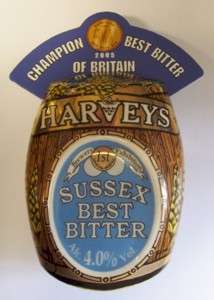
The most popular drink is Harvey’s Bitter, brewed in the town, a beer whose quality was recognised this year when it won the Silver Award at CAMRA’s 2006 Champion Beer of Britain competition. It also won the Gold Award in the Best Bitter category.

Word around the bar is that some 80% or more of the drink sold in the bar is Harveys but Greene-King want to get rid of it. Commercial logic would suggest that if Harvey’s only sold a few pints a week that would be fair enough. But the majority of drinkers in the bar come there for the Harveys and, as a result, make it a successful pub financially.

So what can Greene King’s motive be for banning the home brew? Surely, even if it is another brewer’s product, if its making money for you, what’s the problem. GK are introducing their own ale, called the ‘Lewes Arms’ but they must be delusional if they expect seasoned Harvey’s drinkers to swap over to a lesser brew.

Friends from Cambridge are advising that the Greene King strategy is to get rid of the locals then move in, tart the place up and get a completely new clientele who have no allegiance to the auld brew. They have seen it happen with their ancient locals. Before you know it, they say, there’ll be men wearing crombies at the door and they’ll be serving blue cocktails.

So it may come as a surprise or not, that the trade magazine The Publican is running a national campaign called Proud of Pubs, whose main sponsor is Greene King. More than 1 in 10 MPs from across the parties in the House of Commons, have signed up to a motion backing the trade and the campaign.

In fact Rooney Anand, chief executive of Greene King, told his audience of licensees and MPs at the campaign’s launch in Parliament, that the motion was “a great start” in the battle to put pubs on the front foot and highlight their positive contribution to the nation. “It’s about time society started standing up for pubs, and recognising them as one of our nation’s greatest assets.”

This point was underlined by Fiona Hope, marketing director of Greene King, who said: “The pub and the pint are great institutions that play a positive role in millions of people’s lives.’ The campaign’s website urges readers to pledge allegiance to their local by filling in and submitting a small form. By pledging allegiance in this way, says Fiona Hope, it ‘gives pub-goers a communal voice in support of great pubs and great beer.’

The Lewes Arms already has a communal voice and its saying: ‘So why is Greene King proposing to remove Harveys from the Lewes Arms’. It is an important community pub, full of life and laughter, which serves a great beer that everybody likes – Harveys.

It is clear that, if they continue to insist with this misguided strategy, then a substantial number of our little community will be scattered to the winds and the welcoming arms of other establishments around the town. Does this matter? It matters if you believe all the values that Greene King say they aspire to.

Fiona again: “We want to show the wider world that it’s not just the pub industry that values pubs and beers. It’s the millions of people who visit pubs for great company, quality food and excellent beer. People who care about their local.”

We are some of the people who care about our local and hope to hold Greene King to the high values that they claim to espouse. They can demonstrate this by leaving the Lewes Arms and its Harvey’s alone.

To take the argument one step further. There is another national campaign called Local Works, backed by more than 80 national organisations – including the Campaign for Real Ale (CAMRA) and the Society of Independent Brewers (SIBA) – which is a lobbying for the introduction of a Sustainable Communities Bill.

‘If the bill becomes law, writes Daniel Pearce in The Publican, it will set up a process where local communities will have more decision-making power over local issues and the government will be required to help reverse ‘Ghost Town Britain.’

Roy Bailey, who is leading the campaign, says such a bill will put pressure on pub companies to do more to ensure local beers find their way into local pubs.

SIBA director Nick Stafford told The Publican : “There’s already a consensus that the pub is the hub of the community. What better support can the pub get from its local brewer? It’s got to be a priority for every brewer to help its local pub by providing it with quality beer, at a reasonable price.” Harveys is already doing this and should be allowed to continue.

We are familiar with the concept of ‘food miles’ so now we should be talking about ‘beer miles.’ Local beer in local pubs means less lorries and tankers on the road and less damaging greenhouse gases.

Incidentally, has Greene King got an environmental policy. Perhaps it could use its considerable energy and expertise to commit to making the lighting in all its pubs energy efficient and ensure that beer is delivered the shortest distance from source to mouth. The corporate colour is Green but one suspects the company is a long way from fulfilling its social obligation in this regard.

It summary, it seems that Greene King, like many other large corporates, has a public face which claims to be supporting the very values that they are actually intent on destroying.

Recent reviews of the Lewes Arms from www.beerintheevening.com

Beware!! It is strongly rumoured down here in Lewes that Greene King are trying to remove Harvey's from the six remaining former Beard's pubs which they own. This, the Wellington in Seaford and the Red Lion in Bromley are three of them - I don't know which the other three are. There has been a petition going in the Lewes Arms. If one of these pubs is your local and you want Harvey's to remain, you may wish to do the same.

*

The "own brew beer" is almost certainly a beer from the Greene King portfolio rebadged for this pub, but I do not know which one. It is rumoured that the Harvey's in this pub (and other former Beard's pubs) is under threat again. Greene King should realise that if they can't get Harvey's here, many people will go elsewhere to get it. Not only is it damn good beer, local people are fiercely loyal to their home-town brewery.

*

This is the sort of pub you dream about having as your local. After many years of dreaming, it now is. Despite being a Greene King tied house, it still serves Harvey's Best although this winter there is, alas, no Old. Nice atmosphere (even in the front bar - we don't bite, you know!). Come on a Sunday afternoon and you may well get press-ganged into one of the crazy competitions they occasionally hold, such as pea-throwing or paper aeroplanes. A real community pub.

*

This is a fabulous pub. It is everything a pub should be - very friendly punters, good beer, a relaxing place to be. It has three separate rooms, including an intimate front bar. A great place to play chess as well! Although it is a Greene King pub, Harvey's is still served from its days as a Beards house because the regulars prefer it! I thoroughly recommend this pub for the great beer and people.

Saturday, September 30, 2006

EARTHED; THE NEW ENERGY REVOLUTION

Back in the early 1990s, the tremors of an ‘industrial revolution’ were beginning to reverberate around the globe. The digital technology tsunami subsequently swept all before it, transforming our world irrevocably.

Within ten short years, we were a society unalterably linked in new ways, connected globally by the internet, by wireless and broadband links, by billions of mobile phones. We are still trying to come in terms with the realities and implications of this seismic occurrence.

Brace yourselves! There’s a new ‘industrial revolution’ which is going to have equally powerful transformative effects on our lives.

The New Energy Revolution is about shifting our societies from our dependence on fossil fuels (oil, coal and gas), on nuclear power, on huge centralised energy generating systems, feeding power down a massive national grid, to a world that runs largely on renewable and sustainable energy sources, where energy is produced, above all, close to where it is needed via a new kind of ‘energy internet’ built up of a huge number of localised and micro-power sources, shaped to local and regional needs.

Computing became personalised and localised in the same way. The age of the centralised mainframes gave way to a distributed network of personal computers. The same is about to happen with energy. We understand the notion of ‘food miles’ so now think ‘energy miles.’

All good industrial revolutions need ‘drivers’: unstoppable forces, great sweeping tides of history coinciding with a wave of fresh technologies coming on-stream at the same time.

The biggest driver of all is climate change. Now David Attenborough says its happening we can all believe in it. No-one knows the full implications; some believe we’re already doomed. Scenarios range from the uncomfortable to the catastrophic. Our human societies are creating this crisis through their profligate use of energy. Even children know that now.

To meet this threat, governments around the world and at every level, have been peering into the energy future – and it looks fairly scary.

Strategically, it is not a good idea to be largely dependent on imported oil and gas and, also, not a good idea to be using it in the first place.

We have to make a shift, in our thinking and our actions. Mayors of the world’s cities know that best of all as cities are at the sharp end of this transformation. This is why they are moving faster than states and states are moving faster than countries towards a new energy future.

The pace and pressure is increasing as more and more legislation – from Kyoto on down – EU, National, Local – comes to bear on the situation.

Business will be forced to conform to some rigid efficiency/low carbon guidelines; this will prove to be cost-effective and introduce a whole new perspective on corporate activities.

At present, the most visible business activity is on large-scale projects but it is on a micropower level that things will really shift dramatically.

All houses and buildings will be forced to do an annual energy rating. Legislation will be streamlined to allow much greater flexibility for home owners to install wind and solar alongside water-saving technology. Insulation, double-glazing, energy efficient light bulbs will all be part of the national make-over. All new build will be required to include a certain percentage of renewable energy in the project.

This will stimulate a huge gadget/DIY market that will be eagerly seized upon by the big chains; in addition, a thousand small-scale entrepreneurial flowers will bloom on the net.

We are all going to have to change or modify our cars: voluntarily or by legislation. There are signs of movement within the global car market towards the concept of green motoring – through the success of the Prius. Oil price rises will stimulate the market. More and more of us will return to the bike.

We’re going to have to fly less. Governments need to pressure the airlines to show some significant movement towards these goals. The public will become more aware than ever of the damage being caused to the atmosphere by human flight.

This is how this new energy revolution is going to express itself in our lives. The major component parts of that future: energy efficiency/carbon control; the development of renewable/sustainable energy industries; the transformation of our buildings and transport.

We are not going to escape our addiction to fossil fuels that easily but through these initiatives, we can imagine how the new energy revolution is going to transform our societies over the next 5-15-year period.

This shift in perspective and reality is going to be driven by the need to save and conserve energy at every level (oil and gas prices are never going to go down again) and the need to transform our buildings and our transport.

Britain is ideally suited to such a shift – an island nation with an important engineering heritage. We have remarkable natural resources which we are not employing. A shift of the kind envisaged means that we can play a major role globally by putting ourselves at the forefront of many of the major industries of the future.

This will, in turn, create immense economic and employment possibilities, and represents a new hope and future for our young people who will be inheriting the planet that the older generation will leave behind them.

Our embrace of this new vision will signal to the rest of the world our willingness and openness to change and offer us immense opportunities to export this experience and these technologies around the world to the benefit of all.


[This document was written as a proposal to a major mainstream supplement on the 31st June 2006. I have been thinking about this issue ever since I met Amory Lovins in 1996, have presented it in various forms over the intervening years to publishers, financiers, entrepeneurs - and the back bar of the Lewes Arms. Its now kicking off.]

Previous Postings:

Earthed: Amory Lovins
Earthed: Amory Lovins 2
Earthed: The New Industrial Revolution

EARTHED: THE RETAIL REVOLUTION


This is Sharp's first solar module manufacturing plant in Europe, opened in 2004 and based in Wrexham, North Wales. The facility assembles monocrystalline and polycrystalline solar modules for residential and commercial installations. Sharp claim to be the global leader in solar cell production, with more than 45 years' experience in the industry. With installations as diverse as satellites, commercial, public and residential buildings, over a quarter of solar modules installed worldwide are manufactured by Sharp. In 2005, Sharp’s annual production capacity increased to 428 megawatts. With a current market share of 26 per cent, Sharp has been the worldwide leader in production of solar cells for six years. [Information from company press release: Sharp Electronics (UK) Ltd]

Micropower generation by home owners is set to take off in a major way - and the High Street is gearing up for it.

One month ago, Curry's became the first major retailer on the British high street to offer a range of solar panels to the home customer. The panels, produced by Sharp Electronics – who claim to be the world’s leading solar panel manufacturer - are now on sale in just three Currys stores (West Thurrock, Fulham and Croydon) but are also available on-line. Currys is Britain’s biggest electrical retailer with a network of more than 550 stores nationwide.

According to the Sharp press release: ‘After a detailed in-store consultation with a trained adviser, customers with suitable houses will be offered a home assessment free of charge. Should the house be capable of supporting the technology – and most are – installation of the solar panels on the property roof takes just one or two days and requires a minimum of equipment to be installed, usually in the roof space.’

They claim the cost for an installation of nine solar panels (enough to cover approximately half of a household’s electricity requirements on an average three bedroom house) is approximately £9,000. ‘Customers opting for solar power can expect to reduce their electricity bill by up to 50% and could cut down their home’s carbon dioxide emissions by up to two tons per year. Panels come with a performance warranty of 25 years, and minimum maintenance is required by the customer.’

Sharp claim that customers who install their panels can expect a potential increase to the value of their property and poaint out that grants are available through the Low Carbon Buildings Programme. www.lowcarbonbuildings.org.uk/home/ and www.est.org.uk/myhome/generating/application/

Then, on 28th September, the DIY chain B&Q announced that, from October, they will be selling wind turbines and solar panels in every one of their 320 UK stores.

According to The Guardian, the turbines will cost £1,498 - a price that includes a home survey, help with applying for planning permission and installation. Its staff will also help customers apply for grants from the Energy Saving Trust - which can cover 30% of the cost of the turbine.

The turbine are 1.75m wide and 2m tall and will generate 1kw of electricity directly into a ring main. They may not suit every home. Home owners will also get advice as to whether their property is structurally suitable and/or whether it is located in an area too sheltered from the wind to make wind power economical.

Unlike the Curry's solar panels - designed to generate electricity - the one's sold by B&Q will heat water using daylight, providing enough for half the average family's needs. They are priced as follows: Single unit (£1,798); two-panel unit (£1,498); three-panel unit (£2,498).

Monday, September 25, 2006

EARTHED: BIOFUELS & BRANSON


Richard Branson has recently been doing what he does best - capturing world headlines - with his very public committment to pledge all his profits from Virgin's rail and air businesses - an estimated $3bn (1.6bn) - to combat climate change. What seems on the surface a magnanimous gesture is, in fact, just another business opportunity for Branson - all the money will go into Virgin Fuels, his new renewable energy business.

Virgin Fuels business will invest up to 400 million US dollars (£214 million) in renewable energy initiatives over the next three years. Their first investment came this September - $60m into Cilion, a California-based venture that plans to make bioethanol from corn and to construct seven refineries by 2009. Virgin Trains are switching their diesel-power trains to run on biodiesel.

According to a BBC report 'Branson's Grand Power Strategy' (22nd Sept 2006), Virgin Fuels' ambitions stretch across the entire power-generation sector. 'The company talks of investing in more ventures like Californian firm Cilion...Wave power and wind farms are on the agenda, so is nuclear power. Virgin Group director Will Whitehorn said that 'Virgin Fuels has been carefully positioned to bridge the gap between environmental rhetoric and commercial reality.'

The article concludes: 'After the fuel bill for his Virgin Atlantic airline grew by £300m over two years [Branson] spoke of wanting to build a new oil refinery to reduce world prices. At that time, in late 2005, the fuel bill for both Virgin Atlantic and Virgin Express airlines was running to £750m a year, Sir Richard said. It seems there is a compelling commercial logic behind Sir Richard's drive for new fuels.'

According to 'Green virgins in outer space' byJean Mahony (New Statesman 15th May 2006): 'Virgin's four airlines consume more than 2.6 billion litres of standard jet fuel every year; naturally, the Group thinks the government should "urgently address" the possibility of a biofuel mix for commercial flights. At present, the aviation industry generates almost as much carbon dioxide every year as all human activities in Africa. However, Virgin's public commitment to the environment is only part of the story: ethanol, unlike oil, is relatively cheap to produce, and is not subject to the whims of Russia or Opec.

'In November 2005, Richard Branson told reporters that he hoped "some or all" of Virgin's jet fuel would be replaced with ethanol "over the next five to six years". To date the European Aviation Safety Agency has not received any requests to certify the technology that would allow for a biofuel blend on commercial flights, and aircraft coming on-stream now have lifespans of up to 50 years. Even if the technology were widely available, regulatory authorities would have to be satisfied that the characteristics which make pure ethanol an unsatisfactory choice for jet engines - its propensity to thicken at low temperatures, its low flashpoint, its low energy density and its release of dangerous gases at low power settings - are adequately addressed.

'It seems that even Branson's enthusiasm for the fuel has been tempered: in January 2006 he told Fortune magazine that he was not sure if ethanol "will ever do it" for jet aeroplanes. However, habitual confidence undimmed, he went on to predict that if we could run all land-based transport on cellulosic ethanol and leave aeroplanes to burn petroleum-based fuel, "issues like global warming will be fixed".'

UPDATE: 'Support for Branson plea to clean up skies is slow to get off the ground' - Dan Milmo [The Guardian 28 Sep 2006]

There's an interesting discussion on biodiesel airplanes at Treehugger

According to an Associated Press story 'Researchers Seek Alternative Jet Fuel' (June 20, 2006): 'Government and corporate researchers are looking into ways to power commercial jet engines with alternative fuels, although many caution that widespread use could be years or even decades away. Scientists face myriad obstacles, including the difficulty of producing, transporting and using massive amounts of these fuels under harsh conditions such as extreme cold. And for now at least, experts say many alternative jet fuels are more expensive than traditional ones. "It's just so much easier to develop a fuel for automobile applications than for airplane applications," said Billy Glover, director of environmental performance for Boeing Co.'


In his essay 'Biofuels: Green energy or grim reaper?' Jeffrey A McNeely, chief scientist of IUCN, the World Conservation Union, explains why many people are calling biofuels - made by producing ethanol, an alcohol fuel made from maize, sugar cane, or other plant matter - 'deforestation diesel'. Consider the following:

* The grain required to fill the petrol tank of a Range Rover with ethanol is sufficient to feed one person per year. Assuming the petrol tank is refilled every two weeks, the amount of grain required would feed a hungry African village for a year

* Much of the fuel that Europeans use will be imported from Brazil, where the Amazon is being burned to plant more sugar and soybeans, and Southeast Asia, where oil palm plantations are destroying the rainforest habitat of orangutans and many other species.

* If ethanol is imported from the US, it will likely come from maize, which uses fossil fuels at every stage in the production process, from cultivation using fertilisers and tractors to processing and transportation. Growing maize appears to use 30% more energy than the finished fuel produces, and leaves eroded soils and polluted waters behind

* To meet the EU's proposed biofuel target of 5.75% would require, according to one authoritative study, a quarter of the EU's arable land

* Using ethanol rather than petrol reduces total emissions of carbon dioxide by only about 13% because of the pollution caused by the production process, and because ethanol gets only about 70% of the mileage of petrol.

McNeely concludes: 'The bottom line is that biofuels can contribute to energy and environmental goals only as part of an overall strategy that includes energy conservation, a diversity of sustainable energy sources, greater efficiency in production and transport, and careful management of ethanol production.'

According to Thomas L. Friedman in an Op-Ed piece entitled 'Dumb as we wanna be' in the New York Times (20th Sept 2006), the US has imposed a 54-cents-a-gallon tariff to prevent Americans from importing sugar ethanaol from Brazil, due to pressure from Midwest farmers and agribusinesses. Brazilian sugar ethanol provides eight times the energy of the fossil fuel used to make it; American corn ethanol provides only 1.3 times the energy of the fossil fuel used to make it. He claims that sugar cane can't be grown in much of the Amazon because it is too wet but that Brazil's planned expansion of sugar cane acreage from 15 to 25 million acres over the next few years will threaten the cerrado, the species-rich Brazilian savannah.

EARTHED: GREEN CAR GUIDE


The new BMW Hydrogen 7, the world’s first hydrogen-powered luxury performance car. Destined to make its first public appearance at the Los Angeles Motor Show in November, the Hydrogen 7 is a production-ready car to be built in limited numbers – just 100 initially - and offered to select users in 2007.


Carbon dioxide emissions from cars account for less than 13 per cent of man-made CO2 in Britain, compared to 36.9 per cent for the energy industry and 15.7 per cent from residential sites, according to DEFRA.

The UK motor industry's seventh annual sustainability report (see www.smmt.co.uk), published on 18th September, claims that, in the period 2001-2005, UK vehicle makers have cut energy use, waste and CO2 emissions by half in four years.

End of the SUV?: Ford has finally predicted the fall of the SUV, a vehicle that has supported the company’s finances for decades. SUV sales have been falling month by month with a speed that Ford’s chief sales analyst describes as “pretty eye-popping”. As consumers abandon SUVs and light trucks in favour of smaller cars, the big three US automakers, General Motors, Ford and Daimler-Chrysler, are having to take a hard look at their own product lines. Ford announced in early June that it would produce 58,000 fewer trucks in the next quarter than it had in the same period last year – but 40,000 more cars. Meanwhile Chrysler’s senior vice-president of sales, Gary Dilts, has told the Washington Post that his company plans to ‘dial up’ the fuel-efficiency message, with TV ads highlighting how many miles per gallon you can get in its more compact cars.
As Detroit hits problems, the main beneficiaries of the new trend are the Japanese. Toyota and Honda are seeing their pioneering investments in fuel-efficient compact cars and petrol-electric hybrids start to pay big dividends. Toyota is on the verge of overtaking GM as the world’s largest vehicle manufacturer.

This information and much more can be found on an excellent new website: http://www.green-car-guide.com

For a special report in What Car? the magazine hired Britain's foremost fuel economy expert, Peter de Nayer, to carry out independent tests on 85 best-selling cars. He found that the average discrepancy between economy claims and real-world driving was 8%.The worst offender was the Toyota Prius. On paper, it is supposed to average 65.7mpg, but when tested, it averaged 52.0mpg - 13.7mpg less.

According to: 'This new breed of car is electrifying' The Guardian/September 23, 2006:
'Fully electric models are starting to have an impact - from city runarounds like the G-Wiz (www. goingreen.co.uk) and new Sakura Maranello4 (www.sbsbsb.com) to the dashing Tesla Roadster (www. teslamotors.com), with its eyebrow-raising 130mph top speed and 0-60 in four seconds. Aside from the need to recharge, which can take some time, critics say electric cars are difficult because they just shift the source of pollution back to the electricity generating plant. But Tesla plans to deal with this by selling solar panels for your house with its cars, so you can offset your consumption that way. An ideal solution would be if the electric car itself could be recharged via a solar-powered fuelling station. A study by the Institute for Lifecycle Environmental Assessment has determined that a car powered this way would be far and away the cleanest of all current possibilities.


Car Plus is a charity promoting car clubs and car sharing in the UK

Britain's road-building bill has spiralled out of control and could be £1bn more than predicted because the Highways Agency has lost its grip on the rising costs, according to a report from the Commons Transport Committee. It says: 'The Highways Agency has lost budgetary control of the Targeted Programme of Improvements (TPI). If overruns continue at the current rate, the cost of yet-to-be-completed TPI road projects would be 50 per cent higher than originally estimated. Such an increase would be an irresponsible and unacceptable waste of public money. This is a very serious matter, and Mr Robertson, as Agency Chief Executive, must take personal responsibility for ensuring that an increase of this magnitude does not occur. We wish to know how that will be achieved.' According to Road Block: 'In the recently published Highways Agency Business Plan it was revealed that their road building budget had been increased from £589 million in 2005-6 to £1046 million in 2006-7 - almost doubling. They have stolen the money from the Managing Traffic and Improving Technology budgets.'

The Commission for Global Road Safety claims that more than 3,000 people die daily in road crashes worldwide. There are 1.2 million deaths and 50 million injuries on the roads every year. Experts forecast a 65% surge in fatalities by 2020. Road accidents claim more lives in the world's poorest countries than malaria and tuberculosis. Africa has the highest road mortality rate of any continent, with 28 deaths for every 100,000 people. (Britain's rate is 5 per 100,000). The Commission believe road deaths should be treated as a global disease and are calling on the G8 to support a $300m plan to tackle the problem.

And finally: Check out the story of the ENV - the world's first purpose-built fuel cell motorcycle.

EARTHED: E-WASTE


A huge pile of computer keyboards at a waste dump in China. It is cheaper for companies to dump hazardous e-waste in China than implementing a proper product recycling network.

* Some 20-50 million tonnes of electronic waste are generated globally every year; Asia alone discards an estimated 12 million tonnes each year

* E-waste now makes up five percent of all municipal solid waste worldwide, nearly the same amount as all plastic packaging. E-waste is much more hazardous.

* E-waste is now the fastest growing component of the municipal solid waste stream because people are upgrading their mobile phones, computers, televisions, audio equipment and printers more frequently than ever before. Mobile phones and computers are causing the biggest problem because they are replaced most often.

* In Europe e-waste is increasing at three to five percent a year, almost three times faster than the total waste stream. Developing countries are also expected to triple their e-waste production over the next five years.

* The average lifespan of computers in developed countries has dropped from six years in 1997 to just two years in 2005. Mobile phones have a lifecycle of less than two years in developed countries.

* 183 million computers were sold worldwide in 2004 - 11.6 percent more than in 2003. 674 million mobile phones were sold worldwide in 2004 - 30 percent more than in 2003.

* By 2010, there will be 716 million new computers in use. There will be 178 million new computer users in China, 80 million new users in India.

These facts and figures come from a detailed study by Greenpeace International, who are running a toxic campaign against e-waste. Check out their Green Electronics Guide, which ranks leading mobile and PC manufacturers on their global policies and practice on eliminating harmful chemicals and on taking responsibility for their products once they are discarded by consumers. Companies are ranked solely on information that is publicly available.

Tuesday, September 12, 2006

9/11 REVISITED


Ever since my previous post, have been thinking and reading about 9/11. Having trawled and cogitated at length, here is what I recommend:

Wikipedia has come into it own on this. It has its critics but the following make extremely good starting points for understanding why there is a substantial number of people in the US who disagree with the official version of events.

Sept11, 2001 Attacks
An account of the official sequence of events and subsequent aftermath

9/11 Commission Report
This provides a brief summary of the official report and provides a download link to get a pdf of the whole thing. It highlights key facts, carries a summary of major articles and lists substantial criticisms on the report.

9/11 Conspiracy Theories
This examines the subject in exhaustive detail and lists the major topics/questions put forward
by networks of different groups and individuals who do not believe the 'oficial truth.' Includes extensive links.

The conspiracy theorist community broadly divides itself between people who believe that Bush's government Let it Happen On Purpose (LHOPs) and those who believe that Bush's government Made it Happen on Purpose (MHOPs).

Researchers Questioning the Official account of 9/11
Short profiles of some of the most prominent members of this community

Much coverage has been given to Scholars for 9/11 Truth
Wikipedia entry lists every member and really explains who they are - and their credentials.

Books

I recomend 'The 5 Unanswered Questions About 9/11' by James Ridgeway [Seven Stories Press]. Ridgeway, Washington correspondent for the Village Voice, does not believe the government or the conspiracy but he does believe that someone, somewhere should be held accountable. His unanswered questions are:

1. Why Couldn't We Stop an Atttack from the Skies: How the Airlines and the FAA Resisted Air Security Measures That Might Have saved Lives.

2. Why Didn't the Government Protect Us?: How the United States Government Failed Its Citizens Before, During, and After 9/11.

3. Why Didn't We Know What Was Coming?: How Business as usual at the FBI and the CIA Helped Leave the Way Clear for the Attacks

4. Did US Allies Help Make the Attacks Possible?: How Pakistan, Saudi Arabia and US Foreign Policy Contributed to the Events of 9/11

5. Why Couldn't the 9/11 Comission Get to the Truth?: How the Report protects the System at the Expense of the Public.

There's a lot of good journalistic research here, original interviews, and a clear writing style. One is left with a deeper appreciation of the whole - and a lot of questions, many of them quite disturbing. The spirit of Tom Paine is in his writing and in his passion for the truth.

Being a sucker for graphic novels, I also bought 'The Illustrated 9/11 Commission Report: A Graphic Adaptation' by Sid Jacobsen & Ernie Colon. Interesting to look at after reading Ridgway. The book as a whole has a weird feeling about, like it came out of a Phillip K. Dick novel.

Read Martin Amis' lengthy essay in The Guardian: The Age of Horrorism

Also Tariq Ali's review of 'The Looming Tower: Al-Qaeda's Road to 9/11' by Lawrence Wright

UPDATE: Thanks to Gordon for link to Project Censored: Unanswered Questions of 9/11

Saturday, September 02, 2006

ALTERNATIVE SOCIETY 1970s: BIT by bit

One of the many delights of doing THE GENERALIST is all the connections it enables us to make. Following my previous post on ‘An Index of Possibilities’ [see Nikola Tesla], received the following e-mail from Anthony I.P. Owen who has been living in Casablanca for the last two years.

Excuse me mailing you, but I came across your name (and blog) when googling 'Index of Possibilities' - a copy of which I still refer to and (internet notwithstanding) is still a mine of interesting and accessible information. IoP is still valued and used (it turned me on to Tesla, still an interest), thirty odd years after the event. All your sweat and toil is still appreciated!! I look forward to hearing more about the Index. It really was the concept of the Web before the internet existed....being too soon can be just as frustrating as being too late .

I was googling 'IoP' in the hope of finding any sites referring to the 'BIT' group which was operating around West London around the same time as IoP. I used to hang around their offices as a teenager 'up from the country'. I journeyed to India with one of their travel guides as sole reference and look back on them fondly. Do you know of any websites detailing them (or any of the other myriad of 'alternative' organisations which seemed to flourish then in West London especially, due to the accessibility of IBM typesetting and offset litho - a sort of worldwide paper web.

Thus began our correspondence, whioch has led in many interesting directions. Here is Anthony’s second message

I've done some searching through some boxes which have been following me around the world for a few years unopened and managed to find a 1981 edition of the India Guide (scan of cover enclosed). By this time it was being edited by Geoff Crowther and published by Ian Robb King under the 'Magic Ink Travel Club' imprint, based in Margate (I have a slight memory that Ian was in a wheelchair? I can't remember ever meeting him, so that was maybe from correspondence.). 1981 would have been my second or third trip to India and I imagine that I got the guide mail order - in fact I am sure I did. How I found the address I have no idea!. The first time I headed east - 1975-76 - I remember that I did go up to the BIT office a day or so before I left. They didn't have any finished guides, the pages were printed but not the cover and they had not been bound but they let me have a copy unbound (just a collection of pages) in a plastic bag. That travelled with me for many months, but disappeared many years ago.

Anyway, this is probably more than you ever wanted to know about the BIT travel guides and it shows how relaxed it is here that I have the time to get it together. I guess if I was serious I would edit down the BIT history from the introduction and post it on Wikipedia (a sort of co-operative BIT guide to everything in the world?) and see if there is any response.

As said in my first mail I was very much a 'consumer' of the West London scene, bunking off school in the afternoons, hitching up the M4 and spending the afternoons hanging around squats, underground papers.....all the mayhem - and the memories are dim through the smoke!! Who knows all who passed through BIT's portals and what effect it had on them

In his third mailing Anthony writes:

Another memory: BIT used to give out 'unofficial' international student cards as a 'service to travellers and others' (they were good for getting discounts and visas if your passport said 'student'). They were green and black with a photograph and whichever stamp happened to be on the desk at the time. It fooled everyone from Calais to Katmandu!

I've searched all the UK Free Festival sites I can find but no references to BIT at all, though they were certainly involved. I am just amazed that there seems to be so little information available, especially online as I would have thought that the sort of people who got BIT together, and hung around their offices, would be just the sort of people who would have taken to the Net. This piece of history should be better known!

So as a contribution to this end, here are a number of related posts.

Having hung out in Ladbroke Grove myself during the early 1970s, working on the underground newspaper Frendz, I knew the BIT Information offices well and one of its most energetic activists Nicholas Albery. Also involved was his friend Nicholas Saunders, author of an important publication of the time ‘Alternative London.’ Sadly both died around the turn of the millennium in separate car crashes within two years of each other. Happily their legacy lives on.

What follows is: 1) The introduction to the aforementioned BIT travel Guide (courtesy of Anthony). 2) A piece on another publication, the BIT Arts Lab Newsletter, which I unearthed in the HQINFO Archives. 3) An appreciation of the two Nicholas’s. Hopefully this will trigger other memories and material which we would be grateful to receive.

Thursday, August 31, 2006

ALTERNATIVE SOCIETY 1970s: BIT Travel Guide


The cover and introduction of the
BIT travel guide

The first "edition" of this guide, which became known as the "Bible of the East”, saw the grey light of dawn back in 1970 as one of BIT Information & Help Service's free hand-outs. Put together by Nicholas Albery and Ian King as a result of endless requests for information from intending travellers, it consisted of half a dozen or so duplicated foolscap sheets stapled together with one staple and no cover. Yet so successful was it, in the absence of any other source of grass-roots information, that BIT was soon receiving an average of six letters per week from travellers all along the route.

These letters, with their valuable up-to-date information, formed the basis of the rapid succession of up-dates and expansions which the guide went through over the next two years. By the time I arrived at BIT to write the ‘72 edition it had grown to such a size that the cost of putting it together demanded that BIT charge a "minimum donation" of £0.50 per copy. We thought at first that having to make a "donation" would put people off. Quite the opposite. So eager were people to get hold of a copy that they regularly left double what was asked in order to support BIT's activities.

Arriving at BIT to write my first edition I was confronted with over 200 letters from travellers which had accumulated in the overflowing files, the scruffiest "office" I’d ever seen before - or since, several sleeping bags full of snoring human beings on the floor, an arthritic IBM electric typewriter which frequently threw fits and the sound of night-shift worker Jimmy Red's inimical style of guitar drifting up from the room below.

It seemed an impossible task but three weeks later it was ready — all 100 pages of it, double- sided. Nicholas and I spent the next 48 hours drinking wine and smoking mushrooms non-stop while we churned out a thousand copies of the new guide on the second-hand manually-operated duplicating machine. Though it was necessary to hike the "minimum donation" to an unprecedented £1 per copy, it was a phenomenal success and competed with Nepalese Temple Balls as the most sought-after commodity on The Road to Kathmandu. The money from the guides was ploughed back into supporting BIT's activities.

What was BIT? No-one will ever succeed in defining what BIT was if only because it refused to be confined by any definitions but Rick Crust once made a brave attempt. He wrote of it:. "We know this guide costs lot of money and you really can’t afford it but we gotta get money from somewhere and this guide is our main source of income. We 're open every day of the year from 10am to 10pm (telephone 24 hours) and we give free help and information about anything to anyone who wants it. Dirty, untidy office; friendly, sometimes exuberant atmosphere, inefficient staff, confused clientele, aggressive cat. Free information, free bogs, free bath. free duplicator and typewriter, free kittens and puppies, free clothes, free food — cheap at other times but free if you're really starving, free people to talk to, free alternative library, free day-room to freak out in or sleep in, free crashpad, lots of other free floor space depending on the season, free optimism, free ecstasy, free lots of other things plus expensive travel guides to pay for it all."

More specifically, it was a constantly changing collection of drop-outs, misfits, visionaries, deviants, information freaks, students, runaways, travellers, electronics whizz-kids and even "normal" people from all over the world, none of whom were paid and many of whom worked all hours God sent. Apart from social welfare, info on jobs, housing, squatting, social security, the law and health, BIT could also supply information on anything from geodesic domes and herbal remedies to how to mend your bike when you got stuck on the Yorkshire Moors. It would even mend your television set for you.

Some of the babies which it nurtured through to independence included the Commune Movement, COPE (an anti-psychiatry info and help service for mental patients and people suffering from mental problems, run by ex-patients), the Arts Labs Newsletter and CLAP ("Community Levy for Alternative Projects" which raised over £30,000 for radical and imaginative projects throughout Britain by asking readers of a regularly published list of projects needing money to give 1% of their income to the projects of their choice. Successful projects were asked to do the same though few ever did).

For none of this work did it ever receive any financial support from government authorities nor did it want such strings-attached grants. It was occasionally given £500 or £1,000 by a rock star (Paul McCartney & Pete Townsend in particular) or by a charitable trust but for its main income it was forced to rely on the travel guides. It's bills were enormous – always.


Back to the guides. By 1974, when I came to work full-time at BIT, the India guide was generating an incredible average of twelve letters per week. The task of getting all that extra information into the guide was beginning to occupy 25 hours a day but it wasn’t that which forced a change of format. By early 1975, it had grown to over 200 foolscap pages still stapled together with one staple and no cover. It weighed a ton and was so bulky we began to doubt whether there would be room in a traveller's rucksack for anything other than the guide.


Also, in order to keep up with demand, we'd worn out two duplicating machines and were entirely reliant on the gullibility of successive IBM or Gestetner representatives who we could persuade to deliver us a new machine for a couple of days "on trial". No machines in the history of technology have ever been subjected to such a rigorous "trial". In the short time they were left with us, we managed, one way or another, to coax well over half a million sheets out of them. But that was only the start of the work since then the sheets had to be collated - by hand. The donkey's back was about to break so, after several stormy meetings of the collective we decided to go into print after I’d re-written and up-dated the whole thing.


In mid-1975 I set out to do this against impossible odds. The odds included a pirate radio station which broadcast from the room next door and frequently attracted posses of axe-wielding Metropolitan police bent on destroying everything in sight; bus-loads of travellers constantly banging on the door in search of up-to-the-minute information on everywhere from Istanbul to Port Moresby, some of whom brought me a little something to smoke (bless them!); a friend who daily needed an ear to pour stories into and who would march me off to the pub by lunch-time and leave me incapable of doing anything by mid-afternoon, and, of course, the demands of doing shift-work at BIT. Remarkably, it was ready within six weeks though we weren’t too sure what the printer would think of the copy as it was done on the same arthritic IBM electric I’d struggled with three years ago and which had become even more cantankerous with advancing age. Nevertheless, Ian King, our printer, did a beautiful job. I retired to the country for half a year exhausted.

The new guide was even more of a success than the old though because of increased costs we had to hike the "minimum donation" to a swingeing £2 plus 10% "CLAP Tax" (CLAP - Community Levy for Alternative Projects). It was about this time that many other guides to the England - India - Australia route started to appear. They varied from good to garbage and many of them were thinly disguised rip-offs of the BIT guide. We even got one letter from a nasty piece of work in California enclosing $25 and saying thanks for the information, he was going to print and sell it himself. But there were other, constructive, developments which BIT supported such as the Italian translation which was brought out by "Stampa Altemativa" — Italy's equivalent of "International Times".

By early '77 another vast pile of travellers’ letters had accumulated and I put them together in a separate up-date section which we stapled into the main guide. After that I lost touch with BIT for a while and went to South America for a year with the intention of writing a guide to that area of the world ("South America on a Shoestring", Lonely Planet, Jan. '80, pp 442, £3.95, available from Magic Ink).

When I got back, BIT was in dire straights and teetering towards the edge of the precipice having been taken over by a bunch of petty crooks, speed freaks, rip-off artists, winos and cider freaks. It was a sight for suppurating eyes. A short while later, from the end of '79 and early 1980 it finally folded, after receiving the most outrageous telephone bill you can imagine. But the idea didn't die and the files are still intact.

On hearing of this, Ian (our printer) and I, unwilling to see the guides die after all that effort by the thousands of travellers who've written in over the years and are still writing in - keep those pens busy, please! - decided to take over the running of the guides. So keep those letters flowing This guide is only as good as the letters which we receive from you. It’s you who have made it into what it is and only you who can keep it that way - that is, up- to-date and containing the sort of information you want to find in it. There are plenty of other guides to this route available but they're all one-person affairs and none of them have anywhere near the same volume of feedback as the BIT guide and so rapidly go out of date. Feedback is what keeps it alive and always has. If the day ever arrives when it ceases to be a mirror of traveller's experiences and an exchange of information then we’ll lay it down to rest and leave you in the hands of the strictly commercial boys.

Meanwhile here is the latest completely re-written and up-dated BIT guide. Unlike all the previous editions which have been dragged screaming from various seedy West London basements on the crest of eviction orders, this one was put together in a semi-derelict, Morning Glory-covered, former banana shed in the depths of the rain forest in northern New South Wales, Australia. This time it’s taken three months to put together but then it is twice the size and, as there's no electricity here and half of every day is spent keeping lantana, groundsel, leeches, land mullets and 6ft-plus pythons at bay, it's not altogether surprising.

Geoff Crowther (Editor)

Australia.

March 1980.


ALTERNATIVE SOCIETY 1970s: Arts Labs

The HQ INFO archive contains Issue 1 of the Arts Lab Newsletter, produced by BIT Information Service (then resident at 141 Westbourne Park Road) in October 1969. It begians as follows:

THE ARTS LAB MOVEMENT 1970 Vision: May 150 Labs bloom!

1969 Facts; 54 Labs: just under a dozen fully-fledged ones in Britain - about a dozen and a half Labs without permanent premises but nevertheless active - and well over two dozen Labs at an early stage, sometimes no more than a nucleus of people meeting and planning their first benefit concert.

NOW WHAT IS AN ARTS LAB ANYWAY?

Jim Haynes of the Drury Lane Lab tells it like it is: "I feel that an Arts Lab has the following characteristics:

(a) a Lab is an 'ENERGY CENTRE' where anything can happen depending upon the needs of the people running each individual Lab and the characteristics of the building.

(b) a Lab is a NON-INSTITUTION. We all know what a hospital, theatre, police station and other institutions have in the way of boundaries, but a Lab's boundaries should be limitless.

(c) Within each Lab a space should be used in a loose fluid MULTI-PURPOSE way - ie. a theatre can be a restaurant, a gallery, a bedroom, a studio, etc. etc.

(d) I am interested in creating a fluid COMMUNE situation where a group of people live and work together. At the Covent Garden Lab we have 15 to 20 people who live and work together 7 days a week. No one is paid - "from each according to his abilities, to each according to his needs"- We have space, food, ideas, work, etc.

Now may I say something about politics. People ask me if the Arts Lab is political. Anyone who is interested in changing anyone's attitude to anything is committing a political act. We at the Covent Garden Lab have certain philosophical attitudes to the world, and we hope to show others by word and deed that these political/philosophical attitudes can be transmitted via non-political media. Every person is a medium; use it carefully.

AS FOR ART.. .we are more interested in bringing people together in a real involved way; not very interested in "marketing" art or anything else for that matter".

ARTS LABS SOLIDARITY July 27th, '69; Arts Labs met and divided themselves into 8 regional co-operatives with a co-ordinator for each region. Earlier in the year, Jim had proposed a support system for Labs which he named ‘Arts Labs in Great Britain Trust’. The Trust, launched 5 months ago as a sub-group of a registered charity called Community Development Trust, is administered by a committee of elected Arts Labs representatives and Arts Council observers, and meets every two months in London. Its aim is to help Labs over legal hurdles and in their negotiations with local authorities, and to raise something like £1/2m for Labs from Industry, the Arts Council, Foundations.

My mates and I formed the WORTHING WORKSHOP, which was part of the South-East Arts Lab Co-op and I wrote the following report of our activities, published in this newsletter:

Premises: None permanent at present time. Previous activitiesd held in hired pub room and common room of local college of design (via 'Student's Union') - liason with bureaucratic hierarchy minimal. Also St John's Ambulance HQ at times.

Technical and other facilities: Silk-screen press just started; light show (Crystalline Foetus, presented by Ian) - liquids, film and static slides; electronics expert - designs and builds group and hi-fi maps and speakers, light equipment etc,; Discotheque - equipment and approx. 200 records plus regular DJ, sundry Musicians, artists etc.

About 5,000 people turned up for their free concert with Steamhammerr in August and this gave them a great burst of publicity; their name is now down on council list for premises; recently their World's First Bubble-In was on TV.

On Saturday October 19th at 7:30pm at the Norfolk Hotel for only 5/- you would get the Entire Sioux Nation + lightshow and discotheque. Lots of other things happening too.

They are opening a head shop soon, one half newspapers and jewellry, the other half a 24 hour coffee bar, with free music all day. They hope this will provide an outlet for art student's work and people like this. The Council meet to consider the proposal on October 26th and they hope to open in mid-November. [This didn't happen, by the way]

ISN'T IT ABOUT TIME WE STARTED A NEW ARTS LAB MOVEMENT IN BRITAIN ?


ALTERNATIVE SOCIETY 1970s: Nicholas Albery

Photo Of Nicholas Albery by Mark Edwards,
who now runs the excelllent photo agency
Still Pictures

Obituary:The Independent

Nicholas Albery, generalist, social inventor, author. Born St Albans 28 July 1948; married Josefine Speyer 1991, one son Merlyn. Died in a car accident on 3 June 2001.

Founder and principal officer of the Institute for Social Inventions, Nicholas Albery was an innovative generalist widely respected, not only for having learned how to brainstorm himself and others to solve problems and produce new ideas, but also for testing and living them out.

Among the illustrious supporters of the Institute are Lord Beaumont, Sir Richard Boddy, Edward Goldsmith, Brian Eno, Anita Roddick, Fay Weldon, Sir Peter Parker, Linne Franks, Colin Wilson, Stafford Beer, Lord Young of Dartington, Diane the wife of Ernst "small is beautiful" Schumacher.

The breadth of his thinking and the scope of his output was extraordinary. From the Global Ideas Bank (as he put it "the website of the Institute, it has extended this collecting of ideas to the Internet, with millions accessing the site every year") to the Natural Death Centre ("advising those wishing to organise green, inexpensive family-based funerals"); from the International Poetry Challenge Day ("individuals and schools take up the challenge to learn poems by heart to raise money for charity") to the Apprentice-Master Alliance ("a free service that links graduates or school-leavers wishing to learn a trade with small or one person businesses for long-term apprenticeships"), Nicholas has left his mark on society in a way that, in buddhist terminology, represents "the creation of merit for the benefit of all beings", although not a buddhist himself.

Nicholas was the collaborator, or catalyst, par excellence. He rarely claimed innovations as his own. Having realised early on in his life that information could be free and not withheld or possessed for some people to gain advantage over others, he then set about carrying this principle out with an almost manic energy.

His publications include The Book of Visions-an encyclopaedia of social innovations, Virgin, 1993; Poem for the Day, Chatto, 1994; Time Out Book of Country Walks, Penguin, 1997; Seize the Day (forthcoming), 2001. An Internet search for "Nicholas Albery" yields about 1850 items.

Born in 1948, he was one of 4 siblings in the theatre-land dynasty headed by Sir Donald Albery. Public school educated and an Oxford University dropout, he was equally a child of the optimistic sixties who never lost his early vision of the role that information could play in a society where computers are widespread. But rather than being a techno-nerd, he was interested in the social uses of information. In this sense he was a generation ahead of most of his peers in envisaging, in the late sixties, the socially beneficial uses of what has now become the Internet.

At age 19 Nicholas lived on complan for a year because he wanted to test its claim to be a compete food. At 29 he was a leading light of the Free Republic of Frestonia, an area of Notting Hill that declared itself independent of the UK in order to resist evictions and subsequent commercial development (they won). At 30 he stood as Ecology Party candidate in Kensington & Chelsea and got 800 votes, including the ballot paper marked with a heart instead of a cross which after lengthy debate was accepted as valid as it clearly expressed the voter's intent.

In the late 60's he ran BIT, the London-based alternative information service. In between finding crash pads and temporary work for allcomers he produced the first overland guide to India, complied from travellers tales. A cover of BITMAN magazine in the mid-70's shows him and Nicholas Saunders (the Neal's Yard/Covent Garden entrepreneur) walking naked down Piccadilly captioned "rehearsal for the year 2000".

The collaboration of the two Nicholases, Saunders and Albery, became the pivot for a raft of social innovations for the next quarter century; Albery as the socially involved ideas man who stayed up all hours with the computer as well as running a highly varied open-plan social life, Saunders as the entrepreneur risk-taker with the Midas touch. Sadly, each of them died in a freak car crash where the other passengers were unscathed, Saunders in 1998, Albery this past weekend.

To his friends he was supportive and showed great generosity and loving-kindness. For friends and strangers alike, he brought a sense of excitement to every occasion, challenging, always asking questions that got to the heart of the situation, and spilling over with ideas.

But perhaps his greatest contribution is as a role model for how to behave in our information-dense, technology-based society: trying to be inclusive not exclusive, always curious but not accepting the given as fixed or immutable, putting people before machines. The website www.globalideasbank.org is exemplary. When asked what one needs to become a social inventor he replied "a mentor who believes in you; to have run an enterprise when quite young; to be an artist with a creative mind".

His interest in country walks, which he managed to do once a week for many years, dates from his being diagnosed with the potentially crippling disease ankylosing spondylitis which tends to weld one's vertebrae together. Characteristically his response was to take a large amount of exercise to combat the problem head-on, and although he was no athlete he retained a glow of youth that eludes most of us in middle age. Unusually, he looked no younger in death than when alive.

*

Nick was a wonderful energetic and lively person who not only achieved a great deal in his life but also has left a vibrant legacy, much of which can be tracked at the site of The Nicholas Albery Foundation.

Spoke with Nick Temple who now runs the Global Ideas Bank, which spun off from the Institute for Social Inventions. Run by volunteers, it registers half a million unique hits a year.

ALTERNATIVE SOCIETY 1970s: Nicholas Saunders


Photo Anya Saunders.
Text and photos found on
The Vaults of Erowid

Obituary: The Independent

Nicholas Carr-Saunders, writer and businessman: born Water Eaten, Oxfordshire 25 January 1938; (one son by Britt Nitzek) died Kroonstadt, South Africa 3 February 1998.

Nicholas Saunders was a pioneer of the wholefood movement and the man behind the development of Neal's Yard in Covent Garden (people who came up to him there often addressed him as Neal). In the Seventies he was the author of Alternative London, a guide to alternative living, and in the Nineties of E for Ecstasy, a study of the new drug culture. Saunders was always conscious of a trend.

He was born in 1938 at Water Eaten Manor near Oxford, a youngest son, born late in life to his academic parents. His father, Sir Alexander Carr Saunders was from 1937 to 1956 Director of the London School of Economics.

Nicholas was educated at Ampleforth College, in Yorkshire, and completed two years at Imperial College, London, before leaving without a degree. He disliked authority and preferred to study the subjects he was interested in. From early childhood he had a curious mind; he was anxious to find out how things worked and how they could be changed or improved.

He was fascinated with the breaking up of the conventional life-style in the Sixties. He constructed a flat in Edith Grove, west London, so that ducks in the pond outside could swim under a plate-glass window and into his living room, and he slept in a papier-mache 'cave'. The flat became a centre for hippies and anyone with new alternative ideas. These he began to record and the first edition of Altemative London was brought out in 1970. It be came an immediate best-seller. Further editions followed until a friend meditating in front of a candle inadvertently burnt the flat down. Saunders was ready to take up a new interest.

He had private means and in 1976 had fallen in love with and bought a warehouse in Neal's Yard, then let as a store for theatrical scenery. The end of its lease coincided with the closing of the old fruit market and the start of the new Covent Garden. Saunders knew many young people who had skills and wanted to work for themselves, and didn't have financial backing to do this. He enjoyed either starting himself or enabling others to run new ventures; and these were often soon copied elsewhere. Though always a firm buyer of ready-cooked meals from Marks and Spencer for himself, he welcomed the new demand for wholefood and by packing it in large quantities made it available at a more reasonable price.

Gradually he bought up other buildings in the yard, where he helped to finance a cooperative bakery, dairy, flour mill, apothecary and cafe. He planted trees in tubs, covered the buildings with window boxes so that a profusion of flowers trailed down the walls and imported white doves who fluttered overhead. In fine weather the yard was crowded with office workers, tourists and regulars eating their lunch.

The wholefood shop was sold in the mid-Eighties, whereupon, hearing about the many practitioners of alternative medicines who had nowhere to practise, Saunders decided to open therapy rooms they could hire. His intention was for each practitioner's c.v. to be available to potential patients. Two buildings at one end of the yard were rebuilt and there, having been excited early on by the potential of computers, Saunders started the first Desk Top Publishing Studio, where people could hire computers by the hour and be given professional help. A "self-fulfilment agency" and a small restaurant were housed in the same building.

On the top floors he designed an imaginative rooftop garden and a flat where he slept in a suspended egg and arranged a padded ledge for guests. Here his son, Kristoffer, of whom he was immensely proud, slept on his regular visits from Denmark.

Nicholas Saunders spent the last years of his life investigating the drug culture and particularly Ecstasy, which he realised had become a way of life among many young people. The result was his book E for Ecstasy, published in 1993, followed by Ecstasy and the Dance Culture (1995) and Ecstasy Reconsidered (1996). When he died he was working on another book, about drugs and spirituality.

Saunders believed that it was now impossible to ban drugs altogether; it was better that they should be used sensibly. He particularly disliked the sensational and inaccurate newspaper coverage of the subject, and regretted that politicians of all parties were unable to discuss the problem seriously.

With his partner, Anya Dashwood, with whom he had found complete happiness during the last few years, Saunders travelled all over the world gathering information for his new book. It was on the only trip that she did not accompany him that he met his death in a car accident in South Africa.

- Flora Maxwell Stuart