Sunday, February 12, 2006

The Truth Is Out There Somewhere


'You can't believe everything you read in the papers' is a well-known cliche - and if you want full and on-going evidence of same, we recommend the following two websites that specialise in documenting the errors so common in our daily press - let alone our national tv news. Both are beautifully organised and executed and deserve regular viewings:

Regret the Error is the work of Craig Silverman who deserves some kind of Pulitzer Prize for keeping a constant and beady eye on print pratfalls. Some are just hilarious (see 'beef panties' story above]; others have serious consequences.
In his review of 2005, Craig writes:

'Let’s just say it: This was a very bad year. That's the inevitable conclusion after just a few minutes spent reviewing this year’s long list of errors, corrections and plagiarists. But it’s about more than just quantity. What jumps out is that this was a year during which we witnessed the astounding consequences of media errors.

'It was the year that Newsweek’s Koran error played a role in deadly riots, the year a Fox News commentator’s error caused a family to be terrorized by its neighbors, the year the Chicago Tribune was sued for $1 million for mistakenly labeling a man a mobster (it did the same to another man the same week but he declined to sue). The year the New York Times' reputation took a beating over its failure to accurately report on WMDs in Iraq. And let’s not forget the furor over a “nudge” that never was.

'Media errors caused incredible consequences for average citizens and the media in 2005. These consequences, though dire for all involved, do have a silver lining. They are a powerful argument in favor of instituting a higher standard of accuracy in the media. Fact checking needs to play a greater role in the editing process, anti-plagiarism software should be utilized within newsrooms, and the correction must be evolved to meet a higher standard of disclosure.'


Equally marvelous is Museum of Hoaxes, the work of Alex Boese, whose encylopaedic site includes not only a monumental chronological history of hoaxes and April Fools through the ages but also a Hoax website gallery and Hoax photo gallery, the Top 10 College Pranks of All Time and the Tell-Tale Creature Gallery. Plus a forum.

See also the Wikipedia entry on Urban Legends with many links to worthwhile sites, the intro of which is digrested below:

Urban legends are a kind of folklore consisting of stories often thought to be factual by those circulating them.
Urban legends are sometimes repeated in news stories and distributed by e-mail. People frequently say such tales happened to a "friend of a friend" (FOAF). In the UK, urban legends are sometimes referred to as WTSs (Whale Tumour Stories), from a famous WWII story about whale meat.

Urban legends are not necessarily untrue, but they are often false, distorted, exaggerated, or sensationalized. Despite the name, urban legends do not necessarily take place in an urban setting. The name is designed to differentiate them from traditional folklore created in preindustrial times.

Some urban legends have survived a very long time, evolving only slightly over the years, as in the case of the story of a woman killed by spiders nesting in her elaborate hairdo. Others are new and reflect modern circumstances, like the story of people being anaesthetized and waking up minus a kidney surgically removed for trsnplant.

Urban legends often are born of fears and insecurities, or specifically designed to prey on such concerns.

Bringing Our Rivers Back To LIfe

A paradigm shift in our thinking about river management

Severe flooding in Britain is now an annual event and the frequency of such inundations is only likely to increase in the years ahead due to climate change.

The management of our rivers is in the hands of the Environment Agency, an organisation dominated by engineers with a mere sprinkling of conservationists. Thus it should come as no surprise that the majority of solutions proposed for dealing with flooding involve large-scale construction projects. The funding of such projects mainly comes from DEFRA but such funds, whilst large, are still limited and all projects have to line up in a queue for government cash.

The Treasury, recognising that there is not enough money to go round, have devised a cell system, based on rateable property values. Each flooded community or area is broken down in this manner and the cells are prioritised. Thus rather than managing the problem as a whole, funding is made available for one or two cells at a time, thus providing some evidence of activity whilst obviously failing to deal with the root causes of the problem.

Norman Baker, MP for Lewes and Environment Spokesman for the Lib Dems, told me, when I raised this issue with him, that Environment Minister Elliot Morley had told him that the cell system was, in his opinion, rubbish.

To understand the real solution to the problem, one must look back to the history of river management. In general and in brief, all the rivers in Britain were progressively canalised and engineered from the 1700s onwards, generally being straightened by removing meanders and dredged in order to make navigation easier.

In addition, through the establishment of Drainage Boards, farmers were able to further interfere with the water table, canalising subsidiary streams and rivulets on their land in order to drain water off into the main river as quickly as possible. Thus what used to be living rivers are now little more than drains, designed to swiftly move water from source to mouth and rendering them unable to function efficiently in times of flooding.

The other prime cause of flood damage is development of the flood plain. Pre-Neolithic times, every floodplain had a forest, the northern hemisphere’s equivalent of a rain forest, biodiverse environments rich in species. The first farmers began clearing trees and vegetation from these areas to gain access to the rich fertile floodplain soil and, this process has accelerated over the centuries until, in our present day in Britain, there are just a handful of genuine patches of original floodplain forest left.

In modern times, the accelerated and short-sighted development of floodplains for housing and industrial purposes has exacerbated the problem. In addition, as towns have grown, greater areas have been tarmaced, thus increasing the volume of water run-off which previously would have been absorbed in the soil.

Having consulted widely with leading experts in both Britain and Europe and having seen at first hand the kind of landscape scale riverine conservation projects being carried out in the Netherlands, it is clear to me that we need to make a dramatic shift in our thinking towards a system of sustainable river management and natural flood control.

Interestingly, this paradigm shift has already happened in coastal management due to expert advice from the oceanographers at Southampton University. They demonstrated beyond question that we could no longer build our way out the problem. There was not enough money available to do that even if it was a sensible option. Rather than trying to hold the sea back, King Canute-like, we should allow the sea to inundate where it obviously wants to and, instead, compensate landowners and householders for their losses.

A new system of management for rivers naturally follows in the flow of the EU Water Framework Directive [see below], which provides for a continental-wide system of control centred around the basic unit of the river catchment system – that is the entire tree-like branching structure of the main river and all its thousands of tributaries which generally extend over a large area.

Under this EU law, every catchment area in England must be assessed – a huge task that has hardly begun – to provide a proper holistic environmental overview of the river system and to enable an appropriate river management plan for each river to be devised.

Overall, there are a palette of possibilities that can be employed to provide natural approaches to flood control and to massively increase the biodiversity of riverine environments.

Firstly we have the art and science of ‘river restoration’ – retro-engineering the river back to a more natural shape and structure by, amongst other techniques, reinstalling meanders, developing bank and gully systems, and removing banks back to the edges of field to enable the creation of ‘washlands’ for holding flood water.

Secondly, we need to restore both riverine forest and wetlands where possible. These incredibly rare and important biodiverse environments have a top priority for conservation funding and will provide important river management functions as well helping with flood control and providing an environment for a myriad of rare and important species.

Obviously, in some places, construction may be needed. Taking another leaf from the Dutch, currently engaged in a wide variety of huge schemes to allow their major rivers to ‘breathe’, we need to follow their lead in developing flood-proof housing and sustainable drainage. We need also to ban as much future development on flood plains as possible.

Such tremendous and exciting possibilities are within our grasp but, as with so many issues, the first blockage in the system is a dam of outmoded thinking, deep-seated prejudices and widespread public ignorance. Pressure should be brought on DEFRA and the Environment Agency to urge the adoption of this new paradigm which has huge benefits and opportunities. Let’s stop building walls and start bringing our rivers back to life.

Footnotes/Links:

The Water Framework Directive (WFD), which came into force on 22 December 2000, is the most substantial piece of EC water legislation to date. It requires all inland and coastal waters to reach "good status" by 2015. It will do this by establishing a river basin district structure within which demanding environmental objectives will be set, including ecological targets for surface waters. The full text of the Directive can be found here

Three Great Books

Good things often arrive in threes ! I have abandoned reading the newspapers this last week due to reading these three wonderful books.

Hand to Mouth - Paul Auster [Picador. 2003], a brilliant short memoir of the young writer struggling to find his way in the world and having adventures en route. Anyone seeking to be a writer can benefit from this one.

He says: 'Becoming a writer is not a "career decision" like becoming a doctor or a policeman. You don't choose it so much as get chosen, and once you accept the fact that you're not fit for anything else, you have to be prepared to walk a long, hard road for the rest of your days.'
See Literary Review review here.

The Trouble with Tom: The Strange Afterlife and Times of Thomas Paine by Paul Collins [ Bloomsbury.2005]
This extraordinary and wonderful book follows the author through space and time as he unravels the journey of Tom Paine's bones [dug up by the radical William Cobbett and shipped to England] and gives us a wonderful picture of the radical life and times of the 1700s. [The information in this book supersedes the 'bones' story given in my previous Tom Paine posting to be found here. ]
See reviews here: Bookslut, The Telegraph,

Minor Characters by Joyce Johnson [Methuen 2006]. To be serialised this coming week on BBC Radio 4's Women's Hour, this wonderful beat memoir takes you right into the heart of the Greenwich Village mid-1950s scene throught the eyes and experiences of the young girl who became one of Jack Kerouac's girlfriends. Beautiful and insightful on many levels.

This is the legendary journalist Al Aronowitz [who sadly died last year] on this book: 'As part of my research, I pick up a book the young woman wearing a sweater which seemed to have more button holes than buttons wrote about her two-year romance with Jack Kerouac and her travels with Jack through the then-embryonic Beat scene. As I start to read the book, I find that behind that woman's icy wall of superiority is a talented writer who offers eyewitness history with compelling storytelling style, keen perception, extreme sensitivity and total candor. Published some 20 years after the party described below, the book is called Minor Characters, a title which might leave browsers with the impression that the author considered herself to have been one: a minor character. Actually, the title is meant to be ironic, referring to the women of the Beat Generation, all shoved out of the spotlight shining on the Beat Generation's stars, Kerouac, Cassady, Ginsberg. Minor Characters not only tells about the heroes but it also celebrates the heroines. The young woman wearing a sweater which seemed to have more button holes than buttons was certainly one. The fact of the matter is that, some 40 years later, she has emerged in Beat annals as a very, very major character.'

See more of Al's work at The Blacklisted Journalist

GENERALIST NEWS

No, this is not a vision of one of John Prescott's new strategic worker estates in the Thames Gateway - rather low income homes in Ixtapaluca, an area of Mexico City. This complex has more than 10,000 homes. This is real - not Photoshopped. One of a set of remarkable and stunning pictures taken by a helicopter pilot.
See: http://homepage.mac.com/helipilot/PhotoAlbum31.html

Is this for real?: http://mytrailerpark.com/

Using two mobile phones to cook an egg: http://www.wymsey.co.uk/wymchron/cooking.htm


Bush's War Plan includes the Use of Nuclear Weapons http://www.uruknet.info/?p=20475

Books and Bombs http://enjoyment.independent.co.uk/books/features/article344349.ece

[Thanks to (in order): John Trux, Ian Grant, Alex May, Sue Murray and Phil Flowers]

Friday, February 03, 2006

The First and Last Telegram


News that Western Union has sent its last telegram (see 'The Telegram Is Dead Stop in The Independent) prompted me to dig out the above telegram, sent to me by the Daily Mail when I was 17. It resulted in my first appearance in print in the national press.

It followed a typical Mail hatchet job on the marvellous and wonderful Magical Mystery Tour by the Beatles,
which had received a right slagging off by the balding tv critic of the time. I was outraged enough to pen them the following letter which was printed as follows:

'I believe the Beatles to be real artists, in the Renaissance sense of the word, a belief which was strengthened by seeing this film. We were presented with 50 fleeting moments of fantasy which were appealing not only to the young but to everyone who is young at heart. I suspect that the reason so many disliked it was that it was disturbing after the complacent entertainment of pantomime. The music was enchanting, the photography lyrical and the humour funny. I feel if people criticised themselves first, rather than an artistic work such as this, they might then begin to realise its true merit.' - JOHN MAY (17)

Tuesday, January 31, 2006

THE 100TH POST


Thanks to all my friends, comrades, contributors and
readers who have encouraged me this far. And on we go.....

James Lovelock: Man of the Moment

The Terra satellite's orbit around the earth
See the wonders of the Blue Marble from space
at Visible Earth: A catalog of images and
animations of our home planet


Like some Old Testament prophet, James Lovelock of Gaia fame currently bestrides the headlines and the talk shows with two big messages: we will soon be facing planetary conditions of lethal heat due to our mistreatment of the earth and the atmosphere, and that our only viable option at this stage of the impending crisis is to go for nuclear power.

This is set out in his new book 'The Revenge of Gaia: Why the Earth is Fighting Back' [Allen Lane] in which he also claims that fasionable causes like organic farming and renewable energy may be just as damaging as the systems they replace, as they put short-term human interests before the health of the planet.

Now something has been bothering me. I remember very well The Independent running a front-page story on Lovelock, the gist of it being that this ultimate green had almost committed blasphemy by arguing that we had to go back to nuclear power.

The article: 'Only nuclear power can now halt global warming: Leading environmentalist urges radical rethink on climate change' by Michael McCarthy, Environment Editor was published on 24 May 2004. It read in part:

'Global warming is now advancing so swiftly that only a massive expansion of nuclear power as the world's main energy source can prevent it overwhelming civilisation, the scientist and celebrated Green guru, James Lovelock, says. You can buy the full article here

(The full text of a background profile on Lovelock by McCarthy, which appeared the same day, is available for free: 'Guru who tuned into Gaia was one of the first to warn of climate threat')

In the ensuing months, opinion pieces began to spring up in all manner of papers and magazines arguing the case for nuclear and developed such a head of pr steam, that the government felt strong enough to begin pushing for the revival of the nuclear power programme.

On 3rd December 2005, The Independent published 'James Lovelock: The green man' by Ian Irvine, which began:

'James Lovelock has complained before about the lack of urgency with which governments have reacted to his warnings about the future of the planet, but he must be pleased with last week's news. The strong indication that the Prime Minister supports the building of a new generation of nuclear power plants in order to cut our greenhouse gas emissions comes only 18 months after Lovelock's bombshell of an article in The Independent, which launched a fierce debate among scientists and green activists. It was the breaking of the great green taboo. In it he declared that there was no viable alternative to nuclear energy if we were to alleviate the already dire consequences of climate change which will become obvious within a few decades. Lovelock believes that the widespread fear of nuclear energy is ignorant and irrational: "What at first was proper concern for safety has become a near-pathological anxiety.'

The highlighted sentence is the one that gives me pause for thought - mainly due to the fact that Lovelock has aways been advocate for nuclear power, or at least he was an enthusiast for it when I went to interview him on 1 May 1984 to conduct a taped interview (which has yet to be published).

Being an organised soul, I dug out the Lovelock folder from the HQINFO archives and found not only the tape but also contemporary notes about the day. They begin as follows:

'We drove in a powerful car out of Plymouth. Talked about university and encyclopaedias'; the latter he considers 'a tool for marketing men'. (He tells me he was 'conned into buying the Encyclopaedia Britannica when he was a student and that he sold it again - for half-price - through an advert in The Times'.)

'Stopped off to visit the church of Saint Michael of the Rock' (a tiny chapel perched atop a steep granite outcrop). I note: 'L. bounds up the rocks. I'm out of breath. He never breaks his stride. Has great respect for the master masons.'

Then comes the key paragraph: 'We start talking about nuclear energy. Surprisingly he is an advocate. He likens his passion to that of being a heretic. Chances of accident equivalent of airliner landing on his house. Willing to store suitcase-sized chunk of nuclear waste produced by large power station for a year, in a shed in his garden, use the heat it gives off. Happy to have his grandchildren stand by it. Happy to live near Windscale.' Says of Hiroshima that 'death rates of survivors from cancer lower than comparable populations. Deaths from radiation exposure need to be put in proportion compared with tobacoo etc. Far greater threat from CO2 build-up.'

The point I am rather long-windedly making is that Lovelock's views have been consistent and well-known to environmentalists for at least a decade before The Independent's story.

I have consistently remained a great admirer of James Lovelock's and a staunch opponent of the further development of nuclear power.

See also: Paramedic to the Planet [The Guardian]

FEEDBACK:
Rad Decision is a techno-thriller about a looming disaster at a nuclear power plant, written by James Asch an engineer with over twenty years of experience in the American nuclear industry. It tells the story of the people and machinery that make up a nuclear power plant, and the dark tale of a man who believes it is his destiny to destroy it. The novel includes an overview of how electricity is made and a step-by-step, inside look at how a nuclear plant operates - - from its equipment to its people to the politics and money behind it. Chernobyl, TMI and the wonderful world of radiation are also discussed. Armed with this background, the reader plunges into a nuclear accident in the making.
The whole novel is available for reading and download on the this site which is, in itself, an extremely interesting model of how to publish on the web.

It carries an endorsement from Stewart Brand, creator of The Whole Earth Catalog: "I'd like to see 'Rad Decision' widely read." Stewart Brand’s controversial article 'Environmental Heresies' discussing nuclear power, amongst other issues like GM, is available on-line in the May 2005 issue of Technology Review. An extremely interesting piece.

There are, incidentally, some fascinating other articles in this magazine including 'The Internet Is Broken' and
Hack: The iPOD Nano

Curious Clips

The Beat Library [New additions]

[Left]: The two remarkable beat guides to New York and San Francisco by the late great Bill Morgan (turned onto same by Miles, fresh back from the 100th birthday celebrations of Dr Hoffman, the inventor of LSD, in Basle). (City Lights Books. 1997/2003)

(Left) Kevin Ring's excellent evergreen 'Beat Scene' British monthly. Issue 49 due out anytime now.
(Above right) 'All Poets Welcome: The Lower East Side Poetry Scene in the 1960s' by Daniel Kane. (Univ of California. 2003). (Below) 'Women of the Beat Generation' by Brenda Knight (MJF Books, New York. 2000)

'In many ways, women of the Beat were cut from the same cloth as the men: fearless, angry, high risk, too smart, restless, highly irregular. They took chances, make mistakes, made poetry, made love, made history. Women of the Beat weren't afraid to get dirty. They were compassionate, careless, charismatic, marching to a different drummer, out of step. Muses who birthed a poetry so raw and new and full of power that it changed the world. Writers whose words weave spells, whose stories bind, whose vision blinds. Artists for whom curing the disease of art kills.' - Women of the Beat Generation

No Special Night

'Frozen Leaf : Paying Attention'. One of a series called 'Lewes Light'

This a slightly edited version of one of those late-night laptop rants, written on 30th October 2000, rediscovered today as part of an archaeological expedition through my computer files. The piece has been deliberately bowdlerised in a couple of places to protect sensitive readers.

'And so tonight, no special night, in fact a Monday night, I was reading the latest issue of the New Yorker I had managed to get my hand on, in fact, and in particular, reading about post-Milosovec Yugoslavia, when I started thinking about the fact that they say writers can only write about what they know about, and this started me thinking.

In fact, what I am trying to get to is reality, and by that I mean ordinary, everyday, grind-in-your-face reality, which is so rich that you could spend your life trying to capture its richness. So much detail, in one day, that a whole novel could not contain it. And yet that is what increasingly seems to be the only thing there is left to write about.

In this sense. There are figures in history, and scenarios in the space-time continuum, notions, capers and inventions of the mind that writers have employed and sustained since time immemorial to entertain their readership. Stories have been passed down, handed down from hoary legend, many of them, perhaps most of them, replays of some ancient set of stories that men and women would tell each other in windy huts as the night drew in and the stars shone in bright empty skies, free of neon reflection.

But in fact, life as we know it can only be experienced in the real-time here-and-now, and it’s the attention to the details of this life, mundane and mysterious, that now seems to fill my consciousness with its desperate need to be recorded in some meaningful way. Time trying to impress its importance before it gets away.

Just so. It seems right now, as I write these words, that the winds of change are blowing, that words are flowing, and that the mystery of literature is upon me. I am listening to the Jazz Passengers, with Debbie Harry, and outside the window a storm is blowing up real good, lashing raindrops against the window as if it meant it.

So, later, there I am back in the bar, and I’m looking around at all the characters here assembled, as most nights, in a flushed and cozy camaraderie of alcoholic consumption, which helps fill the empty part of our lives with some kind of human contact and, flushed with good feeling, we then feel able to continue with our workaday world, that sustain our alcoholic nightly habit.

Only if I was in prison for life would I have time to write at length about just today. Increasingly it’s the minutae, the microscopic detail of life that captures my attention.

And of course, the stories. And the language. Everywhere is the same in that respect. Even if they say nothing, people possess body language. It’s like that feeling when you arrive at Victoria Station and emerge into this flowing river of humanity, All those walking stories, coming towards you, brief glimpses of entire histories, compacted into a single glance. Is that resonant energy or the true insight?

Before you’ve reached the escalator, you’re cup is full. And yet there is the rest of the full-on city to understand, swallow and digest, like some god-given blast of oxygen at high altitude.

So have we got back yet to the leaves in the gutter, and their colours, their particular angular arrangement around the drain cover. And the odd word, overheard in the darkness, enough to set one off on several trains of thought, which also float, close to the darkening sky. Earlier the trees looked whipped by the wind, like damp bronchial fans, and for a moment the skies were clear, with stars and clouds of smoke.

All these spooling moments, that largely go unrecorded, are the stuff of life. And don’t you forget it. If this was my last evening, I would want to say, simply, how rich it’s been. How very rich.

Last night, there was a ladybird in the bar. In November. Maybe it’s all fcuked up. Or maybe, it’s the breath of a prayer. Is prayer an antidote to technology. I just can’t make up my mind.

So today, the whole country was paralysed, in the grip of a storm. Is this a manifestation of our collective state of mind? Are we in such turmoil?

I do not know, but I care. Goddamn. I fcuking care. And that’s the hard part and also the good part.

The State of the Groundhog

In a few hours time, President Bush will deliver his annual State of the Union Address to Congress.
Thanks to Martin L. for sending us this.

THOUGHT FOR THE DAY:

This year, both Groundhog Day and the State of the Union Address fall on the same day. As Air America Radio pointed out, "It is an ironic juxtaposition: one involves a meaningless ritual in which we look to a creature of little intelligence for prognostication, and the other involves a groundhog."

The full Address can be found here

Transcripts of all the State of the Union Addresses going back to Harry Truman can be found here

Monday, January 16, 2006

DYLAN DIGEST


Happy to report that the book I worked on last year, featuring a 'lost' set of Dylan photos from June-July 1964 by Douglas R. Gilbert [Da Capo Press], with an excellent essay by legendary rock journalist Dave Marsh, is now widely available. Book is packaged with four 8x10 b&w prints. Further details on the background story to these photos is posted here.

Delighted to be in contact with Mike Marquesee, author of the extremely fine 'Chimes of Freedom' which has just been updated and reissued under a new title 'Wicked Messenger' [Seven Stories Press]. The new material on Chronicles is insightful ('His memoir is entirely silent about the critical time-span (1962-67) during which the rupture occurred. He circles the wound, touches it gingerly, finds it's still tender, then shuffles away. He exposes it, then covers it up.') and the personal words at the end, which begin: 'Dylan has long complained about people like me, who presume to decode his mystery. He sees us as part of that army of noisy intruders trespassing on his private domain. But the complaint might easily be reversed. Dylan has burrowed into our flesh and lodged in our minds. For four of my five decades, his words, images, tunes, have been swimming through my head, rising up from the depths at unexpected moments.'
See also Mike's review of the new biography of Sam Cooke here.

As yopu probably all know now, Dylan has signed on to do a weekly hour-long radio show on XM satellite radio starting in March. See here.

UPDATE: Bob Dylan and Philosophy

just published by the Open Court Press

See also: 'Silent Protest: Why we are still turning to Dylan for the soundtrack to our demonstrations.' by Ian Buruma.


ON THE TURNTABLE:
Mkutano - Taj Mahal
The Jazz Album - Shostakovich [Royal Concertgebouw Orchestra. Decca]
Thelonius Monk Quartet with John Coltrane at Carnegie Hall (The lost recording)
The Sound of the City: New York (compiled by Charlie Gillett)
Swing from Paris - Django Reinhardt [Le Chant du Monde label]
Nu-Jazz Volume 2 [Wagram Music]
Miles Ahead - Miles Davis
Ghetto Funk Sessions [2 CD set]

Friday, January 13, 2006

The Wikipedia Debate


Anyone with an interest in the history of encyclopaedias cannot fail to be interested in the current debate regarding the progress of Wikipedia - the online interactive encyclopaedia.

First came 'The Faith-Based Encyclopedia' by Robert McHenry, a critical essay from a former editor of 'Encyclopaedia Britannica', which challenged the value of Wikipedia's organic editing process, claimed this was a flawed way to reach a highly accurate article.
See: http://www.techcentralstation.com/111504A.html

This was followed by an analysis published in Nature which examined a wide range of articles from both Britannica and Wikipedia and found their accuracy levels were quite similar.
See: http://www.nature.com/news/2005/051212/full/438900a.html

These and other issues are expertly reviewed in an article in Village Voice
See: http://villagevoice.com/arts/0602,aviv,71632,12.html

This subject has also been discussed at The Institute of Flaneurology to whom I am grateful for the references.

UPDATE: 'Comedy of Errors hits the world of Wikipedia' [Sunday Times]

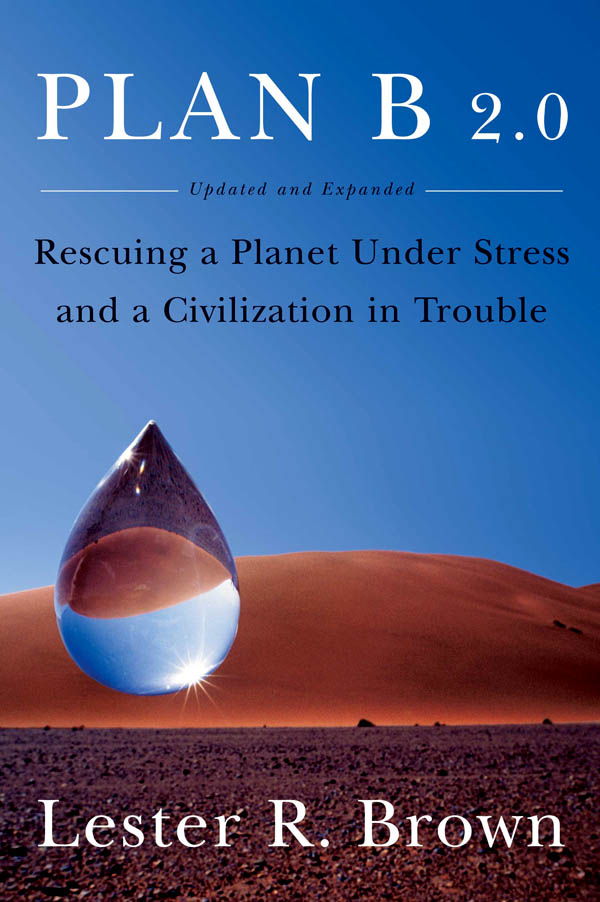
Plan B 2.0: Make That Change


THIS EXTRAORDINARY BOOK SHOULD BE WIDELY READ.
You can buy the book here and find out more about the author.
The whole book is also available on this site as pdf downloads.


“Our global civilization today is on an economic path that is environmentally unsustainable, a path that is leading us toward economic decline and eventual collapse,” says Lester Brown in Plan B 2.0: Rescuing a Planet Under Stress and a Civilization in Trouble.

“Environmental scientists have been saying for some time that the global economy is being slowly undermined by environmental trends of human origin, including shrinking forests, expanding deserts, falling water tables, eroding soils, collapsing fisheries, rising temperatures, melting ice, rising seas, and increasingly destructive storms,” says Brown, President and Founder of the Earth Policy Institute, a Washington, D.C.-based independent environmental research organization.

Although it is obvious that no society can survive the decline of its environmental support systems, many people are not yet convinced of the need for economic restructuring. But this is changing now that China has eclipsed the United States in the consumption of most basic resources, Brown notes in Plan B 2.0, which was produced with major funding from the Lannan Foundation and the U.N. Population Fund.

Among the basic commodities—grain and meat in the food sector, oil and coal in the energy sector, and steel in the industrial sector—China now consumes more than the United States of each of these except for oil. It consumes nearly twice as much meat (67 million tons compared with 39 million tons) and more than twice as much steel (258 million to 104 million tons).

These numbers are about total consumption. “But what if China reaches the U.S. consumption level per person?” asks Brown. “If China’s economy continues to expand at 8 percent a year, its income per person will reach the current U.S. level in 2031.

“If at that point China’s per capita resource consumption were the same as in the United States today, then its projected 1.45 billion people would consume the equivalent of two thirds of the current world grain harvest. China’s paper consumption would be double the world’s current production. There go the world’s forests.”
If China one day has three cars for every four people, U.S. style, it will have 1.1 billion cars. The whole world today has 800 million cars. To provide the roads, highways, and parking lots to accommodate such a vast fleet, China would have to pave an area equal to the land it now plants in rice. It would need 99 million barrels of oil a day. Yet the world currently produces 84 million barrels per day and may never produce much more.
The western economic model—the fossil-fuel-based, auto-centered, throwaway economy—is not going to work for China. If it does not work for China, it will not work for India, which by 2031 is projected to have a population even larger than China’s. Nor will it work for the 3 billion other people in developing countries who are also dreaming the “American dream.”

And, Brown notes, in an increasingly integrated world economy, where all countries are competing for the same oil, grain, and steel, the existing economic model will not work for industrial countries either. China is helping us see that the days of the old economy are numbered.

Sustaining our early twenty-first century global civilization now depends on shifting to a renewable energy-based, reuse/recycle economy with a diversified transport system. Business as usual—Plan A—cannot take us where we want to go. It is time for Plan B, time to build a new economy and a new world.

Plan B has three components—(1) a restructuring of the global economy so that it can sustain civilization; (2) an all-out effort to eradicate poverty, stabilize population, and restore hope in order to elicit participation of the developing countries; and (3) a systematic effort to restore natural systems.

Glimpses of the new economy can be seen in the wind farms of Western Europe, the solar rooftops of Japan, the fast-growing hybrid car fleet of the United States, the reforested mountains of South Korea, and the bicycle-friendly streets of Amsterdam. “Virtually everything we need to do to build an economy that will sustain economic progress is already being done in one or more countries,” says Brown.

“Among the new sources of energy—wind, solar cells, solar thermal, geothermal, small-scale hydro, biomass—wind is emerging as a major energy source. In Europe, which is leading the world into the wind era, some 40 million people now get their residential electricity from wind farms. The European Wind Energy Association projects that by 2020, half of the region’s population—195 million Europeans—will be getting their residential electricity from wind.

“Wind energy is growing fast for six reasons: It is abundant, cheap, inexhaustible, widely distributed, clean, and climate-benign. No other energy source has this combination of attributes.”

For the U.S. automotive fuel economy, the key to greatly reducing oil use and carbon emissions is gas-electric hybrid cars. The average new car sold in the United States last year got 22 miles to the gallon, compared with 55 miles per gallon for the Toyota Prius. If the United States decided for oil security and climate stabilization reasons to replace its entire fleet of passenger vehicles with super-efficient gas-electric hybrids over the next 10 years, gasoline use could easily be cut in half. This would involve no change in the number of cars or miles driven, only a shift to the most efficient automotive propulsion technology now available.

Beyond this, a gas-electric hybrid with an additional storage battery and a plug-in capacity would allow us to use electricity for short distance driving, such as the daily commute or grocery shopping. This could cut U.S. gasoline use by an additional 20 percent, for a total reduction of 70 percent. Then if we invest in thousands of wind farms across the country to feed cheap electricity into the grid, we could do most short-distance driving with wind energy, dramatically reducing both carbon emissions and the pressure on world oil supplies.
Using timers to recharge batteries with electricity coming from wind farms during the low demand hours between 1 and 6 a.m. costs the equivalent of 50¢-a-gallon gasoline. We have not only an inexhaustible alternative to dwindling reserves of oil, but an incredibly cheap one.

“Building an economy that will sustain economic progress requires a cooperative worldwide effort,” notes Brown. “This means eradicating poverty and stabilizing population—in effect, restoring hope among the world’s poor. Eradicating poverty accelerates the shift to smaller families. Smaller families in turn help to eradicate poverty.”

The principal line items in the budget to eradicate poverty are investments in universal primary school education; school lunch programs for the poorest of the poor; basic village-level health care, including vaccinations for childhood diseases; and reproductive health and family planning services for all the world’s women. In total, reaching these goals will take $68 billion of additional expenditures each year.

A strategy for eradicating poverty will not succeed if an economy’s environmental support systems are collapsing. Brown says, “This means putting together an earth restoration budget—one to reforest the earth, restore fisheries, eliminate overgrazing, protect biological diversity, and raise water productivity to the point where we can stabilize water tables and restore the flow of rivers. Adopted worldwide, these measures require additional expenditures of $93 billion per year.”

Combining social goals and earth restoration components into a Plan B budget means an additional annual expenditure of $161 billion. Such an investment is huge, but it is not a charitable act. It is an investment in the world in which our children will live.

“If we fail to build a new economy before decline sets in, it will not be because of a lack of fiscal resources, but rather because of obsolete priorities,” adds Brown. “The world is now spending $975 billion annually for military purposes. The U.S. 2006 military budget of $492 billion, accounting for half of the world total, goes largely to the development and production of new weapon systems. Unfortunately, these weapons are of little help in curbing terrorism, nor can they reverse the deforestation of the earth or stabilize climate.

“The military threats to national security today pale beside the trends of environmental destruction and disruption that threaten the economy and thus our early twenty-first century civilization itself. New threats call for new strategies. These threats are environmental degradation, climate change, the persistence of poverty, and the loss of hope.”

The U.S. military budget is totally out of sync with these new threats. If the United States were to underwrite the entire $161 billion Plan B budget by shifting resources from the $492 billion spent on the military, it still would be spending more for military purposes than all other NATO members plus Russia and China combined.
Of all the resources needed to build an economy that will sustain economic progress, none is more scarce than time. With climate change we may be approaching the point of no return. The temptation is to reset the clock. But we cannot. Nature is the timekeeper.

It is decision time. Like earlier civilizations that got into environmental trouble, we can decide to stay with business as usual and watch our global economy decline and eventually collapse. Or we can shift to Plan B, building an economy that will sustain economic progress.

“It is hard to find the words to express the gravity of our situation and the momentous nature of the decision we are about to make,” says Brown. “How can we convey the urgency of moving quickly? Will tomorrow be too late? “One way or another, the decision will be made by our generation. Of that there is little doubt. But it will affect life on earth for all generations to come.”


As chance would have it, while preparing this post, I got this e-mail press release:
SOUTH WEST LEADS DEBATE ON A ‘ONE PLANET ECONOMY’ AT BRISTOL EVENT

The Government wants a prosperous economy delivered within ‘environmental limits’. But how can we achieve this here in the South West? And who will lead us towards this ‘one planet economy’?

To address these issues, the region’s decision makers and stakeholders in its future will be in attendance at the exclusive Leadership for a One Planet Economy event. taking place at Bristol this Monday 16th of January. A number of high profile speakers have also been invited to kick-start the debate including: Andrew Simms of the New Economics Foundation; Peter Jones, Director of Biffa Waste Management; Simon Roberts, Chief Executive at the Centre for Sustainable Energy; Matthew Spencer, Chief Executive of Regen SW – the South West’s renewable energy agency and Michael Smith, Managing Director of the Venus Company - an ambitiously ‘green’ café outlet.

The event, sponsored by the Environment Agency and supported by the South West of England Regional Development Agency, has been organised by Sustainability South West (SSW), the region’s independent champion of sustainable development. It is the first of a potential series of big regional debates on the South West’s future to be hosted by SSW.

Leslie Watson, Director of Sustainability South West, said: “According to a recent study, our region is running on an ‘overdraft’ of natural resources – as though we had three planets instead of one! This event will begin to provide answers to the question: how can leadership help the South West to gain the benefits of moving towards a more secure, efficient, ‘one planet’, low carbon economy?”

Tuesday, January 10, 2006

I Hate Rock & Roll by Tony Tyler

Cover illustration by Mark Harrison

This virtually unobtainable cult classic, published by Vermillion and Company in 1984 - unique as far as I am aware in the rock literature canon - is the inspired and impassioned work of the former Assistant Editor of the NME during the 1970s Tony Tyler - a multi-instrumentalist who played cards with John Lennon in Hamburg, was backstage the night Dylan played the Albert Hall, is an established Tolkein author - who brought to the NME an erudition, a no-nonsense attitude, great humour and a passion that made a big contribution to making the paper what it was. Its impossible to have an uninteresting conversation with Tony - who was kind enough to lend me his personal copy of this neglected classic and to allow me to present to you some extracts from same. To begin: a section of Chapter Five - 'I'll Conduct The Strings, He Can Play Moog, You're On The Spoons: the path of musical pretension,'. The subject is flares.

'Actually, I have a theory about why so many late sixties/early sev­enties Guitar-Hero 'heavy' combos ended up loathing each other; and it all has to do with flared trousers.
Care to hear it?

Strictly speaking, the subject of 'flares' (or 'loon pants1) comes under the heading of ridiculous clothing and thus properly belongs in chapter 2. Yet for me these garments are a major index of the entire loathly vision I am trying to convey. They are a part of my subjective my­thology, a card in my personal Major Arcana, a Jungian archetype dream-symbol, one of the stations of the Tyler Qabala. ('Do not touch the water!' said the Lady Galadriel softly, and Frodo drew back in awe. I know what it was you saw, for that is in my mind also,' she said, nodding. 'Loon pants! The Enemy has many weapons . . .') In fact, I firmly believe that the cut of late sixties/early seventies pop combos' onstage pantaloons contains a mystical key to the innate fatuousness and dumbo malevolence that, for me, has always underwritten the sharp end of rock and roll.

Consider, if you will, the flared-trouser style. Not the gentle, barely perceptible increase in the calibre of the trouser leg as it approaches the instep (a kind of proportional cheating of the sort used to such tasteful effect by Greek architects of Pericles' time), but - in the case of the Cream's trousers - a sudden, gross, exponential leap in leg width. Tight ('Oooh!') at the crotch and snug at the knees, at ankle level these breeks easily measured a yard from stem to stern. Feet were wholly invisible. At moments of 'excitement' Clapton and his rivals and copyists would brace legs wide apart (cf. the precise angle adopted by drunks urinating against a garage wall), don facial expres­sions evocative of Christ's on the Cross, cock their guitars at approxi­mately 45 degrees of angle and get it on (you know?). What let Clapton and the others down was not so much the getting on, nor even the ridiculously contorted facial expressions - but what befell the flared trousers while the hero held his pose.

It's a subtly visual point and I must explain it as clearly as I can, since so much depends on it.

Each violently flared trouser leg, seen from the front, takes the form of a truncated isosceles triangle.

Now, move the bases of the triangles as far apart as you can while simultaneously retaining the truncated apexes in the same general area.

Although the inner seams remain more or less perpendicular, the outer seams balloon yet further outwards, like a multi-petticoated fifties party frock, almost attaining the true horizontal. The eye naturally follows the extreme line - and this, plus the total invisibility of the feet, causes a subjective optical impression that the posing idol's legs are actually braced at an impossible, contortionist, sinew-cracking an­gle. And one waits for the ping of the buttons, the ripping of cloth and the thud-thud-trickle-trickle as the blues-wailing gonads explode and roll away across the stage towards the peace-sign-making audience, the ultimate rock and roll souvenirs.

Now it is my theory that when members of supergroups of the era wore highly exaggerated flared trousers - as most of them did - they were subjected to wave upon wave of subconscious anxiety thereby. Not all of them were thick, and many of them must have known that they were making possibly the greatest single sartorial mistake since the wholesale adoption of the kilt by peoples of proto-Celtic origin. However, onstage (where one does not, as a rule, spend too much time meditating on the cut of one's trousers) they were of course temporarily able to forget the tragicomic proportions of the garments with which they had chosen to adorn their lower limbs.

Then would inevitably come the cardinal instant, the deadly moment of anti-satori. One man would swing eyes left (or right) across the stage in a routine, showbizzy grimace of ain't-we-really-gettin'-it-on good fellowship . . . and lo! There would be his supercolleague, smirk­ing ritually back, possibly bawling 'Yeah!' - but above all decked out in the most evilly ridiculous, bitterly humiliating pair of trousers on the face of the entire planet!

Reaction One: My God, I'm in a band with this nerd!
Reaction Two: My God, I look like that too!

Meanwhile the drummer - who in any case will be the ugliest mem­ber of the band - has his shirt off, generously allowing the roadies in charge of the supertrooper spotlights to illuminate every single pustule, blackhead, 'track mark' and skin blemish in the boldest possible relief.

It's my guess that, at this point, massive, traumatic resentment then came flooding in - many bum notes and prolonged hesitations in the guitar solos of the day are, I feel sure, due to sudden off-the-wall revelations of this type striking home in mid-flow.

In circumstances like these, it's not surprising that virtually all com­bos of this kind either broke up acrimoniously, or came to be notorious for their in-band hostilities and general psychotic behaviour.

The Cream fought each other like bull terriers and broke up, snarl­ing. The Who similarly hit each other at regular intervals - but early on struck on the idea of taking out their loathing on their instruments (and their hotel rooms), and so stayed together. Led Zeppelin's drum­mer, John Bonham, and their manager-figure, former UK all-in wres­tler Peter Grant, were men of violence in every sense of the word -but also directed it outwards. Jimi Hendrix notoriously despised his back-up musicians - then died of vomit asphyxiation after drugging himself unconscious. This deed may have been due to the poor quality of London nightlife, as I flippantly suggested in an earlier chapter, or it mav have been an accident . . . or it may have been a longstanding morale problem due to his trousers! If so. then this must surely be the extremest reaction on record.

With the arrival of the Great Loon Pants*Psychosis, the Guitar Cowboy begins to clip-clop towards his inevitable sunset. Although legions of clone bands had by now appeared (a few are with us to this day), the gargantuism of the whole thing - enormous walls of ampli­fication, way in excess of need; frighteningly prolific metal Triffids replacing the humble Premier drumkit; interminable guitar solos: in­creasing 'surrealism' (i.e. meaninglessness) of lyrics; ever-escalating ticket prices; ever-louder PA systems; and above all the grotesque, inhuman proportions of the artistes’ trousers - all this rampant, Speer-like gigantism suddenly looked . . . rather ridiculous. Embar­rassing, even. Where hitherto one had joyously patronized concerts by these people, and worn the attendance badges with pride, suddenly -imperceptibly - one grew evasive, even casually dismissive. While paying lip-service to the Guitar Heroes' pioneering role, one - some­how - found oneself no longer actually listening - not very much, anyway - to their records.

Scientists now say that it may have been a giant comet that killed off the dinosaurs. This may or may not be true, but to my mind it was undoubtedly loon pants that sealed the evolutionary doom of the Guitar Hero of rock and roll's very own Jurassic period.

Never underestimate the power of fashion in this racket.'

*The term loon pants' - so apt. so descriptive - appears to have originated with UK mail-order denim companies. Originates from pantaloons, as any fule kno.

Going Toe to Toe With Lou Reed by Pete Culshaw

Delighted to be able to reproduce this great 2003 interview with Lou Reed by one of the most brilliant music journalists in Britain. Enjoy.

"He's never early / he's always late.One thing is certain / you always gotta wait."
Lou Reed, I'm Waiting for The Man

Waiting for the man, Lou Reed, in his Sister Ray production office on Broadway in downtown Manhattan, is a bit like waiting for the dentist. You're not going to back out now, but it probably is going to be painful.

For one thing, he has a professed loathing for journalists. "Show me a critic and I'll show you an asshole. They are the vermin of the century," he says on his latest record, New York Man: The ultimate Lou Reed Collection, which spans his career from the Velvet Undergound to The Raven, his update of Edgar Allen Poe, which he released earlier this year.

Reed has been called petulant, paranoid and insecure - and that's just his friends talking. He is perfectly capable of getting through an entire interview giving only surly, monosyllabic answers. That's if he doesn't swear at you, or just walk out. The only thing Reed does seem to like to talk about - at mindnumbing length - is the technical details of recording technique that are frankly only of interest to trainspotters.

So why bother? Because Reed has written some fabulous songs - such as Pale Blue Eyes, I'm Waiting For the Man, White Light White Heat, for Andy Warhol's house band, the hugely influential Velvet Underground; others like his two big hits, Walk On The Wild Side and Perfect Day, from his David Bowie-produced masterpiece Transformer; and several great tunes on albums such as New York and Street Hassle. In fact, many critics place him, even if his output of late has been patchy, with Neil Young and Bob Dylan as one of the great American songwriters.

Also, he was something of teen idol of mine - his songs of transvestites, drugs, adultery and depravity greatly appealed to my own warped adolescent sensibility. These days every gangster rapper talks about dealers and "hos", but in the '70s it was a novelty.

One of his assistants plays me a new remix of Walk On The Wild Side with added lyrics about "Georgie (Bush) looking for gas" and "kicking Iraqi ass". Reed wanders by and turns it up to deafening levels before retreating to his office. His partner, Laurie Anderson, is in the office and we have a conversation completely at cross-purposes due to the volume. I understand she has been doing some anti-war "performance art" dressed as a burger (that symbol of American evil) - eventually I realise she and her friends have dressed in a burqa.

After about an hour, I am ushered in to Reed's office, where he is eating Japanese takeaway. Although I'm expecting it, it is still unnerving when he goes into his monosyllabic schtick. The only real answer I get from the first five questions is when I ask him about the title of of the collection New York Man. "You mean you can't imagine anyone doing an album called London Man?" Not really, no. "Well, you gotta admit it's better than Akron Man," he cackles. Other questions - about his being an alternative New York icon, about the changes in the city (you are as likely to find a real estate dealer as a drug dealer at Lexington 125 these days) - about his anti-war efforts are stonewalled.

Why does he find interviews such an imposition? "Maybe when the Internet's better I won't have to. You have a new record out, you want people to know about it." Then he drawls, "I enjoy talking about music." I know, with a sinking heart, what these words mean. He spends the next 10 minutes droning on about remastering, 16-bit CD, acetates, analog and digital remixes. At least he's talking. I tell him that as a music specialist, I'm slightly interested in all this, but mostly people don't give a damn. They mostly listen to music on tinny beat boxes and car radios. "What kind of barbaric age are you talking about?" he says.

I suggest that I would rather hear Billie Holiday as originally recorded than any singer I can think of recorded perfectly today. "You are missing the point. Even if most people are deaf. That's like saying why spend time with the lighting for the camera, Marty? What's the big, f---king, deal?"

He spits out the words. In any case, I'm not so keen on what he calls his "cleaning up" digital remastering. I liked the sludgy noise of the Velvet Underground, a shadowy version of Phil Spector's Wall of Sound. Even the lyrics are not necessarily improved by hearing them. There's a line on Pale Blue Eyes (the best version is by Brazilian singer Mariza Monte) that I'd always misheard as "I thought you were my mom and pop", which I thought rich in dark, Freudian meaning. Turns out it was "Thought you were my mountaintop" - much more banal. I say I think vinyl is warmer to listen to, he agrees, apparently undercutting everything he's said on the subject.

Does he actually like making music? "Coming up with the idea. That's not the bitch. Unless you can't do it. Everything else is the bitch."

We talk about the music business and he says, "People here argue about which is more disgusting - the movie business or the music business. Just depends which way you would rather be raped and pillaged."

I tell him I never made any money when I made some records. "You thought you'd make money?" he condescends. "How sweet. How cute of you."

It has occurred to me that Reed, often encrusted in leather, with bug-eyed shades and poisonous tongue, is rather reptilian. But at least his blood is warming up a bit. It occurs to me I haven't yet been enough of an asshole, so I try a high-risk question. "You realise that if you had overdosed on all the drugs you took in the '70s," I suggest, "it would have been a great career move."

There is a silence, during which I'm fairly sure I'm about to be ejected. But he says, "Yeah, think of the number of records I'd have sold. I'd be a legend. Thank you very much." He tells me he's fit now, he's given up smoking.

The thing is, Lou, I venture, people think you're pretentious. Another pregnant pause. "I don't give a shit. I've always done what interests me". True enough, including a double album of atonal feedback called Metal Machine Music (the record company ended up apologising to distributors for that one). He tells me that some German group has played it live and it is now considered an avant-garde masterpiece, influencing industrial rock, although, of course, ignorant critics hated it at the time. Some of us still do.

Many people think he's a great American writer, like Saul Bellow or Philip Roth, but because he's working in the rock field he's not given the accolades due to him. "I wanted to combine Burroughs and Ginsberg with rock. I mean, here was this great music with not much going on lyrically, and here's a book like Last Exit To Brooklyn. You'd have to be retarded not to see the possibilities. I'm amazed," he says, with true arrogance "that I pretty much still have the field to myself."

Lou was christened Lewis Allen Firbank and was born in 1942 in suburban Long Island. He made his first record as the Shades, aged 14, called So Blue - his middle-class parents were so upset by his rock'n'roll tendencies, they persuaded him to have electric shock therapy. He ended up studying English literature at Syracuse University, which is where he met his first mentor, the poet Delmore Schwarz, author of In Dreams Begin Responsibilities. "

One of the greatest short stories ever written, five pages and not one polysyllabic word." When Reed has that directness, his songs are at their best, although The Raven, his recent adaptation of Edgar Allen Poe, is full - nay, replete - with arbours of sculpted ivy, entablatures intertwined and kingly halls that are melancholy shrines, read by plummy actors, and is entirely indigestible. One rock number has Edgar Allen Poe, not once but several times, rhymed with "not exactly the boy next door", as if it was any good the first time round.

His other mentor was Warhol. How important was he for you, I ask. "My God, what luck was that - of all the people to adopt you as his band. It was fantastic. He did it all - we played the same music we had been fired for and beaten up elsewhere. The first week he projected films onto us and we wore black: that was the first multimedia show. People hated him, but now he's dead, he's maybe the greatest American artist."

For the first time, Reed's clear enthusiasm and admiration for Warhol shows a brief flash of humanity, but then his publicist pops in to say my time is up. I tell Reed I hope he keeps up not smoking, that I haven't, and he fishes out the number of his Chinese herbalist. Thanks, Lou, for caring. When I ask him what he's up to next, he says he's interviewing a singer called Anthony for a magazine. He has been out shopping and was considering getting the same microphone as mine. This I can hardly believe. So, Lou, you're joining the assholes? "Well," he says, and his eye twitches like the woman winking at the end of The Weakest Link, "a few of my friends are journalists, actually".

Monday, January 09, 2006

Curious Facts: Art Attacks


'Fountain' - the notorious 1917 artwork by Marcel Duchamp - a standard porcelain urinal exhibited upside-down, was attacked for the second time on January 4th by the same person – a 77-year old French artist from Provence named Pierre Pinoncelli.

Police said the first attack came at an exhibition in Nimes in 1993 when Pinoncelli urinated in the urinal and set about it with a blunt instrument, claiming that his attack was a work of performance art that Duchamp would have appreciated. At his trial, he said that he was ‘restoring dignity to this object, victim of an abuse of purpose if not of personality.’ The judge decided Pinoncelli had wanted to ‘hijack the fame of the original artist’, jailed hjim for a month and fined him €45,000.

This time, Pinoncelli hit 'Fountain', worth £2m, with a hammer, chipping it slightly. The piece was on display at a Dada exhibition at the Pompidou Centre in Paris. Pinoncelli was held by the police overnight. He was released on Thursday and ordered to appear in court in Paris Jan. 24 to answer charges of damaging the property of others. As in 1993, he could face a prison term or a fine.


According to a New York Times story on the incident: 'Since the early 1960's, Mr. Pinoncelli, based in Nice, has been busy with what he calls "les happenings de rue," or "street happenings." In 1969, he used a water pistol to spray red paint on André Malraux, who was then the French culture minister. In 1975, he "held up" a bank in Nice with a fake gun to protest Nice's decision to become Cape Town's twin city while South Africa was still under apartheid rule. The same year, he paraded outside Nice's courts, covered in large yellow stars, in what he called a homage to deported Jews.


'Perhaps his most striking act unfolded in 2002 at a festival of performance art in the Colombian city of Cali. There, he protested the kidnapping of a Colombian politician, Ingrid Betancourt, by the country's leftist guerrillas by chopping off half of the smallest finger of his left hand. He then used his blood to write "FARC," the acronym of the guerrilla group (the Revolutionary Armed Forces of Colombia), on a white wall. "The idea was to share in Colombia's violence," he told reporters at the time. But it apparently did not impress the guerrillas: Ms. Betancourt is still being held.'

Many years ago, I saw the urinal at first hand at a Surrealist exhibition at the Pompidou. At the time I was told that Brian Eno had also pissed in the urinal. Boing Boing confirms that in 1995, Eno collected some of his urine and used plastic tubing to splash it onto 'Fountain' even though the work was displayed behind glass at the MoMA. The full story of this incident can be found on Everything2.


In 2000, two Chinese artists, Yuan Cai and Jian Jun Xi Ianjun, who had jumped on Tracy Emin's "My Bed" the year before, also urinated on 'Fountain' (the Tate Modern's version), noting that Duchamp himself said artists defined art.


Marcel Duchamp's Fountain recently came top of a poll of 500 art experts in the run-up to this year's Turner Prize. Picasso's ‘Les Demoiselles d'Avignon’ (9107) was second, with Andy Warhol's Marilyn Diptych (1962) third, Picasso's ‘Guernica’ fourth and Matisse's ‘The Red Studio’ fifth.
Duchamp (1887-1968)

"Fountain" was rejected for being neither original nor art when Duchamp offered it for the first exhibition of the Society of Independent Artists in New York in 1917. That version of the urinal signed "R. Mutt," was subsequently lost. The Pompidou's "Fountain" is one of eight signed replicas made by Duchamp in 1964.

See also:
'The Richard Mutt Case: Looking for Marcel Duchamp's Fountain' by Michael Betacourt
The Elegant Pisser: Fountain by "R. Mutt" - Max Podstolski
'Making Sense of Modern Art'

Whose Britain Is It Anyway?

The forthcoming BBC2 programme of this name (Tuesday 9th Jan) promises to make fascinating viewing, judging by the Sunday Times piece by its co-producer and presenter Peter 'Swingometer' Snow.

It reveals that there have been only two occasions in the past one thousand years when land has been fully registered. Once when the Domesday Book was compiled 20 years after William the Conqueror invaded in 1066. The second, 800 years later, in 1872. The so-called Return of the Owners of Land managed to register every acre in England and Wales. Today’s Land Registry is able to tell you who owns only 50% of the land. The other half is unregistered. (Scotland is different, there land registry is much more comprehensive.)

'In just over 130 years more than 30m acres have mysteriously gone missing,' says Snow. The Land Registry is hoping to persuade those who own the unregistered half of Britain to own up by 2012 — its target date for full registration.

'There are 60m acres in England, Wales and Scotland, roughly one to each member of the population but I was startled to find,' writes Snow, 'first, that 90% of us live on less than 10% of the land and even the plots we inhabit are shrinking. Second, just under one-third of Britain’s land is still owned by aristocrats and traditional landed gentry. Ordinary British homeowners (freeholders) who have greatly increased in number over the past two decades are competing for land that gets tighter and dearer by the day. '

We in Britain live in smaller spaces than anywhere else in the 15 countries of the old Europe. Housing statistics show that in 2002 Britain’s newly built dwellings had, on average, the smallest floor areas. Britain is actually less urbanised than Germany, Holland, Denmark and Belgium.

Traditionally, says Snow, the crown, church and aristocracy each owned around a third of all British land. Now the church and crown both own just 1% each while the aristocracy still own 30% of the land

The main gainers in ownership of land have been the Forestry Commission and heritage organisations such as the National Trust.

Sunday, January 08, 2006

BIFF Retrospective


One of the casualties of The Guardian's change to a Berliner format was the Biff cartoons and strips that had appeared regulalrly in the paper since 1985. Happily a retrospevctive exhibition of the work of Chris Garratt and Mick Kidd (the originators and creators of the world of Biff) will be held at the Newsroom, 60 Farringdon Road, London EC1R from Jan 19th to March 3rd. Opening times: Monday to Friday 10:00-17:00. Saturday: 12:00-16:00. Admission is free.

Mick and Chris met at grammar school in the 1950s and have collaborated on BIFF since the mid-1970s. Chris creates the artwork - a mixture of collage, found images, tracings and original drawings, and Mick is responsible for the text.One of the unique aspects of BIFF is that Mick lives in London and Chris in the Scilly Isles. They have created their strips and other artwork over the last 30 years by phone, post, email and occasional meetings.

To see more of their work, visit: www.biffonline.com

Inside Dope by Dick Tracy: Cannabis Psychosis, Marijuana Munchies,The Sativex Papers and Does Marijuana Make Your Brain Grow


'Where there's smoke ..' by Blake Morrison, was published as a five-page cover story in the G2 supplement of The Guardian (Friday December 16, 2005). The pitch was as follows: 'When the government last year downgraded it to a class C drug, the message seemed pretty clear: cannabis is harmless. Since then, there has been mounting evidence of a link between the drug and mental illness. So is it safe to skin up?'

The history of cannabis and cannabis prohibition is, of course, littered with scare stories that have been used, at various points in history, to demonise the drug for political reasons. Yet this time we are being asked to believe that this is the proverbial horse of different colour by such prominent spokeswomen as columnist Sue Arnold (who in 1997 extolled the wonders of cannabis after it temporarily cured her eye-condition (retinitis pigmentosa) but went through a volte face when her son had a psychotic incident after smoking skunk and spent six m0nths in hospital) and Rosie Boycott (who memorably led a legalise cannabis campaign when she was editing The Independent but, more recently, has made a tv documentary and written a major piece for the Daily Mail ('The Cannbis Catastrophe') on cannabis psychosis which states that 'cannbis users today are playing russian roulette with their mental health.')

The article is one of the most prominent yet to investigate what has now become a popular media story. But is there any truth in it ? Read the article and see how you feel at the end of it. There's an awful lot of ifs and buts, arguments for and against and, I would say, an unproved causal link between smoking cannabis and psychotic behaviour (particularly schizophrenia). You may disagree.

But you should know this. One of the central planks of the 'cannbis psychosis' argument is that the strength of modern cannabis ('skunk' in particular) has increased dramatically and that this is the principal cause of the problem.

Blake Morrison wrote the following: ...'whereas 30 years ago an average joint contained about 10mg of THC, a joint of skunk today might contain as much as 300mg.'

So it was with some surprise that one read the Letters page of The Guardian a few days later (19 December) to read the communication from Dr Leslie King, former head of the drugs intelligence unit of the Forensic Science Service. King had co-authored a report for the European Monitoring Centre for Drugs and Drug Addiction which had specifically studied trends in cannabis potency in the UK and the EU. (the full report is available here for download)

The report clearly states: 'Statements in the popular media that the potency of cannabis has increased by ten times or more in recent decades are not supported by the data from either the USA or Europe.'

In his letter he writes that 'the amount of herbal cannabis or cannbis resin found in reefer cigarettes has not changed significantly in more than 20 years. The average weight of a cannabis in an unsmoked reefer has remained at around 200mg to 250mg. In other words, not only does a typical joint not contain 300mg of THC, it doesn't even contain 300mg of cannabis. A joint made from 'skunk' with a typical potency of 12% would contain around 30mg, not 300mg THC.' OOPS!!

Dr King traces the origin of this myth of super-strength cannabis back to Alan Walters, the then US drug czar, whose comments to this effect were published in The Washington Post five years ago. He says the same misinformation is on the Royal College of General Practitioners site, which reports that: 'A ‘reefer’ in the 1980s contained about 10mg of 9-tetrahydrocannabinol (THC), the main active chemical, where as a ‘joint’ today may contain around 300mg THC.' [The reference given for that is hardly up to date: 'Marijuana, In 'Comprehensive Handbook of Alcohol and Drug Addiction' by MS Gold (Marcel Dekker Inc, New York (1991)]


Then, to make things even more confusing, in 'The week's questions' (The Guardian Saturday January 7) James Ramerson answered the poser 'Is cannabis getting stronger?'

His answer: 'No. The home secretary, Charles Clarke, charged the Advisory Committee on the Misuse of Drugs in March to look at the decision to declassify cannabis from class B to C. One thing he wanted to know was whether extra-strong varieties such as skunk were raising the average strength.

This idea was given credence five years ago when Alan Walters, the US drug tsar, claimed that modern grass is 10 to 20 times more potent than the benign stuff in the carefree hippy days. This, it appears, is a myth - at least in the UK and almost all of Europe. Paul Griffiths at the European Monitoring Centre for Drugs and Drug Addiction in Portugal said: "Some of the figures quoted are just nonsensical."

He co-authored a report in 2004 which reviewed data on potency. It found that the tetrahydrocannabinol (THC), the effective potency of cannabis, in Britain has stayed at around 6% for the past 30 years. Strong varieties make up only 15% of the market. The only country in Europe where potency is increasing is the Netherlands where intensively-grown cannabis has more than 50% of the market.

He argues that concentrating on potency is a red herring. " Do people who drink whisky take in more alcohol than people who drink beer?" he asked. More important is how often people smoke, how early they started and how much they put in a joint.'


And there's more. The day before the above (Jan 6) The Guardian's political editor Michael White weighed in with a story 'Clarke paves way for U-turn on cannabis.' He wrote:

'Charles Clarke, the home secretary, was criticised yesterday from both sides of the debate on the misuse of drugs when he publicly indicated that he is considering restoring the class B status of cannabis in the light of medical evidence.

'In what the tabloids labelled a "humiliating climbdown" from the decision of his predecessor, David Blunkett, to downgrade the widely used drug to class C, Mr Clarke used media interviews to signal his approval of an imminent report, which he has already read, from the Advisory Council on the Misuse of Drugs.

'Without divulging the report's contents Mr Clarke said he would accept one recommendation - to increase education about the dangerous effects of cannabis and its legal status, after Mr Blunkett's decision two years ago caused anti-drug partisans to claim that the drug had been '"decriminalised".

'In an interview with The Times the home secretary confirmed what his officials have been saying, that new medical evidence has prompted a number of people to change their minds. "I'm very struck by the advocacy of a number of people who have been proposers of the reclassification of cannabis that they were wrong," he said. "I am also very worried about the most recent medical evidence."

The following day, The Guardian recieved the following response:

'The worst kept secret in the drugs field is that, after a detailed scrutiny of the evidence, the Advisory Council on the Misuse of Drugs does not advise the reclassification of cannabis to class B and recommends it remains in class C (Clarke paves way for U-turn on cannabis, January 6). If the government's own group of experts is clear about this it begs the question: why are politicians flying so many kites?
Sebastian Saville
Director, Release

So how come the political editor didn't know that.

In conclusion, most readers will have read Blake Morrison's big splash G2 piece but many will have missed the letters and corrections. Thus are myths perpetuated.


On a lighter note, researchers at Columbia University claimed to have uncovered the machinery of The 'Marijuana Munchies'. See story here.
[H.J.Jo et al.: "Integration Of Endocannabinoid and Leptin Signaling in an Appetite-Related Neural Circuit." Publishing in Neuron, Vol. 48, 1055–1066, December 22, 2005, DOI 10.1016/j.neuron.2005.10.021
www.neuron.org.]


THE SATIVEX PAPERS

The UK company GW Pharmaceuticals was founded in early 1998 and recieved its first Home Office licenses to cultivate, possess and supply cannabis for research purposes were received in June that year with cultivation beginning in August.

In November 1998, the House of Lords Select Committee on Science and Technology published its report "Cannabis: The Scientific and Medical Evidence" which recommended that clinical trials of cannabis medicines should be carried out as a matter of urgency. The Committee warmly welcomed GW's research programme.

Sativex is GW's lead cannabis-based medicine which contains tetrahydrocannabinol and cannabidiol and is taken as a spray into the mouth. It does not contain the active substance found in recreational cannabis and so patients taking Sativex will not become intoxicated.

In April 2005 Sativex received regulatory approval in Canada for the symptomatic relief of neuropathic pain in adults with multiple sclerosis. The law in Canada is such that as soon as Sativex is launched in Canada, doctors will be able to prescribe it legally.

Sativex has recenty been given the go-ahead to enter final stage trials in the US to treat severe pain in cancer patients . A spokesman for the GW Pharmaceuticals said: "This is a major step. The US is the world's largest pharmaceutical market." The trial, which will involve about 250 patients, will establish whether the drug relieves pain in patients suffering from an advanced form of cancer who do not experience relief from opioid drugs such as morphine.

To meet demands for Sativex, GW Pharmaceuticals has increased production of cannabis at its fortified greenhouses to 60t/y.

In the UK however, the company is still conducting trials to try and gain approval for using it to treat muscle tightness in multiple sclerosis patients - approval which may be harder to get following an inquest into the death of a 70-year old woman who had ben involved in earlier trials of the drug.

Here are the 'Notes to Editors' on the GW site in response to the coroner's verdict:

'The inquest into the death of Mrs Rene Anderson commenced on 12 December 2005. Mrs Anderson was 69 years old with a 25 year history of diabetes mellitus, and also suffered from resistant hypertension, clinically significant depression and hyperlipidaemia. She died in March 2004.

One of the factors in her case, which has received media attention, is that Mrs Anderson had taken part in a Sativex clinical trial over a three week period during October 2003. Mrs Anderson’s total exposure to Sativex extended to a total of 42 doses (a total of less than four days worth for a typical patient). During October 2003, Mrs Anderson developed confusion and other intoxication effects and stopped taking Sativex. At the end of October 2003, a full four months before her death, a urine test confirmed that there was no presence of cannabinoids in her body.

A further period of four months of hospital inpatient care passed prior to Mrs Anderson’s death in March 2004 after pneumonia and kidney failure, during which time she received numerous medications under the direction of various doctors.

There were a number of other potential causes of confusion in this patient. Mrs Anderson was also taking a wide range of other medication both before and after her brief involvement in the Sativex trial, including tramadol, haloperidol, nitrazepam, simvastin, citalopram, losartan, frusemide, atenolol and doxazosin. All these medicines have side effects of their own, and a number list confusion on the product label. There are over 50 prescription medicines which list confusion as a side effect.'

In his verdict at the end of the inquest today, the Coroner stated that “Mrs Anderson died on 3rd March 2004 in the Northern General Hospital as a consequence of prolonged immobility following an illness for which she had been admitted on 28th October 2003. On the balance of probabilities, an idiosyncratic reaction to a trial drug (either alone or in combination with other medications) was at least a significant contributory factor to the initiation of this illness.”

According to Drug Development-Technology.Com: '...queries from the [UK] regulators have seen approval repeatedly delayed and raised the question of whether Sativex will ever be approved in the UK. GW Pharmaceuticals and Bayer will not seek wider European approval until UK regulators have given the green light.'

'Estimates suggest that between 10% and 30% of MS patients in Europe smoke cannabis to ease the pain and disabling symptoms of the disease. This activity is illegal and patients run the risk of prosecution. In the UK, cannabis-based medicines were in fact outlawed in 1968 after legislation banned doctors from prescribing tincture of cannabis.'

They conclude with a Marketing Commentary: 'In Europe alone there are some 500,000 MS patients on top of the 4 million experiencing neuropathic pain. This fact, together with a market poorly served by currently available drugs, presents an excellent opportunity for Sativex if the encouraging results seen in multiple sclerosis are reproduced in other patient groups. Regulatory approval of Sativex will set an important precedent for the use of cannabis-derived drugs.'

AND FINALLY
According to 'Marijuana May Make Your Brain Grow.' [Nature 13.10.05], neuropsychologist Xia Zhang and a team of researchers based at the University of Saskatchewan in Saskatoon, Canada, aimed to find out just how marijuana-like drugs, known collectively as cannabinoids, act on the brain.

The researchers injected rats with HU210, a synthetic drug that is about one-hundred times as powerful as THC, the high-inducing compound naturally found in marijuana. They then used a chemical tracer to watch new cells growing in the hippocampus. They found that HU210 seemed to induce new brain cell growth, just as some antidepressant drugs do, they report in the Journal of Clinical Investigation1. This suggests that they could potentially be used to reduce anxiety and depression, Zhang says. He adds that the research might help to create new cannabinoid-based treatments.

"I think it's a very exciting study," says Amelia Eisch, an addiction researcher at the University of Texas Southwestern Medical Center in Dallas. "It makes marijuana look more like an antidepressant and less like a drug of abuse."

Although his findings point to potential benefits of smoking pot, Zhang says that he does not endorse its use. "Marijuana has been used for medicine and recreation for thousands of years," he says. "But it can also lead to addiction." He says his group's next studies will examine this more unpleasant side of the drug.