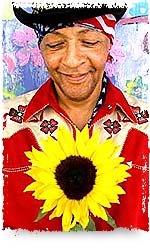
Photo Of Nicholas Albery by Mark Edwards,
who now runs the excelllent photo agency
Still Pictures
Obituary:The Independent
Nicholas Albery, generalist, social inventor, author. Born St Albans 28 July 1948; married Josefine Speyer 1991, one son Merlyn. Died in a car accident on 3 June 2001.
Founder and principal officer of the Institute for Social Inventions, Nicholas Albery was an innovative generalist widely respected, not only for having learned how to brainstorm himself and others to solve problems and produce new ideas, but also for testing and living them out.
Among the illustrious supporters of the Institute are Lord Beaumont, Sir Richard Boddy, Edward Goldsmith, Brian Eno, Anita Roddick, Fay Weldon, Sir Peter Parker, Linne Franks, Colin Wilson, Stafford Beer, Lord Young of Dartington, Diane the wife of Ernst "small is beautiful" Schumacher.
The breadth of his thinking and the scope of his output was extraordinary. From the Global Ideas Bank (as he put it "the website of the Institute, it has extended this collecting of ideas to the Internet, with millions accessing the site every year") to the Natural Death Centre ("advising those wishing to organise green, inexpensive family-based funerals"); from the International Poetry Challenge Day ("individuals and schools take up the challenge to learn poems by heart to raise money for charity") to the Apprentice-Master Alliance ("a free service that links graduates or school-leavers wishing to learn a trade with small or one person businesses for long-term apprenticeships"), Nicholas has left his mark on society in a way that, in buddhist terminology, represents "the creation of merit for the benefit of all beings", although not a buddhist himself.
Nicholas was the collaborator, or catalyst, par excellence. He rarely claimed innovations as his own. Having realised early on in his life that information could be free and not withheld or possessed for some people to gain advantage over others, he then set about carrying this principle out with an almost manic energy.
His publications include The Book of Visions-an encyclopaedia of social innovations, Virgin, 1993; Poem for the Day, Chatto, 1994; Time Out Book of Country Walks, Penguin, 1997; Seize the Day (forthcoming), 2001. An Internet search for "Nicholas Albery" yields about 1850 items.
Born in 1948, he was one of 4 siblings in the theatre-land dynasty headed by Sir Donald Albery. Public school educated and an Oxford University dropout, he was equally a child of the optimistic sixties who never lost his early vision of the role that information could play in a society where computers are widespread. But rather than being a techno-nerd, he was interested in the social uses of information. In this sense he was a generation ahead of most of his peers in envisaging, in the late sixties, the socially beneficial uses of what has now become the Internet.
At age 19 Nicholas lived on complan for a year because he wanted to test its claim to be a compete food. At 29 he was a leading light of the Free Republic of Frestonia, an area of Notting Hill that declared itself independent of the UK in order to resist evictions and subsequent commercial development (they won). At 30 he stood as Ecology Party candidate in Kensington & Chelsea and got 800 votes, including the ballot paper marked with a heart instead of a cross which after lengthy debate was accepted as valid as it clearly expressed the voter's intent.
In the late 60's he ran BIT, the London-based alternative information service. In between finding crash pads and temporary work for allcomers he produced the first overland guide to India, complied from travellers tales. A cover of BITMAN magazine in the mid-70's shows him and Nicholas Saunders (the Neal's Yard/Covent Garden entrepreneur) walking naked down Piccadilly captioned "rehearsal for the year 2000".
The collaboration of the two Nicholases, Saunders and Albery, became the pivot for a raft of social innovations for the next quarter century; Albery as the socially involved ideas man who stayed up all hours with the computer as well as running a highly varied open-plan social life, Saunders as the entrepreneur risk-taker with the Midas touch. Sadly, each of them died in a freak car crash where the other passengers were unscathed, Saunders in 1998, Albery this past weekend.
To his friends he was supportive and showed great generosity and loving-kindness. For friends and strangers alike, he brought a sense of excitement to every occasion, challenging, always asking questions that got to the heart of the situation, and spilling over with ideas.
But perhaps his greatest contribution is as a role model for how to behave in our information-dense, technology-based society: trying to be inclusive not exclusive, always curious but not accepting the given as fixed or immutable, putting people before machines. The website www.globalideasbank.org is exemplary. When asked what one needs to become a social inventor he replied "a mentor who believes in you; to have run an enterprise when quite young; to be an artist with a creative mind".
His interest in country walks, which he managed to do once a week for many years, dates from his being diagnosed with the potentially crippling disease ankylosing spondylitis which tends to weld one's vertebrae together. Characteristically his response was to take a large amount of exercise to combat the problem head-on, and although he was no athlete he retained a glow of youth that eludes most of us in middle age. Unusually, he looked no younger in death than when alive.
*
Spoke with Nick Temple who now runs the Global Ideas Bank, which spun off from the Institute for Social Inventions. Run by volunteers, it registers half a million unique hits a year.