Saturday, August 19, 2006

SCIENCE BLOG NEWS: Cephalopods


A new concept in breakfast cereals. Real science or clever artifice? See: Worth 1000

The most popular science blog written by a scientist according to Technorati is Phyringia, which is listed 179th in their top 3,500 blogs.

Its written and assembled by PZ Meyer a biologist and Associate Professor at The University of Minnesota Morris in the US of A. 'Phyringia' refers to a stage in the evolution of embryos which he and his students study a lot apparently. I'm at somewhat of a loss to explain its great popularity, which is not to say that it isn't lively, interesting and amusing. But Meyer is not only inexplicably interested in cephalopods but also carries articles on such topics as an Oliver Reed film that he happened to watch one afternoon. Good on you.

I enjoyed his post on 'In Search of the Red Demon' by Scott Cassell, who describes his experiences making a documentary in the Sea of Cortez entitled 'Humboldt: The Man-Eating Squid'. He writes:

'For most people, the word “squid” probably conjures images of deep-fried appetizers, not flesh-eating carnivores. But the truth is, Humboldt squid have approximately 1,200 sucker discs, each one lined with 20 to 26 needle-sharp teeth. This allows the Humboldt to attack its prey with more than 24,000 teeth at once. And nestled in its bed of eight muscular arms and two feeding tentacles is a disproportionately large, knife-edged beak similar to a parrot’s. But the Humboldt is much larger than a parrot: they have been found as large as 14 feet in length and weighing more than 700 pounds.

'In addition to the Humboldt’s enormity and impressive array of weapons, this magnificent mollusk possesses a legendary ferocity. The local Mexican fishermen call it Rojo Diablo, or Red Demon. When I arrived in Mexico for the dive, several fishermen told tales of how people had experienced violent deaths after falling in the water with these red demons: “…they would be pulled down and devoured in moments.”

'These stories were true and I knew it. So I developed equipment and techniques to counter a possible attack. These precautions included: anti-squid armor suits; armor plating for the vulnerable parts of my mixed-gas rebreather; anti-squid cage; and back-to-back diving techniques. To prevent being pulled down by a pack of squid, steel cables connected divers to the boat at all times. If these measures sound extreme, I can assure you they weren’t. Each one came into play and proved to be completely necessary.'

SCIENCE BLOG NEWS: Defining Planets/Expanding the Solar System


(Top) The proposed new 12-planet Solar System: Mercury, Venus, Earth, Mars, Ceres, Jupiter, Saturn, Uranus, Neptune, Pluto, Charon and 2003 UB313 (it’s real name has yet to be assigned).

(Bottom) More new planets are likely to be announced by the International Astronomical Union in the future. Here are the dozen ‘candidate planets’ currently on IAU’s ‘watchlist’ which keeps changing as new objects are found and the physics of the existing candidates becomes better known.

On August 24th, between 4:00 and 17:30 CEST, if all goes according to plan, the world’s astronomers, who are meeting at the International Astronomical Union conference in Prague, willvote for or against a new definition of the term ‘planet.’

According to the Resolution they will vote on, two conditions must be satisfied for an object to be called a planet. First, the object must be in orbit around a star, while not being itself a star. Second, the object must be large enough (or more technically correct, massive enough) for its own gravity to pull it into a nearly spherical shape.

The matter has been under discussion for two years. If the new definition is agreed, then we will now have 12 planets in our Solar System.

The Resolution also defines a new category of planet - a ‘pluton’ (Pluto-like object) . Plutons are distinguished from classical planets in that they reside in orbits around the Sun that take longer than 200 years to complete (i.e. they orbit beyond Neptune).

Plutons typically have orbits that are highly tilted with respect to the classical planets (technically referred to as a large orbital inclination). Plutons also typically have orbits that are far from being perfectly circular (technically referred to as having a large orbital eccentricity). All of these distinguishing characteristics for plutons are scientifically interesting in that they suggest a different origin from the classical planets.

SOURCE: IAU

For an alternative view see The Panda's Thumb, one of the top five science blogs written by scientists, according to Technorati ratings.


Tuesday, August 15, 2006

THE TANGIER DIARIES


It is one of the great pleasures, for one such as I, to sift and search second-hand bookshops in search of treasure. So it was a good day when I recently discovered 'The Tangier Diaries 1962-1979' by John Hopkins [Arcadia Books 1997], since when I have been in its spell. (Unfortunately finished it today, at 4:00 in the afternoon, arising late after a battle with some
bourbon the night before.)

Young American Hopkins, a prodigious traveller and novelist, was fortunate to inhabit the Tangiers scene during some of the most interesting years and his beautiful diary - containing entries ranging from a few lines to several pages - is full of wonderful pen portraits of the many and various characters on display - Paul Bowles, William Burroughs, Brion Gysin amongst them, vivid little street scenes and evocations of landscape, insightful passges about writing and his struggles with it, social events and personal stories. He travels throughout Morocco, a country he comes to deeply love and admire, particularly the Sahara which provides him with something akin to a spiritual experience.

Three short extracts must suffice, to whet the appetite:

1964: July 6th: 'I gradually work myself, through a period of protracted concentration, into a state of receptivity where the semi-real idea for the next book becomes inevitable. These days of apparent inactivity with my mind in neutral, often turn out to be the most productive.
As Burroughs says: "Your mind will answer most questions if you learn to relax and wait for the answer. Like one of those thinking machines, you feed in the questions, sit back, and wait..."

1967, February 24 - Tangier: 'The siren of a departing ocean liner makes me dream of Camus

1973, June 8th: 'Tangier City Report: Weather balmy. People stroll the boulevard looking brown from the beach, clean from the sea, free in their light summer clothes. A naval ship is in port, and young, bearded tattooed sailors are making the shopkeepers happy.'

ADDENDUM: An equally fine book in The Generalist library is another second-hand find - 'A Year in Marrakesh' by Peter Mayne [Eland Books, London/Hippocrene Books, New York. First paperback 1982. Originally published 1953.] An outstanding piece of travel literature, which begins 'I am a stranger in these parts and Tangier feeds on the flesh of strangers...' and from then draws you rapidly into Moroccan culture at street level, filling your nostrils with the smells of the blossom and ordure, your mind's eye with vivid scenes to enchant and exhilarate.

TANGIERS 2: PAUL BOWLES


Two gems from The Generalist library, both published by City Lights Books in San Francisco - Laurence Ferlinghetti's famous bookstore and publishing company, in 1962 and 1969 respectively. In the last part of his life, Bowles recorded a lot of Moroccan music, logging all the material at the Library of Congress. He also helped to produce many books of Moroccan stories which he both taped and translated.
'M'Hashish' is one of a number of books based on the stories of the young Mohammed Mrabet (pictured on the cover).
'A Hundred Camels in the Courtyard' is a collection of four tales written by Bowles and set in the contemporary Morocco of the time that he knew so well, but infused with his knowledge of these deeper stories.

To gain a bigger picture of the Tangier's scene, the Ur book is the brilliant 'The Dream At The End of the World: Paul Bowles and the Literary Renegades in Tangier' by Michelle Green. [Bloomsbury 1992]. The blurb concisely sums it up:

'To the expatriates who landed there in the post-war years, the International Zone of Tangier was an exotic and deliciously depraved version of Eden. A sybaritic outpost set against the verdant hills of North Africa, it offered a free money market and a moral climate in which only murder and rape were forbidden. Fleeing an angst-ridden Western culture, European emigres found a haven where homosexuality was openly tolerated, drugs were readily available, and eccentricity was held to be a social asset.'

'At the centre of this extravagant community were Paul and Jane Bowles. A critically acclaimed writer and composer, Paul found Morocco, the perfect setting for his perverse visionary fiction, and for the quotidian intrigue that he loved. For Jane - a brilliant playwright plagued by anxiety and terrified of her own talent - Tangier was as sinister as it was tantalising. When her husband became mentor to a young Moroccan painter, she fell in love with a manipulative peasant woman who, some said, used black magic to keep Jane in her sway.'

Paul Bowles, who died in Tangier at the 88 in November 1995, is particularly fascinating - a kind of pole star around which the whole scene revolves, one of the earliest of the writers to take up residence there and one of the last to leave. The Telegraph obituary describes him as 'the link between the "Lost Generation" of Gertrude Stein and "Beat Generation" of Jack Kerouac.

Having reached Bowles initially through the Beats and the well-documented trips made by Kerouac and Ginsberg (with Peter Orlovsky), I came to his novels rather late - excepting for his most famous, 'The Sheltering Sky' (made into a Bertolucci movie which I remember as being quite good) - and was knocked for six by most of them, particularly 'The Spider's House' and 'Let It Come Down'. There are now a great many of his novels published plus letters, biographies, critical studies and the like yet he is still somewhat of a cult, less well known than Burroughs for instance.

Happened to discover tonight that the publishers Peter Owen in London are reissuing their Modern Classics series (excellent), which includes two books by Jane Bowles - 'Plain Pleasures' and 'Two Serious Ladies.' - and six by Paul.

There is a great single web starting point for studying Bowles further:
Paul Bowles: Online Exhibition and Internet Source Page, produced by the Special Collections Department of the Universe of Delaware Library.

Saturday, August 12, 2006

CULT MUSIC: SYD AND ARTHUR

(Left) This beautiful portrait of Syd is by British artist George Underwood, who has kindly allowed us to reproduce it here. George has produced literally thousands of book covers, LP and CD sleeves, adverts, portraits, sculptures and drawings. To find out more and to see a broad selection of his work go to www.georgeunderwood.com

So we've lost two of the giant gods of the psychedelic rock years. The newstands are awash with special commemorative issues; the obituary writers have done their work. Its time for some last comments.

Personal notes: By the time I first saw the Floyd (at Brighton Dome in 1968, a benefit for The Combination, Brighton's Arts Lab of the time) Syd had already left. They were awesome, scary, overwhelming. Gorgeous huge liquid light show and the Azimuth Coordinator whizzing the sound right round the hall. Later got to see them at the Plumpton Festival (1969/70?) (National Jazz and Blues Festival that, in the end, became the Reading Festival).

Strangely, none of the obituaries or accounts I've read note the exquisite timing of Syd's departure. For almost the last two decades the Floyd had existed but in the background. Their records were available but at least two generations had never had the chance to see them; their music remained influential but rather under the radar. Then came Live8 and from the first chord something magical happened. The reunion of warring band members made it emotional but their sound, one realised, had never truly been superseded or emulated. It sounded fresh and unique, poignant and stirring. As an aftermath, Floyd record sales went through the roof, followed by two solo tours by Dave Gilmore and Roger Waters. Then Syd died, as if to cap this remarkable last flourish off.

(The media construction of Syd Barret's Chatterton-like status (tragic romantic) can be largely traced back to Nick Kent's piece on Syd in the NME April 13th 1974 (Similarly his piece on Nick Drake). Both feature in his brilliant collection of rock journalism 'The Dark Stuff'. His recent piece on Syd for the The Guardian is here.

Read also the piece on Schizophrenia. com; it confirms that Syd
developed a mental illness - most likely schizophrenia (triggered, it is said, by significant drug use as well as the stress and pressure of his career) - and died of complications related to diabetes.

A similar last flourish happened with Arthur Lee. We were there at the Concorde in Brighton for his first ever Love concert in the UK (at Concorde 2), with his young band, and it truly was a magical event. Certainly in my top 20 gigs. He came on like a cross between Jimmy Cliff in 'The Harder They Come' and Marvin Gaye. He looked cool and majestic, he grooved like a king. Most of all, the songs were truly brilliant. Audience was mainly in their 20s with a sprinkling of the older tribe. The young ones knew all the words, Brighton being a bit of a psych-mod capital at the time. Then later, at the Brighton Dome, on the Forever Changes tour. The uncanny and beautifully exact renditions of the song sending shivers up and down one's spine. The last flowering before the leukemia got him.


CULT MUSIC DIGEST: Jazzwise et al

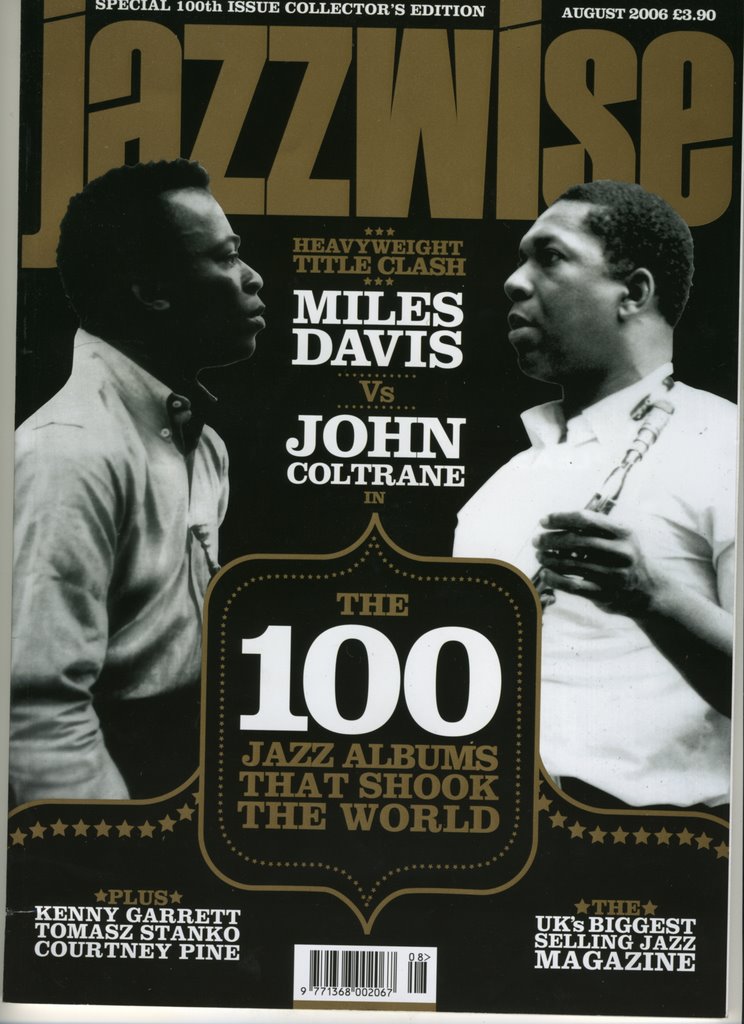
The 100th issue of Jazzwise has just been published - and a fine one it is to. For those unfamiliar, this is Britain's best-selling jazz monthly (available in WHS and other mainstream ouitlets) edited by Jon Newey, who does a thorough job of documenting the latest news, releases and tours as well as featuring many interesting interviews and profiles.

This issue's main feature - The 100 Jazz Albums That Shook The World - is well worth a study. Natch, Kind of Blue and Love Supreme are Nos 1 and 2. Found several albums new to me that I'll be checking out.

Pleased to see one of my favourite albums of all time - 'Indo-Jazz Suite' by John Mayer and Joe Harriott - in the list at No 88. I still have the vinyl copy I've had since I was 17, when we used to sit round and listen to it while smoking Gauloise and learning to play Go.

(Came across a clipping from Mojo April 2004 ('Dance to the Sitar Men' by Justin Spear) about the men behind the 60's sitar groove which confirms that this 1966 record really started the 'whole Indo fusion thing'. Spear writes: 'Put simply, its the wound of a five-piece jazz group and a traditional Indian band - including sitar and tabla - stuck in the same studio and left to forge a new sound of the '60s. Located somewhere between jazz, classical and the complicated form of Indian raga. It still sounds strikingly contemporary.' Amen.

The Observer Music Monthly did 'Fifty Greatest Music Books Ever' in their June edition. It's a strange list, that's for sure, as evidenced by the Top 10:
1. Hellfire - Nick Tosches (bio of Jerry Lee Lewis)
2. Chronicles - Bob Dylan
3. Feel: Robbie Williams - Chris Heath
4.
England's Dreaming - Jon Savage
5. Shostakovich and Stalin - Solomon Volkov
6. Groupie - Jenny Fabian and Johnny Byrne
7. The True Adventures of the Rolling Stones -
Stanley Booth
8. Starlust - Fred and Judy Vemorel
9. Beaneath the Underdog - Charlie Mingus
10. Diary of a Rock 'n' Roll Star - Ian Hunter

If I had to suggest one book that isn't on the list it would be the obscure but wonderful 'Red and Hot: The Fate of Jazz in the Soviet Union' by S. Frederick Starr If that sounds dull, think again. The first negro jazz band arrived in
Russia a few weeks/months after the Revolution and, ever since, jazz has had a strange often underground existence in Russian culture. At one point, Stalin had exiled so many musicians to one Siberian labour camp that they formed the biggest baddest jazz band in the Empire. There's a revised edition out now. The Amazon blurb says that Starr (a prof and a jazz musician himself)
'argues that jazz and jazz-inspired music and world popular culture contributed to the demise of the Communist ideal. The story of jazz represents the history of the emancipation of millions of former Soviet citizens unconsciously groping for a more open relationship between the state and society.'

(Incidentally, can I be the first to register my annoyance about OMM's latest cover feature, heavily splashed on the front of the main paper: Big Brother's Russell Brand meets Keith Richards. Sounded good enough to shell out £1.70. What a disappointment. Brand is an amusing enough fellow but his long description of getting the commission, travelling to the gig, adventures in the hotel room etc took up 98% of the piece. He did finally get in the room with Keith for enough time to exchange a few pleasantries and take a few photos - and then that was it. The whole interview took up about four paras. Short-changed or what!)

THE AMERICA OVER THE WATER TOURING COMPANY are travelling the UK this autumn. http://www.shirleycollins.co.uk See Previous Posting: Over The Water & Over The Road

Jim Morrison's last handwritten notebook was auctioned on July 28th 2006 for £72,000. You can see some of the pages and details of the sale here. Read the original story about the sale in The Independent and then the comments on John Densmore's blog for a closer-to-the-truth version of the story.

RIP:
Billy Preston


Ambrose Campbell - Nigerian musician whose career took in the postwar Soho of Colin McInnes, Nashville - and Leon Russell. Val Wilmer's obituary here.
Read tributes to him here.

Top of the Pops

ON THE TURNTABLE
Ali Farka Toure - Savane [World Circuit Records ]
King Tubby - Father of Dub [3CD set. Delta Music 2005]
James Brown's Funky Summer [Free compilation with Mojo magazine. August 2006]
Thievery Corporation - The Richest Man in Babylon [ESL Music 2002]
Phoenix - Alphabetical [Source/Virgin Music. 2004]
(Playing at the V Festival 19/20th August. Latest album 'Its Never Been Like that')


LONDON: GLOBAL AIR TRAVEL HUB

The Times front page. August 11 2006

London continues to be at the centre of global air travel, with six of the past decade’s 10 fastest growing long-haul routes going through London’s major airports, according to analysis by Ascend, the world’s leading provider of information and consultancy to the global aerospace industry.

They claim the world’s top 10 long-haul global growth routes are:1. London ­ Dubai; 2. London­ Chicago; 3. London ­ Hong Kong; 4. Melbourne ­ Singapore; 5. Sydney ­ Singapore; 6. London ­ Singapore; 7. London ­ Mumbai; 8. Dubai ­ Singapore; 9. London ­ New York; 10. Brisbane ­ Singapore

Over the past 10 years, the London and Dubai route has grown faster than any other. On flights between the two cities, the number of seats available has more than tripled since 1996. Emirates now operates 62 flights a week.

WORLDS WITHIN WORLDS 1:

SHARPEST MANMADE THING: A field ion microscope (FIM) image of a very sharp tungsten needle. The small round features are individual atoms. The lighter colored elongated features are traces captured as atoms moved during the imaging process (approximately 1 second).

Reported by: Rezeq et al., Journal of Chemical Physics, 28 May 2006

Posted on: http://www.aip.org/png/2006/264.htm

Thanks to: Big Fug

URBAN SCREENS


The Victory Media Network, a large-scale digital art gallery in Dallas, Texas

URBAN SCREENS is a concept developed by Mirjam Struppek, who define them as: 'various kinds of dynamic digital displays in urban space such as LED boards, plasma screens, information terminals but also intelligent architectural surfaces being used in consideration of a well ballanced, sustainable urban society - Screens that support the idea of public space as space for creation and exchange of culture and the formation of public sphere by criticism and reflection. Its digital nature makes these screening platforms an experimental visualisation zone on the threshold of virtual and urban public space.'

'[The site] investigates how the currently commercial use of outdoor screens can be broadened with cultural content. We address cultural fields as digital media culture, urbanism, architecture and art. We want to network and sensitise all engaged parties for the possibilities of using the digital infrastructure for contributing to a lively urban society, binding the screens more to the communal context of the space and therefore creating local identity and engagement. The integration of the current information technologies support the development of a new integrated digital layer of the city in a complex merge of material and immaterial space that redefine the function of this growing infrastructure.

I like what Virtual Dschungle 5 have to say on this site about their media facade project in Vienna:

'The harbingers of the media city are cropping up everywhere: projected images the size of an entire facade, huge screens on roof tops and culture buildings used as flickering display surfaces. Developments in the area of display technologies have produced new possibilities for hybrid architecture. The theme of media facades in architecture is not simply the next fashion trend, but represents a step in technological development that will have a lasting impact. This trend will affect the city with or without architects' collaboration. Therefore the important thing is to assume social responsibility and to integrate the new technologies in building in a culturally ambitious way. For an Austrian architecture scene that likes to experiment the potential of such developments is a highly topical question....'

Thanks to DM for this post

FREEWAY BLOGGING


Scarlet P. the anti-war activist has put up more than 2,000 cardboard signs on his own in California. "When you put a sign on the freeway people will read it until someone takes it down. Depending on its size, content and placement it can be seen by hundreds of thousands of people." The freeways are more and more equiped with digital bilboards but they are only open for commercial used. Since 9/11 and the beginning of the War in Iraq, freeway blogging has exploded in the US as reclaiming a space for free speech where you can also reach a big audience.

See the interview with him at Something Cool News

Thanks to DM for this post

PHOTOBLOGGING


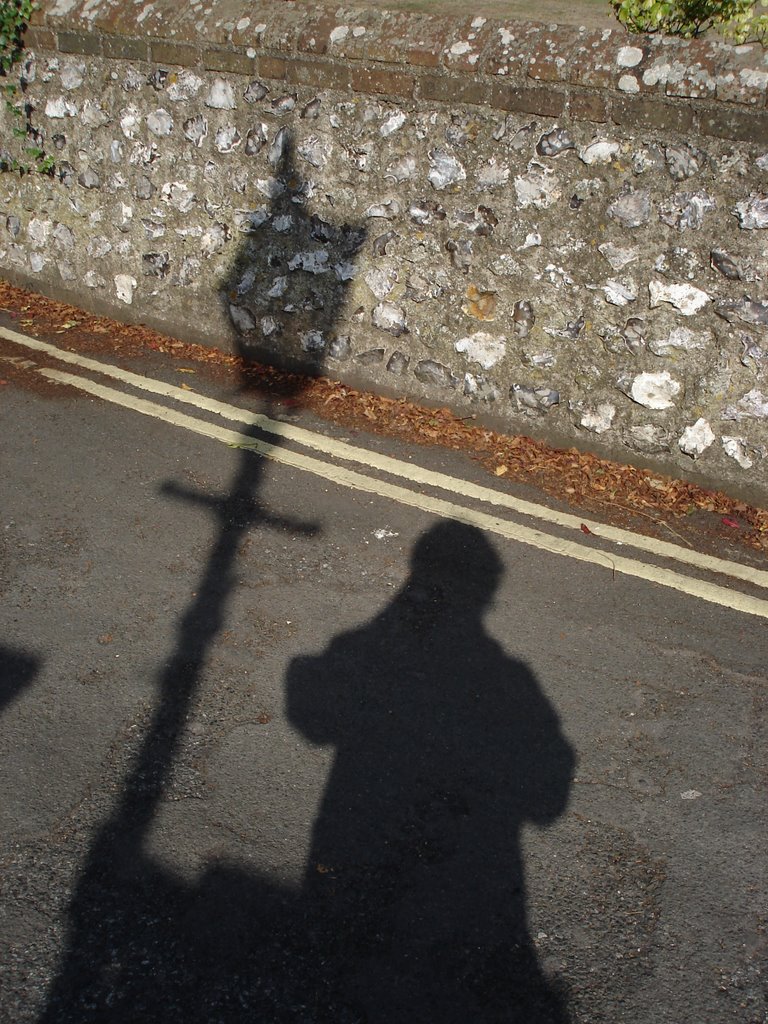
The shadowman with his bent lampshade
Gracing the old flint wall of the bowling green
Where jousters used to practice their skills

Created my first photoblog this week: Lewes Light : A photographic and poetic exploration of the ancient town of Lewes and environs, in all its surprising aspects and details.

Like many others, have been searching for a way to get my photos out into the world, in a simple and practical fashion. Have been looking at Flickr but, in the meantime, find this little blog a beautiful first step. Simple and easy to put together and the pics look good. Inspired to do it by pruchasing a new digital camera (Sony DSC-W5), which is now fixed to my belt. Intend to try to post up pictures every day. A new discipline.

To see some real hi-fi photo pros at work, check out the wonderful Cool Photoblogs

NME TRIBE: VIVIEN GOLDMAN

Completely by chance or not, I stumbled across, as one does, this really good little profile of dear friend Vivien Goldman on the blog The Blond Oracle of Delphi. I am very grateful to Rachel Doyle for her permission to reproduce this. Subsequent, tracked down Vivien's My Space site, contacted her after a gap of many years, found she was in London and spoke on the phone. Turns out, Viv is now doing some Professoring in New York and Rachel is one of her students.


Vivien Goldman is living proof that it is very possible to be, simultaneously:
1) Famous in France,
2) A versatile music journalist/author,
3) A post-punk musician,
4) A documentary film-maker, and
5) A teacher in the Clive Davis School of Recorded Music at NYU.

Goldman’s multitudinous transformations have all been handled gracefully. “I’ve kind of done different careers like serial monogamy,” she said with a laugh as she sat at a table at Le Gamin in the East Village, wearing a matching red-orange Puma skirt and jacket. She took off her large sunglasses and smiled, ordering a quiche in flawless French. I pick up a pen and write a brief note to myself. “Coolest lady ever!”

Goldman, one of NYU’s funkiest, punkiest, most eclectic professors wrote Bob Marley’s first biography, helped launch Flavor Flav’s video career, was a founding member of the Flying Lizards, and released a song called ‘Launderette’ with Johnny Rotten.

Goldman lived in Paris and worked at a magazine for a year and a half, where she was a member of new wave duo Chantage, leading to modest fame in France. She speaks of her music career now with only one regret: that she didn’t market herself better as a musician.

“"I have been blessed with my life in music,” she said. I’ve sung along with Bob Marley while he played guitar, wrote while Ornette Colman practiced in the other room, and heard Fela Kuti and his Afro beat big band playing for hours and hours.” As well as being sonically resonant, these scenarios were also emotionally moving for Goldman.

Born in London, she is the child of two German-Jewish refugees. Music runs in the family. Her father was a musician who escaped Nazi Germany with his violin in tow.

Goldman has always had music in her life. She spent a long time working on TV and also produced and directed videos in her own independent production company. This is where she launched Flavor Flav (of Public Enemy fame) in an Eric B. and Rakin video for “I Ain’t No Joke.”

“One of my early jobs was working in PR at Island Records. At that time, the industry was sort of finding its way. There was that whole making-it-up-as-you-go-along spirit. I worked at Island records with Bob Marley and that’s what changed my life. Otherwise, I don’t know if I’d be the person I am now.”

“Time magazine recently said Bob Marley’s Exodus was the most significant album of the century. I was around while he was recording it,” said Goldman.

Goldman met Bob Marley in 1975 after she left the University of Warwick, where she studied English and American literature in college with famous feminist Germaine Greer, author of The Female Eunuch.

Goldman later worked for all the major British music magazines, such at NME, Sounds, and Melody Maker. “I had that unique career within the music press- they all poached me one after the other. We were traded like football players. I went from one team to the other.”

Goldman was working at Sounds, which she describes as a feisty underdog music paper, when she first became exposed to punk. It was a breath of fresh air for her. At the time, she says, the music scene was really boring and stilted. “There were these big superstars that everybody was completely obsessive about. There were only three main players and they were the type that played stadium shows and did 10-minute-long guitar solos,” said Goldman. “At that time, everything was being invented so it was like a boiling cauldron of creativity. These were all new ideas!”

Goldman moved from London to New York in 1989, stopped doing TV documentaries and began to write again. She has written five books, including Bob Marley’s first biography Soul Rebel/Natural Mystic. She also wrote Black Chord - a book tracing the connections between music and the African Diaspora. That book was ambitious in scope- but Goldman says that her new Bob Marley vehicle; the Book of Exodus is much more so.

“The Book of Exodus is an unusual book – it’s the making of the album and it looks intensely at the social and political events surrounding Bob Marley in a very brief period of his life, between 1976 and 1978,” said Goldman. “That’s when gunman came into his house and tried to kill him. I had actually been staying with him the day before the assassination attempt.”

To research the Book of Exodus, Goldman traveled to Jamaica, Miami, and London to do her interviews. The Book of Exodus comes out in 2006 on Three Rivers Press.

In early 2005, Goldman taught a class entitled ‘Beyond Classic Punk’ for NYU’s Clive Davis School of Recorded Music. The class, which is the first of its kind, was enormously popular and had a huge waitlist.

“It was very funny, cause I was like a true punk professor. I’d never done it before, so it was exactly like the Slits when they got up on stage and didn’t know how to play their instruments.”

Goldman was astounded by the response and output of her first class:
“It’s an old cliché, that the teacher learns from the class as much as the class learns from her but it was true. I got emotional when I saw the final project fanzines. People put so much passion into their work and I was so touched by that. “

© GENIUS 2005

NME TRIBE: GOLDMAN AND SALEWICZ


Vivien Goldman and Chris Salewicz at the launch of
'In Their Own Write' by Paul Gorman, an anecdotal oral history of
the music press. Britart gallery, 60-62 Commercial Street, London E1.
Thursday 1st November 2001 [Photo: John May]

Vivien's wonderful new book 'The Book of Exodus: The Making & Meaning of the Bob Marley & The Wailers' Album of the Century', (which arrived this morning and I'm already two chapters in; magical, mysterious, insightful, delightful, front-line reporting from one of the great mistresses of music writing. It's deep, man) is just published in paperback by Aurum Press. Go seek it out. Extracted in OMM here.
In same issue, story about how Aston 'Family Man' Man Barrett sued the Marley esate for £60m royalties. (Good Marley links too). Read here how he lost the case.

Chris Salewicz's eagerly-awaited extended opus on Joe Strummer (650pp plus)
is due for publication in October

(Also forthcoming: Julien Temple's bio-doc on Strummer, which may be first-screened at the Sundance Film Festival in January)

An extensive collection of their journalism can be found at the excellent
www. rocksbackpages.com

Previous Postings

NME: Adventures in the Music Press
NME: The Stone With the Golden Arm
NME: The Hills Are Alive With The Sound Of Chaos
NME: Alien Visions
NME: I Hate Rock and Roll

Saturday, July 29, 2006

DYLAN DIGEST


DJ DYLAN
Each hour-long show on XM Satellite Radio is composed of Dylan's own hand-picked tracks, and follows a theme - the first being Weather followed by Mothers, Drinking, Cars onto such topics as Coffee, Cigarettes, Marriage. Divorce. The track listing for these first four shows can be found here. The shows are recorded at Dylan's home or on the road

Lee Abrams, XM's creative officer, spent 18 months of negotiation in order to set the Dylan show up. Read his direct first-person account of the events leading up to showtime (in 3 parts) here.

Dylan is the latest big name to be drawn into a battle for radio subscribers between XM Satellite and its main rival Sirius Satellite Radio Inc. See full story: 'Dylan the DJ? You're just gonna have to get used to it' by Jamie Wilson (The Guardian).

'Hey Mister DJ...' by David Smith is The Observer's exclusive preview of the first show.

To these ears: Dylan is a radio natural, a medium that inspired him as a kid back in Hibbing. The programmes are a real joy to listen to, a bit like a musical version of 'Chronicles', mixing a wide range of largely vintage American music with modern tracks, trivia and suprises, occasional interviews and lots of on-air chat from BD himself, full of amusement and erudition. Bob takes great delight in reading out many of the lyrics from the music of what Greil Marcus calls 'wierd, old America.' His voice is stagy, tricksy, waspish, downhome. he never misses a beat and
everything flows perfectly. Like he was born to it.

H ere are some excerpts of Bob's remarks from the Mothers show, broadcast on Mother's Day, as transcribed by the New York Times:

Tommy Duncan/"Daddy Loves Mommyo"
His real name was Thomas Elmer Duncan, born on January 11, 1911, in Whitney, Texas — full of iodine and iron. He won an audition against 66 other singers to join Bob Wills's Light Crust Doughboys, who later became the Texas Playboys. Tommy Duncan left the band in 1948, recorded a number of songs including "Gambling Polka Dot Blues," "Sick, Sober and Sorry" and "There's Not a Cow in Texas" — lot of fuzzy logic there. But in honor of Mother's Day, here's a song. Tommy Duncan, "Daddy Loves Mommyo" — no fatty acid in there.

Buck Owens/"I'll Go to Church With Mama"
Buck Owens. Come out of Sherman, Texas. Made his way to Bakersfield, California. In the 1960's, the Beatles recorded a song of Buck's called "Act Naturally." In those years Buck had 39 chart hits, 19 of 'em at No. 1. Hey, let's not forget "Hee Haw." Never missed it. I still remember some of them jokes from "Hee Haw": "My mother-in-law's very neat — puts paper under the cuckoo clock." Here's Buck singing about hymns that warm your heart in the sweet by-and-by, that chapel in the sky.

Bobby Peterson Quintet/"Mama Get the Hammer"
Some songs you don't have to talk about; they just say it all: "Mama get the hammer, there's a fly on baby's head."

Ernie K-Doe/"Mother-in-Law"
Today's e-mail comes from John Rudolph. ... He writes, "Dear Bob: I've got a hammerhead of a mother-in-law, an ugly, evil-lookin' old woman, so pitiful. She's careworn, drawn and pinched — gaunt and lank. I bought her a new chair, but she won't let me plug it in. She belittles me, depreciates me, disparages me. She downgrades me, berates me, censures me and condemns me, libels me and raps me, dismisses me and rejects me. Could you please play a song for her?" Well, thanks for the letter, John. Your wish is our command.

LL Cool J/"Mama Said Knock You Out"
Don't call it a comeback, he been here for years, rocking his peers, putting 'em in fear, making tears rain down like a monsoon, explosions overpowerin', over the competition LL Cool J is towering. LL Cool J — stands for Ladies Love Cool J.

UK citizens cannot subscribe to the shows unless they have a US billing address. Presumably the same applies to the rest of the world.

DYLAN ENCYCLOPAEDIA
The postie arrived with my copy of 'The Bob Dylan Encyclopaedia', yet another weighty tome from the pen of Michael Gray, following the author's jumbo-sized work of criticism and erudition, 'The Song and Dance Man III: The Art of Bob Dylan', which went into its 5th expanded and revised reprint in 2004.

This new black-bound 736 page hardback is an equally delightful oddball reference work, containing many different kinds of entries which Gray describes as follows: 'some key moments fromDylan’s career and life; singers, musicians, songwriters and composers who have influenced Dylan and/or worked with him; writers, poets and other non-musical cultural figures who have impacted on Dylan’s work and/or who are mentioned within it, in each case delineating the sometimes surprising ways in which they connect to Dylan’s work; critical assessments and factual details (including place and date of recording, date of release and original catalogue numbers) for all Dylan’s albums and for individual songs from all through Dylan’s decades of work; critical assessments and factual details on Dylan’s own books and films; relevant music critics, authors of books and major websites on Dylan; and topics like artists v. critics, angels, Dylan interpeters, the co-option of real music by advertising, early 1960s pop music, Beat poetry, rock’n’roll, country blues, pre-20th century American poetry, Dylan fanzines, cowboy heroes, the use of film dialogue in Dylan’s lyrics and many more.'

Th longest entries by far are Gray's critical disquisitions into individual tracks in which Gray summons up an entire lumber room of references and teases out every last drop of meaning - the entry for the track 'Dignity' for instance, is 5pp long. The biographical pieces are excellent - very good entry on Ramblin' Jack Elliott for instance. He is quite tough on his fellow Dylan critics and writers and, unusually for a reference book writer, includes an entry on himself!

This is a book full of delights, unusual highways and byways, strange connections, original research, refreshing insights and quirky opinions. Turn to the entry on Duluth, Minnesota and its clear that Gray has not only been there but also driven many a country mile following the directions in Dave Engel's book 'Like Bob Zimmerman Blues: Dylan in Minnesota'. In fact, Gray has devoted the largest part of his working life to date chasing Bob Dylan's art and his love and enthusiasm for it permeates every page.

His intro concludes: 'If in 100 years time Dylan's art goes unheard and discounted, well, in 200 years time it may bounce back. If not, The Bob Dylan Encyclopaedia, might well help some scholar of the future to sift through the rusted nuts and bolts of our mistaken enthusiasm.'

Final note: the book contains a disc at the back, a non-printable searchable pdf packed with cross-references. (Did I mention that the typography is very good and that the book smells really nice)

Michael Gray is doing lots of promo, personal appearances, radio shows and the like in the UK
and in the US. Check out his blog for further details.

THE GREAT WHITE WONDER
Not included in the Encyclopaedia is an entry on Dylan Bootlegs (history of same - there is an entry on all the 'official' bootleg series) in general and 'Great White Wonder' in particular - not only the first Dylan bootleg but also the record that ushered in 'rock bootlegging'.

I wouldn't have thought about any of this had not a beat brother lent me a hardback copy of 'Bootleg: The Secret History of the Other Recording Industry' by Clifford Heylin [St Martin's Press/New York June 1995]. This book is extremely hard to find and expensive to buy. It is a primary source on this topic, full of original interviewers with the leading 'bootleggers' of several different decades.

The book is permeated with Dylan bootleg stories and the diaspora of releases of varying quality in many countries. But let's concentrate on the Great White Wonder - hereafter known as GWW - documented in detail in Chapter 3: 'The First Great White Wonders'.

Briefly: A 14-song acetate - drawn from the summer 1967 Basement Tapes sessions of Dylan and the Band - were being circulated within the music industry and played on the radio but were not made publicly available. Dylan had not released an official album for two years.

Michael O heard 'Wheels on Fire' on an underground radio show, located the tape at Records and Supertape on Peco, LA but never did anything with them. It was down to 'Dub' and Ken, also in LA, with some funds from the Greek, who issued 1-2,000 double-albums, in a white cover, white label. They got friend Patrick, an army deserter, to go into the stores to sell them at $12 each.

Immediately he found a demand, first off at a bookstore on Fairfax owned by the LA Free Press. The 'Jewish woman' they spoke to was v. enthusiastic, ordered some and named it right then and there - Great White Wonder. Dub and Ken bought a rubber stamp.

The albums were cut-and-paste jobs, with material from several different sessions - including the Basement material - rearranged in a less-than-ideal order. No matter. Five radio stations immediately began playing the album, the story hit the mainstream press, Dub and Ken became underground heroes. Greil Marcus wrote a six-page article in Rolling Stone' devoted to unreleased Dylan recordings. An insatiable demand was created.

Two LA record store owners thought they'd get in on the act, got hit by an injunction from Columbia Records, gave-up 'Dub' because they thought Dub's girlfriend had snitched them to Columbia's lawyers. However Dub and Ken hi-tailed it to Canada to 'run a gas station' and Columbia's legal action ground to a halt. The cat was out of the bag and a new industry was born.

DYLAN MOVIE
Todd Haynes' told 'The Times' in 2005 that Dylan was ‘too complex' to be played by a single actor, adding: 'I am setting out to explode the idea that anybody can be depicted in a single self.'

Haynes is directing a $20 million movie entitled ‘I’m Not There’ (aka ‘I'm Not There: Suppositions on a Film Concerning Dylan’ ) the first biographical screenplay about Dylan, which was scheduled to start filming in July in Montreal. Christine Vachon, principal of Killer Films and Dylan's business manager, Jeff Rosen are producers. Dylan assigned the filmmakers the rights to his life story and music for the film in June 2004.

Dylan will be played by seven different actors to represent the artist's ever-changing personas, including an 11-year-old child and a black woman. Announced cast list: Heath Ledger (who replaces Colin Farrell), Richard Gere, Christian Bale, and Kate Blanchett (who’ll play an aspect of Dylan, an androgynous singer-songwriter named Jude), Michelle Williams (a model named Coco Rivington) Julianne Moore, and Charlotte Gainsbourg. It is not clear from the reports whether Dylan himself will appear in the film.

Born January 2, 1961, in Encino, California, Todd Haynes has his roots in the US ‘New Queer’ cinema movement. He was famously sued by Richard Carpenter for his 1987 film, ‘Superstar: The Karen Carpenter Story’ (which uses Barbie dolls as actors) and was removed from distribution. His 1991 film ‘Poison’, based on the writings of Jean Genet, partly funded by the National Endowment for the Arts, was attacked by right-wing family groups in the US as inappropriately federally funded ‘filth’. He is known to a broader audience through movies like the glam rock inspired ‘Velvet Goldmine’ (1998), and the Douglas Sirk inspired ‘Far From Heaven’ (2002).

Previous Posts:
Dylan Digest 14.2.06
The Lost Dylan Photos 11.9.05
Deconstructing Dylan 11.10.05


Wednesday, July 26, 2006

CULT FILMS: THE WICKER MAN


The 1973 film 'The Wicker Man' is not only one of the most enduring of modern cult films and one that repays repeated viewings but its soundtrack has also provided inspiration to a new generation of British folk musicians, according to a fascinating piece by Will Hodgkinson entitled 'It was a way into a magical world.'

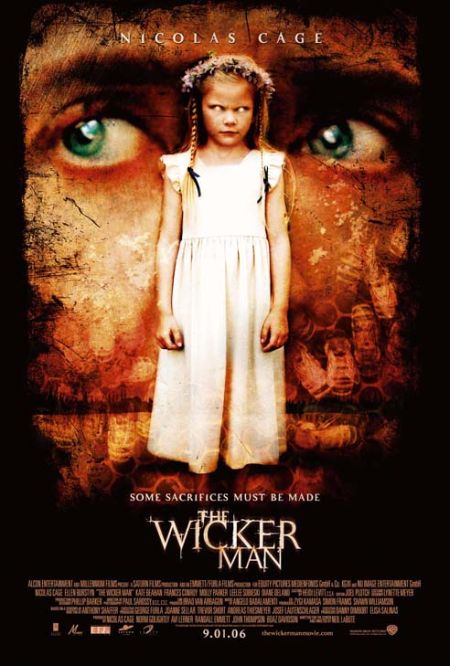
More worrying is the news that Neil LaBute has done a remake which is due for UK release on September 1st. It stars Nicholas Cage in the Edward Woodward role. Cage claims: "My late friend Johnny Ramone invited me to come over and see this movie The Wicker Man. "I was extremely disturbed by it and it stayed with me for a couple of weeks." (www.cagefactor.com)
Christopher Lee's character, Lord Summerisle, is replaced by the head of a matriarchal society, played by Ellen Burstyn, and the action is set off the coast of Maine.Yes, its being Americanised.

Acording to LaBute in an interview with Total Film: "I always loved the movie and I loved the script in particular, but I never thought that it was completed so well that it couldn't be touched again...." You can read the screenplay review here.

Speaking at the Vancouver International Film Festival Trade Forum, LaBute said that when he first saw the movie, he felt it was a "strange kind of creepy thing" and said in an interview that it could bear being remade, but people who like it "are occultists." The intyerview continued: What does he like about the original? "Not the songs: they went. And the strange half-naked girl. The story and the ending really works," he said. Oh dear.

Wicker Man director is flaming furious over Hollywood remake
Brian Pendreigh/The Scotsman (11.9.2005)
'He gave the world arguably the most iconic Scottish film ever made but a US remake which adds a swarm of killer bees and changes the sex of a pagan lord has proved too much for Robin Hardy. The original director of The Wicker Man has called in his lawyers to have his name taken off promotional material for the $40m movie even before lead star Nicolas Cage has finished filming. "The amazing thing is that all the publicity keeps on saying that I have written the screenplay, which is obviously not true," says Hardy, who did not even take a writing credit on the original, though he worked closely with writer Anthony Shaffer.'

According to The Movie Blog: Robin Hardy and Anthony Shaffer are hard at work on their new movie which, they claim, is a 'reimagining' of their earlier work. Called 'May Day' (another source says 'Cowboys for Christ'), it revisits the theme of paganism in modern Scotland and follows two young American evangelists who discover the Border ridings are more than just a quaint tourist attraction. Shooting was meant to begin in Scotland and Texas this spring and 80% of the £3m budget was in place at the time the story was written. (25 November 2005). Vanessa Redgrave and Sean Astin from 'Lord of the Rings' have signed on for it.

There's an extensive and very interesting Wikipedia entry on The Wicker Man here

JOHNNY DEPP MEETS GUSTAVE COURBET


UPDATED POSTING: 8 Feb 2008

Private Collection/Conseil Investissement Art, BNP Paribas

Lovely little portrait of Johnny Depp in one of his Libertine absinthe-soaked roles you might think. In fact, its 'Despair' (1844-1845), a self-portrait by the French realist painter Gustave Courbet (1819-77).

It first came to my attention in a newspaper story in the summer of 2006, at the opening of an exhibition entitled '
Rebels And Martyrs: The Image Of The Artist In The 19th Century' at London's National Gallery. The Independent reported that the exhibition's curator's knew of the painting's existence and wanted to include it in the show. However the painting had vanished, after being last seen in 1978 at a Courbet retrospective at the Royal Academy. The week before the Rebel show was due to be installed, the curators received a phone call from France offering to lend them the painting. The owner's identity remains a mystery.

Yesterday, I bought the New York Review of Books' to see the painting staring out at me once more. There is a major Courbet exhibition which recently ended in Paris, soon to be seen at the
Metropolitan Museum of Art in New York (February 27–May 18, 2008)

As John Golding writes in 'The Born Rebel Artist': 'This is the image that was chosen for the traditional banners that Paris sports to advertise major exhibitions. It would have pleased Courbet to be presiding over hundreds of thousands of Parisians as they roamed through the streets of the capital. And the fact that this relatively small picture survives magnificently the test of being blown up to twenty or thirty times the size of the original testifies to its power and the beauty of its paint effects. It will be seen on posters in New York.'


Read Chrissy Iley's exclusive interview with Johnny Depp here.

THE GLOBAL NUCLEAR ENERGY PARTNERSHIP

Why did Tony Blair preempt the publication of his party's own Energy Review by opening the door to the possibility of reviving nuclear energy in Britain ?
Why have Britain and France signed a new nuclear energy accord?
Why has the Australian Prime Minister returned to his country after a visit to the US with talk of expanding uranium production and processing in his country?

They have all been in discussion with George Bush about his big new idea; THE GLOBAL NUCLEAR ENERGY PARTNERSHIP

Part of his Advanced Energy Programme, the plan is to form an alliance between the US, Russia, France, Japan and the UK - countries that already have nuclear fuel processing capabilities - that would work together to set up a new global nuclear energy regime.

The plan is designed to deal with two major issues that have effectively held back the development of the nuclear industry worldwide:
- the problem of nuclear proliferation and of plutonium in nuclear waste falling into
the wrong hands
- the problem of disposing of huge quantities of nuclear waste.

Under this new regime, the 'supplier' nations (above) would offer to build new nuclear power stations of two main types in developing countries around the world.

One type would be a virtually sealed 'turnkey' reactor, which already contains all the fuel it needs for its 20-year lifecycle. The other would be a new design conventional reactor, to which the 'suppliers' would deliver fuel and then retrieve the waste at the other end.

To make this work, the suppliers will build three or four major reprocessing and waste management facilities in various parts of the world, that will include two new types of reactors:

One would be designed to generate energy using plutonium and all the transuranic elements that form high-level waste as its fuel. This would remove the proliferation/terrorism risk.

The other is designed to be fueled by lower-level waste from all other nuclear power stations.

This would mean that waste will become a resource rather than a problem and that the quantities of waste that need to be disposed of in long term geological storage would be much reduced.

(It is key to the US that they are able to activate the nuclear dump at Yucca Mountain. At present, many dumps of the same size would be needed just to cope with the existing waste from US reactors over their lifetimes, without any further expansion of the industry.

The business plan behind Bush's concept was developed by the Nuclear Fuel Leasing Group (NFLG), a group of four key members, supported by an international grouping of private sector interests that are lobbying governments around the world. One of the NFLG four is reportedly John White the head of Global Renewables, a subsidiary of Gold and Resources Development which recently won a uranium contract in Malawi. White is also chairman of the Australian government's Uranium Industry Framework. (The others have not yet been identified).

Indonesia and Vietnam have already announced plans to develop a nuclear industry - with no objection from the US. They are the first new potential clients for these new reactors and systems.

The Australian PM, whose country holds 40% of the world's uranium reserves, wants to expand their nuclear processing capabilities and develop Australia's role as a nuclear waste repository.

It appears that France and Britain have bought into Bush's plan and Blair's job is to overcome public resistance and all other arguments to try and enable a new generation of reactors to be built in Britain.

THE STORY SO FAR

30.6.06 Australia to debate nuclear future amid waste fears
By Richard Pullin/Gulf Times
Australia, a top US ally, could become the world’s nuclear bank, leasing enriched uranium to other countries to generate power and then storing depeleted fuel rods in its vast, empty outback.But analysts say it won’t happen without a spirited debate. Prime Minister John Howard reignited the nuclear debate in Australia after a visit to the United States
last month, and a prime ministerial taskforce is to report on all aspects of the industry by the end of the year. [Full story here}

28.6.06 Senate appropriations subcommittee approves nuclear spend
Nuclear Engineering International
The Senate appropriations energy and water subcommittee has approved a $30.7 billion spending bill for the Energy Department, $1.25 billion over the budget request, with new funding for the advancement of energy initiatives authorised by the National Energy Policy Act of 2005. Global Nuclear Energy Partnership (GNEP) is allocated $250 million, plus $36 million for facilities upgrades under the bill.
Full story here.

21.6.06 Nuclear Energy Plan Would Use Spent Fuel
By Peter Baker and Dafna Linzer/Washington Post Staff Writers
The Bush administration is preparing a plan to expand civilian nuclear energy at home and abroad while taking spent fuel from foreign countries and reprocessing it, in a break with decades of U.S. policy, according to U.S. and foreign officials briefed on the initiative.

21.6.06 Greens call for resignation of uranium industry body chief
The Australian Greens today called for the resignation of the chairman of the federal government's Uranium Industry Framework, John White. Full text here.

2.6.06 Vision products/ Nuclear Engineering International
The Global Nuclear Energy Partnership
is the USA’s bold vision of how the nuclear industry should operate in the 21st century. GNEP is a very ambitious global vision, which is centred on the USA and a small number of trusted states. The scale of the plan is such that only the USA would be capable of proposing it – let alone achieving it – but GNEP has the potential to address four very significant problems that face nuclear power. Full story here

1.6.06 GNEP: the eight way forward ?
Steve Kidd/Head of Strategy & Research at the World Nuclear Association (formerly the Uranium Institute)/Nuclear Engineering International

The Global Nuclear Energy Partnership (GNEP) proposed by US president George Bush in February 2006 has received a great deal of publicity, much of it centred on the apparent change in US strategy towards reprocessing used fuel, rather than continuing on the march towards repositories (see link below to 'Vision products'). There is, however, much more to the initiative than this and it is worthwhile to examine the obvious ways in which it addresses many of the awkward issues currently faced by the nuclear industry. But at the same time, there are undoubtedly some serious difficulties on the road ahead to ensuring the concepts become a serious reality. Full story here.

24.5.06 House Scales Back Bush Nuclear Power Bid
By H. JOSEF HEBERT/Associated Press
WASHINGTON -- The House late Wednesday scaled back President Bush's ambitious plan to resume nuclear fuel reprocessing as part of an international program to boost nuclear power. A broad spending bill, passed 404-20 and sent to the Senate, cuts Bush's request for the first installment of the nuclear initiative in half, to about $130 million. An attempt to slash it by an additional $40 million was rejected.

23.5.06 Secret committe looking at nuclear power
The Age
An internal government committee has been created to look at Australia's possible role in world nuclear energy, it has emerged.Public servants have confirmed to a Senate estimates meeting that the committee had been created to deal with emerging nuclear issues. It comes as Prime Minister Minister John Howard flags a full-scale nuclear debate when he returns from an overseas trip later this week, and as momentum builds within his own party to develop nuclear power and uranium enrichment programs. The Department of Prime Minister and Cabinet 's deputy secretary Duncan Lewis said the committee had been formed following statements by US President George W Bush to create a global nuclear energy partnership. He said the committee would effectively try to develop an Australian perspective on the American proposal."It's essentially a fact finding exercise to scope what this energy initiative might entail," he said. Full story here.

15..5.06 Strange Love
Keith Barnham and David Lowry/New Statesman supplement
A new US/UK civil nuclear link was revealed in a little reported speech by President Bush in Milwaukee, Wisconsin on 20 February this year, when he said that the US had UK support for the initiative he launched following the last G8 meeting July 2005 at Gleneagles - the ‘Global Nuclear Energy Partnership’ - involving countries that have got advanced nuclear energy programmes, or civilian nuclear energy programmes "like France and Great Britain and Japan and Russia".[7] British involvement was confirmed month later in a written Parliamentary answer [8]. That such a link could influence Blair is suggested by his increasing support for the Asia-Pacific Partnership (AP6) in which the US, Australia, India, China, Japan and South Korea pledge to cooperate on energy technologies outside the Kyoto Protocol [9]. Full text here.

20.2.06 President Discusses Advanced Energy Initiative in Milwaukee
Speech given by George Bush at the Johnson Controls Building Efficiency Business, Milwaukee, Wisconsin

And so we've got some challenges, however, in dealing with this issue. And that's why I put together what's called a global nuclear energy partnership. It's a partnership that works with countries that have got advanced nuclear energy programs, or civilian nuclear energy programs like France and Great Britain and Japan and Russia. And here are the objectives of the partnership.

First, supplier nations will provide fuel for non-supplier nations so they can start up a civilian nuclear energy program. In other words, a lot of countries don't know how to enrich; a handful do, and it makes sense that we share that -- share the benefits of our knowledge with others, but not share the knowledge because there's concern about proliferation.

One of the concerns you hear from critics of expanding nuclear power is all this will do to create proliferation concerns. Well, here's one way to address those concerns - to say, we'll provide the fuel for you - and we'll collect the fuel from you, by the way. And after we collect the fuel from you, we need to reprocess the spent material. By reprocessing you can continue to use the fuel base, but equally importantly, we'll reduce the amount of nuclear waste that needs to be stored. Full text here..

13.2.06 Platt's Nuclear Energy Conference
Remarks Prepared for Energy Secretary Samuel Bodman
'I think most people would these [critical concerns] that I have mentioned at or near the top: the proliferation of nuclear materials, the political concerns over oil dependecy, the need to reduce poverty through economic growth, and curbing or even eliminating the pollution and greenhouse gases emitted by using fossil fuels. The message I want to drive home today is that the Global Nuclear Energy Partnership represents a multi-layered and sophisticated plan to address, at least in part, all of these challenges.' Full story here

8.2.06 US launches Global Nuclear Energy Partnership
Nuclear Engineering International
A $250 million programme, the Global Nuclear Energy Partnership (GNEP) that will see spent nuclear fuel reprocessed, has been launched in the USA. The GNEP programme is aimed at opening the international nuclear power industry and spent fuel disposal by forging a partnership with other countries that deal with spent nuclear fuel. The programme will see new generation nuclear power plants developed in the USA along with new spent fuel reprocessing technologies that supply fuel to those plants. Full story here.

6.2.06 Department of Energy Announces New Nuclear Initiative
WASHINGTON, DC – As part of President Bush’s Advanced Energy Initiative, Secretary of Energy Samuel W. Bodman announced today a $250 million Fiscal Year (FY) 2007 request to launch the Global Nuclear Energy Partnership (GNEP). This new initiative is a comprehensive strategy to enable the expansion of emissions-free nuclear energy worldwide by demonstrating and deploying new technologies to recycle nuclear fuel, minimize waste, and improve our ability to keep nuclear technologies and materials out of the hands of terrorists. Full report here.


THE BERING BRIDGE PROJECT


This piece was originally published in the Fall 1987 issue of the Whole Earth Review, the successor to the Co-Evolution Quarterly, itself a spin-off from Stewart Brand's Whole Earth Catalog operation. (Illustration: Don Ryan)

I want to build a bridge across the Bering Strait.

I'm not the first to have the idea. The honour for that belongs to Joseph Strauss, the man who went on to design one of the world's great bridges — the Golden Gate. In 1892, for his graduation thesis from the University of Cincinnati, he outlined his plan to build a railroad bridge across the Bering Strait.

A look at the map will show you the attractions of such an idea. The Bering Strait separates the Seward Peninsula of the Western Hemisphere from the Chukchi Peninsula of the Eastern Hemisphere and is about 85km (53 miles) wide at its narrowest point.

In the middle of the Bering Strait are two islands, Big Diomedes and Little Diomedes. Big Diomedes ' is 2.5 miles long by 1.5 miles wide and is Russian; Little Diomedes is one-third the size, is owned by the U.S., and is inhabited by about 100 Inuit.

Contained in the narrow strip of sea between these two specks of land is not only the imaginary border between the two countries but also the international date line. In other words, this small stretch of water separates North America from Asia, the Soviet Union from the United States, and today from tomorrow. The advantages of bridging that gap should be obvious to all.

For the historical record, the Strait was discovered by and named after Vitus Bering, a Dutchman who was sent by Peter the Great to explore the eastern margins of Siberia to see if it connected with North America. He successfully rounded the Peninsula on the Russian side in 1728 but completely missed see­ing the North American coast due to dense fog.

Russia owned both sides of the Strait until October 18, 1867, when Captain Aleksei Peschchurov, repre­senting the Emperor of Russia, formally sold Alaska to Brigadier General Lovell Rousseau, representing the United States, for some two cents an acre.

American popular opinion of the time held that it was an expensive deal at that price and dubbed the useless wilderness Seward's Folly after then Secretary of the Interior William Seward, whose determina­tion led to the acquisition of these 375 million acres.

The fossil record indicates that a land bridge more than 1,000 miles wide, known as Bering Land or Beringia, existed at two different times. The first was some 65,000-35,000 years ago, after which it was submerged. It was later reestablished during the Later Wisconsin glacial period — about 28,000-25,000 years ago. This second bridge lasted for another 15,000 years before it was completely submerged by the advancing sea. Not only did it separate Alaska from Siberia, but it also cut off the Pribiloff and Aleutian Islands from continental America.

During the periods that the land was linked there were intensive migrations of plants and animals from continent to continent. The latest evidence also suggests that the original native nations of the American continents (north and south) came over the land bridge from Asia in three waves of migration.

The first wave came from northern China and Mon­golia some 20,000 years ago. These people were the ancestors of the Indian tribes known collectively as the Amerind, including the Aztecs, Cherokee and Algonquins.

The second wave came slightly later from north­eastern Asia, people called collectively the Na-Dene, ancestors of the Navaho and Apache Indians, the Tlingit and Haida tribes of the American Northwest. Some anthropologists believe a "third wave" of migrants arrived 10,000 years ago and became the ancestors of the modern Inuit and Aleuts. This third-wave theory is still controversial.

[Two recent articles examine these ideas in more detail: "The Ancient Bridge" by A. P. Okladnikov (The Alaska Journal, Autumn 1979) and "Getting One's Berings" by Knut R. Fladmark (Natural History, November 1986.]

Such evidence suggests a spectacular opening cere­mony which might be staged when the bridge is unveiled: present-day Amerindians handing over buffalo skins, quetzal feathers and parchments in return for mammoth tusks and magic fungi from the Siberian steppes — an ancient kinship rekindled. But I am getting ahead of myself.

The superpowers have conveniently ignored their common ancestry. In 1984, for instance, a maritime boundary meeting was opened to try to update the demarcation lines as a preliminary to mineral and oil exploration in tbe region.

By the end of the year, talks had broken down. The stumbling block was an area of ocean south of the Strait called the Navarin Basin, situated 400 miles from the U.S. and only 150 miles from the Soviet Union. The Americans claim the basin under the 1867 deal and have sold exploration rights in 20 tracts in the disputed zone to Amoco, Arco and Union Oil. The Russians regard the salt as "provocative."

No doubt plans for the bridge would come up against this sort of international bureaucracy. I am sure one can explain the value of such a link both aesthetically, commercially, and as a means of establishing more stable relations in the world. After all, connecting the Americas with the Eurasian/European, African continental mass could be seen as plate tectonics in reverse.

Of course, there may be construction difficulties and for this I will have to take specialised advice. One colleague has suggested using "icecrete" — ordinary freshwater mixed with wood fibres for strength, poured into a skin made either of concrete or laminated plastic and then frozen and compressed tightly for extra durability and shape.

It occurs to me that perhaps the bridge couk! be simply conceptual — a giant hologram with lasers on both sides of the channel. Naturally, the funding could come out of the SDI budget.